


 Download Free Sample
 Buy Now
Market Size
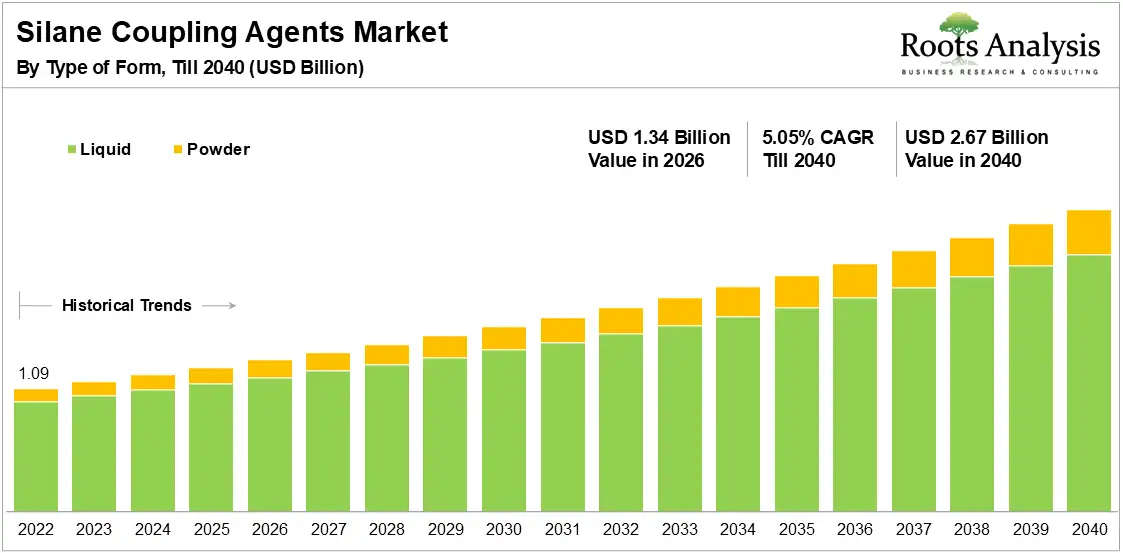
The global silane coupling agents market is projected to reach USD 1.34 billion in 2026 and USD 2.67 billion by 2040, representing a CAGR of 5.05% during the forecast period 2026 to 2040.
See What’s in the Full Report - Request Your Complimentary Insights!
Silane Coupling Agents Industry Overview
Silane coupling agents function as essential organofunctional molecules that modify interfaces to strengthen the bond between inorganic substrates and organic polymers. The market scope encompasses various functional categories, including amino, epoxy, vinyl, and mercapto Silanes, which determine their specific compatibility within diverse composite systems. By enhancing mechanical strength, thermal stability, and electrical performance, these agents serve as a foundational element in advanced material science, driving significant value for manufacturers of high-performance composites, specialized coatings, and industrial sealants.
The global market expansion is fueled by an intensifying demand for lightweight, high-performance composites across the automotive, aerospace, and electronics sectors. These agents are critical for optimizing the durability and structural integrity of fiber-reinforced plastics and specialized adhesives used in modern infrastructure. The transition to electric vehicles represents a substantial growth tailwind; for instance, several key suppliers introduced new product lines that were specifically engineered to improve the adhesion and longevity of battery encapsulation materials and structural composites for EV platforms.
Future industry innovation is increasingly centered on sustainable, eco-friendly formulations, with a strategic shift toward water-based and low-VOC alternatives to traditional solvent-based systems. The market outlook remains positive as manufacturers develop specialized Silanes for high-end applications, particularly in tire production to optimize silica-rubber interactions for better rolling resistance. As global industries prioritize both performance and stringent regulatory compliance, the continued evolution of Silane technology will remain vital for the next generation of sophisticated, multi-functional composite materials.
Market Report: Key Takeaways
- Market Giants: The Silane coupling agents market is concentrated at the top, with five players, such as Evonik, Wacker, Dow, Shin-Etsu, and Momentive. These industrial players are primarily focused on R&D investment in Silane technology and organic expansion (Evonik Smart Effects platform, Dow bio-based Silanes), signaling a shift toward integrated, sustainability-positioned product platforms.
- Startup Ecosystem: The silane coupling agents startup ecosystem is small relative to adjacent chemical markets, but venture activity is intensifying. Startups focusing on bio-based silanes, nano-silane precision chemistry, and waterborne eco-formulations collectively received approximately USD 150 million in venture funding in late 2025 and early 2026.
- Partnerships and Collaborations: Capital flows into the silane coupling agents industry reflecting both strategic confidence, structural repositioning, and partnerships for product portfolio expansion. Recently, Wacker Chemie collaborated with leading European university to develop epoxy-functional silane agents with advanced moisture resistance for marine coatings and industrial adhesives.
- Regional Dynamics: The geographic distribution of the silane coupling agents market is heavily skewed toward the Asia-Pacific region, which functions as both the primary manufacturing hub and the largest consumer market. The Japan-Korea joint venture targeting 5G device encapsulation Silanes exemplifies a growing pattern of end-use manufacturers co-investing with chemical producers to accelerate specialized qualification rather than waiting for off-the-shelf solutions.
- End User Market Share Analysis: Rubber & elastomers is the dominant segment, holding a 32.4% market share in 2026 and is projected to grow at the fastest CAGR of 5.7% through 2040. This expansion is fundamentally driven by the transition to high-dispersible silica (HDS) systems to meet "green tire" labeling standards and the specific wear requirements of electric vehicles (EVs), where tire durability and rolling resistance are critical.
- Future Opportunities: The future focus will be on the ESG-aligned investment, low-VOC reformulation, bio-based silanes and the direct enablement of green tires, renewable energy composites, and sustainable construction materials place SCAs squarely within sustainable chemistry frameworks.
Pay Only for What You Need – The Best Way to Optimize
Recent Industry Developments
- February 2026: Momentive, a global supplier of advanced materials and specialty additives, will present its latest high-performance Silane technologies at Tire Technology Expo 2026 in Hanover, Germany at Booth C420.
- February 2026: Evonik announced product portfolio expansion with new, sustainable coating additives and development of specialized Silanes for water-based coatings.
Market Dynamics
Key Market Drivers
- Automotive Lightweighting and Structural Composite Integration: The acceleration of global fuel efficiency mandates and emission targets is compelling OEMs to prioritize aggressive vehicle mass reduction. Silane coupling agents are essential for optimizing the interfacial adhesion between polymer matrices and advanced reinforcements, such as fiberglass and carbon fiber, facilitating the transition from heavy metallic components to high-strength, lightweight structural composites without compromising safety or performance.
- Escalating Adoption of High-Performance Adhesives and Sealants: Across the aerospace, electronics, and construction sectors, there is a systemic shift toward advanced bonding solutions that streamline assembly and enhance structural durability. Adhesives and sealants market research indicates that silanes serve as critical adhesion promoters within these formulations, enabling robust chemical bridges between chemically dissimilar substrates and allowing manufacturers to replace traditional mechanical fastening systems with more efficient, long-lasting adhesive bonds.
- Infrastructural Scaling of Renewable Energy Assets: The global energy transition, specifically within the wind power sector, necessitates the production of larger, more resilient composite turbine blades. Silane coupling agents are instrumental in improving the fatigue resistance and weatherability of these components, ensuring that high-value renewable energy infrastructure can withstand extreme environmental stressors and maintain extended operational lifecycles.
- Miniaturization and Functional Complexity in Electronics: As electronic components become increasingly compact and powerful, the demand for sophisticated surface modification and encapsulation grows. In semiconductor packaging and printed circuit board (PCB) manufacturing, Silane coupling agents are utilized to enhance dielectric properties and moisture barriers, which are vital for ensuring signal integrity and long-term reliability in high-density electronic architectures.
Market Restraints
- Upstream Feedstock Volatility and Supply Chain Concentration: The production economics of Silane coupling agents are heavily influenced by the price and availability of key precursors like silicon metal, methanol, and chloroSilanes. Pronounced price fluctuations in these commodities, combined with a geographic concentration of supply, introduce significant margin risk and complicate the implementation of stable, long-term pricing strategies for global manufacturers.
- Technical Barriers in Formulation and Application Precision; Achieving the performance benefits of Silanes requires exacting formulation chemistry and highly specific application protocols. Many end-users, particularly small-to-medium enterprises (SMEs) or those in less mature markets, may lack the specialized technical infrastructure and expertise necessary for optimal integration, leading to inconsistent results and acting as a barrier to wider industrial adoption.
- Impact of Stringent Environmental and VOC Regulations: Increasing regulatory scrutiny on Volatile Organic Compounds (VOCs), exemplified by frameworks like the EU’s REACH, is challenging the viability of traditional solvent-based Silane formulations. Complying with these evolving standards necessitates significant capital expenditure for reformulation and compliance, often resulting in higher-cost products that can dampen demand in price-sensitive regions.
- Intense Cost-Sensitivity in High-Volume Commodity Segments: In mass-market applications such as basic plastics and construction fillers, the price premium of Silane-treated materials over untreated mineral alternatives remains a significant deterrent. In these sectors, procurement decisions are frequently driven by upfront cost-efficiency rather than long-term performance gains, limiting the penetration of Silane coupling agents in commodity-grade product lines.
Your Business is Unique – Why Shouldn’t Your Report Be?
Market Share Insights
Silane Coupling Agents Market Size by Application
Based on the silane coupling agents market segmentation analysis, adhesion promotion segment maintains the largest current market share, accounting for 58.4% of the industry in 2026. However, its market position is projected to contract to 52.6% by 2040, growing at a modest 4.3% CAGR. This anticipated loss in share is primarily attributed to the maturity of its core downstream markets, specifically the traditional tire and automotive rubber-to-metal bonding sectors.
While the "green tire" industry and construction sealants provide a steady volume baseline, high price sensitivity and the emergence of bio-based alternative binders are slowing long-term momentum. Furthermore, as the automotive sector pivots toward electric vehicle (EV) lightweighting, capital is increasingly diverted from bulk adhesion products toward more specialized material interfaces, characterizing this segment as a late-stage mature market.
Crosslinking is positioned as a high-growth segment, with its market share expected to rise from 28.2% in 2026 to 31.9% by 2040, supported by a strong 6.0% CAGR. This expansion is fundamentally linked to the global energy transition and the modernization of power infrastructure. The demand for silane-crosslinked polyethylene (XLPE) is accelerating due to non-negotiable regulatory mandates for grid decarbonization, which necessitate the long-term insulation longevity provided by these agents in high-voltage transmission networks. Additionally, the rapid scaling of solar PV encapsulation (where crosslinking is vital for module durability) serves as a critical deployment signal for sustained capital allocation into this segment.
Regional Market Share Analysis of Silane Coupling Agents Industry
According to the market forecast estimates in the silane coupling agents market report, the industry is fundamentally an Asia-led volume story with a Europe-led value / innovation story, and a North America-led reshoring /green chemistry story. Each region presents distinct entry strategies, risk profiles, and growth vectors.
Asia-Pacific: The Volume Engine
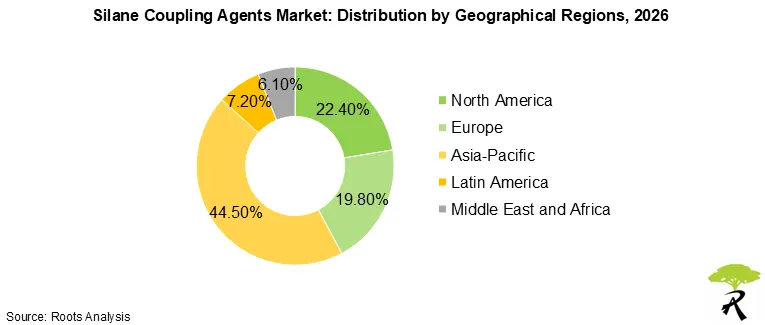
The Asia-Pacific region dominates the global landscape with a 44.5% market share, a figure expected to surge to 50.8% by 2040. As the fastest-growing region with a CAGR of 6.1%, its leadership is underpinned by its status as the global epicenter for semiconductor packaging, electric vehicle production, and tire manufacturing.
The region benefits from a robust integrated value chain that bypasses global logistics bottlenecks, evidenced by the January 2026 operational expansions of major chemical clusters in Jurong Island and Gujarat. This aggressive infrastructure spending and localized manufacturing capability ensure that the Asia-Pacific remains the primary destination for the global reallocation of Silane demand.
North America: Reshoring & Green Infrastructure
North America currently maintains the second highest silane coupling agents market share, though this position is projected to contract by 2040. Despite a modest CAGR of 4.2%, the region faces long-term share erosion due to a maturing industrial base and the high "green" cost of compliance under stringent VOC and EPA oversight.
Growth is increasingly concentrated in high-value specialty grades and high-purity functionalized silanes required for medical and aerospace applications. This shift toward niche, high-performance materials is a strategic response to the offshoring of mass-market manufacturing, as highlighted by the US Department of Energy’s 2025 roadmap, which identifies Silane-anchored primers as critical enablers for next-generation EV battery enclosures.
Europe: The Regulatory-Innovation Nexus
Based on Silane coupling agents market forecast, Europe’s market share is estimated at 19.8% in 2026, with a projected decline to 16.5% by 2040 as it registers the lowest regional CAGR of 3.7%. The outlook is constrained by industrial energy volatility and the escalating costs of REACH compliance, which have lengthened product registration lead times and intensified the search for bio-based Silane alternatives.
While the region remains a leader in "green tire" silica-Silane technology, the structural migration of primary demand drivers toward lower-cost energy hubs limits expansionary growth. Efforts to maintain competitiveness are visible in initiatives like Europe’s "Renovation Wave," which scales demand for Silane-modified weatherable sealants to meet strict energy and emission targets for 35 million buildings by 2030.
Want Information on Specific Region / Segment?
Silane Coupling Agents Competitive Landscape
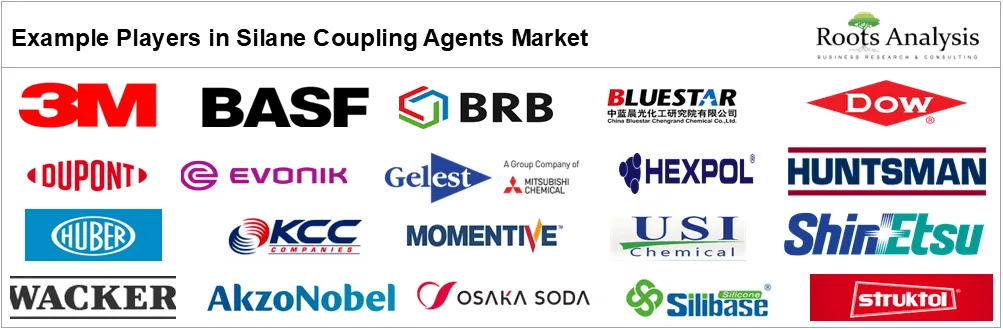
Based on the global Silane coupling agents market analysis, the industry is highly characterized by a moderate to high degree of consolidation. Industrial giants, such as Evonik, Wacker, Dow, Shin-Etsu, and Momentive are controlling a substantial share through vertically integrated silicon value chains, proprietary process technologies, and global application support networks.
The competitive landscape is bifurcated between Western specialty incumbents competing on performance, compliance, and application engineering, and Asian (primarily Chinese) producers competing on cost and scale.
Startup Ecosystem: Focused on Bio-Based Formulations and Disruptive Innovation
While the Silane coupling agents industry is dominated by legacy players, a new wave of startups is emerging at the intersection of material science, focusing on bio-based Silanes, nano-Silane precision chemistry, and waterborne eco-formulations. Some of the recent initiatives of the startup companies are as follows.
- Hubei Bluesky New Material: This China based startup company is broadly emphasizing on bio-based Silane coupling agents. Recently, Hubei Bluesky New Material received government funding for dedicated bio-Silane production facility.
- Struktol Company: This startup company has launched Silane product line for aerospace and power generation, specifically high-temperature applications.
- Guangzhou Ecopower New Materials: This company is primarily manufacturing low-VOC waterborne Silane formulations. Fast-growing in China's construction adhesives market. Positioned for REACH-equivalent regulation compliance in APAC.
Silane Coupling Agents Industry Trends
- Innovation in Sustainable and Bio-Derived Silane Solutions: The industrial shift toward a circular economy and lower environmental footprints creates a strategic opening for eco-friendly and bio-based Silane chemistries. Developing water-borne or renewable-source Silanes that eliminate VOC emissions allows manufacturers to capture high-growth, sustainability-driven market segments and align with the ESG mandates of global Tier 1 suppliers.
- Growth in Nanotechnology and Additive Manufacturing Frameworks: The convergence of Silane chemistry with nanomaterials presents significant potential for enhancing dispersion and interfacial bonding in next-generation functional coatings. Additionally, as additive manufacturing (3D printing) moves toward industrial-scale production, Silanes offer a pathway to improve inter-layer adhesion and the mechanical properties of printed polymers and composites.
- Specialized Customization for Emerging Polymers and Niche Industries: Moving beyond general-purpose agents, there is a high-margin opportunity in engineering tailored Silane solutions for high-performance specialty polymers. Customization for demanding environments-such as medical-grade devices, aerospace interiors, and high-temperature industrial processing-allows for greater market differentiation and the capturing of value in technically rigorous sectors.
- Strategic Transition Toward Water-Based Systems and Surface Treatments: The industry-wide migration from solvent-based to aqueous systems provides a robust growth avenue for specialized Silanes designed for stability in water-borne media. Furthermore, expanding the application of Silanes from simple filler modification to in-situ surface treatments broadens their utility across a wider array of automated industrial processes and coating technologies.
Have Questions? Let’s Get Them Answered
Silane Coupling Agents Market: Scope of the Report
| Key Report Attributes | Details | |
| Historical Trend | Since 2022 | |
| Forecast Period | Till 2040 | |
| Market Size 2026 | USD 1.34 Billion | |
| Market Size 2040 | USD 2.67 Million | |
| CAGR (Till 2040) | 5.05% | |
| Segments Covered |
|
|
Market Segmentation
Based on the research, we have segmented the silane coupling agents market into type of product, type of form, application, end use industry, geographical regions, and key players.
Market Share by Type of Product
- Amino Silanes
- Vinyl Silanes
- Epoxy Silanes
- Methacryl Silanes
- Sulfur Silanes
- Alkyl Silanes
Market Share by Type of Form
- Liquid
- Powder
Market Share by Application
- Adhesion Promotion
- Crosslinking
- Surface Modification
Market Share by End Use Industry
- Paints & Coatings
- Adhesives & Sealants
- Plastics & Composites
- Rubber & Elastomers
- Electrical & Electronics
- Others
Market Share by Geographical Regions
- North America
- US
- Canada
- Mexico
- Rest of North America
- Europe
- Austria
- Belgium
- Denmark
- France
- Germany
- Ireland
- Italy
- Netherlands
- Norway
- Russia
- Spain
- Sweden
- Switzerland
- UK
- Rest of Europe
- Asia-Pacific
- Australia
- China
- India
- Japan
- New Zealand
- Singapore
- South Korea
- Rest of Asia-Pacific
- Latin America
- Brazil
- Chile
- Colombia
- Venezuela
- Rest of Latin America
- Middle East and Africa (MEA)
- Egypt
- Iran
- Iraq
- Israel
- Kuwait
- Saudi Arabia
- UAE
- Rest of MEA


