Smart Advertising Market
Smart Advertising Market Till 2035: Distribution by Type of Component (Hardware, Software, and Services), Type of Product (Digital Billboards, Digital Posters, Interactive Kiosks, and Others), Type of Platform (Desktop and Mobile), Type of End User (Corporate, Education, Food & Beverage, Government, Media & Entertainment, Retail & Consumer Goods, and Others), and Geographical Regions (North America, Europe, Asia, Latin America, and Middle East and North Africa and Rest of the World): Industry Trends and Global Forecast
-
Lowest Price Guaranteed
-
Slides
204 -
Last Updated
October 2026 -
View Count
10955 -
Smart Advertising Market Overview
The smart advertising market size is projected to grow from USD 3.13 billion in 2025 to USD 19.03 billion by 2035, representing a CAGR of 19.79% during the forecast period till 2035.
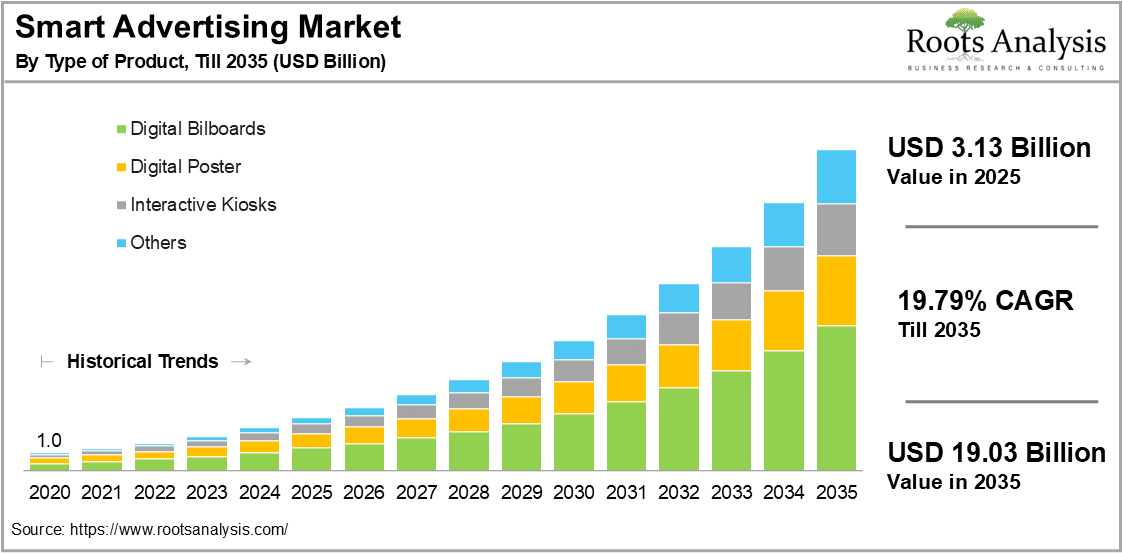
The new research study consists of smart advertising market and trends analysis, detailed market forecast analysis, and provides actionable strategic recommendations.
With the advent of artificial intelligence, machine learning, IoT, and big data analytics, the advertising industry is transcending from traditional advertisement to smart advertisement. Smart advertising is an approach that uses advanced technologies and data-driven strategies to deliver personalized, targeted, and efficient advertising campaigns. This has encouraged companies to leverage these smart advertising technologies to understand consumer behavior and optimize ad delivery, thus, fueling the demand for data-driven marketing solutions.
Resulted in, the smart advertising market is witnessing remarkable growth where significant key drivers are augmenting the market potential. The mounting use of mobile, social media platforms, and smart devices including connected TVs has transformed the industry by offering new channels for advertising and consumer interactions. Beyond this, its core features, such as data-driven personalization, real-time targeting, automation, and omnichannel approach are attracting businesses to maximize their ad campaigns. Therefore, more and more brands are adopting interactive ad formats to boost engagement by offering immersive and engaging ways to interact with their advertisements.
Additionally, the growth of programmatic advertising is driving the adoption of smart display advertising that enables companies to deliver targeted and automated campaigns with greater precision and efficiency. As a consequence, stakeholders and capital venture companies are investing in the industry to capitalize on the increasing popularity of smart advertising. For example, in October 2024, Croatian AEOS, an edtech startup raised EUR 10 million in a Series B investment round led by Taiwania Capital, alongside existing investors Lead Ventures, J&T Ventures, and South Central Ventures. Through this funding, the company aims to expand AI-powered video advertising solutions. Overall, considering these aspects, the future of the smart advertising industry looks promising and the market is poised to sprout out vigorously during this forecast period.
Smart Advertising Market Share Insights
The smart advertising market report presents an in-depth analysis of the various companies that are involved in offering smart advertising, across different segments, as defined in the table below:
Smart Advertising Market: Report Attributes / Market Segmentations
| Key Report Attributes | Details | |
| Historical Trend | Since 2020 | |
| Forecast Period | Till 2035 | |
| Current Market Size | $ 3.13 Billion | |
| Market Size Value by 2035 | $ 19.03 Billion | |
| CAGR (Till 2035) | 19.79% | |
| Type of Component |
|
|
| Type of Product |
|
|
| Type of Platform |
|
|
| Type of End User |
|
|
| Geographical Regions |
|
|
| Leading Market Players |
|
|
| PowerPoint Presentation (Complimentary) |
Available | |
| Customization Scope | 15% Free Customization | |
| Excel Data Packs (Complimentary) |
|
|
Smart Advertising Market Segmentation
Market Share by Type of Component
The global smart advertising market features a wide range of components including hardware, software, and services. As per market research, the hardware components dominate the segment by holding (~49%) of the current market share. Hardware incorporates a variety of smart displays, IoT devices, AR/VR hardware, and digital billboards. These components facilitate personalized, location-based and high-quality ads and enhance consumer engagement through video marketing effectiveness. Additionally, the software segment is gaining traction due to the widening demand for critical tools and platforms that enable personalized, automated, and data-driven advertising. Thus, the software segment is expected to experience an excellent (20.66%) growth rate during this forecast period.
Market Share by Type of Product
This segment of the market for smart advertising is categorized into different types of products wherein digital billboards lead the segment and are anticipated to occupy the largest (~41%) of the market share by 2035. Digital billboards are typically placed in high-traffic areas such as urban centers and commercial districts which make them highly visible and able to reach a large audience. Also, the surge in digital billboard innovation is advancing the industry by integrating with programmatic advertising technology.
Furthermore, the digital poster segment is likely to rise at a faster (22.14%) CAGR over this projection timeframe due to its extensive use in malls, retail stores, and other public spaces. As well as its cost-effectiveness as compared to billboards sustain the demand for the product.
Market Share by Type of Platform
Based on the type of platform, the segment is split into mobile and desktop where the mobile segment shows dominance in the market. The mobile segment is projected to occupy the maximum (~62%) of the market share by 2035. This leading position can be attributed to the rise of mobile traffic, greater user engagement, and location-based targeting which also offer a variety of interactive and engaging ad formats from in-app ads to video ads. Further, mobile platforms are also gaining popularity due to social media growth as businesses use social media advertising strategies to boost engagement and drive conversions. As a result, the mobile platform is expected to expand at an outstanding (20.97%) CAGR throughout this forecast period.
Market Share by Type of End User
This segment of the smart advertising market features diverse end users wherein the corporate sector is driving the segment growth with the highest (~42%) of the current market share. The corporate sector heavily invests in gathering and analyzing customer data to make informed decisions about advertising strategies and adopt omnichannel marketing approaches to ensure that advertising reaches consumers at every touchpoint of their journey.
While the retail and consumer goods industry is expected to register an excellent (22.17%) growth rate in the upcoming decade. This growth is mainly ascribed to the wide use of personalized advertising to target consumer based on their browsing and purchasing behaviors. In addition, the rise of e-commerce has driven the demand for e-commerce advertising solutions, thus, propelling the market outlook.
Market Share by Geographical Regions
This segment highlights the distribution of the smart advertising market across various geographical regions, such as North America, Europe, Asia, Latin America, the Middle East and North Africa, and the rest of the world. In the context of revenue, North America is anticipated to dominate the industry by holding (~47%) of the current market share by 2035.
Moreover, the smart advertising market in Asia reflects impressive growth and is expected to rise at (22.05%) CAGR during this forecast period. The confluence of factors is driving the market expansion in the region. One such factor is the expanding digital ecosystem and booming e-commerce sector. This is due to the fact that the region witnessing an ever-growing adoption rate of internet and mobile devices in countries such as China, India, and other Southeast Asian nations, elevating mobile advertising growth. Likewise, the excelling e-commerce market in the region is supplementing the need for targeted and performance-based advertising. Besides, the growing consumer base and growth of social media are further strengthening the market prospects in Asia.
Smart Advertising Market Key Insights
The “Smart Advertising Market, Till-2035: Industry Trends and Global Forecasts” report features an extensive study of the current market landscape, market size and future opportunities within the smart advertising market, during the given forecast period. The market report highlights the efforts of several stakeholders involved in this rapidly emerging segment of the service providers industry. Key takeaways of the smart advertising market report are briefly discussed below.
Key Drivers of the Smart Advertising Market
Several key drivers are accelerating the smart advertising market growth, however, the rising adoption of digital platforms is primarily attributed to this growth. The increasing use of smartphones, social media, and streaming services has provided diverse platform for advertisers to reach their audience effectively. Businesses are seeking to deliver more relevant and engaging ads which is driving the adoption of tools similar to consumer behavior analytics that help to understand consumer preferences. In addition, the growing connected TV advertising trends driven by the popularity of OTT platforms are advancing the market development as it offer advertisers premium video inventory and precise audience targeting options. Moreover, owing to technological advancement, artificial intelligence in the advertising industry is solidifying the market scope by enabling real-time advertising and improving campaign effectiveness.
Smart Advertising Market Competitive Landscape
Numerous global leaders along with regional market players and small startups are shaping the competitive landscape of the smart advertising industry. Successful companies such as Adobe, Meta, Google, Comcast, and many more dominate the industry by capturing substantial digital advertising market share. These companies differentiate themselves through their advanced technologies, diverse platforms, and vast ad networks. Simultaneously, newcomers and startups are introducing innovative solutions tailored to specific industries and audience segmentations that help them stay ahead of the market competition.
Market Challenges in Smart Advertising Market
Despite the rapid growth, the key challenges in data privacy and ad blockers can obstruct market expansion. There are many global and regional data privacy regulations such as GDPR in Europe and CCPA in the US which impose strict rules on how companies can collect, store, and use consumer data. These laws restrict smart advertising companies from accessing detailed consumer data and make it harder to create personalized targeted campaigns. Likewise, the growing use of ad-blocking software can limit the reach of online advertising campaigns, impacting the potential growth of the market.
Regional Analysis: North America is Expected to Lead the Market with the Largest Smart Advertising Market Share
North America dominates the landscape of the global market for smart advertising with the highest (~47%) of the current market share. Crucial factors such as advanced technological infrastructure and high adoption of digital platforms catalyze regional market expansion. North America boasts a strong infrastructure for emerging technologies such as IoT, AI, and big data analytics that allow innovative advertising solutions. Also, the high penetration of smartphones and widespread use of the internet and digital platforms aid advertisers in targeting consumers effectively through personalized campaigns.
Furthermore, the established retail, e-commerce, and entertainment industries allocate significant budgets for advertising and raise the demand for smart advertising solutions for online consumer engagement in the region. For instance, in October 2024, Vibe launched a new AI-powered product suite Vibe IQ2, Vibe AI Assistant, Vibe Studio, and Vibe Connect, designed to help SMBs access and optimize streaming TV advertising. With 3,000 advertisers onboard, 80% of them first-time TV advertisers, Vibe is revolutionizing CTV advertising for smaller businesses.
Leading Smart Advertising Solution Providers
Examples of key players involved in the market for smart advertising (which have also been captured in this market report, arranged in alphabetical order) include Adobe (US), CAPTIVATE (US), Changing Environments (US), CIVIQ Smartscapes (US), Clear Channel Outdoor (US), Exterion Media (UK), IBM (US), IKE SMART CITY (US), Include (Croatia), Intersection (US), JCDecaux (France), Lamar Advertising Company (US), Meta (US), Omnicom Group (US), OUTFRONT Media (US), PubMatic (US), and Salesforce (US). This market report includes an easily searchable excel database of all the companies who have adopted the smart advertising market.
Recent Developments in Smart Advertising Market
- In January 2025, Comcast launched Universal Ads, a TV advertising platform launching in Q1, enabling advertisers to easily purchase premium video at scale from top media companies. Built on FreeWheel’s advanced ad technology, it simplifies transactions for ad buyers and sellers in a single platform.
- In December 2024, Skyscanner presented the Skyscanner Ads Platform, an advanced advertising solution developed with airlines, travel agents, and brands to help partners navigate the changing digital advertising landscape.
- In June 2024, Samsung Ads Europe introduced Smart Outcomes, a machine-learning advertising solution. This tool helps advertisers optimize CTV campaigns automatically and utilize Europe's largest single-source deterministic TV data set.
Smart Advertising Market Report Coverage
The market report presents an in-depth analysis, highlighting the capabilities of various companies engaged in this domain, across different segments. Amongst other elements, the market report includes:
- A preface providing an introduction to the full report smart advertising market, 2020-2024 (Historical Trends) and till-2035 (Forecasted Estimates).
- An outline of the systematic research methodology adopted to conduct the study on the smart advertising market providing insights on the various assumptions, methodologies, and quality control measures employed to ensure the accuracy and reliability of our findings.
- An overview of economic factors that impact the overall smart advertising market including historical trends, currency fluctuation, foreign exchange impact, recession, and inflation measurement.
- An executive summary of the insights captured during our research. It offers a high-level view on the current state of the smart advertising market their likely evolution in the mid-long term.
- A detailed assessment of the smart advertising market landscape, based on several relevant parameters, including year of experience, company size, location of headquarters, and ownership structure.
- Elaborate profiles of prominent players engaged in the smart advertising market, featuring information on their year of establishment, location of headquarters, company size, company mission, company footprint, management team, contact details, financial information, operating business segments, smart advertising market portfolio, moat analysis, recent developments, and an informed future outlook.
- A qualitative assessment of the various megatrends ongoing in the smart advertising industry, including rise of connected TV advertising, growing trend of interactive and immersive ad formats.
- An analysis highlighting the key unmet needs across the smart advertising market, featuring insights generated from real-time data on unmet needs as identified from social media posts, recent publications, industry blogs and the views of key opinion leaders expressed on online platforms.
- An in-depth analysis of various patents that have been filed / granted related to the smart advertising market and its components, based on various parameters, such as type of patent, patent publication year, patent age and leading players.
- A detailed analysis of recent developments in the smart advertising market domain, based on relevant parameters such as year of initiative, type of initiative (partnerships and collaborations, expansions, funding and product launches), geographical distribution and most active players (in terms of number of recent developments).
- Key winning strategies framework that helps in analyzing the level of competition within an industry, by tracing the key market activities including partnership, funding, expansion of leading players
- A qualitative analysis, highlighting the five competitive forces prevalent in smart advertising market, including threats for new entrants, bargaining power of suppliers, bargaining power of customers, threats of substitution and rivalry among existing competitors.
- A discussion on affiliated global smart advertising market trends, key drivers and challenges, under a SWOT framework, which are likely to impact the industry’s evolution, along with a Harvey ball analysis, highlighting the relative effect of each SWOT parameter on the overall smart advertising market.
- A value chain analysis featuring a discussion on various stakeholders involved in the development of the smart advertising market, from suppliers to end-users.
- A detailed estimate of the current market size and the future growth potential of the smart advertising market over the next decade. Based on multiple parameters we have provided an informed estimate on the market evolution during the forecast period 2025-2035. The report also features the likely distribution of the current and forecasted opportunity within the smart advertising market. Further, in order to account for future uncertainties and to add robustness to our model, we have provided three forecast scenarios, namely conservative, base, and optimistic scenarios, representing different tracks of the industry’s growth.
- Detailed projections of the current and future market across various types of components such as hardware, software, and service.
- Detailed projections of the current and future market across various types of products such as digital billboards, digital posters, and interactive kiosks, and others.
- Detailed projections of the current and future market across various types of platforms such as Desktop and mobile.
- Detailed projections of the current and future market across various types of end users such as corporate, education, food & beverage, government, media & entertainment, retail & consumer goods, and others.
- Detailed projections of the current and future smart advertising market across various geographical regions, such as North America (US, Canada, Mexico and other North American countries), Europe (Austria, Belgium, Denmark, France, Germany, Ireland, Italy, Netherlands, Norway, Russia, Spain, Sweden, Switzerland, UK and other European countries), Asia (China, India, Japan, Singapore, South Korea and other Asian countries), Middle East and North Africa (Egypt, Iran, Iraq, Israel, Kuwait, Saudi Arabia, UAE and other MENA countries), Latin America (Brazil, Chile, Colombia, Venezuela and other Latin American countries) and rest of the world (Australia, New Zealand and other countries).
Author: Ronit Sharma and Neha Kashyap
Customization Opportunities
At Roots Analysis, we genuinely care about your success and understand that your business requirements are unique. While our market research reports provide valuable insights, we recognize that they might not cover every aspect you need to make well-informed strategic decisions. To account for that, we offer 15% free report customization tailored to your specific needs. Whether you require additional quantitative analysis, qualitative insights, or any other information related to the smart advertising market, reach out us today at: support@rootsanalysis.com