
Lowest Price Guaranteed
Slides
224
Last Updated
February 2026
View Count
12280
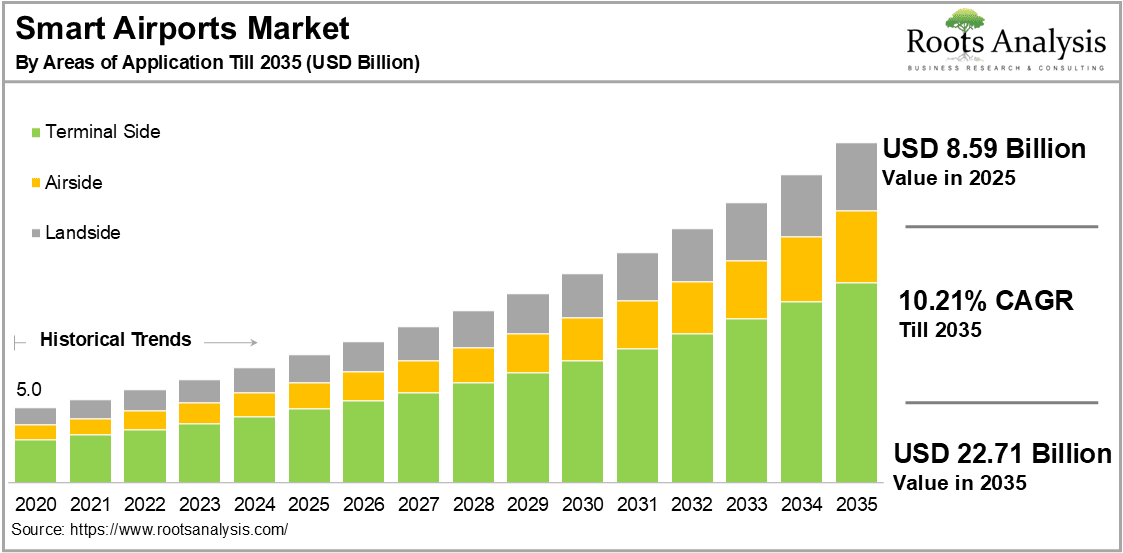
The smart airport market size is projected to grow from USD 8.59 billion in 2025 to USD 22.71 billion by 2035, representing a CAGR of 10.21%, during the forecast period till 2035.
 |
The new research study consists of global smart airport analysis, detailed market analysis, mega trends, patent analysis, porter five forces, SWOT analysis, value chain analysis and other strategic frameworks.
Smart airports are revolutionizing the way airport operations are managed, providing seamless accessibility and control through mobile devices and wireless communication. These advanced solutions encompass smart gates, beacon technology, mobile navigation tools, and facial recognition systems. They play a crucial role in overseeing various functions such as IP-based security monitoring, check-in management, air traffic management, baggage handling, communications, ticketing, and freight operations. By offering fast, convenient, and flexible alternatives for travelers, smart airport solutions are designed to enhance the overall passenger experience. Automation and IoT are transforming airport baggage handling systems into predictive, error-resistant logistics hubs.
The landscape of smart airports is undergoing a significant digital transformation and automation, driven by the need for improved operational efficiency and passenger experience enhancement technologies. Airports globally are rapidly adopting biometric technologies and contactless solutions. For instance, major hubs like Dubai International Airport have implemented over 100 smart gates to streamline passenger processing. This digital transformation extends beyond just passenger flow; it also includes automated baggage handling systems, security screening, and resource management, creating an integrated airport management system.
Artificial intelligence (AI) and automation have become foundational technologies in modern airport operations. Leading airports are deploying AI-driven airport operations, such as automated baggage screening and intelligent flight information displays. Shenzhen Airport has introduced a facial recognition system for its flight information displays, while Dubai Airport's smart tunnel allows travelers to pass through passport control without assistance. As airports transition toward fully digitized operations, air traffic control systems are evolving with real-time analytics and predictive routing. These innovations exemplify how AI is enhancing operational efficiency and airport automation.
The smart airport market report presents an in-depth analysis of the various companies that are involved in offering smart airport solutions, across different segments, as defined in the table below:
| Key Report Attributes | Details | |
| Historical Trend | Since 2020-2024 | |
| Forecast Period | 2025-2035 | |
| Market Size Value in 2025 | $ 8.59 Billion | |
| Market Size Value by 2035 | $ 22.71 Billion | |
| CAGR (Till 2035) | 10.21% | |
| Type of Airport Model |
|
|
| Areas of Application |
|
|
| Types of Airport Size |
|
|
| Type of Operations |
|
|
| Type of System |
|
|
| Type of Technology |
|
|
| Type of Airside |
|
|
| Type of End-Users |
|
|
| Type of Enterprise |
|
|
| Geographical Regions |
|
|
| Leading Market Players | ||
| PowerPoint Presentation (Complimentary) |
Available | |
| Customization Scope | 15% Free Customization | |
| Excel Data Packs (Complimentary) |
|
|
Based on the type of airport model, the market is split into airport 2.0, airport 3.0, and airport 4.0. Among these categories, the airport 3.0 segment growth is expected to dominate the market with a share of 75.8%. This growth is fueled by the wide adoption of airport 3.0 model in various airports, particularly in North America, due to its effective integration of advanced technologies that enhance operational efficiency and passenger experience.
On the other hand, the airport 4.0 segment is expected to witness rapid growth at a significant CAGR of 13.23% during the forecasted period. This model focuses on creating a cohesive digital environment that connects all stakeholders, emphasizing real-time flight information systems and operational connectivity. As airports increasingly adopt this model, it is expected to drive significant growth in the market.
The global smart airport market is segmented into various areas of application, such as airside, landside, and terminal side. According to our smart airports industry analysis, the terminal side segment will augment the segment's growth with the largest market share of over 74.56% by the next decade. This growth is driven by the increasing integration of advanced technologies such as contactless check-in kiosks, biometric authentication systems, and intelligent security solutions aimed at enhancing passenger experiences and operational efficiency.
On the other hand, it is worth highlighting that the airside segment is expected to witness the fastest CAGR of around 12.78% during the forecasted period. This segment benefits from the rising demand for smart airport systems that improve ground operations, reduce aircraft turnaround times, and enhance safety through technology integration. The focus on optimizing air traffic management and aircraft maintenance further fuels the growth of this segment.
The market is segmented into various types of airport size such as large, medium and small. According to our smart airport growth forecast, the large airport segment will augment the segment's growth with the largest market share of over 75.6% by the next decade. The market growth can be attributed to its significant share, driven by the availability of larger budgets and resources that allow for the implementation of advanced smart technologies and infrastructure. Large airports typically handle a higher volume of passengers and flights, necessitating efficient processes and automation to enhance operational efficiency and passenger experience.
Furthermore, the medium segment is expected to witness a growth of CAGR of 14.84% during the forecast period. This growth is attributed to increasing investments in smart technologies aimed at improving operational efficiency and passenger services, as medium-sized airports seek to compete with larger hubs by enhancing their capabilities and overall traveler experience.
The market is segmented into various types of operations, such as aeronautical operations and non-aeronautical operations. According to our smart airport market statistics, the non-aeronautical operations segment will augment the market's growth with a market share of 85.7% as well as the fastest CAGR of around 11.33% during the forecasted period. This segment encompasses a range of revenue -generating activities that are not directly related to air travel such as retail, smart parking solutions for airports, food and beverage services and other amenities within the airport. The growth of this segment is majorly driven by the diversification of revenue sources for airports, allowing them to reduce dependency on aeronautical income and stabilize financial performance.
The market is segmented into various types of systems, such as communication & network systems, data storage, endpoint devices and software & solutions. According to our smart airport analysis, the communication & network segment will augment the market's growth with a market share of 57.65% during the forecasted period. This growth can be owed to its critical role in ensuring seamless connectivity and operational efficiency across airport operations. These systems facilitate real-time communication among various stakeholders, enhancing overall airport management and passenger experiences.
Furthermore, the endpoint devices segment is expected to witness the fastest CAGR of around 14.27% during the forecasted period. This growth is driven by the increasing adoption of advanced technologies such as biometrics, RFID tags, and beacons that enhance security, streamline passenger processing, and improve operational efficiency at airports. The rising demand for innovative solutions that optimize screening processes and enhance customer service further fuels this segment's rapid expansion.
The market is segmented into various types of technology, such as air/ground traffic control, cargo & baggage handling control, communication systems, endpoint devices, passenger and security systems. According to our smart airport analysis, the air/ground traffic control segment will augment the market's growth with a market share of 35.65% during the forecasted period. This segment is crucial for ensuring efficient operations, safety, and coordination between air traffic and ground services. The increasing complexity of air travel and the need for improved safety measures drive significant investments in advanced air and ground traffic management systems.
Furthermore, the cargo & baggage handling control segment is expected to witness the fastest CAGR of around 15.2% during the forecasted period. This surge is largely driven by the rising demand for efficient baggage tracking systems and automated handling solutions that enhance operational efficiency and reduce delays. As airports strive to improve passenger experience and streamline operations, investments in advanced cargo and baggage handling technologies are expected to surge.
The market is segmented into various types of airsides, such as aircraft packing, air traffic management, aircraft maintenance, resource management. According to our smart airports market size forecast, the air traffic management segment will augment the market's growth with a market share of 67.5% during the forecasted period. This segment is critical for ensuring the safe and efficient movement of aircraft both in the air and on the ground. The increasing volume of air traffic and the need for enhanced safety measures drive significant investments in advanced air traffic management technologies.
Furthermore, the aircraft maintenance segment is expected to witness the fastest CAGR of around 11.2% during the forecasted period. The growing emphasis on operational efficiency, safety, and compliance with regulatory standards is leading airports to adopt innovative maintenance solutions. Technologies such as predictive maintenance and IoT-enabled monitoring systems are becoming increasingly popular, contributing to the rapid growth of this segment.
The market is segmented into various types of end-users, such as implementation and upgrades & services. According to our smart airport analysis, the upgrades & services segment will augment the market's growth with a market share of 87.65% during the forecasted period. This segment is driven by the ongoing digital transformation efforts of airports that seek to enhance passenger experiences and operational efficiency. Airports are increasingly investing in upgrading existing systems with advances technologies and solutions to meet evolving demands.
Furthermore, the implementation segment is expected to witness the fastest CAGR of around 15.2% during the forecasted period. This growth is fueled by the increasing need for airports to deploy new smart technologies and systems as they adapt to higher passenger volumes and seek to improve overall operational efficiency. The focus on implementing innovative solutions to enhance service delivery and streamline operations contributes to this segment's rapid growth.
The market is fragmented into multiple types of enterprise namely large and small and medium enterprise. Currently, the large enterprise segment is anticipated to dominate with 60.34% of the market share of smart airport solutions. However, small and medium enterprise segments are expected to witness a relatively higher (17.78%) growth rate until 2035. This is ascribable to their agility, innovation, focus on niche markets, and ability to adapt to changing customer preferences and market conditions.
This segment highlights the distribution of smart airport market share by region, such as North America, Europe, Asia, Latin America, Middle East and North Africa, and the rest of the world. According to our regional analysis, North America currently exhibits dominance with 37.69% of overall market share. The North America smart airport market is driven by the presence of a significant number of air travelers and numerous international airports across the U.S. and Canada, the well-established air travel ecosystem, economic affluence, high level of awareness, and increased adoption of smart technologies.
The “Smart Airport Market, Till-2035: Industry Trends and Global Forecasts” report features an extensive study of the current market landscape, market size and future opportunity within the smart airport market forecast period. The market report highlights the efforts of several stakeholders involved in this rapidly emerging segment of the service providers industry. Key takeaways of the global smart airport market report are briefly discussed below.
The smart airport market is driven by several key factors that are reshaping the aviation landscape. One of the primary drivers is the increasing demand for enhanced passenger experiences, which has led to the adoption of advanced technologies such as biometrics, artificial intelligence, and the Internet of Things. These innovations facilitate smoother operations, including automated check-ins, real-time baggage tracking, and improved security screening processes.
Additionally, the surge in global air travel is pushing airports to modernize their infrastructure and operations to accommodate higher passenger volumes efficiently. Sustainability goals are also influencing market growth, as airports seek to implement renewable energy solutions and reduce their environmental impact. Furthermore, the integration of smart technologies enables airports to optimize resource management and operational efficiency, ultimately enhancing customer satisfaction and operational performance. As airports continue to evolve in response to these demands, the smart airport market is set for significant expansion.
With the presence of several small and large companies, the competitive landscape of smart airports is experiencing intense competition and changing market dynamics. From large multinational companies to local players, companies are striving to enhance their competitive edge. In terms of market share, large enterprises and multinational companies are dominating the market. The key players are using strategies such as partnerships, acquisitions, ventures, innovations, novel product launches, R&D and geographical expansions in an attempt to solidify their position in the industry. For instance, in September 2024, the Adani group launched Aviio, an app for the airport ecosystem that aspires to bring the aviation community together to collaborate and serve passengers better. In reference to this, Arun Bansal, AAHL CEO, stated that on the face of it, this multipurpose app is designed to revolutionize stakeholder collaboration, equipping both internal and external stakeholders at airports with improved situational awareness for informed decision-making. However, the most important impact of Aviio would be on passenger journeys. This app is all set to transform the way passengers transit through our airports.
The smart airport market faces several significant challenges that could hinder its growth and implementation. One of the primary obstacles is the high initial costs associated with deploying smart technologies, which can deter many airports, particularly smaller ones, from making necessary upgrades. These expenses encompass not only the purchase of advanced systems and infrastructure but also the training of personnel to operate and maintain these technologies.
Additionally, the integration of diverse systems from multiple vendors can be complex and requires meticulous planning and coordination, often leading to interoperability issues. Ensuring data privacy and cybersecurity is another critical challenge, as airports handle sensitive passenger information and are increasingly targeted by cyber threats. Furthermore, regulatory hurdles can slow down the adoption of new technologies, with lengthy approval processes potentially stalling innovation. Addressing these challenges will be crucial for unlocking the full potential of smart airports and ensuring their successful evolution in a rapidly changing aviation landscape.
With respect to regional industry insights, North America is likely to dominate the market for the forecasted period. The dominance of this region is majorly influenced by the growing investments in critical airport infrastructure projects, increasing focus on enhancing the overall passenger experience, and presence of key industry players are additional factors adding to the regional growth prospects. Furthermore, the Transportation Security Administration (TSA) actively promotes and invests in modernizing airport infrastructure which creates a supporting environment for the development and implementation of smart airport technologies.
Examples of leading smart airport manufacturers (which have also been captured in this market report, arranged in alphabetical order) include Akamai Technologies, Airbus, AirIT, Amadeus, Ascent, Bosch Security, Cisco, Collins Aerospace, Daifuku, Honeywell, Huawei, IBM, Indra Sistemas, Infax, Kiewit, L3Harris, Leidos Holdings, NEC, Raytheon, SITA, Siemens, Smart Airport Systems, Smiths Detection, Thales, T-Systems, Vanderlande, and Wipro.
The market report presents an in-depth analysis, highlighting the capabilities of various companies engaged in this domain, across different segments. Amongst other elements, the market report includes:
At Roots Analysis, we genuinely care about your success and understand that your business requirements are unique. While our smart airport market research reports provide valuable insights, we recognize that they might not cover every aspect you need to make well-informed strategic decisions. To account for that, we offer 15% free report customization tailored to your specific needs. Whether you require additional quantitative analysis, qualitative insights, or any other information related to the smart airport market, reach out us today at: support@rootsanalysis.com