


 Download Free Sample
 Buy Now
Market Size
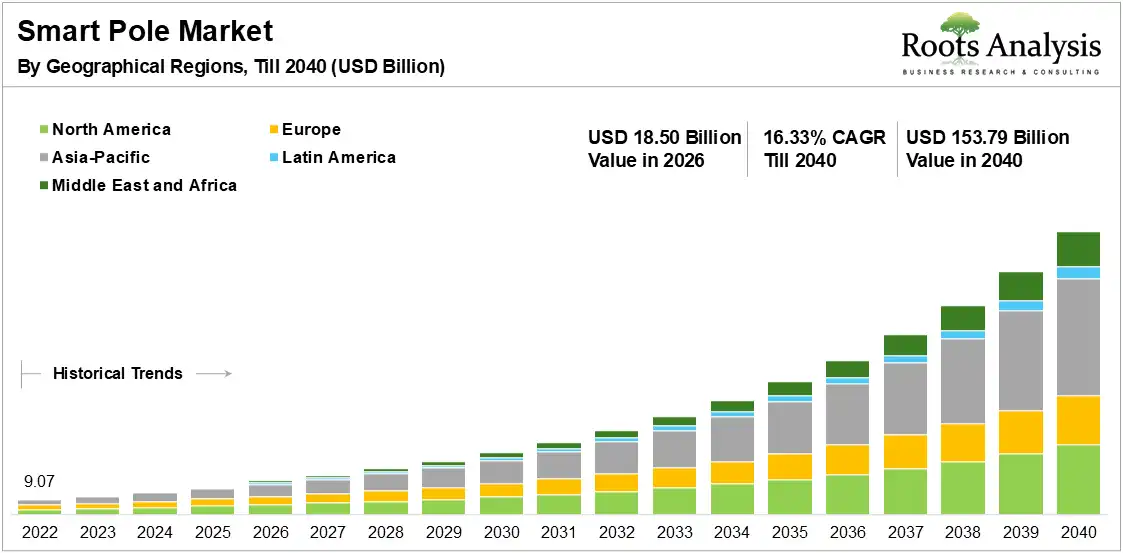
The global smart pole market is projected to reach USD 18.50 billion in 2026 and USD 153.79 billion by 2040, representing a CAGR of 16.33% during the forecast period 2026 to 2040.
See What’s in the Full Report - Request Your Complimentary Insights!
Market Overview
The smart pole market represents a sophisticated evolution of urban infrastructure, merging traditional street lighting with multifaceted digital utility modules. These integrated systems consolidate LED illumination, environmental sensors, security cameras, and telecommunications hardware, including Wi-Fi and small cells, alongside electric vehicle charging stations. Functioning as essential data nodes, these structures provide the backbone for modern smart city frameworks by enabling real-time monitoring and connectivity for traffic coordination, public safety, and various municipal services across dense metropolitan landscapes.
Sustained market growth is fueled by a global surge in smart city development and the strategic necessity of 5G network expansion. Because smart poles offer a standardized framework for small cell deployment, they are increasingly vital for meeting the connectivity requirements of a growing industrial internet of things (IIoT) ecosystem. Heightened focus on public security and urban mobility further accelerates the integration of surveillance and intelligent transport technologies. Recent large-scale deployments in American cities like Chicago and Phoenix demonstrate this momentum, showcasing how these platforms facilitate high-speed connectivity and data-centric governance.
The industry is currently transitioning toward advanced data analytics and the incorporation of artificial intelligence to maximize infrastructure value. Research and development emphasize sensor fusion and the creation of unified data platforms, which allow municipalities to synthesize raw information into predictive models for energy use and traffic flow. This technological maturity, paired with improving cost efficiencies, positions smart poles as a permanent fixture of digital urban planning. Future scalability remains high as cities increasingly rely on these intelligent platforms to manage complex environmental and operational challenges.
Market Report: Key Takeaways
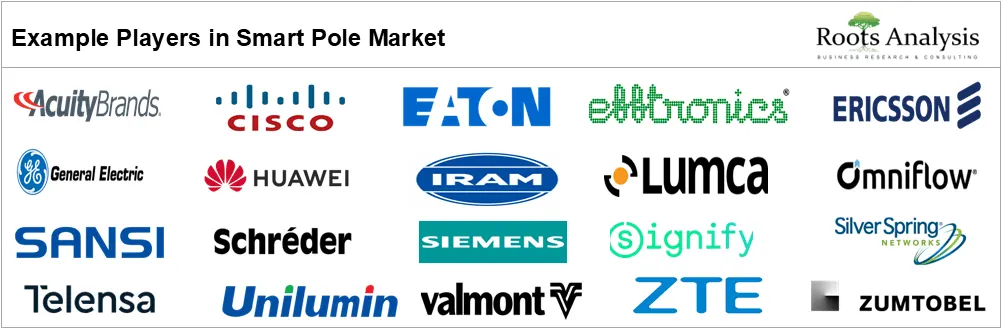
- Market Giants: The market features a range of influential players, such as Signify, General Electrics, and Siemens are making significant advances, characterized by a shift from pure hardware manufacturing to the delivery of integrated urban connectivity ecosystems. Signify leveraged strategic partnership with NTT DATA to co-develop digital twin-integrated smart pole networks for Japanese municipalities, targeting 30,000 pole deployments through 2028.
- Startup Ecosystem: The first few months of 2026 have seen big investments in startups focused on sustainability, pole-as-a-service model, and AI infrastructure, sectors that are increasingly converging with the smart pole industry. Startup companies like Waabi closed a $1 billion funding round to advance autonomous trucking and robotaxi tech, which relies on the connectivity provided by smart pole networks, significantly driving the C-V2X smart pole implementation.
- Smart City Smart Pole Market Drivers: The accelerating 5G services network deployments globally serve as the most significant catalyst for market growth. Furthermore, the rising concerns over public safety and traffic management are also pushing governments to invest in AI-infused poles equipped with LiDAR, 360-degree cameras, and emergency response systems.
- Public Safety Smart Pole Applications: The public safety and surveillance segment is a high-growth pillar of the market, expected to increase its share from 24.8% in 2026 to 29.4% by 2040, supported by a strong CAGR of 17.8%. Adoption is driven by the integration of AI-powered edge analytics, which offers significant performance advantages over traditional CCTV by reducing latency and backhaul costs.
- Regional Analysis: Currently, Asia-Pacific leads the market with 33.8% of the overall revenue share. The growth is propelled by China's Digital China program (700+ smart cities), India's Smart Cities Mission Phase 2 (100 cities), South Korea's Digital New Deal, and Singapore's Smart Nation initiative.
- Future Global Smart Pole Industry Trends: The development of AI-infused smart city poles is a prominent trend transforming urban landscapes. Another emerging trend is the transition toward service-based models, such as subscription-based management and predictive maintenance, providing municipalities with affordable and scalable solutions.
Pay Only for What You Need – The Best Way to Optimize
Recent Industry Developments
- February 2026: Ubicquia announced the closure of a $106 million Series D investment to accelerate intelligent infrastructure growth in grid modernization and public safety solutions. The investment is intended to fuel AI development, smart lighting, international expansion, and "as-a-service" offerings for municipalities and utilities.
- February 2026: CU Phosco showed their latest innovations in multi-functional smart pole solutions, designed to support the rising demand of urban connectivity at Mobile World Congress (MWC) Barcelona.
- January 2026: Sumedang launched first smart pole with EDOTOCO Indonesia as Infrastructure Partner.
Market Dynamics
Key Market Drivers
- Deployment Requirements for 5G Small Cell Densification: As per the 5G smart pole integration report, the transition to 5G architecture necessitates a dense network of small cells to maintain high-frequency, low-latency coverage within urban topographies. Smart poles function as the premier hosting solution for this equipment, providing ready access to power, backhaul connectivity, and optimal elevation. By utilizing existing vertical assets, telecommunications providers can bypass the logistical hurdles of traditional site acquisition, significantly accelerating the expansion of next-generation wireless infrastructure.
- Smart City Transformation and Holistic Digital Integration: Municipalities are increasingly adopting data-driven governance models to optimize urban resource management and improve liability. Smart poles serve as the foundational hardware layer for smart pole technology trends, consolidating diverse sensor arrays-including air quality monitors, traffic sensors, and surveillance systems-into a unified platform. This converged approach eliminates infrastructure redundancy and provides city planners with a centralized stream of real-time intelligence for informed decision-making and enhanced public safety.
- Escalating Requirements for Accessible EV Charging Infrastructure: The global shift toward electric mobility has created an urgent demand for ubiquitous, curbside charging solutions. Integrating EV charging modules into smart poles offers a high-impact, low-footprint strategy for deploying infrastructure in dense commercial and residential districts where space for standalone stations is limited. This co-location strategy simplifies the permitting process and reduces civil engineering requirements, lowering the barrier to entry for urban charging networks.
- Enhanced Operational Efficiency and Total Cost of Ownership (TCO) Optimization The replacement of legacy lighting systems with intelligent LED-based smart poles offers immediate reductions in energy consumption and maintenance expenditure. Beyond lighting, the "converged infrastructure" model allows municipalities to amortize the costs of installation and upkeep across multiple services, including connectivity and public safety. By consolidating disparate utility assets into a single managed unit, cities can achieve significant long-term TCO savings through streamlined asset management.
Market Restraints
- Initial High Capital Expenditure and Procurement Complexity: Smart poles command a substantially higher initial investment compared to traditional streetlights, creating significant budgetary pressure for municipalities, particularly those with limited resources. Furthermore, the complexity of procuring integrated solutions-which often involve technologies from disparate vendors (lighting, telecom, IT, and sensor manufacturers)-complicates tendering processes and increases risk for city procurement officers.
- Regulatory Fragmentation and Permitting Hurdles: The deployment of smart poles requires coordination across multiple regulatory domains, including utility departments (power supply), telecom regulators (small cell deployment), and public works departments (right-of-way access). This results in fragmented permitting requirements that vary significantly between jurisdictions. The slow, bureaucratic process often creates substantial delays, pushing back deployment timelines and increasing soft costs for integrators and vendors.
- Lack of Standardization and Interoperability Issues: The smart pole market currently lacks universal standards for data protocols, hardware integration interfaces, and communication methods. Different technology providers offer proprietary solutions, leading to potential vendor lock-in and significant interoperability issues when attempting to integrate components from various manufacturers. This fragmentation hinders large-scale deployments and complicates long-term system management for city IT departments.
- Data Privacy Concerns and Ethical Use Frameworks: The deployment of smart poles equipped with surveillance cameras and sensors raises significant public concerns regarding data privacy and surveillance. Without robust, transparent ethical frameworks and clear data governance policies, local opposition and regulatory scrutiny can stall projects. Cities must address these concerns proactively to maintain public trust, especially concerning the collection of personally identifiable information (PII) from citizens.
Your Business is Unique – Why Shouldn’t Your Report Be?
Market Share Insights
Hardware Holds the Largest Share
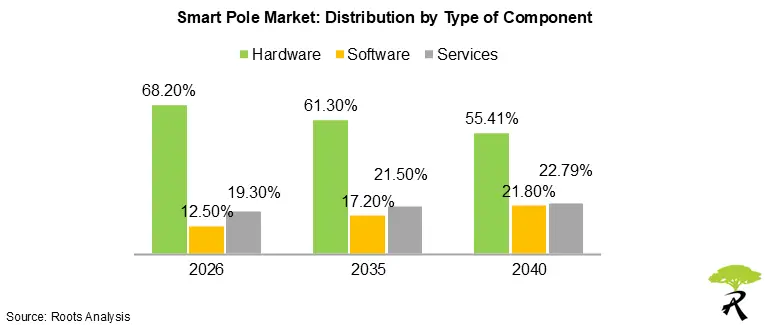
Based on smart pole hardware and software market analysis, hardware currently holding the dominant market share at an estimated 68.20% in 2026. This leadership is sustained by the high initial CapEx required for lighting fixtures, sensors, and communication modules. However, the segment is projected to experience a share loss, dropping to 55.41% by 2040 as components commoditize and modularity reduces price premiums.
In contrast, the software is positioned as the fastest-growing category, expected to achieve a market-leading CAGR of 20.7% through 2040. This rapid ascent to a 21.8% market share by 2040 is fueled by the transition toward Infrastructure-as-a-Service (IaaS) and the integration of AI-driven edge analytics and 6G orchestration, as evidenced by the January 2026 "Unified Urban Grid" pilot in Singapore which prioritized cloud-native platforms over proprietary hardware.
Simultaneously, services are projected to grow at an 17.8% CAGR, reaching a 22.79% share by 2040. This growth is underpinned by the increasing complexity of multi-tenant retrofitting and long-term managed service contracts required to meet "Net Zero" regulatory mandates and maintain aging sensor arrays.
Regional Analysis: Asia-Pacific Dominates the Market
Asia-Pacific: The Rapid Deployment Hub
Based on the smart street light market report, Asia-Pacific region currently leads the global market with a 33.8% share and is projected to be the fastest-growing sub-segment, expanding at a 18.1% CAGR through 2040. This dominance is underpinned by rapid urbanization and massive smart city subsidies that facilitate the high-density deployment of urban operating systems.
As the global manufacturing hub for LED and sensor components, the region benefits from a lower total cost of ownership (TCO) and significant pre-deployment investment in 6G infrastructure. Evidence of this momentum was underscored in January 2026 by the expansion of integrated 5G / 6G small cell deployments in the Pearl River Delta, which signalled a 22% year-on-year increase in infrastructure CAPEX for intelligent street furniture.
North America and Europe: The Specialized Market
North America and Europe are holding 31.2% and 24.5% smart pole market shares respectively in 2026. These are expected to experience a relative loss in market share. While North America maintains high 5G density and Europe prioritizes EV charging integration, both markets are shifting toward lower-margin replacement cycles and are increasingly constrained by strict data privacy regulations and heritage preservation requirements.
Want Information on Specific Region / Segment?
Market Ecosystem Insights
Competitive Landscape of Major Smart Pole Manufacturers
The smart pole market features a tiered competitive structure: global infrastructure conglomerates at the top, specialist smart city technology firms in the mid-tier, and emerging startups focused on niche applications at the base. The primary focus of these companies is on expanding smart pole infrastructure, future proof pole designs, and integration of AI technology.
In addition, the market players are also prioritizing smart city as a service model for the deployment of smart poles and lighting, which is likely to maintain a long term competitiveness in the market.
Smart Pole Market Key Players Initiatives
Some of the recent initiatives of the leading smart pole industry players are as follows:
- Signify (Philips Lighting): Signify expanded its Interact City platform in Q4 2025 with a dedicated AI-powered pedestrian flow analytics module, piloted in 12 cities across the Netherlands and Singapore. The company also announced a strategic partnership with NTT DATA to co-develop digital twin-integrated smart pole networks for Japanese municipalities, targeting 30,000 pole deployments through 2028.
- Siemens Smart Infrastructure: In September 2025, Siemens launched its Sievert Smart Pole Hub, an integrated product combining 5G small cell, bi-directional EV charger (22kW AC + 50kW DC), environmental sensors, and adaptive lighting into a single pole system. The Sievert Hub secured procurement contracts in Munich, Dubai (EXPO City), and São Paulo Q1 2026.
- Ericsson: Ericsson's Street Macro 6701 product line secured a landmark deal with Verizon in November 2025, covering deployment of 4,500 smart poles across New York, Los Angeles, and Dallas, the largest single 5G smart pole contract recorded in North America. Commercial rollout began Q1 2026.
Startup Companies and Venture Capital Activity
For startups in the smart pole space, such as Clovity (launched the City Smart Pole) and Linker Vision (raised $35 million in December 2025 for AI Edge Computing), the path to scaling depends on precise deployment in key transit lanes and metropolitan paths. Investors are attracted to the SaaS revenue model (USD 20–80 / pole / month), the large installed base addressability, and the defensible data moat created by proprietary city datasets.
Smart Pole Market Growth Opportunities
- Pole-as-a-Service (PaaS) and Public-Private Partnerships: To overcome high initial capital costs, the "Pole-as-a-Service" model allows private companies to deploy, own, and operate the infrastructure, leasing services (like lighting, connectivity, and data collection) back to the municipality. This approach shifts the financial burden from public budgets to private investors, creating new revenue streams for infrastructure developers and accelerating adoption in cash-strapped municipalities.
- Retrofitting Existing Infrastructure: A significant opportunity exists in retrofitting existing street lighting assets rather than complete replacement. By upgrading existing poles with modular smart technology kits (sensors, controllers, and small cells), cities can achieve smart pole functionality at a lower cost and with less operational disruption. This approach is particularly effective in Tier 2 cities and developing economies where full-scale new infrastructure projects are financially unfeasible.
- Monetization of Aggregated Urban Data: Smart poles generate vast amounts of valuable data on traffic patterns, environmental conditions, and population movement. This aggregated, anonymized data can be monetized by selling it to third parties, such as urban planners, commercial real estate developers, and transportation companies. Data monetization creates a compelling ROI pathway for private partners and provides a potential revenue source for city operations.
- Integration with Autonomous Vehicles (V2X Communications): As autonomous and connected vehicle technologies mature, smart poles will serve as critical communication hubs for vehicle-to-infrastructure (V2I) communication. By relaying real-time traffic updates, road hazard warnings, and navigation data, smart poles can significantly improve the safety and efficiency of autonomous mobility networks. This creates a powerful long-term value proposition for the transportation sector.
Get an Instant Quote in 10 Minutes. Lowest Price Guaranteed
Smart Pole Market: Scope of the Report
| Key Report Attributes | Details | |
| Historical Trend | Since 2022 | |
| Forecast Period | Till 2040 | |
| Market Size 2026 | $ 18.50 Billion | |
| Market Size 2040 | $ 153.79 Billion | |
| CAGR (Till 2040) | 16.33% | |
| Segments Covered |
|
|
Market Segmentation
Based on the research, we have segmented the smart pole market into type of component, application, end user, geographical regions, and leading players.
Market Share by Type of Component
- Hardware
- Software
- Services
Market Share by Application
- Public Safety and Surveillance
- Smart Lighting
- Transportation Management and Traffic Monitoring
- Environmental Monitoring
- Electric Vehicle (EV) Charging Infrastructure
Market Share by End User
- Government / Municipalities
- Commercial
- Residential
Market Share by Geographical Regions
- North America
- US
- Canada
- Mexico
- Rest of North America
- Europe
- Austria
- Belgium
- Denmark
- France
- Germany
- Ireland
- Italy
- Netherlands
- Norway
- Russia
- Spain
- Sweden
- Switzerland
- UK
- Rest of Europe
- Asia-Pacific
- Australia
- China
- India
- Japan
- New Zealand
- Singapore
- South Korea
- Rest of Asia-Pacific
- Latin America
- Brazil
- Chile
- Colombia
- Venezuela
- Rest of Latin America
- Middle East and Africa (MEA)
- Egypt
- Iran
- Iraq
- Israel
- Kuwait
- Saudi Arabia
- UAE
- Rest of MEA


