Smart Seat Belt Technology Market
Smart Seat Belt Technology Market Till 2035: Distribution by Type of Smart Seat Belt (Active Buckle Lifter, Active Seat Belt, Attention Retention System (ARS), and Intelligent Ignition System), by Type of Sales Channel (Aftermarket and Original Equipment Manufacturer), by Type of Technology (Actuator-Based Technology, Sensor-Based Technology, and Smart Fabric Technology), by Type of Propulsion (Alternate Fuel Vehicle, Electric & Hybrid, and Internal Combustion Engines), by End Users (Heavy Commercial Vehicles, Light Commercial Vehicles, and Passenger Vehicles), by Type of Enterprise (Large Enterprises, Small and Medium Enterprises (SMEs)), and Key Geographical Regions (North America, Europe, Asia, Latin America, and Middle East and North Africa and Rest of the World) Industry Trends and Global Forecasts.
-
Lowest Price Guaranteed
-
Slides
216 -
Last Updated
May 2025 -
View Count
9875 -
Smart Seat Belt Technology Market Overview
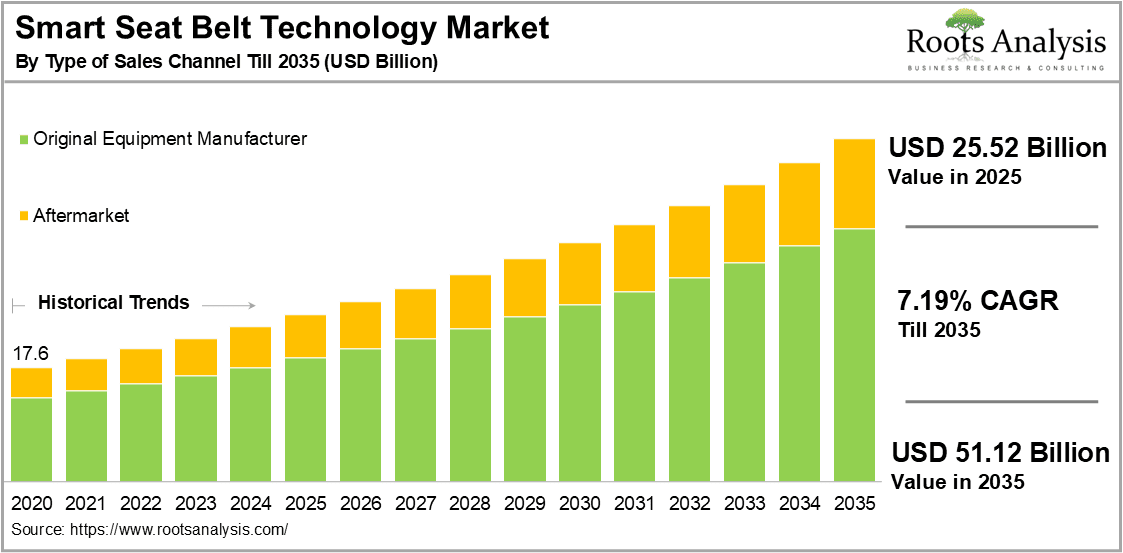
The global smart seat belt technology market, valued at USD 23.7 billion in 2024, is projected to reach USD 25.52 billion in 2025 and USD 51.12 billion by 2035, representing a CAGR of 7.19% during the forecast period.
 |
The new research study consists of global smart seat belt technology analysis, detailed smart seat belt technology market analysis, mega trends, patent analysis, porter five forces, SWOT analysis, value chain analysis and other strategic frameworks.
Smart seat belts are seat belts equipped with modern technologies that work towards improving the safety features of an automobile. Smart seat belts with automatic tightening features are being introduced which tighten themselves before an accident, reducing the chance of damage. For instance, ZF Friedrichshafen has created active control retractor (ACR) technology which actively informs the driver with vibrations in the seat belt if the car drifts out of its lane or approaches another car too closely.
The rapid growth of smart seatbelt technology can be driven from the expansion of the luxury vehicle market. Generally, luxury vehicles have evolved over time to incorporate sophisticated safety features and the use of advanced technologies that enhance driving experience while ensuring passenger safety precautions. To explain it further, luxury car makers are increasingly integrating smart seat belt systems as part of their latest safety applications put in their cars which can detect threats using sensors and respond to them via connectivity.
Furthermore, the demand for intelligent seat belt technology is driven by developments in the auto industry, particularly the increasing focus on vehicle safety and advanced driver assistance systems (ADAS). As automakers continue to implement more stringent safety regulations in their bid to improve vehicles’ safety features, there has been a growing demand for smart seat belts. These seat belts offer safety advantages such as pre-tensioning during crash, occupant classification for optimizing airbag deployment, and reminding users about belting themselves up. According to Joe Thell, SVP at E-Smart, when they saw the statistics from the National Highway Traffic Safety Administration that 69.3% of the drivers who died in crashes in 2022 were not wearing seat belts, they were heartbroken but they knew that their technology (of smart seat belts) could make a difference and help solve this problem.
Smart Seat Belt Technology Market Share Insights
The smart seat belt technology market report presents an in-depth analysis of the various companies that are involved in offering smart seat belt technology services, across different segments, as defined in the table below:
Smart Seat Belt Technology Market: Report Attributes / Market Segmentations
| Key Report Attributes | Details | |
| Historical Trend | Since 2018 | |
| Forecast Period | Till 2035 | |
| Current Market Size | $ 25.52 Billion | |
| Market Size 2035 | $ 51.12 Billion | |
| CAGR till 2035 | 7.19% | |
| Type of Smart Seat Belt |
|
|
| Type of Sales Channel |
|
|
| Type of Technology |
|
|
| Type of Propulsion |
|
|
| By End-Users |
|
|
| Type of Enterprise |
|
|
| Geographical Regions |
|
|
| Leading Market Players |
|
|
| PowerPoint Presentation (Complimentary) |
Available | |
| Customization Scope | 15% Free Customization | |
| Excel Data Packs (Complimentary) |
|
|
Smart Seat Belt Technology Market Segmentation
Market Share by Type of Smart Seat Belt
The global smart seat belt technology market is segmented into various types of smart seat belts such as active buckle lifter, active seat belt, attention retention system (ARS), and intelligent ignition system. According to our global smart seat belt systems market size analysis, the active seat belt market will augment the segment's growth with the largest market share of over 64.56% by the next decade. This market growth is largely due to the smart restraint systems of active seat belts which go beyond traditional passive restraints. The features include real time adjustment of tension and positions of the seat belts on the basis of data & vehicle conditions. Another prominent reason for the market growth of this segment is the growing sensitivity to road safety and modern car safety measures.
Market Share by Type of Sales Channel
The market is segmented into various types of sales channels such as aftermarket, and original equipment manufacturers (OEM). According to our smart seat belt technology growth forecast, the original equipment manufacturer segment will augment the segment's growth with the largest market share of over 75.6% by the next decade. The growth is attributed to the integration of advanced safety features into new vehicle models as well as to meet regulatory requirements and consumer demand for enhanced safety and convenience features.
Furthermore, the aftermarket segment is expected to witness a growth of CAGR of 10.83% during the forecast period. This growth is fueled by the retrofitting of older vehicles with smart seat belt systems and intelligent ignition systems to improve safety and security.
Market Share by Type of Technology
The market is segmented into various types of technology, such as actuator-based technology, sensor-based technology, and smart fabric technology. According to our analysis, the sensor-based technology segment will increase the market share of smart seat belt technology by 54.6% during the forecast period. This dominance is attributed to the ability of sensor-based seat belts to enhance safety mechanisms through real-time monitoring and feedback, which is critical for accident prevention.
Furthermore, the actuator-based technology is expected to witness the fastest CAGR of around 9.21% during the forecast period. This growth is driven by the significant role of this technology in providing adjustable tensioning and loosening of seatbelts in response to various driving conditions, enhancing comfort and protection for occupants.
Market Share by Type of Propulsion
The market is segmented into various types of propulsions, such as alternate fuel vehicles, electric & hybrid, and internal combustion engines. According to our analysis, the internal combustion engines (ICE) segment will increase the market share of smart seat belt technology by 64.65% during the forecasted period. This growth is driven by their dominant market presence and continued demand for conventional gasoline and diesel-powered vehicles.
On the other hand, it is worth highlighting that the electric and hybrid vehicle segment is expected to witness the fastest CAGR of around 11.59% during the forecast period. This growth is being fueled by government incentives, environmental regulations, and consumer preferences for cleaner, more fuel-efficient transportation solutions.
Market Share by End-Users
The market is segmented into various end-users, such as heavy commercial vehicles, light commercial vehicles and passenger vehicles. According to our analysis, the passenger vehicles segment will increase the market share of smart seat belt technology by 54.63% during the forecasted period. This growth is driven by the widespread adoption of advanced safety features in passenger cars and SUVs to enhance occupant protection and achieve higher safety ratings.
Furthermore, the light commercial vehicles segment is expected to witness the fastest CAGR of around 9.24% during the forecast period. This growth is driven by the increasing regulatory mandates, fleet safety requirements, and commercial vehicle operators’ focus on driver safety and accident prevention.
Market Share by Type of Enterprise
The market is fragmented into two types of enterprises, namely large and small and medium enterprises. Currently, the large enterprise segment is expected to dominate the segment with 72.34% of the market share. However, small and medium enterprise segments are expected to witness a relatively higher (8.19%) growth rate until 2035. This is ascribable to their agility, innovation, focus on niche markets, and ability to adapt to changing customer preferences and market conditions.
Market Share by Geographical Regions
This segment highlights the distribution of smart seat belt technology market share by regions, such as North America, Europe, Asia, Latin America, Middle East and North Africa, and the rest of the world. According to our regional analysis, Asia currently exhibits dominance with 37.69% of overall market share. The market is driven by the manufacturers’ need to meet stringent safety regulations and consumer demands for advanced safety features. For this, they are increasingly integrating smart seat belt technologies into their vehicles across the region.
Smart Seat Belt Technology Market Key Insights
The “Smart Seat Belt Technology Market, Till-2035: Industry Trends and Global Forecasts” report features an extensive study of the current market landscape, market size and future opportunity within the smart seat belt technology market forecast period. The market report highlights the efforts of several stakeholders involved in this rapidly emerging segment of the service providers industry. Key takeaways of the global smart seat belt technology market report are briefly discussed below.
Smart Seat Belt Technology Market Drivers
The global smart seat belt technology market growth is expected to be driven by several key factors including advancements in active safety systems, the increasing stringency of safety regulations, and the rising demand for intelligent systems that enhance vehicle occupant safety and overall road safety. Active seat belts, equipped with automotive safety sensors and actuators, automatically adjust tension and positioning to secure passengers during sudden maneuvers or accidents, reducing the risk of injury.
Attention retention systems (ARS) further contribute to market growth by monitoring driver behavior and alertness levels to prevent accidents caused by driver fatigue or distraction. Heightened road safety concerns and the expansion of the luxury vehicle market also contribute to the growth of smart seat belt technology. These factors collectively drive the integration of advanced safety features in vehicles, contributing to a safer driving experience for passengers and drivers worldwide.
Competitive Landscape of Smart Seat Belt Technology Market
According to the smart seat belt technology competitive landscape analysis, with the presence of several small and large companies, the market is experiencing intense competition and changing market dynamics. From large multinational companies to local players, companies are striving to enhance their competitive edge. In terms of market share, large enterprises and multinational companies are dominating the market. The key players are using strategies such as partnerships, acquisitions, ventures, innovations, novel product launches, R&D and geographical expansions to solidify their position in the industry.
Smart Seat Belt Technology Market Challenges
Despite the strong market growth projection, there are several challenges in the smart seat belt technology market, including high initial costs, complex integration processes, and concerns regarding data privacy and security. The high cost of smart seat belts, stemming from expensive sensors and electronic components, increases vehicle prices, potentially deterring cost-sensitive consumers. Retrofitting older vehicles with this technology poses integration challenges due to compatibility issues with existing wiring configurations and vehicle architectures.
Additionally, consumers worry about the collection and potential misuse of personal data gathered by these systems, raising apprehensions about surveillance and unauthorized access. Addressing these challenges through cost reduction, simplified integration processes, and robust data protection measures is crucial for the widespread adoption of smart seat belt technology.
Regional Analysis: Asia is Expected to Dominate the Market with the Largest Smart Seat Belt Technology Market Share
With respect to regional analysis of smart seat belt technology, Asia is likely to dominate the market for the forecast period. The region being the key hub for the automotive safety market as well as manufacturing is a significant reason for a larger market for smart belt technologies. These systems and technologies utilize sensors and algorithms to detect various parameters such as occupant position, movement, and vital signs, enhancing overall safety throughout the regions.
Leading Players in Smart Seat Belt Technology Market
Examples of leading smart seat belt technology manufacturers (which have also been captured in this market report, arranged in alphabetical order) include Aisin Seiki, Ashimori, Autoliv, Bosch, Continental, DENSO, Far Europe, FinDreams, GRUPO ANTOLIN, GWR Safety Systems, Honeywell, HYUNDAI MOBIS, ITW Automotive Products, ITW Safety, Joyson Safety Systems, Key Safety Systems, Mitsubishi Electric, Seatbelt Solutions, Takata, TOKAIRIKA, TRW Automotive, Webasto, Yanfeng, and ZF Friedrichshafen.
Recent Developments in Smart Seat Belt Technology Market
- In June 2024, E-Smart announced its active seat belt safety system which detects if the driver is not wearing the seat belt and limits the vehicle to a predetermined speed.
Smart Seat Belt Technology Market Report Coverage
The market report presents an in-depth analysis, highlighting the capabilities of various companies engaged in this domain, across different segments. Amongst other elements, the market report includes:
- A preface providing an introduction to the full report, smart seat belt technology market, 2020-2024 (Historical Trends) and 2025-2035 (Forecasted Estimates).
- An outline of the systematic research methodology adopted to conduct the study on the smart seat belt technology market, providing insights on the various assumptions, methodologies, and quality control measures employed to ensure the accuracy and reliability of our findings.
- An overview of economic factors that impact the overall smart seat belt technology market, including historical trends, currency fluctuation, foreign exchange impact, recession, and inflation measurement.
- An executive summary of the insights captured during our research. It offers a high-level view of the current state of the smart seat belt technology market and its likely evolution in the mid-long term.
- A detailed assessment of the smart seat belt technology market landscape, based on several relevant parameters, including year of experience, company size, location of headquarters, and ownership structure.
- Elaborate profiles of prominent players engaged in the smart seat belt technology market, featuring information on their year of establishment, location of headquarters, company size, company mission, company footprint, management team, contact details, financial information, operating business segments, smart seat belt technology market portfolio, moat analysis, recent developments, and an informed future of smart seat belt technology.
- A qualitative assessment of the various megatrends ongoing in the smart seat belt technology market, including integration with autonomous vehicles, stringent safety regulations, and advanced driver assistance systems (ADAS).
- An analysis highlighting the key unmet needs across smart seat belt technology market industry, featuring market research on smart seat belt industry insights generated from real-time data on unmet needs as identified from social media posts, recent publications, industry blogs and the views of key opinion leaders expressed on online platforms.
- An in-depth analysis of various patents that have been filed / granted related to smart seat belt technology market and its components, based on various parameters, such as type of patent, patent publication year, patent age and leading players
- A detailed analysis of recent developments in the smart seat belt technology market domain, based on relevant parameters such as year of initiative, type of initiative (partnerships and collaborations, expansions, funding and product launches), geographical distribution and most active players (in terms of number of recent developments).
- Key winning strategies framework that helps in analyzing the level of competition within an industry, by tracing the key market activities including partnership, funding, expansion of leading players
- A qualitative analysis, highlighting the five competitive forces prevalent in smart seat belt technology market industry, including threats for new entrants, bargaining power of suppliers, bargaining power of customers, threats of substitution and rivalry among existing competitors.
- A discussion on affiliated global smart seat belt market trends, key drivers and challenges, under a SWOT framework, which are likely to impact the industry’s evolution, along with a Harvey ball analysis, highlighting the relative effect of each SWOT parameter on the overall smart seat belt technology market.
- A value chain analysis featuring a discussion on various stakeholders involved in the development of the smart seat belt technology market, from suppliers to end-users.
- A detailed estimate of the current market size and the potential growth future of smart seat belt technology market initiatives over the next decade. Based on multiple parameters we have provided an informed estimate on the market evolution during the forecast period 2025-2035. The report also features the likely distribution of the current and forecasted opportunity within the smart seat belt technology market. Further, in order to account for future uncertainties and to add robustness to our model, we have provided three forecast scenarios, namely conservative, base, and optimistic scenarios, representing different tracks of the industry’s growth.
- Detailed projections of the current and future market across various types of smart seat belt such as active buckle lifter, active seat belt, attention retention system (ARS), and intelligent ignition system.
- Detailed projections of the current and future market across various types of sales channels such as aftermarket, and original equipment manufacturer.
- Detailed projections of the current and future market across various types of technology such as actuator-based technology, sensor-based technology, and smart fabric technology.
- Detailed projections of the current and future market across various types of propulsion such as alternate fuel vehicles, electric & hybrid, and internal combustion engines.
- Detailed projections of the current and future market across various end-users such as heavy commercial vehicles, light commercial vehicles and passenger vehicles.
- Detailed projections of the current and future smart seat belt technology market across various geographical regions, such as North America (US, Canada, Mexico and other North American countries), Europe (Austria, Belgium, Denmark, France, Germany, Ireland, Italy, Netherlands, Norway, Russia, Spain, Sweden, Switzerland, UK and other European countries), Asia (China, India, Japan, Singapore, South Korea and other Asian countries), Middle East and North Africa (Egypt, Iran, Iraq, Israel, Kuwait, Saudi Arabia, UAE and other MENA countries), Latin America (Brazil, Chile, Colombia, Venezuela and other Latin American countries) and rest of the world (Australia, New Zealand and other countries).
Author: Ronit Sharma and Anmol Bali
Customization Opportunities
At Roots Analysis, we genuinely care about your success and understand that your business requirements are unique. While our smart seat belt technology market research reports provide valuable insights, we recognize that they might not cover every aspect you need to make well-informed strategic decisions. To account for that, we offer 15% free report customization tailored to your specific needs. Whether you require additional quantitative analysis, qualitative insights, or any other information related to the smart seat belt technology market, reach out us today at: support@rootsanalysis.com