Smart Socks Market
Smart Socks Market Till 2035: Distribution by Type of Category (Children, Men, and Women), by Type of Distribution Channel (Offline and Online), by Type of Material (Cotton, Nylon, Polyester and Wool), by Type of Style (Ankle-length, Knee-high, and Low-cut), by End-Users (Casual, Healthcare, and Sports), by Type of Enterprise (Large Enterprises, Small and Medium Enterprises (SMEs)), and Key Geographical Regions (North America, Europe, Asia, Latin America, and Middle East and North Africa and Rest of the World) Industry Trends and Global Forecasts.
-
Lowest Price Guaranteed
-
Slides
214 -
Last Updated
October 2026 -
View Count
12273 -
Smart Socks Market Overview
The global smart socks market, valued at USD 57.3 billion in 2024, is projected to reach USD 62.77 billion in 2025 and USD 144.69 billion by 2035, representing a global smart socks market CAGR of 8.7% during the forecast period.
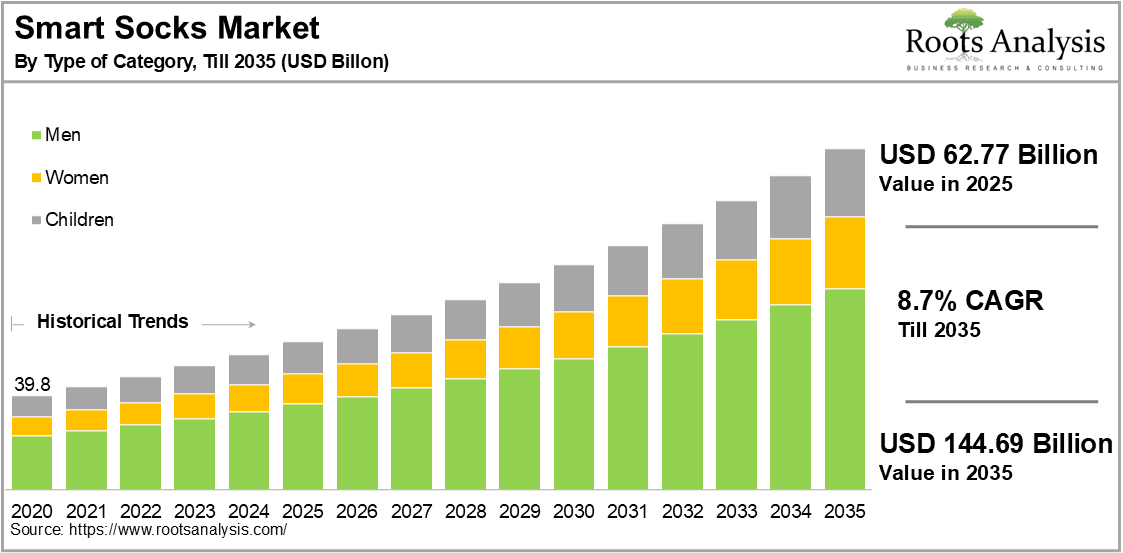
The new research study consists of smart socks industry analysis, detailed smart socks market analysis, mega trends, patent analysis, porter five forces, SWOT analysis, value chain analysis and other strategic frameworks.
Smart socks are the latest edition in the wearables technology industry. These socks are incorporated with sensors and connectivity features to monitor various health metrics and provide feedback to the wearer. They look like ordinary socks and are designed to track movement, heart rate, and sweat levels. In addition to this, these socks also help in assisting healthcare professionals to monitor factors, including weight borne by a fractured limb, swelling during weight bearing, and increased warmth during exercise. These socks are machine washable and do not require charging.
The increasing focus on personal health and wellness is primarily driving the smart socks market demand. The socks actively track vital signs, activity levels, and overall foot health. The rise in fitness consciousness, combined with an emphasis on preventive healthcare, is leading to a surge in demand for technologies that provide actionable insights into personal health. Furthermore, the rise of telemedicine and remote patient monitoring socks is also fueling the growth of the smart socks market. The increasing use of telehealth services has created a demand for devices that provide consistent and remote monitoring of health metrics.
Another key innovation in the smart socks market is their ability to connect and integrate with other devices and platforms. Many smart socks can easily sync with smartphones, smartwatches, and health monitoring systems, enabling users to track health metrics across multiple devices. This seamless connectivity improves the user experience and facilitates more comprehensive foot health monitoring by combining data from smart socks with information from other wearables and apps.
Smart Socks Market Share Insights
The smart socks market report presents an in-depth analysis of the various companies that are involved in offering such solutions, across different segments, as defined in the table below:
Smart Socks Market: Report Attributes / Market Segmentations
| Key Report Attributes | Details | |
| Historical Trend | Since 2020-2024 | |
| Forecast Period | 2025-2035 | |
| Current Market Size Value | $ 62.77 Billion | |
| Market Size 2035 | $ 144.69 Billion | |
| CAGR (Till 2035) | 8.7% | |
| Type of Category |
|
|
| Type of Distribution Channel |
|
|
| Type of Material |
|
|
| Type of Style |
|
|
| By End-Users |
|
|
| Type of Enterprises |
|
|
| Geographical Regions |
|
|
| Leading Market Players |
|
|
| PowerPoint Presentation (Complimentary) |
Available | |
| Customization Scope | 15% Free Customization | |
| Excel Data Packs (Complimentary) |
|
|
Smart Socks Market Segmentation
Market Share by Type of Category
The smart socks market segmentation by type of categories, includes children, men and women. Among these categories, the men segment growth is expected to dominate the market with a share of 45.8%. This growth is attributed to their increasing awareness of chronic health conditions, particularly those related to foot health, such as diabetes and neuropathy. As men become more proactive in managing their health, smart socks are gaining traction by offering a convenient and non-invasive way to monitor health and provide early warnings. This is allowing men to take preventive measures and reduces the risk of severe health issues.
On the other hand, women segment is expected to witness rapid growth at a significant CAGR of 9.23% during the forecasted period. The growth of this segment is attributed to the increasing awareness of foot health, particularly among the women who spend long hours standing or wear high-heeled shoes. Prolonged standing or wearing uncomfortable footwear leads to foot pain, poor circulation and other health issues. Smart socks monitoring foot pressure and temperature help women in identifying addressing these problems. Focus on foot health paired with the ease of wearable technology is driving the traction of this market.
Market Share by Type of Distribution Channel
The global smart socks market is segmented into various types of distribution channels, such as offline and online. According to our smart socks industry analysis, the online segment will augment the market growth with a share of over 74.56% by the next decade. This dominance is largely due to the rapid expansion of e-commerce infrastructure which makes it easier to reach companies as well as a global audience. With the proliferation of online marketplaces, direct to consumer websites, and improved logistics, smart sock manufacturers have the ability to offer their products to customers across different regions without the limitations of physical retail. Easy access to these products through online stores in areas where they are not widely available in stores, is also driving the market growth.
On the other hand, it is worth highlighting that the offline segment is expected to witness the fastest CAGR of around 9.72% during the forecasted period. The offline segment growth is driven by the strategic placement of smart socks in specialty stores, such as athletic apparel shops, health and wellness stores and medical supply outlets. The presence of smart socks in these stores allows for targeted marketing as well as the opportunity to educate potential customers.
Market Share by Type of Material
The market is segmented into various types of materials such as cotton, nylon, polyester and wool. According to our smart socks market size forecast, the polyester segment will augment the segment's growth with the largest market share of over 57.6% by the next decade. This dominance can be attributed to its durability, moisture-wicking properties, and cost-effectiveness. Polyester is widely used in wearable technology because it blends well with electronic components, offers flexibility, and is easy to maintain. Its ability to integrate seamlessly with sensors and conductive threads makes it a preferred choice for smart sock manufacturers, ensuring comfort and functionality for users.
Furthermore, the nylon segment is expected to witness a growth of CAGR of 9.84% during the forecasted period. The lightweight, stretchable and breathable nature of nylon makes it a suitable material for smart socks which requires a comfortable and snug fit for long wearable hours.
Market Share by Type of Style
The market is segmented into various types of styles, such as ankle-length, knee-high, and low-cut. According to our smart socks market forecast analysis, the ankle-length segment is expected to dominate by a market share of 65.8% during the forecasted period. This segment is favored due to its versatility, comfort, and widespread popularity across various end-user applications, including casual, sports, and healthcare. The growth of ankle-length smart socks is also being fueled by their everyday use preference as well as their compatibility with smart technologies like sensors and conductive threads.
Furthermore, the knee-high segment is expected to witness the fastest CAGR of around 9.63% during the forecasted period. Knee-high smart socks are gaining traction, particularly in the healthcare and sports sectors, due to their enhanced functionality. In healthcare, they are used for better compression therapy and improved monitoring of blood circulation, especially for patients with diabetes or venous disorders. In sports, knee-high socks provide additional support and muscle stabilization, which is beneficial for athletes. The growing demand for specialized and performance-oriented smart socks is driving the rapid growth of this segment.
Market Share by End-Users
The market is segmented into various end-users, such as casual, healthcare and sports. According to our global smart socks analysis, the sports segment will augment the market's growth with a market share of 69.62% during the forecast period. As athletes increasingly rely on digital tools to monitor their performance, track progress, and set goals, the traction for smart wearables market is increasing rapidly. Smart socks can be seamlessly connected with smartphones, smartwatches, and fitness apps, offering a holistic approach to data collection and analysis which further allows the athletes to view comprehensive data on their performance, including metrics from other devices, all in one place.
Furthermore, the smart socks healthcare applications report segment is expected to witness the fastest CAGR of around 10.83% during the forecasted period. This rapid growth of smart socks in the healthcare segment is attributed by the rising prevalence of chronic diseases such as diabetes and peripheral artery disease (PAD). Smart socks are increasingly being used to manage these conditions by providing continuous data on foot health and circulation. Furthermore, smart socks are also proving to be a transforming turn in the care of people suffering from dementia as these socks help in tracking distress.
In reference to this, Dr. Zeke Steer, the inventor of SmartSock stated that foot is actually a great place to collect data about stress and socks being a familiar piece of clothing are easily incorporated in the daily routine of people. Research has shown that socks can accurately recognize signs of stress which could really help not just those with dementia, but their carers as well.
Market Share by Type of Enterprises
The market is fragmented into multiple types of enterprises, namely large and small and medium enterprises. Currently, the large enterprise segment is expected to dominate the segment with 73.34% of the market share. However, small and medium enterprise segments are expected to witness a relatively higher (9.23%) growth rate until 2035. This is ascribable to their agility, innovation, focus on niche markets, and ability to adapt to changing customer preferences and market conditions.
Market Share by Geographical Regions
This segment highlights the distribution of smart socks market share by regions, such as North America, Europe, Asia, Latin America, Middle East and North Africa, and the rest of the world. According to our regional analysis, North America currently exhibits dominance with 37.69% of overall market share. Smart socks North America market trends include the robust healthcare infrastructure in North America which facilitates the adoption of smart socks in medical and clinical settings. Hospitals, clinics, and rehabilitations centers are increasingly incorporating wearable health technology into patient care to improve outcomes and enhance monitoring of chronic conditions. In these settings, smart socks are being actively incorporated to provide real-time patient health data, aiding in the diagnosis, treatment and recovery processes.
Smart Socks Market Key Insights
The “Smart Socks Market, Till-2035: Industry Trends and Global Forecasts” report features an extensive study of the current market landscape, market size and future opportunity within the smart socks market forecast period. The market report highlights the efforts of several stakeholders involved in this rapidly emerging segment of the service providers industry. Key takeaways of the smart socks market PDF report are briefly discussed below.
Smart Socks Market Drivers
The smart socks market is driven by several key factors that contribute to its rapid growth and popularity. An increasing awareness of health and fitness is encouraging the adoption of wearable technology like smart socks. These socks provide real-time data on metrics such as steps taken, distance traveled, and foot health, empowering users to make informed decisions about their physical activity and overall well-being.
The rising prevalence of chronic health conditions, including diabetes, cardiovascular issues, and mobility impairments, also drives market growth, as smart socks can detect early signs of foot ulcers and other complications. Continuous advancements in smart sock technology, particularly innovations in materials and the integration of smart sensors and connectivity features, further support market development by enhancing comfort, durability, and ease of use. The increasing popularity of e-commerce expands product visibility and allows brands to reach a wider audience, including health-conscious consumers.
Smart Socks Market Competitive Landscape
With the presence of several small and large companies, the market is experiencing intense competition and changing market dynamics. From large multinational companies to local players, companies are striving to enhance their competitive edge. In terms of market share, large enterprises and multinational companies are dominating the market. According to smart socks market key players analysis the key players are using strategies such as partnerships, acquisitions, ventures, innovations, novel product launches, R&D and geographical expansions in an attempt to solidify their position in the industry. Additionally, the increasing emphasis on sustainability is driving companies to invest in smart socks further intensifying the competitive landscape.
Smart Socks Market Challenges
Despite the strong market growth projection, there are several challenges in the smart socks industry affecting its growth trajectory. Regulatory hurdles and competition with established brands in the broader socks market can impede the entry of new smart sock brands. Additionally, smart socks can be difficult to install. While not explicitly stated, factors such as data security and privacy concerns regarding the personal health information collected by these devices, and the higher price point compared to regular socks could also pose challenges to market growth.
Regional Analysis: North America is Expected to Dominate the Market with the Largest Smart Socks Market Share
With respect to the smart socks market regional insights, North America is likely to dominate the market for the forecast period. The dominance of this region is majorly influenced by the increasing disposable income and heightened awareness of personal health and wellness in the region. Innovative ways to monitor and improve physical well-being is also making smart socks an appealing choice as consumers become more health conscious.
Leading Smart Socks Market Players
Examples of leading smart socks suppliers (which have also been captured in this market report, arranged in alphabetical order) include Adidas, ASICS, Balega, Bionox, Blacksocks, Bombas, Champion, Danu Sports, Drymax, Gildan Activewear, Gold Toe-Moretz, Hanesbrands, Icebreaker Holdings, iHood, Jockey, Lululemon Athletica, Milbotix, Nike, Owlet Care, Puma, QUANTA VICI, Renfro, Sidas, Simcos, Siren Care, Smartwool, Stance, The North Face, Thorlo, Under Armour, and Vulpés.
Recent Developments in Smart Socks Market
- In January 2025, Siren bagged a funding of $9.5M to advance the development and adoption of its innovative diabetic foot ulcers prevention solutions.
- In June 2024, Owlet expanded its global footprint with the launch of medically certified Dream Sock, a smart baby monitor with live health readings and notifications for healthy infants between 0-18 months and 2.5-13.6 kg, in the UK and across Europe.
Smart Socks Market Report Coverage
The market report presents an in-depth analysis, highlighting the capabilities of various companies engaged in this domain, across different segments. Amongst other elements, the market report includes:
- A preface providing an introduction to the full report, smart socks market, 2020-2024 (Historical Trends) and 2025-2035 (Forecasted Estimates).
- An outline of the systematic research methodology adopted to conduct the study on the smart socks market, providing insights on the various assumptions, methodologies, and quality control measures employed to ensure the accuracy and reliability of our findings.
- An overview of economic factors that impact the overall smart socks market, including historical trends, currency fluctuation, foreign exchange impact, recession, and inflation measurement.
- An executive summary of the insights captured during our research. It offers a high-level view of the current state of the smart socks market and its likely evolution in the mid-long term.
- A detailed assessment of the smart socks market landscape, based on several relevant parameters, including year of experience, company size, location of headquarters, and ownership structure.
- Elaborate profiles of prominent players engaged in the smart socks market, featuring information on their year of establishment, location of headquarters, company size, company mission, company footprint, management team, contact details, financial information, operating business segments, smart socks market portfolio, moat analysis, smart socks market latest developments, and an informed future of smart socks.
- A qualitative assessment of the various megatrends ongoing in the smart socks market, including e-commerce growth, health awareness, and technological advancements.
- An analysis highlighting the key unmet needs across smart socks market industry, featuring smart socks market research insights generated from real-time data on unmet needs as identified from social media posts, recent publications, industry blogs and the views of key opinion leaders expressed on online platforms.
- An in-depth analysis of various patents that have been filed / granted related to smart socks market and its components, based on various parameters, such as type of patent, patent publication year, patent age and leading players
- A detailed analysis of recent developments in the smart socks market domain, based on relevant parameters such as year of initiative, type of initiative (partnerships and collaborations, expansions, funding and product launches), geographical distribution and most active players (in terms of number of recent developments).
- Key winning strategies framework that helps in analyzing the level of competition within an industry, by tracing the key market activities including partnership, funding, expansion of leading players
- A qualitative analysis, highlighting the five competitive forces prevalent in the smart socks market industry, including threats for new entrants, bargaining power of suppliers, bargaining power of customers, threats of substitution and rivalry among existing competitors.
- A discussion on affiliated global smart socks industry growth trends, key drivers and challenges, under a SWOT framework, which are likely to impact the industry’s evolution, along with a Harvey ball analysis, highlighting the relative effect of each SWOT parameter on the overall smart socks market.
- A value chain analysis featuring a discussion on various stakeholders involved in the development of the smart socks market, from suppliers to end-users.
- A detailed estimate of the current market size and the potential growth future of smart socks market initiatives over the next decade. Based on multiple parameters we have provided an informed estimate on the market evolution during the forecast period 2025-2035. The report also features the likely distribution of the current and forecasted opportunity within the smart socks market. Further, in order to account for future uncertainties and to add robustness to our model, we have provided three forecast scenarios, namely conservative, base, and optimistic scenarios, representing different tracks of the industry’s growth.
- Detailed projections of the current and future market across various types of category, such as children, men and women.
- Detailed projections of the current and future market across various types of distribution channels such as offline and online.
- Detailed projections of the current and future market across various types of material such as cotton, nylon, polyester and wool.
- Detailed projections of the current and future market across various types of styles such as ankle-length, knee-high, and low-cut.
- Detailed projections of the current and future market across various end-users such as casual, healthcare and sports.
- Detailed projections of the current and future smart socks market across various geographical regions, such as North America (US, Canada, Mexico and other North American countries), Europe (Austria, Belgium, Denmark, France, Germany, Ireland, Italy, Netherlands, Norway, Russia, Spain, Sweden, Switzerland, UK and other European countries), Asia (China, India, Japan, Singapore, South Korea and other Asian countries), Middle East and North Africa (Egypt, Iran, Iraq, Israel, Kuwait, Saudi Arabia, UAE and other MENA countries), Latin America (Brazil, Chile, Colombia, Venezuela and other Latin American countries) and rest of the world (Australia, New Zealand and other countries).
Author: Ronit Sharma and Anmol Bali
Customization Opportunities
At Roots Analysis, we genuinely care about your success and understand that your business requirements are unique. While our smart socks market research reports provide valuable insights, we recognize that they might not cover every aspect you need to make well-informed strategic decisions. To account for that, we offer 15% free report customization tailored to your specific needs. Whether you require additional quantitative analysis, qualitative insights, or any other information related to the smart socks market, reach out us today at: support@rootsanalysis.com