


 Download Free Sample
 Buy Now
Market Size
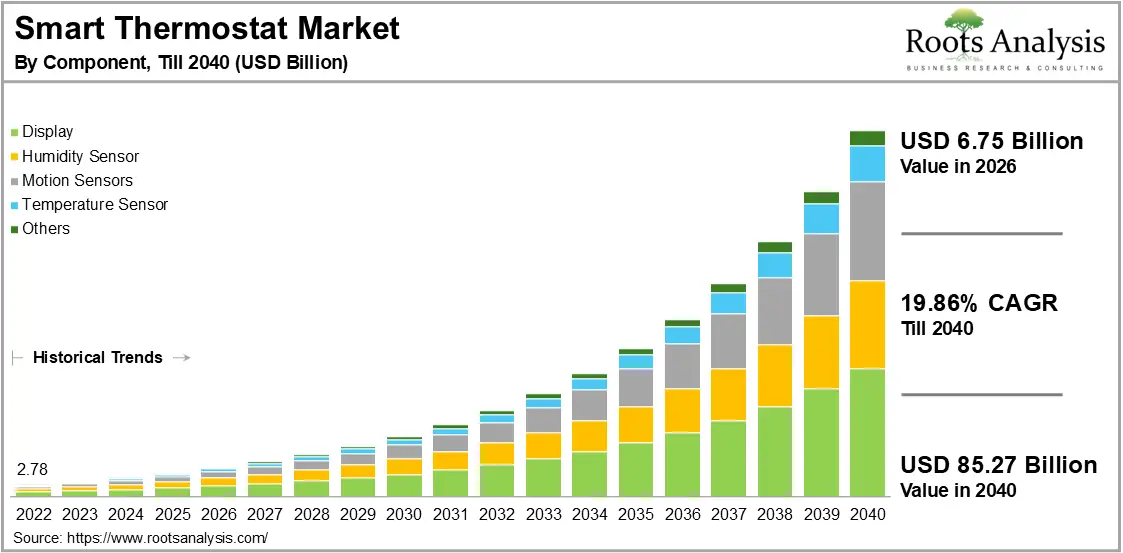
The global smart thermostat market, valued at USD 5.41 billion in 2025, is projected to reach USD 6.75 billion by 2026 and USD 85.27 billion by 2040, representing a CAGR of 19.86% during the forecast period 2026 to 2040.
See What’s in the Full Report - Request Your Complimentary Insights!
Market Report: Key Takeaways
- Wireless connectivity technology dominates the smart thermostat domain, accounting for 68.23% of the current market share. Among the different wireless connectivity technologies, Wi-Fi technology is expected to dominate the market.
- Connected thermostats dominate the current smart thermostat industry by capturing 62.56% market share, while learning thermostats to witness accelerated growth during the forecast period till 2040.
- In terms of application, HVAC control systems dominate the global smart thermostat market.
- Currently, North America dominates the industry by capturing the largest share (44.28%) within the global marketplace; further, Asian region is expected to grow at a faster CAGR through 2040.
- In terms of end use sector, residential segment dominates the current marketplace, holding more than 65% of the market share.
Market Overview
A smart thermostat represents an internet-connected device that manages climate control, heating and air conditioning in both residential and commercial spaces. These systems enable remote temperature adjustments via smartphones, providing precision control over HVAC controls and heating operations while allowing users to optimize energy consumption through advanced automation (such as temperature sensor, humidity sensors, and other advanced sensors) and scheduling capabilities.
The integration of IoT technology into HVAC control systems has fundamentally transformed how buildings manage energy consumption. IoT enabled smart thermostat with geofencing capabilities automatically adjust temperatures when residents are away and approaching home, reducing unnecessary heating or cooling cycles. Government agencies including US Environmental Protection Agency and Department of Energy recognize that heating and cooling account for nearly half of household energy expenditure, making energy efficient thermostat solutions essential for cost reduction.
Smart thermostat technology adoption is accelerating across residential and commercial sectors, driven by escalating electricity costs, environmental concerns, and seamless integration with smart home automation ecosystems. Thermostat automation features combined with remote monitoring capabilities provide transparent energy tracking and maintenance alerts. These innovations position the sector for sustained growth as consumers increasingly prioritize convenience, sustainability, and operational efficiency in building climate management.
Recent Industry Developments
-
In December 2025, Allred Heating, Cooling & Electric was named the exclusive HVAC partner for 11 Lowe’s Home Improvement stores in Western Washington, offering customers free in-home consultations, system design, installation, repairs, and Lowe’s Advantage financing options.
-
In October 2025, Warmup introduced the 7iE Smart Matter Wi-Fi Thermostat, claimed as the first Matter-enabled underfloor heating thermostat, featuring SmartGeo scheduling, multi-zone support, and integration with major smart home platforms.
-
In September 2025, Siterwell announced it would debut an upgraded smart thermostat at CEDIA Expo 2025, emphasizing support for Matter, improved energy-efficiency controls, and enhanced ecosystem compatibility for connected homes.
-
In June 2025, Hive and Samsung expanded their Works with Hive partnership so Samsung Wi-Fi heat pump owners can control heating via the Hive app, aligning smart thermostats and heat pumps with the UK’s Boiler Upgrade Scheme.
-
In May 2025, Generac launched the ecobee by Generac Smart Thermostat Enhanced with Home Energy Management, integrating with Generac home standby generators and PWRcell 2 batteries to optimize HVAC loads and reduce backup system size.
-
In May 2025, Onboard and SKBM Smart Technologies announced a strategic partnership to deliver turnkey bulk internet and smart building solutions, bundling smart thermostats, locks, access control, and monitored cameras for multifamily communities.
-
In May 2025, Copeland expanded its partnership with Canada-based Mysa Smart Thermostats into the US, combining Copeland’s HVAC expertise with Mysa’s electric heating smart thermostat platform to support efficient, grid-aware heating control.
-
In March 2025, Panasonic formed a capital and business alliance with tado, aiming to combine Panasonic heating equipment with tado’s IoT-based energy management and smart thermostat platforms for optimized European home heating solutions.
-
In January 2025, Honeywell launched its first Matter-enabled smart thermostat, Honeywell Home X2S, at CES 2025. The Honeywell Home X2S, valued at $79.99, offers broad smart home interoperability while targeting budget-conscious homeowners seeking modern connected climate control.
Pay Only for What You Need – The Best Way to Optimize
Market Share Insights
Wireless Technology Leads Smart Thermostat Connectivity
Wireless connectivity technology dominates the global smart thermostat industry, capturing 68.23% of the market share. This is primarily due to simplified installation and flexible placement options that eliminate complex wiring needs. Wi-Fi line voltage thermostat and wireless temperature controller solutions enable homeowners to control HVAC temperature control remotely through smartphone for schedules and real-time alerts. This accessibility drives widespread adoption over traditional wired systems that require professional installation.
Zigbee HVAC control and Z-wave wireless thermostat protocols further enhance dominance through low-power mesh networking and seamless smart home automation market integration. In addition, recent advancements such as the Resideo’s December 2025 launch of the Matter-certified X8S smart thermostat (one of the Honeywell thermostat apps) featuring dual-band Wi-Fi and advanced smart thermostat IoT capabilities support the market growth and drive adoption of wireless thermostats.
Wired thermostats retain niche relevance in certain commercial retrofits, while government initiatives, such as the ENERGY STAR program, further propel wireless temperature controller adoption through widespread utility rebates, recognizing Wi-Fi enabled devices for automatic energy-saving adjustments based on occupancy. These initiatives drive residential smart thermostat demand by eliminating wiring constraints and supporting expandable smart thermostat applications across homes and facilities.
Market Share by Type of Product: Connected Thermostats Dominate the Industry
According to the smart thermostat solutions market forecast, connected thermostats dominate the industry by capturing the largest market share of 62.56%. The market growth is driven by seamless smartphone integration that delivers remote controls across residential and commercial applications. Further, smart home Wi-Fi thermostat solutions like IoT sensor-enabled thermostats enable real-time adjustments and energy monitoring through dedicated apps. This universal accessibility establishes connected models as the undisputed market leader.
Learning thermostats demonstrate fast growth (higher CAGR of 21.92%) through AI-driven adaptation to user patterns and occupancy. For instance, Google’s Nest Learning Thermostat (4th gen) utilizes Gemini AI for predictive micro-adjustments based on motion detection and preferences. Similarly, ecobee’s Smart Thermostat Essential (launched in January 2025) integrates Alexa, HomeKit, and Google Assistant for automated comfort optimization that accelerates adoption.
It is worth noting that ENERGY STAR certification requires verified field data proving smart thermostat technology delivers real energy savings. Utility rebates reward connected and learning models through demand-response programs. In essence, smartphone ubiquity combined with artificial intelligence (AI) sophistication ensures connected thermostats maintain dominance while learning models rapidly expand market presence.
What Regional Dynamics Shape Smart Thermostat Growth?
North America: Leading Smart Thermostat Adoption
North America dominates the global smart thermostat market, accounting for the largest market share of 44.28%. This is driven by high HVAC penetration, early smart home automation market maturity, and strong residential smart thermostat demand. For instance, battery smart thermostat models like ecobee Premium integrate with 90% of HVAC systems while Honeywell thermostat apps also support Alexa and Google Assistant ecosystems prevalent in millions of US households.
Utilities such as SRP, United Power, and ComEd offer dedicated smart thermostat technology rebates and “bring your own thermostat” demand-response programs (that reward households for grid-responsive thermostat automation), further reinforcing the region’s leadership in these connected climate control solutions.
Asia: Fastest-Growing Smart Thermostat Region
Asia represents the fastest-growing region in the smart thermostat market, supported by rapid urbanization, expanding middle-class homeownership, and increasing investments in IoT-enabled thermostats designed to manage advanced electric heat tracing networks within smart city and residential automation projects. In India, for example, smart thermostat adoption is tied to broader energy-efficiency and smart city missions, while China’s Ministry of Housing emphasis on Wi-Fi and app-based smart thermostat applications (increasingly integrated with high-efficiency electric heat tracing systems) in apartments and new urban developments accelerates smart thermostat market growth across the region.
Want Information on Specific Region / Segment?
Key Market Insights
Competitive Landscape of Key Players in the Smart Thermostat Industry
Large multinational companies and regional manufacturers collectively shape an increasingly competitive global smart thermostat market, with players differentiating through platform integration, energy services, and grid-interactive capabilities. Established brands such as Google (Nest), Resideo Technologies (historically a part of Honeywell), ecobee (acquired by Generac Holdings), LG, Mitsubishi Electric, Schneider Electric, Siemens, Tado and Netatmo focus on expanding smart thermostat technology portfolios, while smaller smart thermostat manufacturers and local OEMs target niche segments with customized interfaces, regional language support, and tailored energy efficient thermostat solutions for specific HVAC architectures.
Strategic collaborations around demand response and virtual power plants are becoming a defining feature of the competitive landscape. In May 2024, Voltus and Resideo expanded their residential smart thermostat virtual power plant program to cover Commonwealth Edison and PSEG Long Island service territories, aggregating Honeywell Home smart thermostat applications into a demand-side resource that helps avoid outages during peak events while providing upfront and annual incentives to participating households.
Product innovation around AI, interoperability, and user experience continues to intensify competition in the global smart thermostat market, with players differentiating through next-generation platforms and ecosystem readiness. In Europe, tado has launched its new X-series smart heating platform, including Smart Thermostat X, Smart Radiator Thermostat X, Wireless Temperature Sensor X, Bridge X, and Heat Pump Optimizer X, all designed for Matter and Thread-based integration. This positions tado as a leading provider of interoperable, energy efficient thermostat solutions for heat-pump-centric European homes.
Key Market Drivers
Government Energy Efficiency Incentives
- Government subsidies lower smart thermostat acquisition barriers, making energy efficient thermostat solutions accessible to mass markets and accelerating residential adoption rates across price-sensitive consumer segments. For example, Columbia Gas of Virginia offers a $50 rebate and Columbia Gas of Pennsylvania offers up to $100 for ENERGY STAR certified smart thermostats, directly lowering upfront costs and encouraging upgrades from non smart thermostat devices.
Rising Electricity Costs and Savings Awareness
- Escalating electricity prices push households and small businesses to seek measurable savings from thermostat automation. Demonstrated bill reductions from energy efficient thermostat solutions create a clear economic justification for adopting home Wi-Fi thermostat and smart tech thermostat devices instead of sticking with legacy controls. ENERGY STAR notes that smart thermostats can deliver about 8% savings on heating and cooling costs, which they estimate at roughly $50 per year for a typical user, strengthening the economic case for thermostat automation.
Smart Home and IoT Ecosystem Expansion
- Growth in the smart home automation market makes IoT enabled thermostats central nodes within connected homes, coordinating HVAC with other devices and enabling app-based and voice control. Industry analyses of the smart home sector highlight increasing penetration of voice-assistant platforms and connected devices, which in turn boosts demand for interoperable smart thermostat applications as part of broader home energy management systems.
Market Challenges
High Installation and Retrofit Costs
- Deploying a Wi-Fi line voltage thermostat often requires more than the device itself, including professional installation and possible C-wire work. Cost guides indicate that smart thermostat installation plus required wiring can push total project costs into the low-hundreds of dollars range, which deters price-sensitive households even when long-term savings are available.
Legacy HVAC Compatibility Constraints
- Older HVAC infrastructure remains a practical barrier to thermostat automation, as many legacy furnaces and millivolt systems lack the necessary control wiring for modern connected devices. Technical guides show that a significant share of pre-2000 homes do not have a C-wire, forcing the use of add-on power kits or adapters for certain smart thermostats, which complicates installation and slows conversion from traditional HVAC controls.
Interoperability and Ecosystem Fragmentation
- Coexisting standards such as Zigbee HVAC control, Z-wave wireless thermostat, and proprietary Wi-Fi ecosystems create uncertainty for users trying to build unified smart thermostat IoT environments. Technical analyses of smart home standards highlight that, despite progress with frameworks like Matter, many existing thermostats and hubs remain incompatible across platforms, which creates integration issues, erodes user confidence, and slows broader adoption of smart thermostat technology.
Policy-Driven Smart Thermostat Expansion in Europe
Europe shows steady smart thermostat industry trends growth, anchored in stringent EU climate and building-efficiency frameworks rather than pure consumer electronics momentum. The revised Energy Efficiency Directive and Renovation Wave encourage digital, controllable heating in renovation roadmaps, positioning energy efficient thermostat solutions as key enablers of optimized heating schedules and reduced emissions in smart buildings.
In Germany, the now-closed KfW 461 program provided direct grants of up to EUR 75,000 per dwelling for comprehensive renovations to high Effizienzhaus standards, which typically included modern heating controls alongside better envelopes and efficient heat generators. Under newer KfW heating-support schemes, homeowners can receive up to 70% of eligible heating replacement costs, subject to national caps, when switching to climate-friendly systems such as heat pumps, creating a strong financial case for integrating connected thermostats with upgraded HVAC equipment.
Have Questions? Let’s Get Them Answered.
Market Segmentation
Smart Thermostat Market: Scope of the Report
| Key Report Attributes | Details | |
| Historical Trend | Since 2022 | |
| Forecast Period | Till 2040 | |
| Market Size 2026 | $ 6.75 Billion | |
| Market Size 2040 | $ 85.27 Billion | |
| CAGR (Till 2040) | 19.86% | |
| Segments Covered |
|
|
| Key Players Profiled |
|
|
| PowerPoint Presentation (Complimentary) | Available | |
| Customization Scope | 15% Free Customization | |
| Excel Data Packs (Complimentary) |
|
|
Market Segments
Based on research, we have segmented the smart thermostat market into type of product, connectivity technology, component, installation, application, end use sector, type of enterprise, geographical regions, and key players.
Market Share by Type of Product
- Connected
- Learning
- Standalone
Market Share by Connectivity Technology
- Wired
- Wireless
- Bluetooth
- Wi-Fi
- Zigbee
- Z-Wave
Market Share by Component
- Display
- Humidity Sensor
- Motion Sensor
- Temperature Sensor
- Others
Market Share by Installation
- New Installation
- Retrofit
Market Share by Application
- HVAC Control Systems
- Multi-stage Zonal Temperature Control
- Smart Grid and Demand Response Integration
- Indoor Air Quality and Comfort Monitoring
Market Share by End Use Sector
- Commercial
- Industrial
- Residential
Market Share by Type of Enterprise
- Large Enterprise
- Small and Medium Enterprise (SMEs)
Market Share by Geographical Regions
- North America
- US
- Canada
- Mexico
- Rest of North America
- Europe
- Austria
- Belgium
- Denmark
- France
- Germany
- Ireland
- Italy
- Netherlands
- Norway
- Russia
- Spain
- Sweden
- Switzerland
- UK
- Rest of Europe
- Asia
- China
- India
- Japan
- Singapore
- South Korea
- Rest of Asia
- Latin America
- Brazil
- Chile
- Colombia
- Venezuela
- Rest of Latin America
- Middle East and North Africa (MENA)
- Egypt
- Iran
- Iraq
- Israel
- Kuwait
- Saudi Arabia
- UAE
- Rest of the MENA
- Rest of the World
- Australia
- New Zealand
- Other countries


