


 Download Free Sample
 Buy Now
Market Size
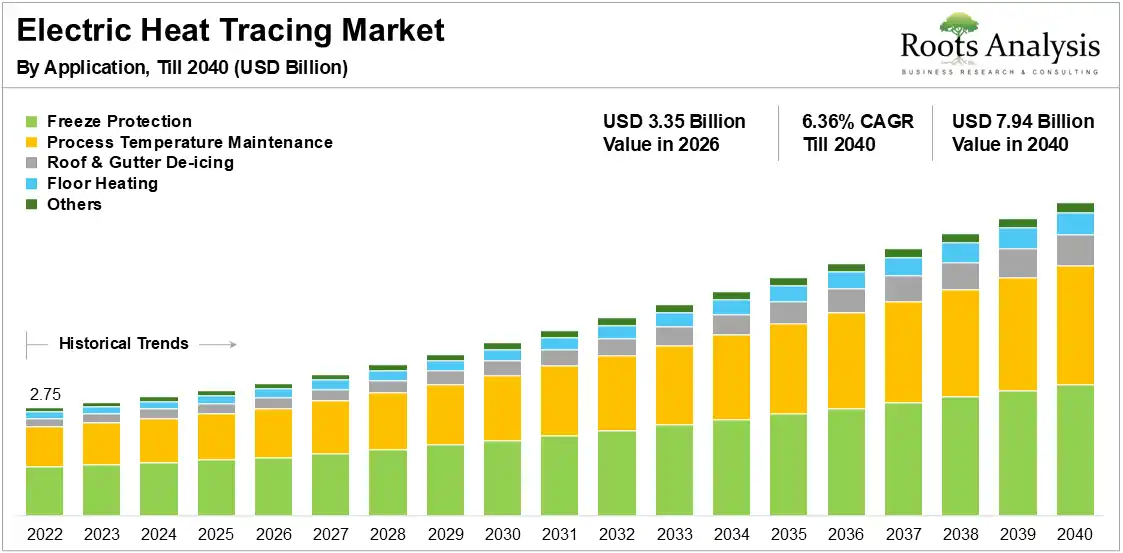
The global electric heat tracing market size is projected to grow from USD 3.35 billion in 2026 to USD 7.94 billion by 2040, representing a CAGR of 6.36% during the forecast period 2026 to 2040.
See What’s in the Full Report – Request Your Complimentary Insights!
Market Report: Key Takeaways
- In terms of product type, heating cables dominate the global industry, supported by increasing demand for robust thermal infrastructure.
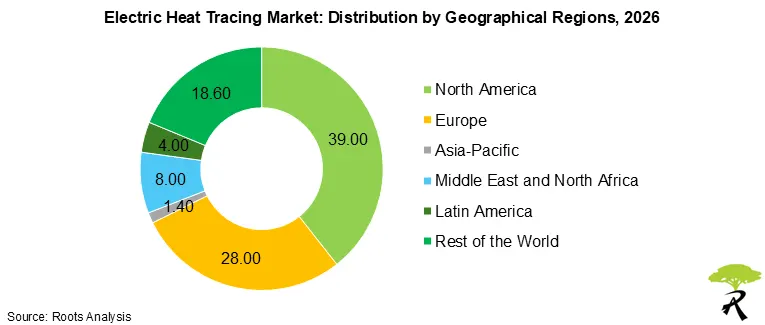
- In 2026, North America captures the largest global industry share at 39%; however, Asia-Pacific is projected to be the fastest-growing region with a 7.80% CAGR.
- Based on electric heat tracing market share by technology type, self-regulating cables dominate and lead growth due to their energy-efficient heat output adjustment and enhanced safety in hazardous, explosive industrial environments.
- Based on the applications, freeze protection dominates the industry, accounting for the largest market share, and process temperature maintenance captures the second largest share within the industry.
- Oil & gas sector dominates the 2026 market share by industry vertical, while chemicals sector is expected to grow at a higher CAGR of 7.50% through 2040.
- In 2026, direct sales channels dominate the current marketplace, based on the high requirement for customized engineering and technical field services.
- Global market adoption across industries aggressively shift from traditional steam-based systems to all-electric heat tracing paired with IoT-enabled controls, fueling long-term growth in decarbonization efforts.
Market Overview
A paradigm shift is reshaping industrial thermal management as operators actively prioritize precise flow assurance and infrastructure reliability. Current dynamics reflect a strategic transition toward advanced process heating solutions, including self-regulating and mineral-insulated cables, engineered to maintain fluid viscosities and prevent pipeline freezing. This evolution from basic temperature maintenance to automated thermal stability marks a critical maturation within the global industrial sector.
This strategic growth is propelled by the rapid expansion of petrochemical infrastructure and a mandate for operational safety. As stakeholders scale liquefied natural gas (LNG) terminals and complex transportation networks, the necessity for dependable heat tracing systems has surged exponentially. Regulatory momentum further accelerates this adoption curve, heavily driven by stringent energy efficiency mandates that require optimized thermal performance across high-stakes processing environments.
The long-term trajectory centers on the digitalization of thermal infrastructure and the integration of the industrial internet of things. Innovation is pivoting toward smart thermostats, controllers and predictive maintenance algorithms to minimize energy waste and eliminate unplanned downtime. As sustainable, data-driven operations become critical, the ongoing synergy between engineered heating materials and intelligent monitoring ensures a highly robust growth outlook.
Recent Developments in Electric Heat Tracing Market
- Chromalox showcased its upgraded 6.6 kV Medium Voltage electric heating technology at DECARBON 2026 in March 2026, facilitating large-scale industrial electrification and rapid decarbonization for heavy process heating applications.
- Kaiser Corporation approved a strategic merger with Emazing Deals in March 2026, aiming to leverage combined engineering resources to scale regional heat tracing projects.
- Chemelex successfully acquired Electric Heat Trace Group in January 2026, integrating the SmartTrace platform to deliver data-driven, predictive maintenance solutions.
- Chemelex formally launched the Raychem Elexant 3500i electronic thermostat in June 2025, providing Bluetooth connectivity and automated system checks for industrial environments.
- Brookfield and CDPQ completed the $1.3 billion acquisition of Antylia Scientific in May 2025, following Brookfield’s strategic purchase of heat tracing leader Chemelex.
Pay Only for What You Need – The Best Way to Optimize
Market Dynamics
Electric Heat Tracing Market Growth Drivers
- Accelerated Midstream Infrastructure Expansion: Global capital allocation toward extensive pipeline networks and liquefied natural gas terminals necessitates advanced process temperature maintenance. Deploying electric heat tracing ensures critical flow assurance and prevents fluid viscosity degradation, directly protecting production yields across high-value downstream chemical processing facilities.
- Stringent Hazardous Location Compliance: Regulatory bodies are enforcing strict safety protocols, including ATEX and IECEx standards, within highly flammable industrial environments. This compliance mandate accelerates the transition from legacy steam systems to certified electric thermal management, mitigating facility risk profiles and lowering maintenance complexity.
- Industrial Decarbonization and OpEx Optimization: Operators are prioritizing energy-efficient self-regulating thermal networks to meet aggressive corporate decarbonization targets. Replacing traditional steam alternatives with intelligent electric heating infrastructure significantly lowers operational expenditures and carbon emissions, delivering direct cost savings that financially justify widespread facility upgrades.
Electric Heat Tracing Market Challenges and Restraints
- High Initial Capital Expenditure (CapEx) for Complex Systems: Deploying advanced, highly engineered thermal control panels and certified self-regulating materials requires substantial upfront capital. This intensive financial barrier, coupled with the continued viability of existing steam infrastructure, frequently delays procurement timelines within cost-sensitive industrial markets and specific retrofit applications.
- Deficits in Certified Installation Expertise: Implementing sophisticated thermal management networks within hazardous locations strictly requires highly specialized, code-certified engineering labor. Systemic global shortages of these qualified technicians disrupt project deployment schedules, driving up localized installation costs and introducing substantial execution risks during complex control integrations.
- Raw Material Volatility and Commoditization: Profit margins remain highly sensitive to volatile pricing fluctuations across essential commodities, including copper, nickel, and specialized polymer compounds. Concurrently, increasing market commoditization of standard heating cables forces manufacturers into aggressive price competition, severely constraining revenue potential across basic freeze protection segments.
Electric Heat Tracing Market Share Insights
Heating Cables Dominate the Market by Type of Product While Controllers & Monitoring Systems Grow at a Higher CAGR
- Growth patterns across the electric heat tracing market highlight heating cables as the primary product segment, capturing a 52.5% share in 2026. This dominance reflects widespread industrial adoption across high-value petrochemical infrastructure, propelled by the scalable integration of self-regulating conductive polymer cores. These advanced thermoplastic matrices guarantee uninterrupted thermal stability during volatile ambient temperature fluctuations, driving high-volume OEM procurement.
- This market trend is further supported by continuous material innovation targeting harsh environments. For instance, Chemelex’s (formerly known as nVent Thermal Management) 2025 deployment of RAYCHEM HTV high-temperature polymer systems directly addresses strict chemical resistance mandates, securing enterprise procurement through absolute thermal stability under extreme exposure.
- Concurrently, controllers & monitoring systems are emerging as the fastest-growing segment, accelerating at a market-leading 7.5% CAGR through 2040. This trajectory is fundamentally propelled by industrial digitalization, where industrial internet of things (IIoT) connectivity provides the intelligent infrastructure necessary for optimized load management and real-time operational diagnostics.
- Validating this shift toward intelligent digitalization, manufacturers are scaling IoT capabilities. For example, Thermon’s 2026 expansion of its Genesis network platform directly integrates predictive maintenance algorithms, allowing facility operators to map thermal anomalies and eliminate unplanned downtime before system failure.
Want Information on Specific Region / Segment?
Market Share Analysis by Geographical Regions: North America Region Dominates the Electric Heat Tracing Industry in 2026
- North America currently leads the market with a 39% market share in 2026, driven by its mature industrial architecture and severe climatically driven freeze protection requirements. A highly structured network of EPC contractors systematically integrates electric thermal management directly into capital-intensive petrochemical, power, and oil production facility blueprints.
- This structural dominance is directly reinforced by stringent regulatory mandates targeting process safety and corporate energy efficiency. Consequently, regional operators accelerate the early adoption of intelligent, self-regulating heating cables to structurally minimize operational expenditures while consistently maintaining critical downstream fluid viscosities.
- Validating this regional shift, Chromalox aggressively expanded its North American electrification portfolio throughout 2025. By deploying advanced medium-voltage tracing systems across newly commissioned US LNG export terminals, they are institutionalizing electric process heating as a standard baseline design requisite rather than a retrofit alternative.
Asia-Pacific is Projected to be the Fastest-Growing Regional Hub Through 2040
- The Asia Pacific region emerges as the fastest-growing segment, registering a CAGR of 7.80% during the period 2026 to 2040, propelled by massive greenfield capital investments. Rapidly scaling industrial infrastructure across regional cold chain logistics, power generation, and petrochemical sectors structurally multiplies the necessary volume of heat-traced pipelines per newly commissioned project.
- This explosive infrastructural expansion coincides with tightening regional environmental and safety regulations. To guarantee absolute compliance, facility stakeholders are rapidly accelerating the deployment of digitally monitored, self-regulating thermal networks that simultaneously optimize energy consumption and deliver crucial protection against severe corrosion.
- Validating this demand for specialized infrastructure, eltherm scaled its engineering operations across Southeast Asia in early 2026. By delivering customized, high-reliability heat tracing solutions specifically engineered for the foundation plates of LNG import terminals, they directly mitigate extreme temperature fluctuations and prevent costly corrosion under insulation.
Europe Secures the Second-Largest Market Share Propelled by Aggressive Decarbonization Mandates and Smart Infrastructure
- Europe currently captures the second-largest market share (28%), fundamentally driven by aggressive industrial decarbonization mandates and a rapid regional transition away from legacy fossil-fueled steam infrastructure. Strategic capital is heavily allocated toward electrifying chemical processing plants and expanding alternative energy networks.
- This structural momentum is significantly reinforced by strict adherence to ATEX safety frameworks across the continent. To guarantee absolute compliance in hazardous locations, facility stakeholders are rapidly integrating certified self-regulating thermal systems that optimize lifecycle expenditures and eliminate complex maintenance protocols.
- Validating this transition toward sustainable infrastructure, Danfoss expanded its intelligent electric heating portfolio throughout 2025 under the LEAP 2030 strategy. By integrating advanced condition-based monitoring across European facilities, industrial operators can proactively manage critical thermal assets and dramatically reduce energy consumption.
Market Ecosystem Analysis
Electric Heat Tracing Market Competitive Landscape Analysis
The global electric heat tracing ecosystem features massive thermal management conglomerates alongside specialized, agile innovators; examples include Bartec, Chemelex, Chromalox (a subsidiary of Spirax Group), Danfoss Electric Heating Solutions (a division of Danfoss), Eltherm, Emerson, Heat Trace Limited (a subsidiary of NIBE Element Group), Mysa, SST Thermal Solutions (a division of SST Group), Thermasure, Thermon (a subsidiary of CECO Environmental), and Warmup PLC. While established giants leverage immense production scale and transformative acquisitions to dominate global industrial networks, emerging players disrupt traditional boundaries by pioneering hyper-customized components and advanced system diagnostics.
Market Consolidation and Cloud-Architected Platforms Solidify the Dominance of Enterprise Giants
Large industrial infrastructure corporations are aggressively scaling their functional portfolios and integrating advanced digital capabilities, creating formidable structural barriers to entry for competitors. By leveraging massive capital deployment and global operational footprints, these established leaders secure dominance across integrated supply chains and define the overarching benchmarks for commercial thermal reliability.
- Thermon: In a transformative structural shift, Thermon entered a strategic combination with CECO Environmental in February 2026. This massive consolidation creates a unified global industrial powerhouse, embedding Thermon’s mission-critical electric heat tracing infrastructure directly into comprehensive environmental and decarbonization supply chains to secure high-volume enterprise procurement.
- Chemelex: Solidifying its software-defined ecosystem as a standalone entity under Brookfield management, Chemelex deployed its Next Generation TraceCalc Net platform in early 2026. This cloud-architected configuration tool enables dynamic, multi-user thermal modeling by seamlessly integrating complex circuit mapping with real-time industrial line lists to guarantee optimized design efficiency for critical petrochemical networks.
Startups Disrupt Legacy Infrastructure with Custom Polymer Science and Modular Architectures
Specialized innovators and agile engineering firms are aggressively disrupting traditional thermal management boundaries. By pioneering novel structural designs and hyper-customized polymer architectures, these emerging players successfully commercialize highly specialized conformal heating techniques that legacy conglomerates are actively seeking to acquire, benchmark, or strategically integrate into broader operational systems.
- eltherm GmbH: Expanding its focus on complex industrial geometries, eltherm significantly scaled its ATEX-compliant engineered heating jacket portfolio in early 2026. This advanced modular technology directly replaces traditional, highly complex cable tracing on critical valves and cleanroom pumps, dramatically optimizing maintenance turnaround times while systematically eliminating severe environmental contamination risks.
- Heat Trace Limited: Driving advanced industrial polymer science, Heat Trace Limited accelerated the deployment of its proprietary semi-conductive polymer matrices throughout 2025. By customizing explosion-proof, self-regulating architectures specifically for highly localized midstream EPC projects, they provide agile, project-specific thermal configurations that large-scale legacy manufacturers frequently struggle to deploy efficiently.
Your Business is Unique – Why Shouldn’t Your Report Be?
Emerging Electric Heat Tracing Market Growth Opportunities
Accelerated Hydrogen and CCUS Infrastructure Deployment Presents a Hyper-Growth Frontier for Advanced Flow Assurance
The industrial process heating landscape is experiencing a paradigm shift driven by aggressive global decarbonization mandates. The accelerated rollout of the hydrogen economy and carbon capture, utilization, and storage (CCUS) networks creates unprecedented demand for mission-critical flow assurance and exact thermal stabilization across complex pipeline infrastructure.
- Transporting liquid hydrogen requires absolute thermal precision to prevent severe cryogenic degradation and maintain structural integrity across distribution networks. This strict operational necessity elevates intelligent electric heat tracing from a peripheral accessory into a foundational, high-value technology critical for scaling next-generation clean energy logistics.
- Managing supercritical carbon dioxide during rapid decompression demands hyper-precise thermal intervention to prevent catastrophic Joule-Thomson freezing and mechanical fractures. Validating this trajectory, enterprise manufacturers are aggressively dedicating 2025 and 2026 engineering capital toward specialized heating systems engineered exclusively to stabilize these highly volatile CCUS networks.
Sub-Nanometer Fab Construction Establishes a Capital-Intensive Market for Precision Chemical and Exhaust Tracing
The global acceleration of semiconductor manufacturing, heavily subsidized by major sovereign infrastructure initiatives, represents a highly lucrative frontier for advanced thermal management. The massive construction of greenfield fabrication plants demands unparalleled precision in electric heat tracing to secure complex chemical delivery networks.
- Supplying ultra-high-purity precursor gases and aggressive liquid chemicals requires exact, continuous thermal stabilization. Engineered heat tracing networks prevent volatile precursor condensation and pipeline crystallization, effectively eliminating severe particulate contamination risks and ensuring high-yield wafer production across advanced, highly sensitive sub-nanometer lithography nodes.
- Validating this high-tech pivot, enterprise leaders including Watlow and BriskHeat expanded their semiconductor-specific heating portfolios throughout 2025. Deploying customized, high-temperature tracing across critical sub-fab exhaust lines prevents hazardous by-product condensation, fundamentally protecting costly abatement systems and minimizing downtime within next-generation microchip fabrication facilities.

Electric Heat Tracing Market: Scope of the Report
| Key Report Attributes | Details | |
| Forecast Period | Till 2040 | |
| Market Size 2026 | USD 3.35 Billion | |
| Market Size 2040 | USD 7.94 Billion | |
| CAGR (Till 2040) | 6.36% | |
| Segments Covered |
|
|
| Geographical Regions Covered |
|
|
| Key Sections Covered |
|
|
Market Segmentation
The global electric heat tracing market research report presents an in-depth analysis, highlighting the capabilities of various stakeholders, based on different segments such as type of product, type of technology, application, installation, industry vertical, sales channel, geographical regions, and key players.
Market Share by Type of Product
- Controllers & Monitoring Systems
- Heating Cables
- Power Connection Kits
- Thermal Insulation Materials
- Others
Market Share by Type of Technology
- Constant Wattage
- Mineral Insulated (MI)
- Self-regulating
- Skin Effect
- Others
Market Share by Application
- Floor Heating
- Freeze Protection
- Process Temperature Maintenance
- Roof & Gutter De-icing
- Others
Market Share by Installation
- Commercial
- Industrial
- Residential
Market Share by Industry Vertical
- Chemicals
- Food & Beverage
- Oil & Gas
- Power & Energy
- Water & Wastewater Treatment
- Others
Market Share by Sales Channel
- Direct
- Indirect
Market Share by Geographical Regions
- North America
- US
- Canada
- Mexico
- Rest of North America
- Europe
- Austria
- Belgium
- Denmark
- France
- Germany
- Ireland
- Italy
- Netherlands
- Norway
- Russia
- Spain
- Sweden
- Switzerland
- UK
- Rest of Europe
- Asia-Pacific
- Australia
- China
- India
- Japan
- New-Zealand
- Singapore
- South Korea
- Rest of Asia-Pacific
- Middle East and North Africa (MENA)
- Egypt
- Iran
- Iraq
- Israel
- Kuwait
- Saudi Arabia
- UAE
- Rest of MENA
- Latin America
- Brazil
- Chile
- Colombia
- Venezuela
- Rest of Latin America
- Rest of the World


