


 Download Free Sample
 Buy Now
Market Overview
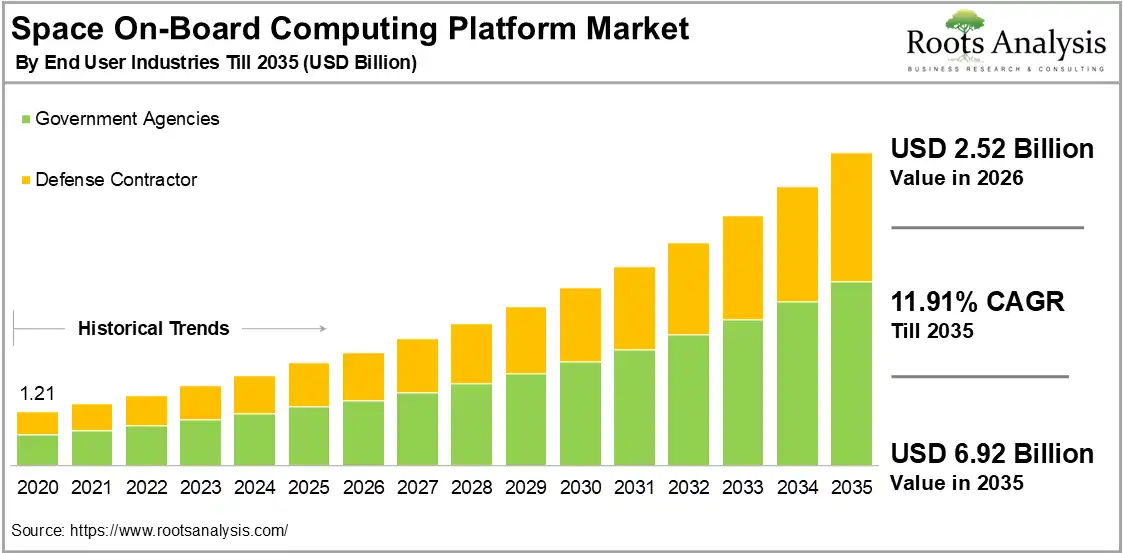
The global space on-board computing platform market, valued at USD 2.52 billion in 2026, is projected to reach USD 3.94 billion in 2030 and USD 6.92 billion by 2035, representing a CAGR of 11.91% during the forecast period.
See What’s in the Full Report – Request Your Complimentary Insights!
The space on-board computing platform represents a crucial aspect of spacecraft systems, which offers essential data processing, storage, and communication capabilities necessary for space missions. The need for reliable, efficient, and accurate computational power to manage increasingly complex payloads and operations in space environments is what necessitates the demand for such platforms.
This market is witnessing significant growth, primarily driven by advancements in hardware and software which have further significantly enhanced the capabilities of space computing systems. Miniaturization technologies are enabling the development of more compact yet powerful computing devices that can fit into small spacecraft and satellites.
Additionally, advances in material science are also contributing to the development of radiation-hardened components that can withstand the harsh conditions of space, such as extreme temperatures and cosmic radiation. These technological strides make space-on-board computing platforms more efficient and reliable, supporting a wide range of applications from Earth observation to deep-space exploration.
Space On-Board Computing Platform Market Share Insights
Which Area of Application Will Dominate the Space On-Board Computing Platform Market?
Based on global satellite computing platform market, the communication segment is set to take the lead, holding a significant share of 40.2% of the market. The dominance of this segment is largely a result of the critical role of on-board computing in satellite-based data services. The rise of mega-constellations such as Starlink and 5G integration is further fueling the demand.
However, it is worth highlighting that the earth observation segment is expected to witness the fastest growth (18.7%) during the forecasted period.
Have Questions? Let’s Get Them Answered.
How is the Large Satellite Segment Dominating Types of Platforms?
Among the types of platforms, the large satellite segment really stands out as the leading segment holding a market share of 37.77%.
The use of large satellites in high-capacity missions including GEO satellites or telecom requires robust computing for complex operations, which is accelerating the market growth of large satellite in the SOBCP market.
Furthermore, it is worth highlighting that the nano satellite segment is expected to witness the fastest CAGR (14.23%) during the forecasted period. This growth is due to their low-cost launches, scalability, and use in Earth observation and IoT.
Which Type of Communication Frequency Will have the Fastest CAGR?
Based on the global space on-board computing platform market analysis, the K-band segment is set to witness the fastest CAGR (15.72%) during the forecasted period. The high bandwidth offering of K-band for next-gen applications, including 5G, and deep-space comms, is driving the market growth. Further, its adoption in commercial and scientific missions will also drive the highest growth through 2035.
On the other hand, it is worth highlighting that the X-band segment is expected to dominate the market with a significant share of 39% during the forecasted period.
Which End-User Industry is Gaining the Most Traction in Space on-board Computing Platform Market?
Amongst the space on-board computing platform end-user industries, the government agencies are set to take the lead, holding a significant market share of over 50% of the market. This market growth is largely a result of the heavy investments agencies like NASA and ESA are making for space exploration, defense and national satellite programs.
On the other hand, the defense contractors sector is likely to witness the fastest CAGR (16.23%) during the forecast period.
Get an Instant Quote in 10 Minutes. Lowest Price Guaranteed
Which Type of Processing Capability is Gaining the Most Traction?
According to our space on-board computing platform market forecast, the high-performance computing units are set to take the lead, holding a significant market share of over 60% of the market. Additionally, this segment is also likely to witness the fastest CAGR (15%) during the forecasted period.
This market growth is largely a result of the critical role high-performance computing units play in complex tasks like AI, real-time satellite data processing, and mission control. Further, as the demand for AI, machine learning and autonomous systems in space keep on rising so does the demand for these units. Their scalability and power efficiency further fuels the growth.
Which Type of Technology Will have the Fastest CAGR?
When it comes to the global space on-board computer market, the software-based solutions segment is set to witness the fastest CAGR (13.32%) during the forecasted period. The software based solutions like AI algorithms and cloud computing are growing at the fastest rate due to their flexibility, upgradability, and integration with distributed systems.
On the other hand, it is worth highlighting that the hardware based solutions segment is expected to dominate the market with a significant share of 65% during the forecasted period.
Why is North America Leading the Space On-Board Computing Platform Market?
According to our space on-board computing platform market by region analysis, the North American market exhibits dominance by capturing 49.86% of the overall current market share. This is mainly because of the region’s substantial investments in space technology and exploration.
Furthermore, the presence of major aerospace and defense contractors, along with ongoing government support and funding for space programs, is bolstering the demand for high-performance space-on-board computing solutions.
Want Information on Specific Region / Segment?
Space On-Board Computing Platform Market Key Insights
Key Drivers for the Space On-Board Computing Platform Industry
The space on-board computing platform market is experiencing significant growth due to several key drivers.
- Rising Space Exploration Missions: Increased missions to the Moon, Mars, and other missions like NASA’s Artemis and China’s Lunar program, require advanced computing for navigation, onboard satellite data processing, autonomous operations.
- Advancements in Satellite Technology: The proliferation of small satellites (CubeSats, and Nano Satellites), and mega-constellations (Starlink, and OneWeb), are driving the demand for compact, high performance computing platforms.
- Demand for Real-time Data Processing: Applications like Earth Observation and military surveillance require on-board artificial intelligence and high-performance computing for real-time analytics, this boosting market growth.
- Expansion of Commercial Space Activities: Private companies such as SpaceX and Blue Origin are investing heavily in space ventures, increasing demand for cost-effective, scalable computing solutions.
Your Business is Unique – Why Shouldn’t Your Report Be?
Trends in Edge Computing for Satellite Constellations
- On-Orbit Data Processing: Local processing reduces bandwidth strain by handling data directly on satellites.
- Real-Time Autonomy: Enables instant decisions (collision avoidance, object detection) without ground control.
- AI/ML Integration: Filters and prioritizes data for efficient downlinking.
- Miniaturized Hardware: Compact, powerful processors fit small satellites (CubeSat onboard computer).
- Swarm Coordination: Satellites collaborate as swarms for shared tasks (sensing, assembly).
What is the Impact of Quantum Computing on Space Missions?
- Mission Planning Optimization: Quantum computers can quickly solve complex planning and trajectory problems, making space missions more efficient and cost-effective.
- Faster Data Processing: They process huge volumes of space data (from telescopes, sensors, etc.) much faster than classical computers, speeding up discoveries.
- Advanced Navigation: Quantum computing, often combined with AI, enables more precise and reliable spacecraft navigation and course corrections.
- Secure Communications: Quantum cryptography (QKD) allows for unbreakable, hack-proof communication between spacecraft and Earth.
- New Materials Discovery: Quantum simulations help design better materials for spacecraft, improving durability and performance in harsh space environments.
How AI is transforming space on-board computing platforms?
- Autonomous Decision-Making: AI enables real-time onboard decisions, reducing ground control dependency for critical mission responses.
- Real-Time Data Processing: AI processes sensor/imaging data directly on spacecraft, minimizing Earth-bound data transmission.
- Adaptive System Control: Machine learning dynamically optimizes spacecraft operations based on environmental changes.
- Edge Computing Efficiency: AI prioritizes mission-critical data to conserve bandwidth.
Unlock Deeper Insights – Schedule Your Personalized Workshop Today!
What are the Key Strategies Used by Companies to Gain Space On-Board Computing Platform Market Share?
Space on-board computing platform companies are using smart strategies to stay ahead. Big players are focusing on partnerships, acquisitions, joint ventures, and innovations to strengthen their position while also investing in R&D to bring innovative and novel products to the market. Launching new technologies and expanding into regions where industry automation is growing are key moves helping them capture more market share.
For instance, in March 2025, Rocket Lab launched next-gen software platforms, InterMission and MAX Constellation, for space missions. Designed to improve autonomy, security and scalability, these platforms aim to address challenges for complex space missions and satellite constellations. In reference to this Brad Clevenger, Vice President of Rocket Lab Space Systems stated that Intermission and MAX Constellation are strengthening Rocket Lab’s industry-leading space software suite, giving their customers the tools to optimize performance, reduce risk, and maximize mission success.
Market Challenges
What Are the Challenges in the Space On-Board Computing Platform Market?
- High Development and Testing Costs: Designing radiation-hardened hardware and software for space is expensive. The added cost of rigorous testing required to ensure reliability further increases the expense, limiting market entry for smaller players.
- Harsh Space Environment: Radiation, extreme temperatures, and vacuum conditions challenge the durability of computing platforms, requiring specialized, costly materials and designs.
- Limited Processing and Storage Capacity: Space constraints on satellites and spacecraft restrict the size and power of computing systems, complicating the integration of high-performance units.
- Cybersecurity Concerns: As satellites rely on software and connectivity, they face risks of cyberattacks, necessitating robust security measures that increase complexity and cost.
Recent Developments in Space On-Board Computing Platform Market
- In April 2025, Sidus Space and Reflex Aerospace signed a MoU to launch JV for Global Satellite Solutions.
- In February 2025, Intuitive Machines’ Athena Lander launched on its journey to the Moon with the help of a SpaceX Falcon 9 rocket from NASA’s Kennedy Space Center in Florida.
- In January 2025, Planet launched high-resolution Pelican-2 Satellite & 36 SuperDoves to orbit by SpaceX’s Transporter-12 Rideshare mission.
Space On-Board Computing Platform Market: Report Attributes / Market Segmentations
| Key Report Attributes | Details | |
| Historical Trend | Since 2020 | |
| Forecast Period | Till 2035 | |
| Market Size 2026 | $ 2.52 Billion | |
| Market Size 2035 | $ 6.92 Billion | |
| CAGR till 2035 | 11.91% | |
| Areas of Application |
|
|
| Type of Platform |
|
|
| Type of Communication Frequency |
|
|
| End-User Industry |
|
|
| Type of Processing Capability |
|
|
| Type of Technology |
|
|
| Type of Enterprise |
|
|
| Geographical Regions |
|
|
| Leading Market Players |
|
|
| PowerPoint Presentation (Complimentary) |
Available | |
| Customization Scope | 15% Free Customization | |
| Excel Data Packs (Complimentary) |
|
|


