Superalloys Market Overview
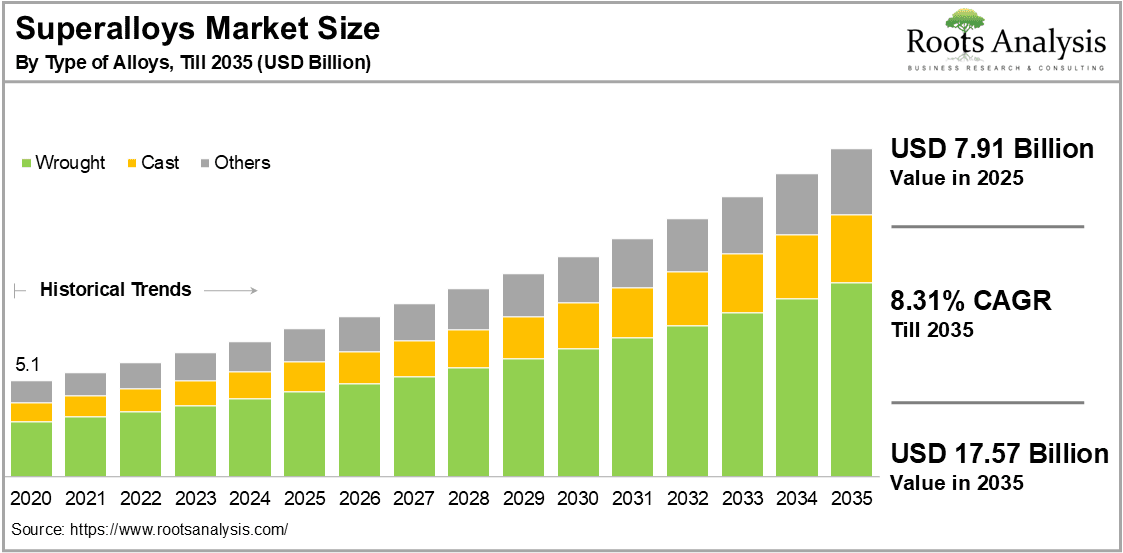
The global superalloys market is projected to rise from USD 7.91 billion in 2025 and USD 17.57 billion by 2035 representing a CAGR of 8.31% during the forecast period.
To learn more about this report, request a free sample copy
The new research study consists of global construction adhesive industry analysis, mega trends, patent analysis, porter five forces, SWOT analysis, value chain analysis and other strategic frameworks.
Superalloys, also known as high-performance alloys, are a class of metallic materials engineered to deliver exceptional mechanical strength, surface stability, and resistance to thermal creep deformation, corrosion, and oxidation at elevated temperatures. Their unique properties stem from advanced alloying and microstructural engineering, including the use of elements like chromium, aluminum, titanium, and refractory metals, which together enable remarkable performance where conventional metals would fail.
The evolution of superalloys is closely tied to the relentless pursuit of efficiency and reliability in critical sectors. In fact, the development of nickel-based superalloys has been one of the most significant advances in enabling the modern gas turbine, both for aviation and power generation. This innovation has not only extended the operational limits of turbines but also contributed to substantial improvements in fuel efficiency and emissions reduction.
Beyond their technical attributes, the superalloys market is increasingly characterized by rapid advancements in manufacturing technologies and a growing emphasis on sustainability. The adoption of additive manufacturing in superalloys has opened new possibilities for producing complex, high-performance components with reduced material waste and shorter lead times.
Superalloys Market Share Insights
The superalloys market report 2025 presents an in-depth analysis of the various companies that are involved in offering superalloys solutions across different segments, as defined in the table below:
Superalloys market: Report Attributes / Market Segmentations
Superalloys Market Segmentation
Which Type of Alloys Will Dominate the Market?
The wrought alloys segment is set to take the lead, holding a significant share of 86.21% of the market. In addition to this, the wrought alloys will also witness the fastest CAGR (9.23%) during the forecasted period.
This is due to their superior mechanical properties and increasing demand in aerospace and other high-performance sectors, where precision and strength are critical. The adoption of advanced manufacturing methods and the push for lightweight, high-strength components are further accelerating the growth of wrought alloys.
Which Base Material Type Will have the Fastest CAGR?
The nickel-based segment is set to witness the fastest CAGR (10.43%) as well as the largest market share of approx. 65% during the forecasted period.
This growth is driven by nickel-based superalloys’ exceptional high-temperature strength, corrosion and oxidation resistance, and their critical role in aerospace, power generation, and gas turbine applications. This growth is further fueled by technological advancements (such as additive manufacturing and ultra-high-temperature alloys), expanding aerospace and energy industries, and increasing performance requirements.
How is the Aerospace Segment Dominating End-Use Industries?
Among the end-use industries, the aerospace segment really stands out as the leading segment holding a market share of 34% as well as the one with the fastest CAGR (9.12%).
This dominance is driven by the critical need for materials that can withstand extreme temperatures and stress in jet engines, turbine blades, and other aerospace components. The ongoing expansion of commercial and military aircraft fleets, coupled with technological advancements in engine efficiency and emissions reduction, continues to fuel the demand for aerospace superalloys.
Which Regions or Countries Offer the Highest Growth Potential for Superalloys?
According to our superalloys regional analysis, the North American superalloys market exhibits dominance by capturing 49.86% of the overall current market share. This leadership is driven by the region’s strong aerospace, defense, automotive, and power generation industries, with the United States playing a particularly significant role.
The growth of the region is also due to its status as a global hub for aircraft manufacturing, advanced material science research, and the presence of major industry players, such as Boeing, Lockheed Martin, and GE Aviation. The region also benefits from advanced manufacturing capabilities, skilled labor, and favorable trade policies, further strengthening its position.
While Asia Pacific is experiencing rapid growth and is expected to expand its market share in the coming years, North America remains the largest and most influential region in the superalloys market as of 2025.
Superalloys Market Key Insights
The “Superalloys Market: Industry Trends and Global Forecasts, Till 2035” report features an extensive study of the current market landscape, market size, superalloys market growth and future opportunity within the global superalloys market forecast period. The market report highlights the efforts of several stakeholders involved in this rapidly emerging segment of the service providers industry. Key takeaways of the market report are briefly discussed below.
Superalloys Market Drivers and Trends
What are the Key Drivers for the Superalloys Market?
- Aerospace Industry Demand: The largest and fastest-growing segment, superalloys are essential for turbine blade materials, combustors, and hot-section components in jet engines due to their ability to withstand extreme temperatures, high stress, and corrosive environments. The expansion of commercial aviation and military fleets globally is a primary growth engine.
- Power Generation Expansion: Superalloys are critical in gas turbines and other high-temperature components for power plants, supporting the shift toward more efficient and lower-emission energy generation. Additionally, small modular reactors (SMRs) offer scalable, clean nuclear power options that complement these advancements.
- Automotive and Industrial Applications: The automotive superalloys sector uses them in turbochargers, exhaust systems, and engine valves to improve fuel efficiency and durability. Industrial sectors, such as chemical processing, oil & gas, and advanced manufacturing also rely on superalloys for their resilience and longevity.
- Renewable Energy Growth: As wind and solar power generation expands, superalloys are increasingly used in components exposed to harsh environments, such as wind turbine generators and concentrated solar power systems.
- Technological Advancements: Innovations in alloy compositions, powder metallurgy, and additive manufacturing are enabling the production of superalloys with superior properties and complex geometries, expanding their use in next-generation superalloys applications.
- Global Industrialization: Rapid industrial growth in emerging economies, especially in Asia-Pacific, is boosting demand for high-performance materials in aerospace, energy, and automotive sectors
What is the Role of Nickel-Based Superalloys in Jet Engines?
Nickel-based superalloys are the backbone of jet engine hot-section components due to their exceptional strength, thermal stability, and resistance to oxidation and corrosion at extreme temperatures. These alloys enable engines to operate at higher temperatures, directly improving efficiency, performance, and fuel economy while ensuring reliability and longer service life.
What are the Advancements in Additive Manufacturing for Superalloys?
Additive manufacturing has revolutionized the production of superalloy components, allowing for complex geometries, reduced material waste, and rapid prototyping. Recent research focuses on optimizing microstructures, minimizing defects, and advancing post-processing techniques like heat treatment and hot isostatic pressing to enhance the mechanical properties and reliability of AM superalloy parts.
What is the Impact of Environmental Regulations on Superalloy Production?
Stricter environmental regulations are pushing superalloy producers to adopt superalloy manufacturing processes and develop alloys with longer lifespans and improved recyclability. There is increased emphasis on reducing hazardous emissions, energy consumption, and the use of critical raw materials, driving innovation in both alloy design and production methods.
What is the Use of Superalloys for Renewable Energy and Wind Turbines?
Renewable energy superalloys are increasingly used in applications, particularly in wind turbines and next-generation power plants, where they provide the high-temperature strength and corrosion resistance needed for critical components. Their use helps improve reliability and efficiency, supporting the transition to cleaner energy sources.
What are the Future Trends in Superalloy Composition and Applications?
Future trends in superalloy include the development of alloys with higher temperature capabilities, improved creep resistance, and enhanced corrosion protection. There is a growing focus on designing corrosion-resistant superalloys specifically for additive manufacturing and on using computational tools to accelerate alloy discovery, enabling broader applications in aerospace, energy, and beyond.
What are the Key Strategies Used by Companies to Gain Superalloys Market Share?
Superalloys companies are using smart strategies to stay ahead. Big players are focusing on superalloys market opportunities in emerging economies, partnerships, acquisitions, joint ventures, and innovations to strengthen their position in the superalloys competitive landscape while also investing in R&D to bring innovative and novel products to the market.
For instance, in July 2024, Aubert & Duval and Alloyed launched the ABD-1000AM nickel superalloy. In context to this, Jean-François Juéry, EVP of Business Development and Strategy at Aubert & Duval commented that they are excited to expand their metallic powder portfolio with ABD-1000AM through their partnership with Alloyed.
Adding this best-in-class alloy, designed for additive manufacturing, reflects the growing demand for high-temperature, sustainable solutions across industries. They’ve seen significant interest in these innovative alloys and look forward to the new possibilities and performance improvements ABD-1000AM will bring.
Superalloys Market Challenges
What are the Major Challenges in Superalloy Manufacturing?
The superalloys market, while growing, faces several challenges that can impede its expansion. Here are 5 major restraints affecting this market:
- High Production and Raw Material Costs: Superalloys require expensive elements like nickel, cobalt, and rare earth metals, and their manufacturing involves complex, energy-intensive processes, such as vacuum induction melting and additive manufacturing.
- Technological and Manufacturing Barriers: Achieving precise compositions, defect-free structures, and consistent quality is technically challenging, especially for advanced applications like aerospace and power generation.
- Supply Chain Vulnerabilities: Scarcity and price volatility of critical raw materials can disrupt production and increase costs, while geopolitical risks may further strain supply chains.
- Environmental and Regulatory Pressures: Superalloy production has a significant carbon footprint and is subject to increasing environmental scrutiny and regulatory requirements, driving the need for more sustainable superalloy manufacturing processes.
- Competition and Innovation Pace: Rapid advancements in material science and the emergence of alternative high-performance materials require continuous R&D investment and adaptation by manufacturers.
Recent Developments in the Superalloys Market
- In April 2025, QuesTek developed a nickel superalloy for Stoke Space’s daily-launch reusable rockets. This superalloy is specifically designed for Additive Manufacturing and high-pressure, high-temperature environments.
Superalloys Market Report Coverage
The market report presents a guide to understanding different types of superalloys and their applications, highlighting the capabilities of various companies engaged in this domain, across different segments. Amongst other elements, the market report includes:
- A preface providing an introduction to the full report, superalloys market, 2020-2024 (Historical Trends) and 2025-2035 (Forecasted Estimates).
- An outline of the systematic research methodology adopted to conduct the study on the superalloys market, providing insights on the various assumptions, methodologies, and quality control measures employed to ensure the accuracy and reliability of our findings.
- An overview of economic factors that impact the overall superalloys market, including historical trends, currency fluctuation, foreign exchange impact, recession, and inflation measurement.
- An executive summary of the insights captured during our research. It offers a high-level view of the current state of the superalloys market and its likely evolution in the mid-long term.
- A detailed assessment of the superalloys market landscape, based on several relevant parameters, including year of experience, company size, location of headquarters, and ownership structure.
- Elaborate profiles of prominent players engaged in the superalloys market, featuring information on their year of establishment, location of headquarters, company size, company mission, company footprint, management team, contact details, financial information, operating business segments, superalloys market portfolio, moat analysis, recent developments, and an informed future of superalloys systems.
- A qualitative assessment of the various megatrends ongoing in the superalloys market, including demand driven by aerospace and power generation, technological advancements and innovation, lightweighting and efficiency.
- An analysis highlighting the key unmet needs across superalloys market industry, featuring market research on superalloys industry analysis generated from real-time data on unmet needs as identified from social media posts, recent publications, industry blogs and the views of key opinion leaders expressed on online platforms.
- An in-depth analysis of various patents that have been filed / granted related to superalloys market and its components, based on various parameters, such as type of patent, patent publication year, patent age and leading players
- A detailed analysis of recent developments in the superalloys market domain, based on relevant parameters such as year of initiative, type of initiative (partnerships and collaborations, expansions, funding and product launches), geographical distribution and most active players (in terms of number of recent developments).
- Key winning strategies framework that helps in analyzing the level of competition within an industry, by tracing the key market activities including partnership, funding, expansion of leading players
- A qualitative analysis highlighting the five competitive forces prevalent in superalloys market industry, including threats for new entrants, bargaining power of suppliers, bargaining power of customers, threats of substitution and rivalry among existing competitors.
- A discussion on affiliated global superalloys market trends 2025, key drivers and challenges, under a SWOT framework, which are likely to impact the industry’s evolution, along with a Harvey ball analysis, highlighting the relative effect of each SWOT parameter on the overall superalloys market.
- A value chain analysis features a discussion on various stakeholders involved in the development of the superalloys market, from suppliers to end-users.
- A detailed estimate of the current market size and the potential growth future of superalloys market initiatives over the next decade. Based on multiple parameters we have provided an informed estimate on the market evolution during the forecast period 2025-2035. The report also features the likely distribution of the current and forecasted opportunity within the superalloys market. Further, in order to account for future uncertainties and to add robustness to our model, we have provided three forecast scenarios, namely conservative, base, and optimistic scenarios, representing different tracks of the industry’s growth.
- Detailed projections of the current and future market across various types of alloys such as cast, wrought and other alloys.
- Detailed projections of the current and future market across various base materials, such as cobalt-based, iron-based and nickel-based.
- Detailed projections of the current and future market across various enterprises such as large enterprises and small and medium enterprises.
- Detailed projections of the current and future market across various end use industries, such as aerospace, automotive, electronics, industrial gas turbine, marine, medical devices, oil & gas, power generation and other end-use industries.
- Detailed projections of the current and future superalloys market across various geographical regions, such as North America (US, Canada, Mexico and other North American countries), Europe (Austria, Belgium, Denmark, France, Germany, Ireland, Italy, Netherlands, Norway, Russia, Spain, Sweden, Switzerland, UK and other European countries), Asia (China, India, Japan, Singapore, South Korea and other Asian countries), Middle East and North Africa (Egypt, Iran, Iraq, Israel, Kuwait, Saudi Arabia, UAE and other MENA countries), Latin America (Brazil, Chile, Colombia, Venezuela and other Latin American countries) and rest of the world (Australia, New Zealand and other countries).
Lead Author: Anmol Bali
Lead Reviewer: Yash Tyagi
Chief Editor: Ronit Sharma
Customization Opportunities
At Roots Analysis, we genuinely care about your success and understand that your business requirements are unique. While our superalloys market research reports provide valuable insights, we recognize that they might not cover every aspect you need to make well-informed strategic decisions. To account for that, we offer 15% free report customization tailored to your specific needs. Whether you require additional quantitative analysis, qualitative insights, or any other information related to the superalloys market, reach out us today at: support@rootsanalysis.com
Frequently Asked Questions
What are superalloys?
Superalloys, also known as high-performance alloys, are a class of metallic materials engineered to deliver exceptional mechanical strength, surface stability, and resistance to thermal creep deformation, corrosion, and oxidation at elevated temperatures.What is the projected size of the global superalloys market by 2035?
The superalloys market size is estimated to be worth $ 17.57 billion by 2035.Who are the leading players in the global superalloys market?
Allegheny Technologies (ATI), AMG Superalloys, Arconic, Aubert & Duval, BaoSteel, Cannon Muskegon, Carpenter Technology, Doncasters, Eramet, Haynes International, High Performance Alloys, Howmet Aerospace, Precision Castparts (PCC), Special Metals, Telex Metals, ThyssenKrupp, United Performance Metals, VDM Metals, Viridis Materials, Shanghai HY Industry.Which regions are leading in superalloys deployment?
North America is leading the superalloys deployment due to its technological leadership in aerospace/defense.Which industries are the largest consumers of superalloys?
Aerospace, power generation, industrial gas turbines, and automotive industries are the largest consumers of superalloys.What are the main types of superalloys and their key properties?
The main types are nickel-based (high temperature strength, corrosion resistance), cobalt-based (thermal stability, wear resistance), and iron-based (cost-effective, good mechanical properties at moderate temperatures).How do superalloys contribute to aerospace engine efficiency?
Jet engine superalloys operate at higher temperatures, enhancing efficiency, thrust, and fuel economy while maintaining structural integrity under extreme conditions.How do environmental regulations impact the superalloys industry?
Environmental regulations drive innovation in cleaner production processes, recycling, and the development of alloys with longer lifespans and reduced environmental impact.What role do superalloys play in renewable energy applications?
Superalloys are used in wind turbines and next-generation power plants for their high-temperature strength and corrosion resistance, supporting improved reliability and efficiency.How is additive manufacturing changing the superalloys market?
Additive manufacturing enables the production of complex, high-performance superalloy components with reduced waste and faster prototyping, expanding design possibilities.