
Lowest Price Guaranteed
Slides
188
Last Updated
August 2026
View Count
14752
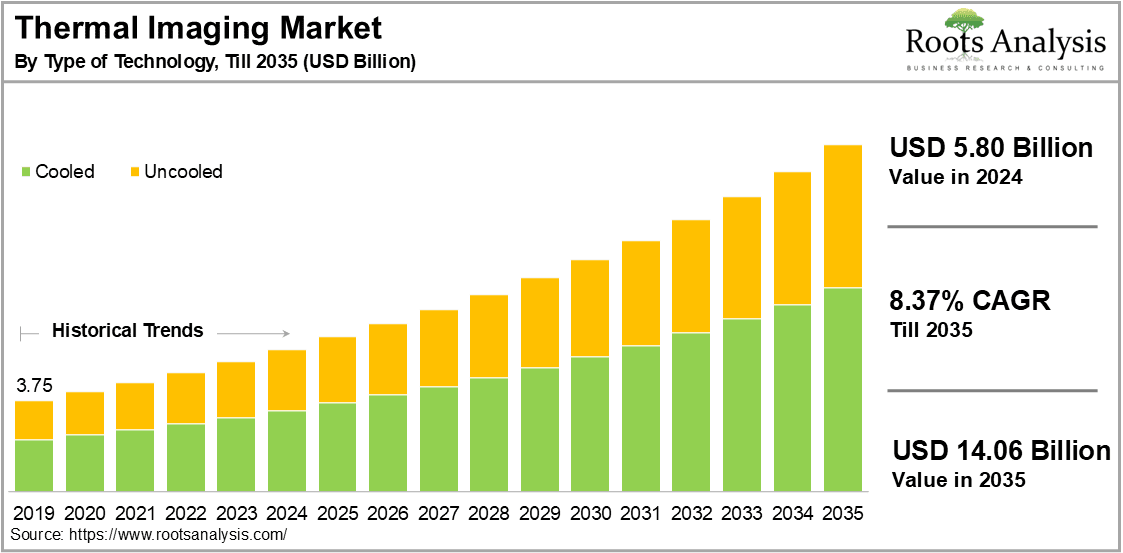
According to the global thermal imaging market size forecast, the market is projected to grow from USD 5.80 billion in 2024 to USD 14.06 billion by 2035, representing a CAGR of 8.37%, during the forecast period 2024-2035.
 |
To learn more about this report, request a free sample copy
The new research study consists of thermal imaging trends 2025 analysis, detailed global thermal imaging growth forecast analysis, and providing actionable strategic recommendations.
Thermal imaging technology captures and processes infrared radiation to create images. This technology is widely used in industries such as automotive, commercial, government and defense, healthcare and life sciences, industrial and residential. The thermal imaging market has been experiencing steady growth and is expected to continue expanding in the coming years. Technological innovations have led to the development of microbolometers, which are further expected to provide several growth opportunities over the forecasted period.
The growing demand for security and surveillance systems across private and public environments is expected to drive thermal imaging market growth. This growth is owed to the increasing need for security among citizens and employees. The rapid urbanization is also expected to impose increased demand for additional advanced security solutions. Rising investment in infrastructural systems and surging demand for professional surveillance are expected to positively impact thermal imaging systems market growth over the forecast period. In addition to this, the exponential growth of advanced driver-assistance systems (ADAS) and the growing demand for wireless temperature sensors are also expected to positively influence the market growth of the thermal imaging industry.
The thermal imaging industry report presents an in-depth analysis of the various companies that are involved in offering thermal imaging solutions, across different segments, as defined in the table below:
| Key Report Attributes | Details | |
| Historical Trend | Since 2019 | |
| Forecast Period | 2024-2035 | |
| Market Size Value in 2024 | $ 5.80 Billion | |
| Market Size Value by 2035 | $ 14.06 Billion | |
| CAGR (Till 2035) | 8.37% | |
| Type of Technology |
|
|
| Type of Product |
|
|
| Type of Wavelength |
|
|
| Type of Vertical |
|
|
| Type of Offering |
|
|
| Type of Resolution |
|
|
| Type of Color Palette |
|
|
| Areas of Application |
|
|
| Company Size |
|
|
| Geographical Regions |
|
|
| Leading Market Players |
|
|
| PowerPoint Presentation (Complimentary) |
Available | |
| Customization Scope | 15% Free Customization | |
| Excel Data Packs (Complimentary) |
|
|
Based on the type of technology, the global thermal imaging market is split into cooled and uncooled. Among these categories, the cooled segment growth is expected to be the maximum, capturing a market share of 75.34% by 2035. This can be attributed to their wide adoption due to their highly sensitive nature which allows these devices to detect even the smallest temperature variations. On the other hand, the uncooled segment is expected to witness a rapid growth at a significant CAGR of 11.23% during the forecasted period. This growth can be attributed to their affordable prices and ease in the manufacturing process with fewer steps and higher yields. They are best suitable for applications with a monitoring area range of under 4-5km.
The global thermal imaging market is segmented into various types of products, such as fixed / mounted thermal camera, handheld, thermal module, and thermal scopes. According to our thermal imaging industry analysis, the fixed / mounted thermal camera segment will augment the segment's growth with the largest market share of over 60.56% by the next decade. The thermal imaging camera market growth can be attributed to the rising adoption of thermal cameras in commercial and residential sectors. On the other hand, the thermal scopes segment is expected to witness the fastest CAGR of about 13.98%. This growth can be owed to the increasing demand for thermal scopes from the military and defense sectors, according to the military and defense thermal imaging market insights.
The global thermal imaging market is segmented into two types of wavelengths, such as longwave infrared (LWIR), mid-wave infrared (MWIR), and shortwave infrared (SWIR). According to our thermal imaging technology analysis, the mid-wave infrared segment will augment the market's growth with a market share of 74.65% by 2035. This can be attributed to its ability to operate efficiently in harsh environments such as aerosol, smoke, or fog. Furthermore, it is worth highlighting that the longwave infrared (LWIR) segment is expected to witness the fastest growing CAGR of around 12.67% in the forecasted period. This growth can be owed to the technological advancement and growing adoption of LWIR cameras in security and surveillance applications.
The market is segmented into various thermal imaging verticals, such as aerospace and defense, automotive, energy & utilities, healthcare, law enforcement, life sciences, and residential. According to our thermal imaging market overview, the aerospace and defense segment will augment the market's growth with a market share of 30.65% during the forecasted period. This growth can be owed to the cost-effectiveness of thermal imaging systems as compared to other lighting systems installed to safeguard the borders. These thermal devices are also used in armored vehicles, and weapon stations to provide situational awareness to the military personnel. On the other hand, it is worth highlighting that the law enforcement segment is expected to witness the fastest CAGR of around 11.67% during the forecasted period. This growth is owed to the role of thermal imaging devices in helping law enforcement officers to effectively manage operations, investigate crime scenes and trace and apprehend suspects.
The market is segmented into various types of offering, such as hardware, services, and software. According to our global thermal imaging market analysis, the hardware segment, mainly the thermal cameras, is anticipated to gain the maximum market share of around 60.78% over this forecast period. This can be attributed to the critical role thermal cameras play in various applications such as security, video surveillance, and industrial inspections. The increasing adoption of these cameras across sectors like healthcare and automotive further fuels market growth. On the other hand, the services segment will witness the fastest CAGR of around 12.98% during the forecasted period. This can be attributed to the rising demand for maintenance, installation, and training associated with thermal imaging systems.
The market is segmented into various types of resolution, such as 160 x 120, 320 x 240, 640 x 480, and others. According to our thermal imaging market analysis, the 640 x 480 segment is anticipated to gain the maximum market share of around 60.78% over this forecast period. This can be attributed to its balance of image quality and cost-effectiveness, making it suitable for a wide range of applications of thermal imaging systems including security, surveillance, and industrial inspections. On the other hand, the 320 x 240 segment will witness the fastest CAGR of around 11.94% during the forecasted period. This can be attributed to the increasing demand for affordable thermal imaging solutions that still provide adequate performance for various applications.
The market is segmented into various types of color palette, such as artic, ironbow, rainbow HC, white hot, and others. According to our thermal imaging market analysis, the white-hot segment is anticipated to gain the maximum market share of around 45.78% over this forecast period. This can be attributed to its wide usage due to its simplicity and effectiveness in providing a clear contrast between hot and cold objects. On the other hand, the rainbow HC segment will witness the fastest CAGR of around 14.67% during the forecasted period. This can be attributed to its ability to offer enhanced detail and visibility of temperature variations, appealing to users in specialized fields such as building diagnostics and firefighting where even subtle temperature differences are critical.
The market is segmented into various areas of application, such as border surveillance, C-UAS, commercial, detection & measurement, industrial, military & defense, monitoring & inspection, residential, search & rescue, and vehicle targeting. According to our thermal imaging market analysis, the border surveillance segment is anticipated to gain the maximum market share of around 30.78% over this forecast period. This can be attributed to the increasing global security threats and the demand for advanced monitoring solutions. This segment’s growth also benefits from the growing need for effective surveillance capabilities, particularly in urban environments and sensitive locations. On the other hand, the monitoring and inspection segment will witness the fastest CAGR of around 12.96% during the forecasted period. This can be attributed to the rising adoption of thermal imaging technology for preventive maintenance, quality control, and safety inspections across various industries.
The global thermal imaging market is fragmented into multiple types of enterprise, namely large and small and medium enterprise. Currently, the large enterprise segment is expected to dominate the segment with 60.34% of the thermal imaging market share. However, small and medium enterprise segments are expected to witness a relatively higher (10.28%) thermal imaging market growth rate until 2035. This is ascribable to their agility, innovation, focus on niche markets, and ability to adapt to changing customer preferences and market conditions.
This segment highlights the distribution of thermal imaging market share by region, such as North America, Europe, Asia, Latin America, Middle East and North Africa, and the rest of the world. According to our regional analysis of thermal imaging markets, North America currently exhibits dominance with 37.69% of overall market share. This growth is owed to the presence of numerous manufacturers and distributors, the low cost of thermal imaging components, and the increasing government expenditure in the aerospace & defense sector. Apart from this, thermal imaging is also being widely used in the region in commercial and industrial settings, hence further fueling the market growth in the region.
The “Thermal Imaging Market, Till-2035: Industry Trends and Global Forecasts” report features an extensive study of the current market landscape, market size and future opportunity within the thermal imaging market, during the given forecast period. The market report highlights the efforts of several stakeholders involved in this rapidly emerging segment of the service providers industry. Key takeaways of the thermal imaging market report are briefly discussed below.
According to thermal imaging industry trends, the market is expected to be driven by the growing need for surveillance and security solutions. The demand for sophisticated surveillance and security systems has been driven by growing security concerns, which have caused the global security landscape to change quickly. Thermal imaging technology is rapidly becoming a vital part of contemporary security systems as a solution to these issues. The technology’s ability to detect heat signatures enables security personnel to identify potential threats quickly and accurately, enhancing overall security measures. Furthermore, the rising demand for thermal imaging in the automotive industry is also a significant market driver as thermal imaging cameras are rapidly being integrated into vehicles to enhance safety and improve the driving experience.
With the presence of several small and large thermal imaging manufacturing companies, the market is experiencing intense competition and changing thermal imaging market dynamics. From large multinational companies to local thermal imaging manufacturing players, companies are striving to enhance their competitive edge. In terms of market share, large enterprises and multinational companies are dominating the market. While small thermal imaging manufacturing players are continuously improving their products to cater to niche markets, or they are offering specialized thermal imaging. These industry players are focusing on adopting competitive strategies, such as developing innovative thermal imaging solution techniques, forming strategic alliances and partnerships to expand their portfolios and global footprint, investing in recent developments and new feature launches to enhance their thermal imaging products offerings. For instance, in September 2024, THERMOEYE launched the new AI-powered thermal camera, TMC EDGE for autonomous systems. In reference to this, Dohwi Kim, the CEO of Thermoeye stated that they are building a safe autonomous environment based on thermal cameras. The goal is to not only commercialize this technology for autonomous applications, but also to find opportunities to integrate thermal cameras into current and future markets we serve.
Despite the strong market growth projection, there are several challenges in the thermal imaging market. The most common challenge is the high cost of thermal imaging cameras. The initial investment required for thermal imaging technology, including the purchase of cameras and training for personnel, can be prohibitive for organizations with limited budgets. Furthermore, limited awareness and skills regarding thermal imaging technology are also one of the major market challenges. Many potential users might not be able to comprehend the working and benefits of thermal imaging technology which can hinder the market’s growth.
With respect to regional thermal imaging industry insights, North America is likely to dominate the market for the forecasted period. The dominance of this region is majorly influenced by the region’s significant investment in defense and security. The region is home to several leading defense contractors and technology companies, including Lockheed Martin, Raytheon, and FLIR Systems, which drive the innovation and adoption of advanced thermal imaging technologies.
Examples of key Thermal Imaging device manufacturers involved in the thermal imaging market (which have also been captured in this market report, arranged in alphabetical order) include 3M, American Technologies Network, Avon Protection Systems, Axis Communications, BAE Systems, Cantronic Systems, Cox & Company, Dali Technology, Drägerwerk, Excelitas Technologies, FLIR Systems, Fluke, Fortive, Honeywell, L3 Harris Technologies, Leonardo, Lockheed Martin, Lynred, Opgal Optronic, Raytheon Technologies, Safran, Seek Thermal, Sofradir, Testo, Thermoteknix Systems, Thales, United Technologies, Xenics nv.
At Roots Analysis, we genuinely care about your success and understand that your business requirements are unique. While our thermal imaging research reports provide valuable insights, we recognize that they might not cover every aspect you need to make well-informed strategic decisions. To account for that, we offer 15% free report customization tailored to your specific needs. Whether you require additional quantitative analysis, qualitative insights, or any other information related to the thermal imaging market, reach out us today at: support@rootsanalysis.com