


 Download Free Sample
 Buy Now
Market Outlook
The tiny machine learning market is projected to reach USD 1.40 billion in 2026 and USD 22.92 billion by 2040, representing a CAGR of 22.10% during the forecast period 2026 to 2040.

See What’s in the Full Report - Request Your Complimentary Insights!
The tiny machine learning market encompasses the machine learning algorithms optimized for microcontrollers and low-power embedded devices, enabling on-device inference without cloud dependency. This market includes components, such as hardware accelerators, software frameworks, and edge artificial intelligence models that deliver real-time processing in constrained environments.
Tiny machine learning (ML) market drivers include ultra-low-power neural networks and hardware optimizations that cut latency and bandwidth costs, with consumer electronics and industrial IoT comprising over 64% of implementations. For instance, in June 2025, Hugging Face launched SmolVLA, a 450-million-parameter vision-language-action model runnable on consumer GPUs, accelerating TinyML adoption in robotics.
Looking ahead, the market holds strong growth potential, driven by innovations focused on maturing embedded AI frameworks and cost reductions in neural processing units, alongside pushes for sustainable, regulation-compliant edge computing. Thereby observed trends point to steady structural growth in intelligent edge ecosystems. With reference as, STMicroelectronics announced plans in 2025 to integrate TinyML into next-generation sensor hubs for broader industrial wearable technology, signaling commercialization in predictive maintenance.
Key Takeaways
- Leading Players Competitive Footprint: Dominant players like Apple, Arm, Edge Impulse, Google, Groq, InData Labs, Luxonis, Meta, Microsoft, NXP, Plumerai, Qualcomm, Renesas, SensiML, STMicroelectronics, Synaptics and Syntiant hold strong market positions with extensive geographic presence in various regions.
- Startup Ecosystem and Innovation Hotspots: Early-stage companies are focusing on catering to the increasing demand for energy-efficient and low-power TinyML solutions for edge AI deployments. The companies are making advancements in areas, such as model compression techniques (for ultra-lightweight inference), neuromorphic hardware (for brain-inspired energy savings), and federated learning frameworks (to enhance privacy and on-device training).
- Regional Penetration and Adoption Trend: Rapid industrialization, rising number of infrastructure projects, and expanding applications across various end-use sectors is leading the regional growth of tiny machine learning in North America. Notably, US drives demand through industrial IoT TinyML, accounting for substantial device shipments.
- C Language Holds Highest Market Segment: In terms of distribution by type of languages, C language holds the maximum market share in 2026. This is due to its low-level optimization, minimal memory footprint, and real-time analytics edge devices essential for resource-constrained microcontrollers.
- TinyML Market Opportunities: exist in the development of ultra-low-power hardware accelerators that meet stringent energy harvesting constraints for battery-less IoT devices. Additionally, there's expansion potential in emerging sectors like sustainable edge AI for smart agriculture, healthcare wearables, and federated learning frameworks enabling privacy-preserving TinyML deployments.
Recent Industry Developments
- March 2025: Renesas Electronics Corporation launched new RZ/V2L microprocessors, featuring the DRP-AI (Dynamically Reconfigurable Processor) for vision AI, designed for edge AI applications requiring low power consumption and real-time processing.
- September 2024: Edge Impulse announced a collaboration with Analog Devices to enable TinyML deployment on Analog Devices (microcontrollers and sensors), including the ADUCM4050 and MAX78000 microcontrollers
- February 2024: Arm and Edge Impulse announced a collaboration to provide optimized software for AI development on arm cortex-M and embedded machine learning with ethos-U processors, integrating Arm's new Kleidi AI software with the Edge Impulse development.
- November 2023: STMicroelectronics introduced its new STM32N6 microcontrollers, which integrates a neural processing unit (NPU) for enhanced edge AI capabilities, enabling more powerful and efficient machine learning applications on embedded devices.
Pay Only for What You Need – The Best Way to Optimize
Market Dynamics
Key Market Drivers
- Edge AI Proliferation in Billions of IoT Devices: Over 2.5 billion edge devices in the past years have leverage embedded ML, with TinyML powering 20% of implementations by enabling local processing that cuts cloud dependency and latency for real-time IoT analytics in industrial sensors and wearables.
- Ultra-Low-Power Hardware Advancements: Specialized neural network ML accelerators and efficient chips from leaders like ARM and STMicroelectronics allow TinyML models to run on milliwatt-scale power, aligning with battery-constrained applications in consumer electronics and remote monitoring.
- Real-Time Processing Demand in Consumer Electronics: This drives the TinyML market as devices such as smartwatches, home automation systems, and voice-enabled assistants increasingly rely on on-device machine learning for functions like image classification and personalized user interactions. This trend is particularly prominent in the Asia-Pacific region and has contributed to about 64% of new US implementations, as consumers seek seamless, low-latency, and offline-capable user experiences.
Market Restraints
- Memory and Compute on Microcontrollers: TinyML models must compress to kilobytes (KB) for less than 1MB RAM devices, limiting model complexity and accuracy in tasks like advanced vision, slowing adoption in high-stakes industrial applications.
- High Upfront R&D Costs for Model Optimization: Quantization and pruning techniques demand specialized expertise, deterring SMEs despite affordable and low power computing TinyML alternatives with hardware accelerators still premium-priced.
- Battery Life Trade-Offs in Continuous Inference: Even efficient TinyML drains power in scenarios like predictive sensors, constraining use in remote agriculture or logistics where recharging infrastructure lags.
Market Share Insights
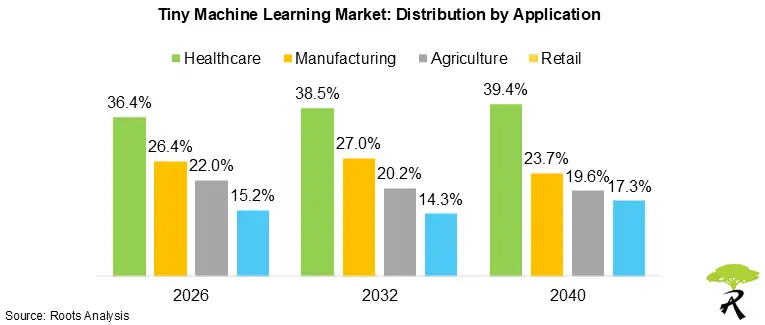
Market Share by Application: Healthcare Hold the Largest Market Share
- According to our tiny machine learning market analysis, healthcare holds the largest market share of 36.4% in 2026. The growth is driven by rising wearable adoption and real-time patient monitoring needs.
- There is a growing industrial demand for healthcare investments and IoT adoption that needs cost-effectiveness and real time data processing on resource-constrained devices to reduce bandwidth costs compared to cloud reliance.
- The tiny machine learning market forecast suggests that the deployment is boosted for personalized medicine and remote patient monitoring. Whereas North America holds the dominant market share elevated through healthcare spending and advanced device adoption (monitoring and imaging). Additionally, Asia-Pacific emerges as the fastest growing region by the year 2040.
- For instance, Apple employs TinyML algorithms on the neural engine within Apple watch processors to enable features, such as ECG analysis, irregular heart rhythm notifications, blood oxygen monitoring, and sleep detection, without cloud dependency.
Market Share by Geographical Regions: North America Dominates the Industry While Asia-Pacific to Witness Rapid Growth Through 2040
- North America currently holds the largest share of the global TinyML market, accounting for approximately 48.37%. This leadership reflects the region’s mature technological infrastructure, strong innovation culture, and concentration of advanced R&D and hardware development firms. The ecosystem in the US and Canada supports rapid prototyping and commercialization of TinyML solutions, enabling continuous market dominance.
- Meanwhile, the Asia-Pacific region is emerging as the fastest-growing market, expected to record a CAGR of 25.21% during the forecast period. The surge is driven by an expanding IoT ecosystem, large-scale electronics manufacturing, and substantial device production across China, India, and Japan. Additionally, government-backed digital transformation initiatives across sectors like agriculture and automotive (alongside widespread smart city development programs) have led to the deployment of over 450 million connected devices, amplifying demand for affordable and efficient TinyML solutions.
Market Ecosystem Insights
Leading Companies Competitive Footprint
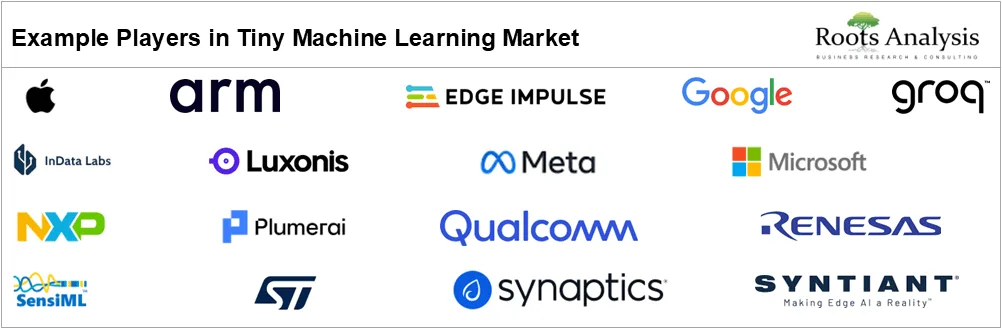
Leading players in the tiny machine learning domain include industry giants such as Apple, Arm, Edge Impulse, Google, Groq, InData Labs, Luxonis, Meta, Microsoft, NXP, Plumerai, Qualcomm, Renesas, SensiML, STMicroelectronics, Synaptics and Syntiant which hold strong market positions through their extensive product portfolios and global reach.
Collaborations and expansions remain key growth strategies, with players accelerating innovation, market penetration, and scalability. For instance, Samsung Electronics and IBM collaborated to develop TinyML solutions for Samsung’s IoT devices, using IBM Watson studio and power AI for model optimization on low-power hardware. This enhances edge analytics in smart home and wearables, accelerating deployments.
Similarly, in February 2025, Analog Devices and Cambridge Consultants collaborated on sensor-based TinyML for industrial IoT, focusing on vibration analysis and predictive maintenance to cut latency in factory automation. These expansions reduce development barriers by enabling faster commercialization of TinyML applications across sectors (healthcare, automotive, and smart cities).
Startup Activity and Innovation Hotspots
The startup activity within the tiny machine learning domain is rapidly evolving with early-stage companies pioneering disruptive applications, primarily focused on sustainable tiny machine learning devices and high-performance formulations. Innovators are launching functionalized improvements for edge AI applications.
Recent launches include investments focused on healthcare wearables, industrial predictive maintenance, and smart agriculture sensors in model compression and hardware accelerators like neuromorphic chips. For instance, Groq raised $640 million in Series D funding at a valuation of $2.8 billion, focusing on high-performance hardware and software solutions for artificial intelligence, including its language processing unit custom chip for large language model development.
Additionally, there are other startups such as those providing technological advancements and innovations as of October 2025, Luxonis serves more than 25,000 customers across 110+ countries, indicating active market participation in machine learning hardware solutions.
Funding and Investment Momentum
The tiny machine learning market has seen robust funding and investment momentum. Investment flows primarily from venture capitalists, private equity firms, and government grants which not only focus on developing sustainable, high-performance tiny machine learning technologies but also on edge AI innovation.
These funds support the accelerated development and deployment of energy-efficient TinyML solutions by enabling R&D in model quantization, neuromorphic computing, and AI inference on embedded devices. Such investments reduce power consumption, hardware costs, and latency, thereby expanding the commercial viability and adoption of TinyML across edge and IoT applications.
Key investors include companies such as Lightspeed Ventures and Together Fund supporting TinyML platforms, with Edge Impulse securing USD 50 million for no-code tools. Similarly, Aira Technologies received USD 15 million for vision-impaired smart glasses using TinyML object detection. In addition, government initiatives and grants predominantly support sustainability-focused innovations by companies in US, Europe and India to receive grants for IoT, and AI prototypes.
Unlock Deeper Insights – Schedule Your Personalized Workshop Today!
Tiny Machine Learning Market: Scope of the Report
| Key Report Attributes | Details | |
| Historical Trend | Since 2022 | |
| Forecast Period | Till 2040 | |
| Market Size 2026 | $ 1.40 Billion | |
| Market Size 2040 | $ 22.92 Billion | |
| CAGR (Till 2040) | 22.10% | |
| Segments Covered |
|
|
Market Segmentation
Based on the research, we have segmented the tiny machine learning (TinyML) market into component, deployment mode, type of language, application, end user, geographical regions, and key players.
Market Share by Component
- Hardware
- Software
- Services
Market Share by Deployment Mode
- Cloud
- On-Premises
Market Share by Type of Language
- C Language
- Java
Market Share by Application
- Agriculture
- Healthcare
- Manufacturing
- Retail
Market Share by End User
- Aerospace & Defense
- Automotive
- Consumer Electronics
Market Share by Geographical Regions
- North America
- US
- Canada
- Mexico
- Rest of North America
- Europe
- Austria
- Belgium
- Denmark
- France
- Germany
- Ireland
- Italy
- Netherlands
- Norway
- Russia
- Spain
- Sweden
- Switzerland
- UK
- Rest of Europe
- Asia-Pacific
- Australia
- China
- India
- Japan
- New-Zealand
- Singapore
- South Korea
- Rest of Asia-Pacific
- Latin America
- Brazil
- Chile
- Colombia
- Venezuela
- Rest of Latin America
- Middle East and Africa (MEA)
- Egypt
- Iran
- Iraq
- Israel
- Kuwait
- Saudi Arabia
- UAE
- Rest of MEA


