


 Download Free Sample
 Buy Now
Torque Sensor Market Size
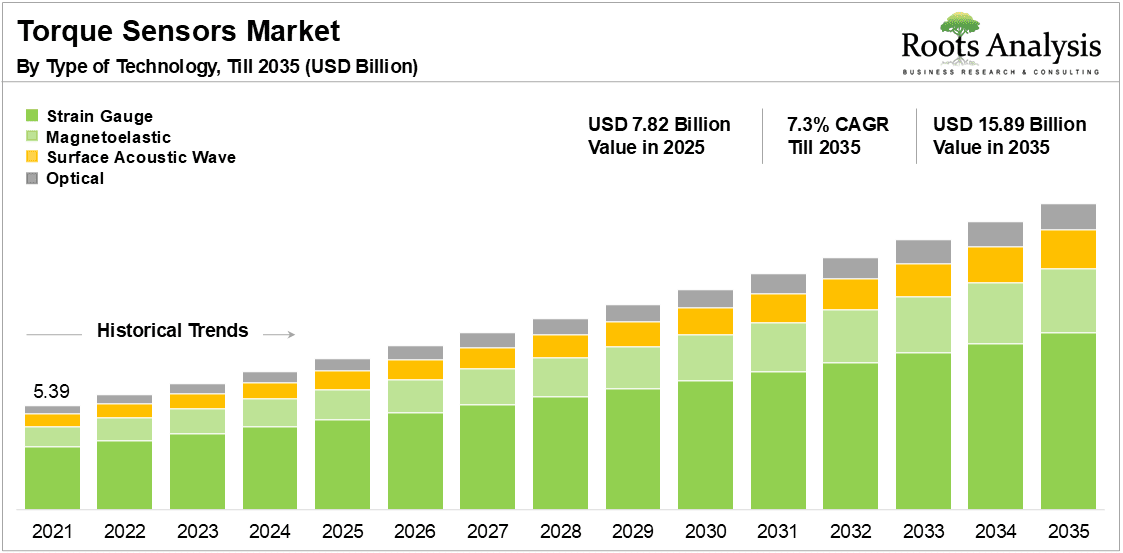
The global torque sensor market, valued at USD 7.82 billion in 2025, is projected to reach USD 11.43 billion in 2030 and USD 15.89 billion by 2035, with a CAGR of 7.3% during the forecast period 2025 to 2035.
Request Your Complimentary Insights!
Key Takeaways
- In terms of type of torque sensor, rotary torque sensors sub-segment secures 55% of the overall revenue share of the global market in 2025.
- Based on the type of configuration, in 2025, wired torque sensors hold the largest share (80%) of global torque sensors market.
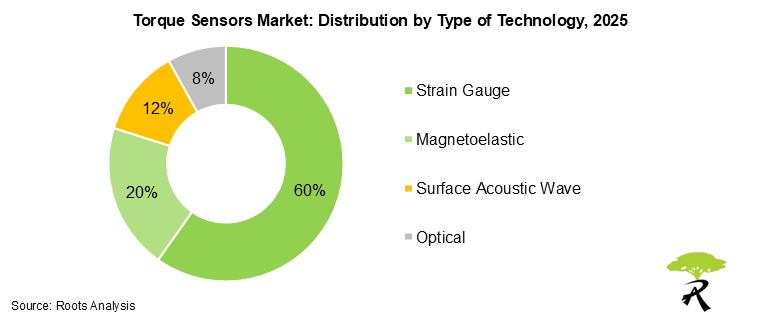
- In 2025, strain gauge segment captures the largest torque sensor market share (60%), by type of technology.
- In terms of application area, automotive safety systems sub-segment secures 45% of the overall revenue share of the global market in 2025.
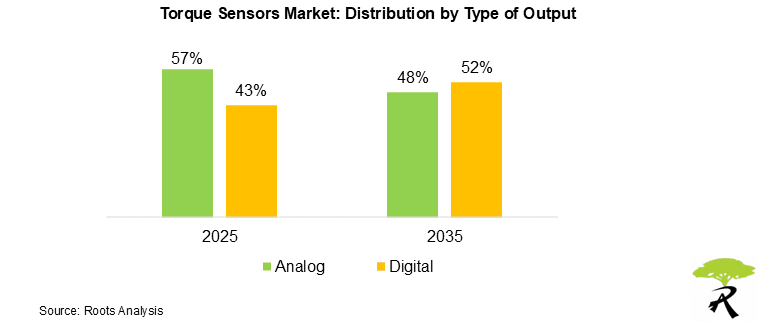
- Based on type of output, analog sub-segment holds the largest share (57%) of global torque sensors market in 2025.
- In 2025, medium torque captures the largest torque sensor market share (44%), by measurement range.
- In terms of torque sensors market share by company, in 2025, large players sub-segment captures the largest share (41%).
- In terms of leading region, Asia-Pacific holds the largest share with 44% share of the market in 2025.
- More than 90% of the startups in this domain provide digital output due to the fact that digital torque sensors offer high accuracy, real-time data processing, and seamless integration with modern digital systems.
- Since 2021, ~4,580 patents have been filed related to torque sensors. This is indicative of the surge in ongoing research and innovations in this field.
Market Outlook
Torque sensors refer to specialized instruments designed to measure and record the twisting or rotational force, known as torque, applied to an object. The fundamental principle behind the working of such sensors is that when torque is applied to a shaft or a surface, it induces a deformation or strain in the material; this deformation is measured by the sensor and can be correlated with the applied torque.
Notably, torque sensors play a critical role in ensuring efficiency, safety, and performance of mechanical and automated systems across various industries, including automotive torque sensor, aerospace torque sensor and healthcare industries. Therefore, measuring torque is a vital parameter in many mechanical and industrial applications as it influences the rotational movement of components, supports quality control in manufacturing, and enhances safety features in various systems.
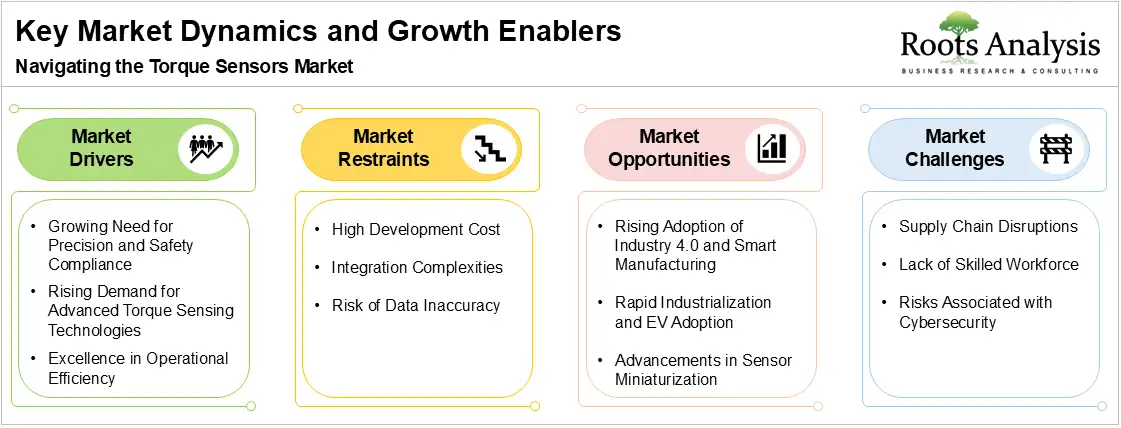
The global torque sensors industry is experiencing steady growth driven by the increasing demand for accurate torque measurements across diverse industries. Several market restraints related to cost and integration persist in the torque sensors domain. However, the growing adoption of electric vehicles creates strong torque sensors market growth opportunities. The market is expected to continue expanding with the growing focus on automation, robotics, and advancements in sensor technology, particularly the rising adoption of torque sensors for robotic systems.
Recent Developments
- In October 2025, Celera Motion launched Sano74, the company’s latest force/torque sensor engineered to deliver a new level of precision, control, and consistency for surgical robotics OEMs.
- In August 2025, Infineon Technologies entered in a technology integration agreement with NVIDIA with a focus on powering the next generation of humanoid robotics with embodied AI.
- In May 2025, Canon Singapore signed an agreement with Mitsubishi Electric in order to integrate Canon’s state-of-the-art force torque sensor FH-300-20 with Mitsubishi electric’s MELFA FR series FR PLUS industrial robots.
- In March 2025, MinebeaMitsumi and Kailas Robotics entered into a collaboration for the development and reliability testing of advanced robot arms equipped with MinebeaMitsumi's miniature 6-axis force torque sensors, with the goal of achieving early practical implementation.
- In January 2025, Bota Systems entered in a product utilization agreement with Kinova to empower research labs to efficiently gather and analyze force-torque, inertial and temperature data, paving the way for novel AI applications.
Pay Only for What You Need – The Best Way to Optimize
Market Share Insights
Rotary Torque Sensors to Drive the Market
According to the global torque sensor market report, rotary torque sensors sub-segment is set to dominate the market with a market share of 55% in 2025. This is due to their essential function in connected, automated, and safety-critical systems, supporting organizations to enhance security, manage emergencies, and protect assets. Owing to these advantages, rotary torque sensors are integral part of Industry 4.0 and IoT-enabled systems, allowing for remote monitoring, predictive maintenance, and real-time performance analysis.
Automotive Safety System Sub-Segment to Shape the Future of Torque Sensor Market
The automotive safety system sub-segment will have the maximum market share (45%) in 2025. This growth is being attributed to the increasing demand for advanced safety features in vehicles, driven by stringent government regulations, rising consumer awareness and technological advancements in active and passive safety systems, such as ADAS and automated driving.
Asia-Pacific Leads Torque Sensor Market
The torque sensors market forecast suggests that Asia-Pacific dominates the market by capturing 44% market share in 2025. The growth is driven by the rising industrial automation, rapid growth in manufacturing and automotive sectors, especially EV production. Further, government initiatives supporting local manufacturing and technological advancements and adoption of Industry 4.0 standards drive growth in this region.
On the other hand, North America shows significant torque sensors market growth driven by the robust demand for sensors from various industries, such as automotive and aerospace.
Market Dynamics
Competitive Landscape of Key Market Players
The competitive landscape of the global torque sensors market is shaped by a blend of established companies and innovative emerging firms specializing in torque sensors development and manufacturing for different industries.
It is worth noting that majority of the companies in the market are small players, followed by mid-sized players; notable example of small companies include (in alphabetical order) MagCanica, Monad Electronics and Welan Technologies.
Further, more than 90% of the companies in this domain offer rotary torque sensors due to various advantages provided by them than the conventional systems. Furthermore, most of the companies integrate strain gauge technology in their torque sensors as strain gauge is a small electrical elements bonded onto the sensor shaft that change the electrical resistance in response to mechanical strain caused by applied torque. This change in resistance is precisely measured through a circuit, allowing for accurate determination of the torque applied to the shaft.
Impact of Electric Vehicles on Torque Sensor Market
The transition towards electric vehicles and hybrid vehicles in the automobile sector is shaping the torque sensors industry. These sensors enable monitoring and control of motor outputs, battery management, regenerative braking systems and drive-by-wire function. This boosts functionality and vehicle handling, with increased safety by enhancing traction control and adaptive cruise systems.
Evolving Regulatory Compliance for Torque Sensors
The regulatory frameworks established for torque sensors vary across countries, upholding a common goal of protecting public health, ensuring product quality and minimizing associated risks. The growing safety and quality expectations by the end-users of various industries have played a major role in the evolution of regulatory frameworks. This evolution has resulted in the growing investment for high-performance, reliable torque sensors to ensure operational compliance and risk mitigation in various industries.
Notable examples of regulatory authorities in the torque sensors industry include National Institute of Standards and Technology (NIST), Occupational Safety and Health Administration (OSHA), Environmental Protection Agency (EPA), European Union Aviation Safety Agency (EASA) and Deutsche Akkreditierungsstelle (DAkkS).
Market Drivers
- Growing Need for Precision and Safety Compliance: The rising need for precision and safety compliance across industries drives the torque sensor market by improving product quality and meeting regulatory standards. Therefore, the increasing emphasis on safe, efficient, and precise industrial operations has compelled manufacturers to adopt advanced torque sensors.
- Rising Demand for Advanced Torque Sensing Technologies: The growing demand for smarter, highly efficient, and connected micromobility vehicles has prompted manufacturers to incorporate sophisticated torque sensing technologies (including E-bikes and micromobility platforms). These sensors measure pedal or motor torque in real time, enabling intelligent control and enhanced user experience.
- Excellence in Operational Efficiency: Torque sensors enable continuous monitoring of motors and drivetrains, ensuring better control, monitoring, and optimization of machinery and processes in various industries. Further, this is known to play a critical role in reducing the energy consumption and further optimizing the overall operational costs.
Want Information on Specific Region / Segment?
Market Challenges
- Supply Chain Disruptions: Torque sensors rely on specialized electronic components (including strain gauge, magnetoelastic, optical and others) and materials that are often in short supply due to global supply chain issues. Such disruptions can slow down market growth by causing production delays, increasing costs, and limiting the availability of advanced torque sensors.
- Lack of Skilled Workforce: The development of torque sensors demands specialized expertise across multiple disciplines, such as IoT integration, wireless communication, and AI-driven analytics. Consequently, the domain necessitates highly skilled professionals capable of installing and maintaining these advanced sensors to harness full potential of the torque sensor solutions.
- Risks Associated with Cybersecurity: Cybersecurity risk not only threatens operational safety and regulatory compliance but also hinders the adoption of advanced and connected torque sensing solutions in several industries. Therefore, protecting torque sensors from cyber threats requires strong security measures to prevent data tampering and unauthorized access.
Market Segmentation
Torque Sensor Market: Scope of the Report
| Key Report Attributes | Details | |
| Historical Trend | Since 2021 | |
| Forecast Period | Till 2035 | |
| Market Size 2025 | USD 7.82 Billion | |
| Market Size 2035 | USD 15.89 Billion | |
| CAGR (Till 2035) | 7.3% | |
| Segments Covered |
|
|
| Key Players Profiled |
|
|
| PowerPoint Presentation (Complimentary) | Available | |
| Customization Scope | 15% Free Customization | |
| Excel Data Packs (Complimentary) |
|
|
Unlock Deeper Insights – Schedule Your Personalized Workshop Today!
Market Segments
Based on the research, we have segmented the torque sensor market into type of torque sensor, type of configuration, type of technology, torque sensor market segmentation by application, type of output, level of measurement range, type of organization and geographical regions
Torque Sensor Market, by Type of Torque Sensor
- Rotary Torque Sensors
- Static Torque Sensors
- 6 Axis Force / Torque Sensors
- 4 Axis Force / Torque Sensors
- Others
Torque Sensor Market, by Type of Configuration
- Wired Torque Sensors
- Wireless Torque Sensor
Torque Sensor Market, by Type of Technology
- Strain Gauge
- Magnetoelastic
- Surface Acoustic Wave and Optical
Torque Sensor Market, by Application Area
- Automotive Safety Systems
- Robotic Systems
- Medical Devices
- Welding and Assembly Processes
- Aircraft Flight Control Systems
- Others
Torque Sensor Market, by Type of Output
- Analog
- Digital
Torque Sensor Market, by Level of Measurement Range
- Low Torque
- Medium Torque
Torque Sensor Market, by Type of Organization
- Small Players
- Mid-sized Players
- Large Players
Torque Sensor Market, by Geographical Regions
- North America
- US
- Canada
- Europe
- France
- Germany
- Italy
- Spain
- UK
- Rest of Europe
- Asia-Pacific
- China
- India
- Japan
- South Korea
- Rest of Asia-Pacific
- Latin America
- Argentina
- Brazil
- Rest of Latin America
- Middle East and Africa (MEA)
- Morocco
- South Africa
- Rest of MEA


