Market Outlook
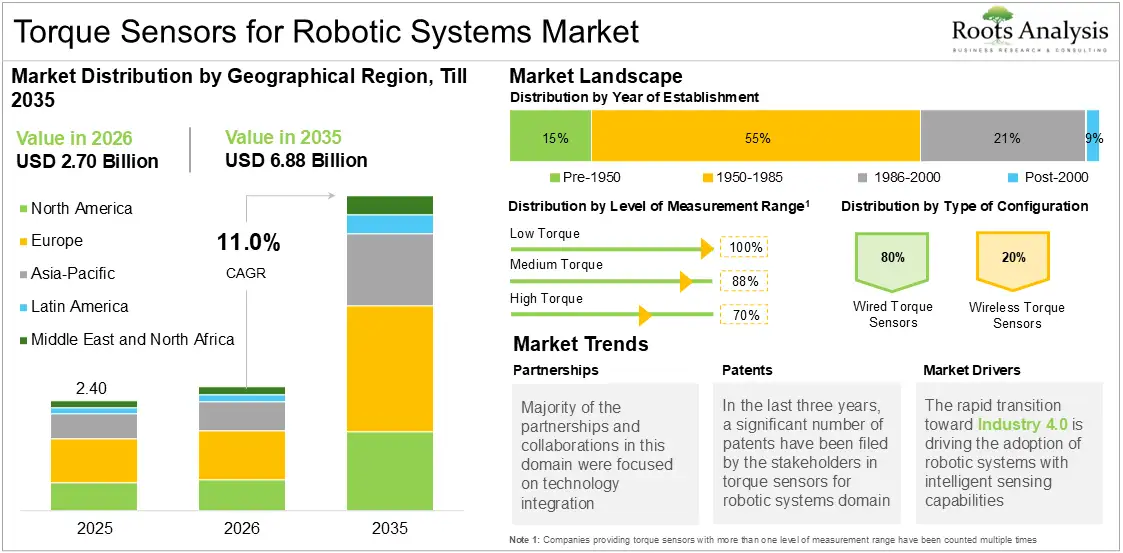
The global torque sensors for robotic systems market, valued at USD 2.40 billion in 2025, is projected to reach USD 2.70 billion in 2026 and USD 6.88 billion by 2035, representing a CAGR of 11.0% during the forecast period 2026 to 2035.
To learn more about this report, request a free sample copy
Market Report: Key Takeaways
Market Size & Trends
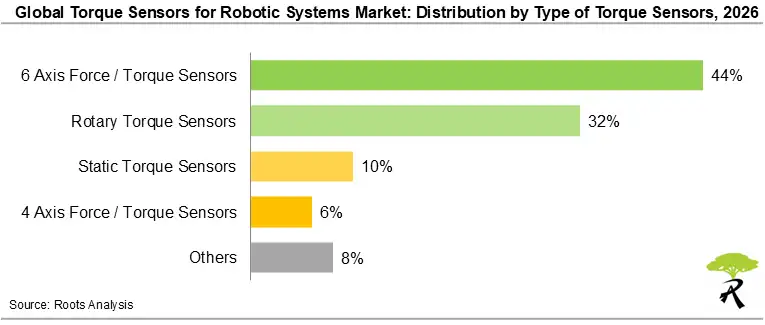
- By type of torque sensor, 6 axis force / torque sensors account for the largest share, representing nearly 45% of the current market.
- With respect to configuration, wired torque sensors dominate the current market.
- Based on the type of technology, strain gauge captures the largest share of the current market; this trend is unlikely to change in the future.
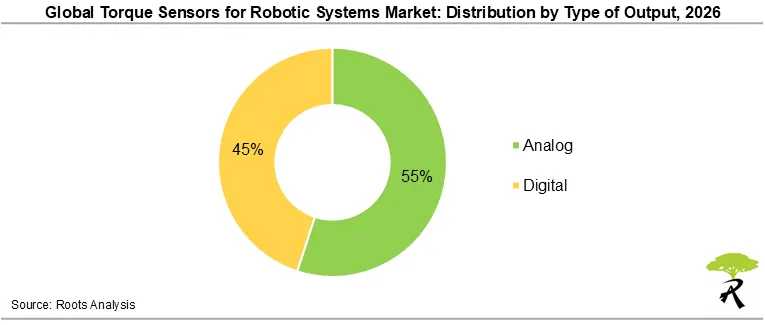
- Amongst the type of outputs, analog captures the largest share (about 55%) of the current market.
- With respect to level of measurement range, low torque dominates the current market.
- Based on the type of organization, large players capture the largest share of the current market.
- In terms of geographical regions, Asia-Pacific currently holds the highest market share (around 40%).
Key Market Statistics
- Market Size in 2026: $2.70 Billion
- Estimated Market Size in 2035: $6.88 Billion
- CAGR (2026-2035): 11.0%
- Asia-Pacific: Largest market in 2026
- Asia-Pacific: Fastest growing region
Market Introduction
Torque sensors represent a fundamental component of modern robotic systems, enabling precise measurement of rotational force to support accurate motion control, force feedback, and safe human-robot interaction. As industries increasingly adopt collaborative robots, industrial automation, and precision assembly solutions, torque sensors have evolved from supplementary components into essential technologies. These sensors enhance robot intelligence, adaptability, and operational reliability. Their ability to provide real-time feedback significantly improves process accuracy while reducing mechanical stress and system failures.
The increasing deployment of collaborative robots, humanoid robots, and AI-enabled automation is accelerating demand for high-performance torque sensing technologies. Recent technological advancements include multi-axis sensing, miniaturized sensor designs, embedded joint torque sensors, and wireless architectures. These features enable higher sensitivity, lower latency, and seamless integration with robotic control systems.
A key industry trend is the integration of torque sensors with artificial intelligence, machine learning, and advanced motion control software to enable adaptive robotic behavior. By combining force feedback with predictive control algorithms, robotic systems can automatically adjust grip force, detect unexpected collisions, and execute complex contact-based tasks with greater precision. Key applications include precision assembly, polishing, surgical assistance, and quality inspection. This transition from programmed automation to intelligent, responsive robotics is significantly increasing the strategic importance of torque sensing technologies.
Over the forecast period, the torque sensors for robotic systems market is expected to benefit from sustained investments in digitally connected manufacturing facilities, Industry 4.0 initiatives, and next-generation robotics. Moreover, companies are increasingly prioritizing integrated sensing solutions that deliver higher accuracy, enhanced durability, and real-time diagnostics while reducing system complexity.
Leading Torque Sensors for Robotic System Products
| Product |
Company |
Headquarters |
YoE |
Sensor Type |
Robotic Fit |
| Multi-Axis Force / Torque Sensor System |
ATI Industrial Automation |
US |
1989 |
Multi-axis force / torque sensor |
Industrial robots, research robots, surgical robots |
| HEX 6-Axis Force / Torque Sensor |
OnRobot |
Denmark |
2018 |
6 axis force / torque sensor |
Collaborative and industrial robots |
| FT-300-S |
Robotiq |
Canada |
2008 |
6-DOF force-torque sensor |
Collaborative robots and Physical AI systems |
| SensONE T80 |
Bota Systems |
Switzerland |
2020 |
6 axis force-torque sensor |
High-payload collaborative robots and industrial automation |
| PixONE |
Bota Systems |
Switzerland |
2020 |
6 axis force-torque sensor |
Industrial robots requiring internal cable routing |
| KMS 40 |
Weiss Robotics |
Germany |
2008 |
Six-axis force / torque sensor |
Service robots, small industrial robots, human-robot collaboration |
| 6A55RI |
Interface |
US |
1968 |
6 axis robot flange force-torque sensor |
Robotics and medical applications |
Abbreviation: YoE: Year of Establishment
Market Segmentation
Based on the research, we have segmented the Torque Sensors for Robotic Systems Market into type of torque sensor, type of configuration, type of technology, type of output, level of measurement range, type of organization and geographical regions.
By Type of Torque Sensor
- Rotary Torque Sensors
- Static Torque Sensors
- 6 Axis Force / Torque Sensors
- 4 Axis Force / Torque Sensors
- Others
By Type of Configuration
- Wired Torque Sensors
- Wireless Torque Sensors
By Type of Technology
- Strain Gauge
- Magnetoelastic
- Surface Acoustic Wave
- Optical
By Type of Output
By Level of Measurement Range
- Low Torque
- Medium Torque
- High Torque
By Type of Organization
- Small Players
- Mid-sized Players
- Large Players
By Geographical Regions
- North America
- Europe
- Asia-Pacific
- Middle East and Africa
- Latin America
Torque Sensors for Robotic Systems Market Key Insights
What are the Key Drivers for Torque Sensors for Robotic Systems Market?
- Rising Adoption of Collaborative and Intelligent Robots: The increasing deployment of collaborative robots (cobots), humanoid robots, and autonomous robotic systems across manufacturing, logistics, healthcare, and electronics is a key driver of the market. Torque sensors enable precise force control, collision detection, and safe human-robot interaction, making these sensors critical for applications that require high accuracy, controlled force feedback, and alignment with industrial safety standards.
- Technological Advancements in Sensor Integration and AI-Based Robotics: Continuous innovations in MEMS technology and miniaturized multi-axis sensors enhance the performance and integration capabilities of torque sensors for robotic systems. Moreover, digital communication interfaces and AI-enabled robotic control systems are enabling real-time force feedback, adaptive motion control, and predictive maintenance, thereby improving the intelligence and operational efficiency of robotic platforms.
What are the Main Challenges for Market Growth?
- High Cost of High-Precision Torque Sensing Solutions: Advanced torque sensors designed for robotic applications require sophisticated sensing technologies, precision calibration, and durable materials, resulting in relatively high acquisition costs. The additional expenses associated with system integration, controller compatibility, and periodic calibration can discourage adoption among small and medium-sized manufacturers operating under budget constraints.
- Performance Reliability in Harsh Industrial Environments: Torque sensors deployed in industrial robotics must maintain measurement accuracy under challenging operating conditions, including vibration, temperature fluctuations, mechanical shock, dust, and electromagnetic interference. Ensuring long-term reliability and minimizing sensor drift while maintaining compact form factors remains a significant engineering challenge for sensor manufacturers, particularly in demanding industrial and heavy-duty robotic applications.
Recent Developments in Torque Sensors for Robotic Systems Market
- In June 2026, researchers introduced Tactile Genesis, a GPU-parallel tactile sensor simulation platform for robotic manipulation. The platform includes per-taxel force / torque sensor signals and supports large-scale training environments, reinforcing the importance of force / torque data for dexterous robotic hands and contact-rich manipulation.
- In January 2026, PaXini showcased its PX6D / PXTS Hall-effect 6D force/torque sensor at CES 2026. The sensor is designed for embodied AI applications. The sensor is positioned for wrist and joint force control, supporting whole-body force perception and stable force control in humanoid and dexterous robotic systems.
- In October 2025, Celera Motion launched Sano74, the company's latest force / torque sensor engineered to deliver a new level of precision, control, and consistency for surgical robotics OEMs.
Industry Experts on Torque Sensors for Robotic Systems Market
Driven by the expanding adoption of industrial, collaborative, medical, and service robots across manufacturing, healthcare, logistics, and automation sectors, the torque sensors for robotic systems market is expected to witness robust growth.
Emphasizing this, Klajd Lika (Chief Executive Officer, Bota Systems), stated that, "The automation market is reaching a new level where robots are becoming more sensitive and, above all, more autonomous. They are also learning faster and artificial intelligence is becoming more and more important, which significantly increases the range of applications for robots."
The market report includes transcripts of the following third-party discussions:
- Vice President and Chief Technology Officer, Very Large Company, US
- Chief Executive Officer, Small Company, Switzerland
- Chief Executive Officer, Small Company, Hungary
- Chief Executive Officer, Mid-sized Company, Denmark
- Chief Executive Officer, Mid-sized Company, US
- Chief Technical Officer, Mid-sized Company, Canada
- President and General Manager, Mid-sized Company, US
- Global Head of Engineering, Very Large Company, UK
- Product Specialist, Mid-sized Company, Canada
- Systems Engineer – Robotics, Very Large Company, US
Market Share Insights
Which Type of Torque Sensor Accounts for the Largest Share in the Torque Sensors for Robotic Systems Market?
- In 2026, the 6 axis force / torque sensors segment occupies the highest market share (around 45%). Further, this segment is likely to witness a significant growth rate during the forecast period.
- This dominance is attributed to their ability to simultaneously measure forces and torques across all six degrees of freedom (Fx, Fy, Fz, Mx, My, Mz), making them indispensable for precision robotic applications. Moreover, their widespread adoption in collaborative robots, industrial automation, surgical robotics, and advanced assembly operations enables real-time force feedback, collision detection, and compliant motion control, thereby driving market dominance.
Regional Analysis: Which Regions are Showing the Fastest Growth in Torque Sensors for Robotic Systems Industry?
Asia-Pacific: Dominating the Market by Securing Highest Share
According to our projections, Asia-Pacific is likely to capture the majority (~40%) of the torque sensors for robotic systems market share in 2026. The market in this region is also expected to grow at a relatively faster pace through 2035. This is driven by the region's leadership in industrial robotics manufacturing and adoption. Countries including China, Japan, South Korea, and Taiwan are investing heavily in smart manufacturing, electronics, automotive production, and semiconductor fabrication, all of which require high-precision force / torque sensing. Moreover, the presence of leading robot manufacturers, expanding collaborative robot (cobot) deployments, and government initiatives supporting Industry 4.0 and advanced manufacturing continue to drive demand for torque sensors across the region.
Amongst the Type of Output, Which Segment Holds the Highest Share in the Torque Sensors for Robotic Systems Market?
- Currently, the analog output segment is projected to hold the largest share (nearly 55%) of the torque sensors for robotic systems market. This dominance stems from its proven reliability, low latency, and seamless compatibility with legacy industrial automation and robotic control systems.
- The digital segment is likely to grow at a higher CAGR during the forecast period. Digital torque sensors offer superior measurement accuracy, built-in signal processing, reduced susceptibility to electrical noise, and seamless integration with industrial Ethernet protocols such as EtherCAT, PROFINET, and CANopen. This makes them well-suited for next-generation industrial robots, collaborative robots (cobots), autonomous mobile robots (AMRs), and medical robotic systems.
Scope of Torque Sensors for Robotic Systems Market Report
| Key Report Attribute |
Details |
| Historical Trend |
Since 2021 |
| Forecast Period |
Till 2035 |
| Market Size 2026 |
$ 2.70 Billion |
| Market Size 2035 |
$ 6.88 Billion |
| CAGR (Till 2035) |
11.0% |
| Segments Covered |
- Type of Torque Sensor
- Type of Configuration
- Type of Technology
- Type of Output
- Level of Measurement Range
- Type of Organization
- Geographical Regions
|
| Key Players |
(A complete list of players captured is available in the report) |
PowerPoint Presentation
(Complimentary) |
Available |
| Customization Scope |
15% Free Customization |
Excel Data Packs
(Complimentary) |
Available |
Frequently Asked Questions
What are torque sensors for robotic systems?
These are precision sensing devices that measure the rotational force (torque) generated or experienced by a robotic joint, motor, actuator, or end effector.How big is torque sensors for robotic systems market?
The torque sensors for robotic systems market is estimated to be around USD 2.70 billion in 2026.What is the projected growth of the torque sensors for robotic systems market?
The market is likely to grow at a CAGR of 11.0% during the forecast period, from 2026 to 2035.Which region holds the highest market share in the torque sensors for robotic systems market?
Presently, Asia-Pacific captures around 40% of the overall industry.Who are the leading players specializing in the torque sensors for robotic systems market?
ATI Industrial Automation, Bota Systems, HBK, Honeywell, Kistler, OnRobot, Robotiq, SCHUNK, Sensodrive, and TE Connectivity.