


 Download Free Sample
 Buy Now
Market Size
The global urban air mobility market, valued at USD 4.79 billion in 2025, is projected to reach USD 6.63 billion in 2026 and USD 206.79 billion by 2040, with a CAGR of 27.85% during the forecast period 2026 to 2040.

See What’s in the Full Report – Request Your Complimentary Insights!
Market Report: Key Takeaways
- In terms of component, hardware secures 59% of the overall revenue share of the global market.
- Based on distribution by vehicle type, air taxis dominate the current market with a market share of 63%.
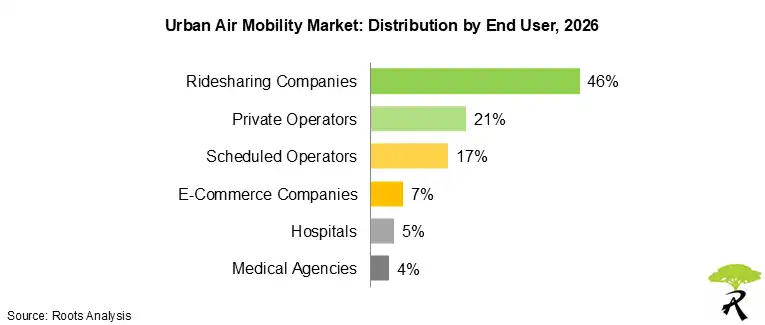
- In terms of end use industry, ridesharing companies hold the largest share (46%) of urban air mobility market.
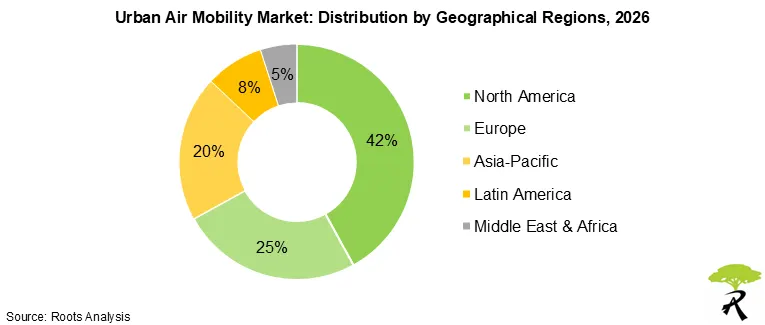
- In terms of leading region, North America holds the largest share with 42% share of the market.
- Market growth of urban air mobility market is driven by traffic congestion, urbanization, and investment in eVTOL technology worldwide.
Market Overview
Urban air mobility (UAM) refers to on-demand, automated air transportation systems designed for passengers and cargo within densely populated urban and metropolitan areas. UAM for passenger and cargo transport primarily leverages electric vertical takeoff and landing (eVTOL) aircraft to operate safely above ground infrastructure. This concept reimagines vertical airspace as a dynamic mobility layer, with the integration of UAM into existing air traffic management, enabling seamless city-scale flights.
Key applications of UAM span passenger commuting via air taxis to alleviate daily gridlock, cargo delivery for time-sensitive logistics like medical supplies, and specialized uses such as emergency medical evacuations, public safety surveillance, and organ transport. These extend to inter-city connectors for business travelers and scheduled operations linking urban hubs to airports, bypassing traditional road limitations while supporting rescue services in congested environments.
Growth in UAM is propelled by escalating urbanization that intensifies road congestion, coupled with intelligent technologies like autonomous flight systems and enhanced air traffic control for efficient airspace utilization. Electric propulsion advancements promise lower emissions and quieter operations, aligning with sustainability imperatives amid depleting resources, while regulatory collaborations and innovations in battery autonomy further enable scalable integration into existing mobility ecosystems.
Recent Developments
- In November 2025, Ehang Holdings, a global leader in advanced air mobility market, successfully launched an urban human-carrying flight event in Bangkok with the CAAT and local partners under the AAM Sandbox Initiative.
- In October 2025, ePlane accelerated urban air mobility innovation with Dassault Systemes’ 3DEXPERIENCE Platform.
- In August 2025, Joby Aviation, a company developing electric air taxis for commercial passenger service, announced its definitive agreement with Blade Air Mobility, to purchase Blade’s leading urban air mobility passenger business.
- In July 2025, Horizon Aircraft and ZeroAvia announced a partnership for exploring hydrogen-electric propulsion for regional vertical take-off and landing (VTOL) aircraft.
Pay Only for What You Need – The Best Way to Optimize
Market Share Insights
Ridesharing Companies to Shape the Future of UAM Industry
The ridesharing companies’ sub-segment will have the maximum market share (46%) during the current year. This growth can be attributed to established players like Uber leveraging existing ride-hailing apps, customer bases, and operational expertise. They can seamlessly integrate air taxis into their business models, enabling rapid scalability through partnerships with electric vertical takeoff and landing (eVTOL) services providers such as Joby Aviation and vertiport developers.
High commuter demand for premium, time-saving services, combined with early investments, brand loyalty, and regulatory progress favoring passenger operations positions the ridesharing companies ahead of e-commerce or medical users, which face slower adoption due to niche applications and infrastructure hurdles.
Air Taxis to Lead the Urban Air Mobility Market
According to the urban air mobility market report, air taxis sub-segment is set to dominate the current market with a market share of 63%. This dominance is due to the high potential of urban congestion reduction with air mobility, particularly for short distances. These taxis can avoid road traffic entirely.
Unlike traditional transportation that operates on fixed routes, on-demand urban air taxi services enable direct point-to-point journeys, cutting out detours and potentially shortening total travel time. These benefits are driving the air taxi market growth. Additionally, advancements in urban air mobility solutions using eVTOL air taxis for intra-city passenger transport and airport shuttles are making UAM a more practical and potentially cost-effective transportation option, which is likely to boost the segment’s prospects in the years ahead.
On the other hand, cargo air vehicles are expected to have the fastest CAGR (25.67%) over the forecast period. Urban air mobility applications for cargo logistics, medical evacuation, and emergency response operations enable these vehicles to deliver critical value, fueling the growth of this sub-segment.
Regional Urban Air Mobility Market Forecast Suggests Dominance of North America
North America currently dominates the market with a share of 41.90%. North America leads due to its mature aerospace ecosystem, featuring major manufacturers like Boeing and Joby Aviation, alongside high R&D investments exceeding billions from public-private partnerships.
Early FAA regulatory engagement accelerates certifications and pilots, while dense urban congestion in cities like Los Angeles and New York fuels demand for air taxis. Robust UAM infrastructure development includes vertiports, air corridors, and integration with existing public transit networks further outpace regions like Asia-Pacific.
Want Information on Specific Region / Segment?
Market Dynamics
Market Drivers
- Severe Urban Congestion and Demand for Faster Transport: Market growth of urban air mobility driven by traffic congestion, urbanization, and investment in eVTOL technology worldwide is shaping industry. These vehicles offer direct aerial routes for swift intra-city and short-haul journeys that bypass surface bottlenecks.
- Advances in Electric Propulsion, Batteries, and Autonomy: Breakthroughs in hybrid-electric systems, higher-density batteries, advanced composites, and AI-driven autonomy are rendering eVTOL designs more feasible, cost-effective, and operationally reliable for urban skies, further fueling the eVTOL aircraft market.
- Supportive Investment and Government Smart-city Initiatives: Robust private equity, corporate backing, and public sector commitments, alongside urban air mobility for smart cities and green policies, are fast-tracking R&D, vertiport development, and pilot programs across North America, Europe, and Asia-Pacific.
Market Challenges
- Public Acceptance, Noise and Safety Regulations for UAM: Public acceptance of urban air taxis hinges significantly on addressing safety fears, especially regarding flights over populated areas. Noise pollution, privacy issues, and skepticism towards autonomous flight systems further temper acceptance, necessitating transparent communication and stringent safety protocols to foster broader community support.
- Landing Sites, Vertiport Siting, and Urban Integration: Establishing vertiports in densely built urban zones remains challenging due to scarce land availability, strict zoning regulations, and the need to minimize noise and environmental impacts. Integration with existing transport networks to enable smooth multimodal connections is critical to the system's practicality and user convenience.
- Business-Model Viability and Industry Consolidation Risk: Market dynamics indicate that only a limited number of eVTOL manufacturers will successfully achieve certification and operational scale. This scenario raises concerns over investor confidence and compels operators and producers to demonstrate sustainable financial models and resilient operational economics to survive in a competitive landscape.
Key Market Insights
Competitive Landscape of Key Market Players
In the urban air mobility market, Joby Aviation leads with its advanced eVTOL designs and partnerships for regulatory approvals, focusing on scalable urban air taxi networks. Volocopter advances autonomous multicopter technology for seamless city integration, emphasizing noise reduction and vertiport and skyport infrastructure development.
Archer Aviation competes through rapid prototyping and collaborations with major airlines, prioritizing high-speed passenger transport, consequently fueling the passenger air mobility market. EHang Intelligent Technology pioneers fully autonomous operations in Asia-Pacific, leveraging early certifications for cargo and medical applications and enhancing the autonomous urban air mobility market.
Alongside these key players, Lilium is notable for its innovative electric jet technology, aiming for regional air mobility with a focus on range and efficiency. Vertical Aerospace is also prominent, pushing forward with FAA certification efforts, investment and partnerships in urban air mobility, targeting sustainable solutions. These companies collectively drive the competitive UAM landscape through continuous technological innovations, strategic alliances, and active engagement with regulatory bodies to accelerate commercial deployments at scale.
Regulatory Frameworks and Airspace Management for Safe Deployment of Urban Air Mobility Services in Major Cities
- EASA U-Space/UTM Regulatory Package: This package supports high-density drone and eVTOL operations via digital services for traffic management, identity verification, and geo-awareness, applicable from early 2023 after a transition period.
- FAA UAM Concept of Operations: The U.S. Federal Aviation Administration (FAA) outlines a comprehensive Concept of Operations (ConOps v2.0) for UAM, which emphasizes seamless operations in visual and instrument meteorological conditions while retaining FAA authority over the National Airspace System.
- AI-Driven Urban Traffic Management (UTM / ATM): Advanced UTM systems leverage AI and machine learning to orchestrate low-altitude airspace, analyzing real-time data on weather, traffic, and no-fly zones for dynamic path optimization and conflict avoidance. These scalable platforms integrate UAM with manned aviation, addressing urban density challenges for safe, efficient deployments.
- Global Harmonization and ICAO Guidelines: ICAO advocates for standardized UAM / AAM frameworks to harmonize state-level initiatives, similar to UTM provisions, ensuring interoperability across borders. This includes noise mitigation policies and dedicated corridors, fostering regulatory consistency for cross-city operations.
- Vertiport and Infrastructure Standards: Regulatory efforts focus on ground infrastructure like vertiports, mandating integration with urban design, energy networks, and public safety protocols. Performance-based rules from EASA and FAA prioritize noise reduction, cybersecurity, and scalability for major city rollouts.
Have Questions? Let’s Get Them Answered.
Market Segmentation
Urban Air Mobility Market: Scope of the Report
| Key Report Attributes | Details | |
| Historical Trend | Since 2022 | |
| Forecast Period | Till 2040 | |
| Market Size 2026 | USD 6.63 Billion | |
| Market Size 2040 | USD 206.79 Billion | |
| CAGR (Till 2040) | 27.85% | |
| Segments Covered |
|
|
| Key Players Profiled |
|
|
| PowerPoint Presentation (Complimentary) |
Available | |
| Customization Scope | 15% Free Customization | |
| Excel Data Packs (Complimentary) |
|
|
Market Segments
Based on research, we have segmented the urban air mobility market into component, vehicle type, platform architecture, operation mode, propulsion type, maximum take-off weight, range, infrastructure, end user, geographical regions, and leading players.
Market Share by Component
- Hardware
- Services
- Software
Market Share by Vehicle Type
- Air Ambulance & Medical Emergency Vehicles
- Air Metro
- Air Shuttle
- Air Taxis
- Cargo Air Vehicles
- Last-mile Delivery Vehicles
- Personal Air Vehicles
Market Share by Platform Architecture
- Fixed Wing
- Hybrid
- Rotory Wing
Market Share by Operation Mode
- Fully Autonomous
- Piloted eVTOLs
- Remotely Operated
Market Share by Propulsion Type
- Electric
- Hybrid-Electric
- Hydrogen Fuel Cell
- Others
Market Share by Maximum Take-off Weight
- <100 kg
- 100-300 kg
- >300 kg
Market Share by Range
- Intercity (50-200 km)
- Intracity (<50 km)
- Long Range (>200 km)
Market Share by Infrastructure
- Air Traffic Control System
- Charging Stations
- Maintenance
- Repair & Overhaul
- Vertiports
- Others
Market Share by End User
- E-Commerce Companies
- Hospitals
- Ridesharing Companies
- Medical Agencies
- Private Operators
- Scheduled Operators
Market Share by Geographical Regions
- North America
- US
- Canada
- Mexico
- Rest of North America
- Europe
- Austria
- Belgium
- Denmark
- France
- Germany
- Ireland
- Italy
- Netherlands
- Norway
- Russia
- Spain
- Sweden
- Switzerland
- UK
- Rest of Europe
- Asia-Pacific
- Australia
- China
- India
- Japan
- New Zealand
- Singapore
- South Korea
- Rest of Asia-Pacific
- Latin America
- Brazil
- Chile
- Colombia
- Venezuela
- Rest of Latin America
- Middle East and Africa (MEA)
- Egypt
- Iran
- Iraq
- Israel
- Kuwait
- Saudi Arabia
- UAE
- Rest of MEA


