


 Download Free Sample
 Buy Now
Yaw System Market Overview
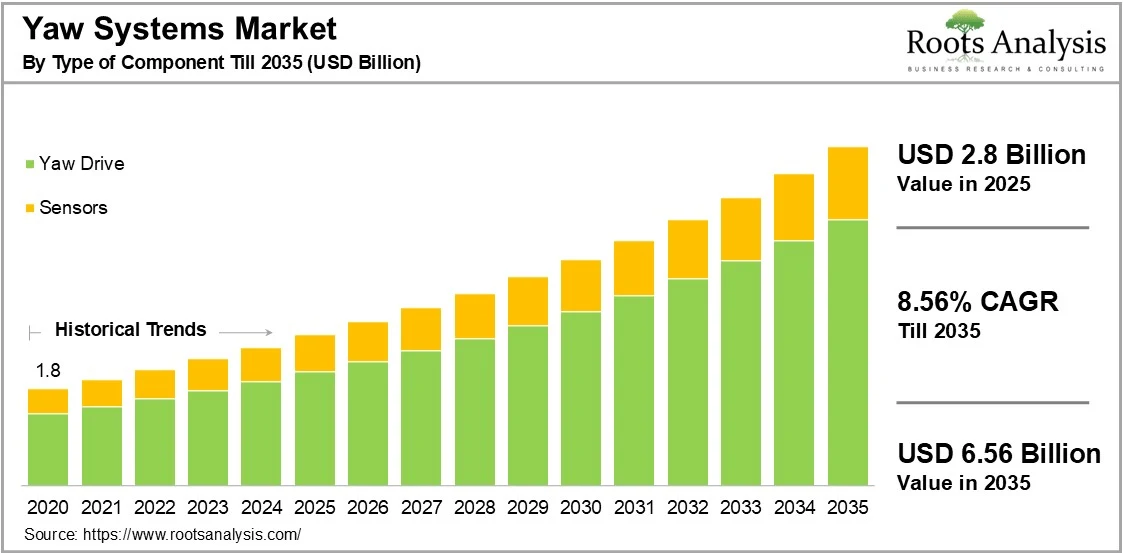
The global yaw system market, valued at USD 2.6 billion in 2024, is projected to reach USD 2.8 billion in 2025 and USD 6.56 billion by 2035, representing a CAGR of 8.56% during the forecast period.
 |
See What’s in the Full Report–Request Your Complimentary Insights!
The new research study consists of detailed yaw system market analysis, mega trends, patent analysis, porter five forces, SWOT analysis, value chain analysis and other strategic frameworks.
The yaw system is a critical component in wind turbines, responsible for aligning the rotor with the wind direction to maximize energy production. It achieves this by rotating the nacelle around the tower axis, ensuring optimal positioning and orientation. Key functions include protecting the wind wheel and automatically untwisting the turbine wheel. The system consists of yaw bearings, brakes, and drives, which work together to maintain the turbine's alignment with the wind, thereby enhancing energy efficiency and robustness.
The global yaw system industry is experiencing significant growth due to increased awareness of renewable energy, government initiatives promoting wind energy, and rising demand for power. However, high installation and manufacturing costs pose challenges. Technological advancements are expected to reduce these costs, offering new opportunities for market expansion.
The market's growth is further driven by the increasing demand for wind energy yaw systems and international campaigns for sustainable energy. Yaw systems are essential for maximizing wind energy production, and their technological innovations continue to improve performance and efficiency, supported by government programs encouraging renewable energy use.
Yaw System Market Segmentation Insights
The market report presents an in-depth analysis of the various companies that are involved in offering yaw systems, across different segments, as defined in the table below:
Yaw System Market: Report Attributes / Market Segmentations
| Market Segmentations | Details | |
| Historical Trend | Since 2020 | |
| Forecast Period | Till 2035 | |
| Market Size 2025 | $ 2.8 Billion | |
| Market Size 2035 | $ 6.56 Billion | |
| CAGR till 2035 | 8.56% | |
| Type of Yaw System |
|
|
| Areas of Application |
|
|
| Type of Component |
|
|
| Type of Technology |
|
|
| By End-Users |
|
|
| Type of Enterprise |
|
|
| Geographical Regions |
|
|
| Leading Market Players |
|
|
| PowerPoint Presentation (Complimentary) |
Available | |
| Customization Scope | 15% Free Customization | |
| Excel Data Packs (Complimentary) |
|
|
Have Questions? Let’s Get Them Answered.
Yaw System Market Share Insights
Market Share by Type of Yaw System
The global market is segmented across various types of yaw systems, such as active yaw systems and passive yaw systems. According to our global yaw system systems market size analysis, the active yaw market will augment the segment's growth with the largest market share of over 74.56% by the next decade. These systems are widely used due to their significant role in enhancing power generation and extending the service life of turbines.
Active yaw systems are more effective in aligning the wind turbine rotor with the wind direction, which maximizes energy output. This effectiveness makes them a preferred choice over passive systems, especially in large-scale wind farms where optimal energy production is crucial.
Market Share by Areas of Application
The yaw system solutions market is segmented into various areas of application such as gear motors, water conservancy project, wind energy, and other applications. According to our yaw system growth forecast, the wind energy segment will augment the segment's growth with the largest market share of over 65.6% by the next decade. This growth is due to the widespread use of yaw systems in wind turbines.
These systems are crucial for optimizing wind turbine performance by aligning the rotor with the wind direction, thereby maximizing energy output. The dominance of wind energy in the yaw system market is attributed to the rapid expansion of wind farms globally and the essential role yaw systems play in ensuring turbines operate efficiently.
Market Share by Type of Component
The market is segmented into various types of components, such as sensors and yaw drive. According to our analysis, the yaw drive segment will hold 84.6% yaw systems market share during the forecast period. The widespread use of yaw drives in large-scale wind farms, where optimal energy production is critical, contributes to their dominance in the market. Yaw drives consist of powerful electric motors and gearboxes that provide the necessary torque for slow and precise rotation, ensuring that the turbine remains aligned with changing wind conditions.
Market Share by Type of Technology
The market is segmented into various type of technology, such as electromechanical systems and hydraulic systems. According to our analysis, the electromechanical systems segment will hold 75.6% yaw system market share as well as grow at the fastest CAGR (9.7%) during the forecast period. These systems are widely used in active yaw systems due to their ability to provide precise control and dynamic adjustments necessary for optimizing wind turbine performance. Electromechanical systems, which include motors and gearboxes, are preferred for their reliability and efficiency in aligning turbines with wind directions.
Market Share by End Users
The market is segmented into various end users, such as energy sector, and industrial sector. According to our analysis, the energy segment will hold the largest share (74.6%) of the yaw system industry during the forecast period. This sector, particularly the wind energy segment, holds a significant market share due to the critical role yaw systems play in optimizing wind turbine efficiency and maximizing energy production. The energy sector's dominance is driven by the rapid expansion of wind farms globally and the increasing demand for renewable energy sources.
Market Share by Type of Enterprise
The market is fragmented into two types of enterprises, namely large and small and medium enterprises. Currently, the large enterprise segment is expected to dominate the segment with 60.34% of the market share. However, small and medium enterprise segments are expected to witness a relatively higher (9.19%) growth rate until 2035. This is ascribable to their agility, innovation, focus on niche markets, and ability to adapt to changing customer preferences and market conditions.
Market Share by Geographical Regions
This segment highlights the distribution of yaw system market share by regions, such as North America, Europe, Asia, Latin America, Middle East and North Africa, and the rest of the world. According to our regional analysis, the Asia yaw system market currently exhibits dominance with 32.89% of overall market share. The market is driven by its high requirement of wind power capacity and increase in urbanization & industrialization in countries such as China and India. China contributes to the largest share in the market due to the number of water conservancy projects in the region.
See What’s in the Full Report–Request Your Complimentary Insights!
Yaw System Market Key Insights
The “Yaw System Market, Till 2035: Industry Trends and Global Forecasts” report features an extensive study of the current market landscape, market size and future opportunity within the forecast period. The market report highlights the efforts of several stakeholders involved in this rapidly emerging segment of the service providers industry. Key takeaways of the global yaw system industry report are briefly discussed below.
Yaw System Market Drivers
The global yaw systems market growth is expected to be driven by several key factors including the global shift towards renewable energy sources, particularly wind power. The increasing awareness and demand for clean energy solutions are major factors propelling the market forward. Government initiatives to explore wind energy and implement policies supporting renewable energy also play a crucial role in fostering market growth.
Additionally, the surge in demand for wind energy, driven by the transition to renewable energy sources, continues to propel the market. Technological advancements in yaw systems further enhance their performance and efficiency, contributing to increased adoption in wind turbines. Lastly, the rising demand for power supply, coupled with the depletion of natural energy resources, adds to the market's expansion.
Competitive Landscape of Yaw System Market
According to the yaw system competitive landscape analysis, with the presence of several small and large companies, the market is experiencing intense competition and changing market dynamics. From large multinational companies to local players, companies are striving to enhance their competitive edge. In terms of market share, large enterprises and multinational companies are dominating the market. The key players are using strategies such as partnerships, acquisitions, ventures, innovations, novel product launches, R&D and geographical expansions to solidify their position in the industry.
Yaw System Market Challenges
Despite the strong market growth projection, there are several challenges in the yaw system industry. High capital investment requirements for manufacturing and installing yaw systems are a significant barrier, often discouraging smaller competitors and limiting market expansion. The lack of standardized components and interfaces complicates production and integration, leading to higher costs and longer lead times.
Additionally, the market faces competition from other renewable energy sources like solar and hydropower, which offer more flexible and cost-effective options. Technological challenges, such as ensuring reliability in extreme weather conditions, particularly in offshore settings, also pose a challenge. Furthermore, the complexity of integrating yaw systems with existing turbines and the need for continuous research and development to improve efficiency add to the market's challenges.
Regional Analysis: Asia is Expected to Dominate the Market with the Largest Yaw System Market Share
With respect to regional analysis of yaw system, Asia is likely to dominate the market for the forecast period. The growth of this region can be attributed to the rising demand for wind power, which is being driven by aggressive renewable energy targets in nations like China and India. Yaw system technological developments increase turbine dependability and efficiency, which draws in more investment. The expansion of wind energy infrastructure is also greatly aided by government programs encouraging the use of renewable energy sources and urbanization.
Unlock Deeper Insights–Schedule Your Personalized Workshop Today!
Leading Players in Yaw System Market
Examples of leading yaw system manufacturers (which have also been captured in this market report, arranged in alphabetical order) include Altra Industrial Motion, Antec, Bonfiglioli, Bosch Rexroth, DEIF A/S, Eaton, Enercon, General Electric, Geartechnology, Goldwind, Grede Holding, Hanning Kahl, Hydratech, Keba, Kor-Pak, Mitsubishi, Moog, NGC Gears, Nordex SE, Seaglet, Senvion, Shanghai Electric, Siemens, SIBRE Siegerland Bremsen, Suzlon Energy, Svendborg Brakes, Vestas Wind Systems, Wecsrenewables, and ZOLLERN.
Recent Developments in Yaw System Market
- In April 2024, Bonfiglioli announced a new electronic yaw control solution that integrates with their existing gear motors, enhancing energy management capabilities for wind turbines.
- In March 2024, Siemens introduced a new active yaw control system designed for wind turbines, focusing on improved efficiency and reliability under varying wind conditions.
Yaw System Market Report Coverage
The market report presents an in-depth analysis, highlighting the capabilities of various companies engaged in this domain, across different segments. Amongst other elements, the market report includes:
- A preface providing an introduction to the full report, Yaw System Market, 2020-2024 (Historical Trends) and 2025-2035 (Forecasted Estimates).
- An outline of the systematic research methodology adopted to conduct the study on the yaw systems, providing insights on the various assumptions, methodologies, and quality control measures employed to ensure the accuracy and reliability of our findings.
- An overview of economic factors that impact the overall yaw system industry, including historical trends, currency fluctuation, foreign exchange impact, recession, and inflation measurement.
- An executive summary of the insights captured during our research. It offers a high-level view of the current state of the market for yaw system and its likely evolution in the mid-long term.
- A detailed assessment of the yaw system market landscape, based on several relevant parameters, including year of experience, company size, location of headquarters, and ownership structure.
- Elaborate profiles of prominent players engaged in the yaw system industry, featuring information on their year of establishment, location of headquarters, company size, company mission, company footprint, management team, contact details, financial information, operating business segments, product portfolio, moat analysis, recent developments, and an informed future of yaw system.
- A qualitative assessment of the various megatrends ongoing in the yaw system market, including renewable energy transition, government initiatives and policies, and technological innovations.
- An analysis highlighting the key unmet needs across yaw system industry, featuring market research on yaw system industry insights generated from real-time data on unmet needs as identified from social media posts, recent publications, industry blogs and the views of key opinion leaders expressed on online platforms.
- An in-depth analysis of various patents that have been filed / granted related to yaw systems and its components, based on various parameters, such as type of patent, patent publication year, patent age and leading players
- A detailed analysis of recent developments in the yaw system domain, based on relevant parameters such as year of initiative, type of initiative (partnerships and collaborations, expansions, funding and product launches), geographical distribution and most active players (in terms of number of recent developments).
- Key winning strategies framework that helps in analyzing the level of competition within an industry, by tracing the key market activities including partnership, funding, expansion of leading players
- A qualitative analysis, highlighting the five competitive forces prevalent in yaw system industry, including threats for new entrants, bargaining power of suppliers, bargaining power of customers, threats of substitution and rivalry among existing competitors.
- A discussion on affiliated global yaw system market trends, key drivers and challenges, under a SWOT framework, which are likely to impact the industry’s evolution, along with a Harvey ball analysis, highlighting the relative effect of each SWOT parameter on the overall yaw system industry.
- A value chain analysis featuring a discussion on various stakeholders involved in the development of the yaw systems, from suppliers to end-users.
- A detailed estimate of the current market size and the potential future of yaw system market initiatives over the next decade. Based on multiple parameters we have provided an informed estimate on the market evolution during the forecast period 2025-2035. The report also features the likely distribution of the current and forecasted opportunity within the yaw system market. Further, in order to account for future uncertainties and to add robustness to our model, we have provided three forecast scenarios, namely conservative, base, and optimistic scenarios, representing different tracks of the industry’s growth.
- Detailed projections of the current and future market across various types of yaw systems such as active yaw systems, and passive yaw systems.
- Detailed projections of the current and future market across various areas of application such as gear motors, water conservancy project, wind energy, and other applications.
- Detailed projections of the current and future market across various types of components, such as sensors and yaw drive.
- Detailed projections of the current and future market across various type of technology, such as electromechanical systems and hydraulic systems.
- Detailed projections of the current and future market across various end-users, such as energy sector, and industrial sector.
- Detailed projections of the current and future market across various types of enterprises such as large enterprises and small and medium enterprises.
- Detailed projections of the current and future yaw system market across various geographical regions, such as North America (US, Canada, Mexico and other North American countries), Europe (Austria, Belgium, Denmark, France, Germany, Ireland, Italy, Netherlands, Norway, Russia, Spain, Sweden, Switzerland, UK and other European countries), Asia (China, India, Japan, Singapore, South Korea and other Asian countries), Middle East and North Africa (Egypt, Iran, Iraq, Israel, Kuwait, Saudi Arabia, UAE and other MENA countries), Latin America (Brazil, Chile, Colombia, Venezuela and other Latin American countries) and rest of the world (Australia, New Zealand and other countries).
Want Information on Specific Region/Segment?
About Authors
Lead Author: Anmol Bali
Lead Reviewer: Prachi Bhalla
Chief Editor: Ronit Sharma
Customization Opportunities
At Roots Analysis, we genuinely care about your success and understand that your business requirements are unique. While our market research reports provide valuable insights, we recognize that they might not cover every aspect you need to make well-informed strategic decisions. To account for that, we offer 10% free customization tailored to your specific needs. Whether you require additional quantitative analysis, qualitative insights, or any other information related to the Yaw Systems market, reach out us today at: support@rootsanalysis.com


