Aluminum Alloys Market Overview
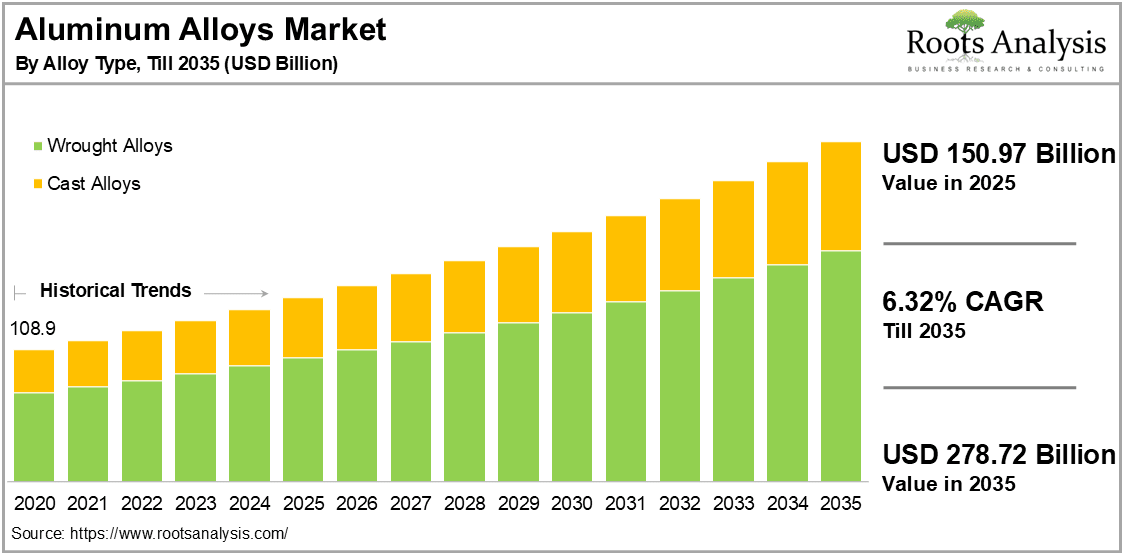
The global aluminum alloys market size is expected to rise from USD 150.97 billion in 2025 to USD 218.1 billion by 2030, and USD 278.72 billion by 2035, representing an overall CAGR of 6.32% till 2035.
To learn more about this report, request a free sample copy
Aluminum alloys are metallic materials in which aluminum serves as the primary component, combined with elements, such as copper, magnesium, manganese, silicon, tin, nickel, and zinc to enhance their mechanical and physical properties.
The aluminum alloys market stands out for its remarkable adaptability to technological innovation and sustainability demands. As industries worldwide seek lighter, stronger, and more energy-efficient materials, aluminum alloys have become a material of choice for next-generation engineering.
These alloys are engineered to deliver specific characteristics, such as increased strength, improved corrosion resistance, better workability, and tailored electrical conductivity, making them indispensable in a wide range of applications, from aerospace and automotive to construction and consumer electronics. Their high strength-to-weight ratio and corrosion resistance are particularly valued in sectors, such as electric vehicles and renewable energy infrastructure, where performance and longevity are paramount.
Another defining feature of the aluminum alloys market is its responsiveness to circular economy principles and advanced manufacturing. The alloys’ inherent recyclability aligns with global sustainability goals, while innovations in processing, such as additive manufacturing, AI-driven quality control, and solid-state techniques like friction extrusion, are expanding the boundaries of what is possible with aluminum. Notably, these methods enable the creation of nanostructured alloys from recycled scrap, where nanoscale precipitates and nanoclusters (e.g., Guinier-Preston zones in upcycled 6063-to-7075 equivalents) boost strength by over 200% without melting, further enhancing circularity and performance.
In fact, it’s also being noted by various researchers that the ability to recycle aluminum alloys without loss of properties is a game-changer for industries striving to reduce their environmental footprint and embrace closed-loop production systems. This blend of performance, versatility, and sustainability positions the aluminum alloys market as a key enabler of industrial transformation in the 21st century.
Aluminum Alloys Market Share Insights
The aluminum alloys market report 2025 presents an in-depth analysis of the various companies that are involved in offering aluminum alloys, across different segments, as defined in the table below:
Aluminum Alloys Market: Report Attributes / Market Segmentations
Aluminum Alloys Market Segmentation
Which Alloy Type Will Dominate the Market?
Among the different types, the wrought alloy sub-segment is set to take the lead, holding a significant share of 67.78%.
This significant position of the wrought aluminum alloy market is a result of the rising use of wrought alloy for food packaging and consumer products as it is cheaper. Further, wrought alloys have a superior-strength-to-weight ratio, enabling applications that require both durability and lightweight materials.
However, the cast aluminum alloys sub-segment is likely to witness the fastest aluminum alloys market CAGR (6.45%) during the forecasted period.
How is Sheets Sub-Segment Dominating the Market?
According to our aluminum alloys market forecast, sheets sub-segment stands out as the leading one, holding a market share of 74%.
This growth is due to the extensive use of aluminum alloy sheets in automotive industry, where they contribute to the lightweight of vehicle body panels and structural components. Further, they are also being used in aerospace for fuselage panels and wing skins, while in construction they are used for roofing, facades and siding.
Meanwhile, the foils segment is likely to witness the fastest CAGR (6.76%) during the forecast period.
Which Series Will Dominate the Aluminum Alloys Market?
According to our aluminum alloys market analysis, the 1000 series aluminum alloys stand out as the leading one, holding a market share of 37%.
The growth of this sub-segment is because of its high purity as well as high electrical conductivity and corrosion resistance. These properties corroborate the segment’s wide usage in the chemical and processing industries.
Meanwhile, the 6000 series sub-segment is expected to witness the fastest CAGR (7.12%) during the forecasted period.
Why the High Strength Aluminum Alloys Lead the Global Market?
The global aluminum alloys market is segmented into high strength aluminum alloys and ultra high strength aluminum alloys based on their strength. The global market is led by the high strength aluminum alloys, capturing 87% market share during the forecasted period.
This is due to the rising demand of aluminum alloys for automotive, aerospace, construction, and marine industries, where a balance of strength, weight, and corrosion resistance is critical for structural and safety components.
Which Production Technique Will Dominate the Aluminum Alloys Market?
Of the production technique, the high pressure die casting sub-segment is set to hold the largest share of 47% as well as is likely to grow at a relatively faster pace (CAGR of 7.56%) during the forecasted period.
This significant position of the high pressure die casting technique is due to its ability to produce complex, high-precision, and high-volume parts efficiently, primarily in the automotive and electronics sectors. In addition, the increasing adoption of this technique by automakers and manufacturers to meet the demand for lightweight, intricate, and cost-effective components, further fuels the market growth.
Which End Use Industry Will Dominate the Aluminum Alloys Market?
Of the end use industry, the aluminum alloy for automotive industry sub-segment is set to capture the largest share of 37% in the current global market.
This is a result of high prioritization of aluminum alloys by automakers for lightweighting, improving fuel efficiency and emission reductions of their vehicles. Apart from this, the central role of aluminum alloys in the construction of vehicle bodies, chassis, and components further fuels the market.
Meanwhile, the aluminum alloy for packaging sub-segment is expected to witness the fastest CAGR (6.97%).
Which Regions are Expected to See the Highest Aluminum Alloys Market Demand?
According to our regional analysis of aluminum alloys market demand, Asia is likely to contribute the largest due to the increasing industrialization, urbanization, and infrastructural development. In countries, such as China and India, the utilization of aluminum alloy for construction and manufacturing is primarily driving the demand of aluminum alloys.
In fact, the Asian aluminum alloys market exhibits dominance by capturing 36.86% share within the current global market. On the contrary, the aluminum market in North America is set to witness the fastest CAGR (7.11%) during the forecasted period.
Aluminum Alloys Market Key Insights
The “Aluminum Alloys Market: Industry Trends and Global Forecasts, Till 2035” report features an extensive study of the current market landscape, market size, and future opportunity within the global aluminum alloys market forecast period. The market report highlights the efforts of several stakeholders involved in this rapidly emerging segment of the service providers industry. Key takeaways of the market report are briefly discussed below.
Aluminum Alloys Market Drivers and Challenges
What are the Key Drivers for Growth in the Aluminum Alloys Market?
The aluminum alloys market is experiencing robust growth due to several key drivers. Here are some significant factors contributing to this expansion:
- Increasing Demand for Lightweight, High-Strength Materials in Automotive and Aerospace: The wide usage of aluminum alloy for aerospace and automotive industries is a major growth factor for the market. Alloys are widely used in these industries due to their superior strength-to-weight ratio. The push for fuel efficiency, reduced emissions, and improved performance is driving manufacturers to adopt aluminum alloys for vehicle frames, body panels, and aircraft components. The growth of electric vehicles (EVs) and the need for lightweight solutions further amplify this trend.
- Expansion of Construction and Infrastructure Activities: Aluminum alloy for construction is widely used to build window frames, roofing, and structural elements due to its corrosion resistance and durability. Rapid urbanization, infrastructure development, and the need for sustainable building materials are fueling demand in this sector.
- Technological Advancements and Manufacturing Innovations: Recent advances in 3D printing, AI automation, and additive manufacturing are enabling the production of lighter, more complex, and high-performance aluminum alloy components. These innovations reduce material and energy use, enhance product quality, and support the development of advanced alloys for specialized applications.
- Growth in Packaging and Consumer Electronics Industries: Aluminum alloys are essential in packaging of food, beverages, and pharmaceuticals due to their complete barrier properties and recyclability. Further, the expansion of consumer electronics manufacturing also drives demand for aluminum alloys in casings, heat sinks, and connectors.
What Challenges Affect Aluminum Alloys Production and Supply?
The existing challenges in the aluminum alloys market are as follows:
- Volatility in Raw Material Prices: Fluctuations in the prices of aluminum and alloying elements can impact production costs and profit margins for manufacturers.
- Supply Chain Disruptions: Geopolitical tensions, trade restrictions, and logistical challenges can disrupt the supply of raw materials and finished products, affecting market stability.
- Environmental Regulations and Compliance: Strict environmental regulations regarding emissions, waste management, and resource utilization require manufacturers to invest in cleaner technologies and sustainable practices, increasing operational costs.
- High Production and Processing Costs: The manufacturing of aluminum alloys involves complex processes and significant energy consumption, leading to high production costs and potential barriers for new entrants.
- Competition from Alternative Materials: The emergence of advanced polymers, composites, and other high-performance materials may challenge the dominance of aluminum alloys in certain applications.
What is the Impact of Automotive Sector on Aluminum Alloys Market?
The automotive sector is a major force driving the aluminum alloys market, as automakers increasingly use aluminum alloys to manufacture lighter vehicles that meet stricter emission standards and improve fuel efficiency, with the shift to electric vehicles further boosting demand.
How are the Advancements in 3D Printing and AI Automation for Aluminum Alloys Shaping the Industry?
Advancements in 3D printing and AI automation are revolutionizing aluminum alloy manufacturing by enabling the creation of complex, high-precision parts, optimizing production processes, and reducing material waste, though widespread industrial adoption is still evolving.
How is Aluminum Alloys Market Growth Driven by Construction Industry?
The construction industry plays a crucial role in driving the aluminum alloys market, fueling steady demand in both residential and commercial sectors. This is due to the increased use of aluminum alloy for construction owing to their strength, corrosion resistance, and sustainability in modern building and infrastructure projects.
How are Government Policies Influencing Aluminum Alloys Market?
Government policies, including emission regulations, incentives for lightweight and sustainable materials, and tariffs on raw materials, significantly shape market demand, production strategies, and the competitive dynamics of the aluminum alloys industry.
Competitive Landscape and Key Players in Aluminum Alloys Market?
The aluminum alloys market is competitive, with leading players, including Alcoa, Alcan, and Nippon Light Metal investing in innovation and strategic partnerships to maintain their edge, while new entrants focus on cost leadership and specialized applications. These companies invest heavily in R&D to offer differentiated solutions, while also facing competition from open-source and emerging proprietary companies. Apart from that, competitors are opting for various technological innovations to strengthen their position in the aluminum alloys competitive landscape 2025.
Recent Developments in the Aluminum Alloys Market
- In June 2025, The Shanghai Futures Exchange, for the first time launched the cast aluminum alloy futures and options for trading amongst the other renewable commodities.
- In March 2025, Alloyed raised £37 million in a Series B funding round to accelerate the development of its digital alloy design platforms and enhance the Alloyed product line, , which includes copper alloys, alloy steels, stainless steels, and aluminum alloys.
- In February 2025, Nio developed a new aluminum alloy material to use in the body-in-white of Nio ET9 and Onvo L60.
- In January 2025, Gravita India commenced the commercial production of recycled aluminum alloy at its new recycling plant in Ghana, having the capacity of around 4,000 MTPA in phase-1.
Glossary for Aluminum Alloys Market
- Circular Economy: A system where aluminum materials are designed, used, and recycled repeatedly to reduce waste and save resources, promoting sustainability by keeping materials in use instead of discarding them.
- Closed-Loop Production Systems: Manufacturing processes where aluminum products are recycled and reused continuously within the system, minimizing waste and the need for new raw materials.
- Fuselage Panels: Aluminum sheets or panels used in the body structure of aircraft, valued for their strength and light weight.
- High Pressure Die Casting (HPDC): A fast and economical casting method where molten aluminum is forced under high pressure into a metal mold, used for making precise, large-volume parts.
- Investment Casting: A casting process where a wax pattern is coated with a ceramic shell to form a mold, then molten aluminum is poured in; it produces detailed and complex shapes with good surface finish.
- Low Pressure Die Casting: A casting method where molten aluminum is pushed into a mold at low pressure, producing parts with better mechanical properties than high pressure die casting.
- Permanent Mold Casting: A casting process using reusable metal molds where molten aluminum is poured or forced in, offering better quality and strength than sand casting.
Aluminum Alloys Market Report Coverage
The market report presents a guide to understanding different types of aluminum alloys and their applications, highlighting the capabilities of various companies engaged in this domain, across different segments. Amongst other elements, the market report includes:
- A preface providing an introduction to the full report, aluminum alloys market, 2020-2024 (Historical Trends) and 2025-2035 (Forecasted Estimates).
- An outline of the systematic research methodology adopted to conduct the study on the aluminum alloys market, providing insights on the various assumptions, methodologies, and quality control measures employed to ensure the accuracy and reliability of our findings.
- An overview of economic factors that impact the overall aluminum alloys market, including historical trends, currency fluctuation, foreign exchange impact, recession, and inflation measurement.
- An executive summary of the aluminum alloys market insights captured during our research. It offers a high-level view of the current state of the market and its likely evolution in the mid-long term.
- A detailed assessment of the aluminum alloys market landscape, based on several relevant parameters, including year of establishment, company size, location of headquarters, and ownership structure.
- Elaborate profiles of prominent players engaged in the aluminum alloys market, featuring information on their year of establishment, location of headquarters, company size, company mission, company footprint, management team, contact details, financial information, operating business segments, aluminum alloys market portfolio, moat analysis, recent developments, and an informed future of aluminum alloys systems.
- A qualitative assessment of the various megatrends ongoing in the aluminum alloys market, including lightweighting, sustainability & circular economy, and digitalization & industry 4.0 integration.
- An analysis highlighting the key unmet needs across aluminum alloys market industry, featuring market research on aluminum alloys industry analysis generated from real-time data on unmet needs as identified from social media posts, recent publications, industry blogs and the views of key opinion leaders expressed on online platforms.
- An in-depth analysis of various patents that have been filed / granted related to aluminum alloys market and its components, based on various parameters, such as type of patent, patent publication year, patent age and leading players
- A detailed analysis of recent developments in the aluminum alloys market domain, based on relevant parameters, such as year of initiative, type of initiative (partnerships and collaborations, expansions, funding and product launches), geographical distribution and most active players (in terms of number of recent developments).
- Key winning strategies framework that helps in analyzing the level of competition within an industry, by tracing the key market activities, including partnership, funding, and expansion of leading players
- A qualitative analysis, highlighting the impact of five competitive forces on the aluminum alloys market, including threats for new entrants, bargaining power of suppliers, bargaining power of customers, threats of substitution and rivalry among existing competitors.
- A discussion on affiliated aluminum alloys market trends, key drivers and challenges, under a SWOT framework, which are likely to impact the industry’s evolution, along with a Harvey ball analysis, highlighting the relative effect of each SWOT parameter on the overall aluminum alloys market.
- A value chain analysis features a discussion on various stakeholders involved in the development of the market, from aluminum alloy suppliers to end-users.
- A detailed estimate of the current market size and the potential growth future of aluminum alloys market initiatives over the next decade. Based on multiple parameters we have provided an informed estimate on the market evolution during the forecast period 2025-2035. The report also features the likely distribution of the current and forecasted opportunity within the aluminum alloys market. Further, in order to account for future uncertainties and to add robustness to our model, we have provided three forecast scenarios, namely conservative, base, and optimistic scenarios, representing different tracks of the industry’s growth.
- Detailed projections of the current and future market across various alloy type, such as cast alloys, and wrought alloys.
- Detailed projections of the current and future market across various form, such as foils, plates, and sheets.
- Detailed projections of the current and future market across series, such as 1000 series, 2000 series, 3000 series, 4000 series, 5000 series, 6000 series, 7000 series, and 8000 series.
- Detailed projections of the current and future market across various strength, such as high strength and ultra-high strength.
- Detailed projections of the current and future market across various production technique, such as high pressure die casting, low pressure die casting, investment casting, permanent mold casting, and sand casting.
- Detailed projections of the current and future market across various process, such as casting, extrusion, forging, rolling, and others.
- Detailed projections of the current and future market across various end use industry, such as aerospace & defense, automotive, building & construction, consumer durables, electrical & electronics, packaging and others.
- Detailed projections of the current and future aluminum alloys market across various geographical regions, such as North America (US, Canada, Mexico and other North American countries), Europe (Austria, Belgium, Denmark, France, Germany, Ireland, Italy, Netherlands, Norway, Russia, Spain, Sweden, Switzerland, UK and other European countries), Asia (China, India, Japan, Singapore, South Korea and other Asian countries), Middle East and North Africa (Egypt, Iran, Iraq, Israel, Kuwait, Saudi Arabia, UAE and other MENA countries), Latin America (Brazil, Chile, Colombia, Venezuela and other Latin American countries) and rest of the world (Australia, New Zealand and other countries).
From the Author’s Desk
Author’s View on Aluminum Alloys Market
The aluminum alloys market is seeing strong growth, fueled by demand from industries, such as automotive, aerospace, construction, and energy. Aluminum alloys offer key advantages, such as light weight, strength, and corrosion resistance, making them essential for building durable and efficient products. As industries advance and focus on sustainability, aluminum alloys are vital for innovation and greener manufacturing worldwide.
Lead Author: Anmol Bali
Lead Reviewer: Yash Tyagi
Chief Editor: Ronit Sharma
Customization Opportunities
At Roots Analysis, we genuinely care about your success and understand that your business requirements are unique. While our aluminum alloys market research reports provide valuable insights, we recognize that they might not cover every aspect you need to make well-informed strategic decisions. To account for that, we offer 15% free report customization tailored to your specific needs. Whether you require additional quantitative analysis, qualitative insights, or any other information related to the aluminum alloys market, reach out us today at: support@rootsanalysis.com
Frequently Asked Questions
What are aluminum alloys?
An aluminum alloy is a metallic material in which aluminum serves as the primary component, combined with elements, such as copper, magnesium, manganese, silicon, tin, nickel, and zinc to enhance its mechanical and physical properties.What is the projected size of the global aluminum alloys market by 2034?
The projected aluminum alloys market size will be worth USD 262.14 billion by 2034.Which region dominates the aluminum alloys market globally?
Asia leads the global aluminum alloys market, particularly China, due to rapid industrialization and strong automotive and construction sectors.What are the main types of aluminum alloys available in the market?
The primary types are wrought alloys and cast alloys.How does the automotive industry influence aluminum alloys demand?
The automotive industry is a major driver, using aluminum alloys for lightweighting to improve fuel efficiency and meet emission standards, especially with the rise of electric vehicles.How is the construction sector impacting the aluminum alloys market?
The construction sector boosts demand for aluminum alloys due to their durability, corrosion resistance, and increasing use in sustainable building materials.Who are the leading manufacturers in the aluminum alloys market?
Leading manufacturers include Alcoa Corporation, Rio Tinto, Norsk Hydro ASA, RusAL, Hindalco Industries, Constellium, AMG ALUMINUM, Kaiser Aluminum, Arconic, and Vedanta Aluminium & Power.What role do government policies play in the aluminum alloys market?
Government policies on emissions, fuel efficiency, and sustainable construction materials directly influence demand and production practices in the aluminum alloys market.What technological advancements are shaping the aluminum alloys market?
Innovations in recycling, 3D printing, and alloy formulation, as well as automation and AI-driven manufacturing, are enhancing efficiency and enabling new applications.How do raw material price fluctuations affect the aluminum alloys market?
Fluctuations in raw material and energy prices impact production costs and profitability, sometimes leading to supply constraints or capacity reductions.What are the emerging trends in high-performance and sustainable aluminum alloys?
Trends include the development of high-strength, lightweight alloys, increased use of recycled materials, and a focus on alloys with improved performance for EVs and green construction.