


 Download Free Sample
 Buy Now
Market Size
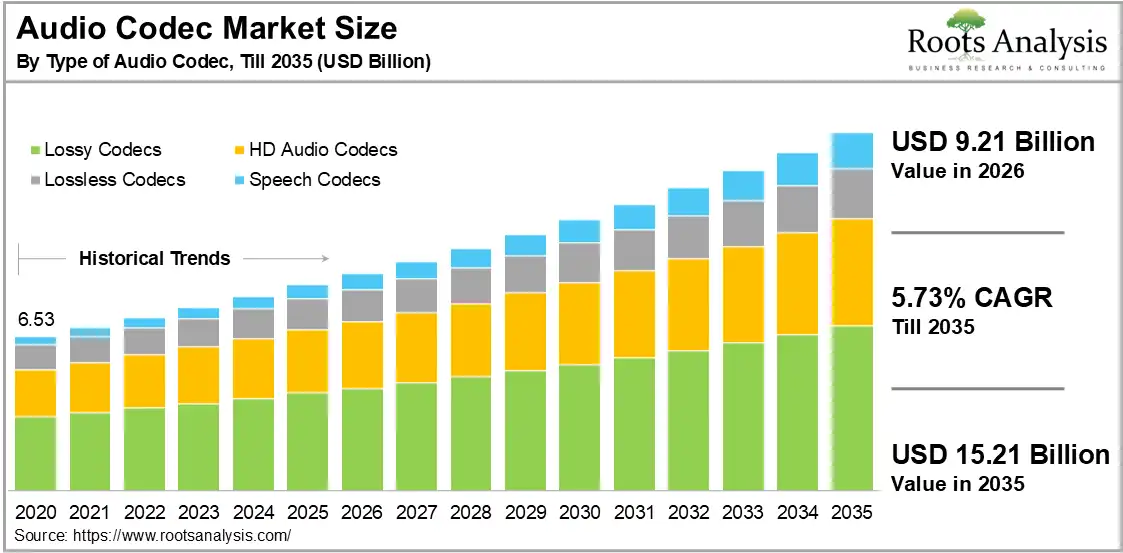
The global audio codec market size is projected to reach USD 9.21 Billion in 2026, USD 12.17 billion in 2030, and USD 15.21 billion by 2035, representing the 5.73% CAGR during the forecast period.
See What’s in the Full Report – Request Your Complimentary Insights!
Market Overview
An audio codec is a device or software program that encodes or decodes digital audio data, compressing it for storage or transmission and decompressing it for playback. The primary goal of an audio codec is to represent high-fidelity audio signals using as few bits as possible without sacrificing quality, thereby reducing storage requirements and bandwidth for audio files and streams.
In hardware, an audio codec typically integrates both analog-to-digital (ADC) and digital-to-analog (DAC) converters, facilitating seamless conversion between analog and digital audio signals for a wide range of devices and applications.
The audio codec market is evolving rapidly, driven by the proliferation of consumer electronics, the rise of IoT-enabled devices, and the increasing demand for high-quality audio experiences across platforms, including smartphones, smart home devices, and automotive infotainment systems.
As audio codecs become more sophisticated, they are not only supporting higher resolutions and wider dynamic ranges but also enabling features, such as low-latency streaming and multi-channel audio integration. This shift is particularly significant in professional and consumer applications, where users expect immersive, studio-quality sound in everything from business conferencing to home theater electronics.
As Ken Nevard, product marketing manager for digital audio products at Analog Devices, notes, the PC is equipped with professional sound quality that's expected in business conferencing, as well as music and home theater electronics, highlighting how advances in codec technology are narrowing the gap between professional and consumer audio experiences.
Recent Industry Developments
- In June 2025, Apple unveiled a new spatial audio format that expands on Dolby Atmos, rivaling Google and Samsung's Eclipsa Audio. This format has two components; ASAF, which is used in audio and video production to position audio elements in a three-dimensional space, and APAC (Apple Positional Audio Codec), which is the codec that's used to deliver it.
- In May 2025, Sony launched WH-1000XM6, the new ANC flagship headphones, with LDAC codec support for high-resolution audio streaming, along with 360 Spatial Sound Technology.
- In February 2025, Noise launched their 'Noise Master Buds TWS' which comes with Sound by Bose technology, adaptive Active Noise Cancellation (ANC), spatial audio and high-definition audio codec support, making them a strong contender in the premium TWS market.
Pay Only for What You Need – The Best Way to Optimize
Market Share Insights
Which Audio Codec Type Will Dominate the Market?
Among the audio codec, the lossy codecs sub-segment is set to take the lead, holding a significant share of 63.78%. This growth is driven by their widespread use in streaming, mobile devices, and online communications, where efficient audio compression codecs and bandwidth saving are crucial for mass-market adoption. However, the HD audio codec sub-segment will witness the fastest audio codec market CAGR (6.18%) during the forecasted period.
How is the Hardware Sub-Segment Dominating the Market?
According to our audio codec market analysis, the hardware sub-segment stands out as the leading one, holding a market share of 77%. This growth can be attributed to the miniaturization and power efficiency of hardware codecs. The miniaturization of these devices is crucial for integrating high-quality audio processing into portable and wearable devices.
The smaller and efficient the hardware codecs, the more sleekly it can be designed without compromising on the audio quality. As technology continues to evolve, hardware codecs will likely become even more efficient and versatile, broadening their application scope. Meanwhile, the software sub-segment is expected to witness the fastest CAGR (6.84%) during the forecasted period.
Which Channel Type Will Dominate the Audio Codec Market?
According to our audio codec market analysis, the stereo sub-segment stands out as the leading one, holding a market share of 57%. This growth can be reasoned with the fact that most consumer electronics, such as smartphones, laptops, and televisions, primarily use stereo sound for music, video, and general media applications.
Meanwhile, the multi-channel sub-segment is expected to witness the fastest CAGR (7.52%) during the forecasted period.
Which Function Will Dominate the Audio Codec Market?
Of the function, the without DSP sub-segment is set to hold the largest revenue share of 76% during the forecasted period. This segment growth can be attributed to the high preference of audio codecs without DSP for applications where cost is a critical factor.
These codecs provide the necessary audio compression and decompression without the added expense of DSP capabilities. This makes them suitable for low-cost consumer electronics, such as audio codec for smartphones, basic feature phones, and entry-level audio devices. However, the with DSP sub-segment is likely to witness the fastest CAGR of 7.16% during the forecasted period.
Which Technology Standard Will Dominate the Audio Codec Market?
Of the technology standard, the AAC is set to hold the largest revenue share of 40% during the forecasted period. This growth can be attributed to the ability of AAC technology to offer an optimal balance between compression efficiency and audio quality.
This makes it the preferred choice for a wide range of consumer electronics, including smartphones, streaming platforms, and smart devices. Its widespread adoption is further supported by compatibility with major operating systems and streaming services, as well as its ability to deliver high-fidelity sound at lower bitrates.
Meanwhile, the TWS sub-segment accounted for the fastest CAGR (6.78%) due to explosive growth of wireless earbuds and headphones.
Which End Use Will Dominate the Audio Codec Market?
From the end use segment, the mobile phones and tablets sub-segment is set to hold the largest share of 39% during the forecasted period. This growth is being fueled by the excessive demand for smartphones and tablets with superior sound quality.
This enables the manufacturers to incorporate advanced audio codecs capable of handling higher bit rates and sample rates to deliver detailed and immersive audio experiences. This trend is particularly evident in flagship models and premium devices where audio quality is a key differentiator. However, the IoT devices segment is likely to witness the fastest CAGR of 6.56% during the forecasted period.
Which Vertical Will Dominate the Audio Codec Market?
Among the vertical, the entertainment sub-segment is set to hold the largest revenue share of 33% during the forecasted period. The growth of this segment is because audio codecs are fundamental to delivering high-quality sound in streaming media, music, movies, and content creation.
With the explosion of digital streaming platforms, such as Spotify, Netflix, and YouTube, as well as the growth of music downloads and podcasts, there is continuous demand for efficient codecs that can compress audio without sacrificing quality. However, the automotive sub-segment is likely to witness the fastest CAGR of 7.34% during the forecasted period.
Which Regions are Expected to See the Highest Audio Codec Market Demand?
The Asia Pacific audio codec market exhibits dominance by capturing 36.86% of the overall current market share. According to our regional analysis of audio codec market, this growth is primarily driven by the introduction of 5G technology in Asia. This has propelled consumer devices, such as smartphones, tablets, and smart speakers.
Furthermore, the significant economic growth in this region's developing countries, rising per capita income, and the emergence of IIoT are among the primary reasons driving the region's audio codec market. On the other hand, the North American market is set to witness the fastest CAGR (8.67%) during the forecasted period.
Want Information on Specific Region / Segment?
Key Market Insights
Key Market Drivers
- Proliferation of Smartphones and Portable Devices: The widespread adoption of smartphones and tablets has dramatically increased demand for advanced audio codecs that deliver high-quality sound while efficiently compressing data. As smartphones become the primary device for streaming, calls, and multimedia consumption, the need for robust, power-efficient codecs has intensified.
- Expansion of Digital Media and Streaming Services: The rapid growth of music streaming, podcasts, and video-on-demand platforms requires audio codec for streaming that ensures seamless, high-fidelity playback over bandwidth-constrained networks. This trend is further amplified by the popularity of audio-centric apps and the rise of subscription-based content models.
- Emergence of IoT and Connected Devices: The integration of audio capabilities into smart home assistants, wearables, and other IoT devices is driving demand for compact, low-power audio codecs that enable voice interaction and high-quality audio playback in resource-constrained environments.
- Advancements in Automotive Audio Systems: Modern vehicles are increasingly equipped with advanced infotainment and communication systems, necessitating sophisticated audio codec for automotive that support hands-free calling, navigation prompts, and immersive sound experiences.
Market Challenges
The audio codec market challenges are as follows:
- High Competition and Market Fragmentation: The audio codec market is highly competitive, with numerous players offering similar solutions, leading to pricing pressures and the need for continuous innovation to maintain market share.
- Integration Complexity in IoT and Smart Devices: Embedding advanced audio codecs into resource-constrained IoT devices and ensuring seamless interoperability can be technically challenging and costly.
- Rapid Technological Change and Obsolescence Risk: The fast pace of innovation in audio codec technology requires continuous R&D investment, and solutions may quickly become obsolete if not updated.
- Regulatory and Standardization Issues: Navigating varying regional standards and regulatory requirements for audio quality, data privacy, and interoperability can complicate market entry and product development.
- Bandwidth and Latency Constraints: Delivering high-quality audio over bandwidth-limited networks while minimizing latency remains a technical challenge, especially for real-time applications, including gaming and VoIP.
What is the Impact of Smartphone Adoption on Audio Codec Market?
The rapid adoption of smartphones has significantly boosted the audio codec market, as consumers demand high-quality audio for music, streaming, gaming, and communications. This trend is driving innovations in codec technology, including support for high-resolution, low-latency, and AI-enhanced audio with manufacturers integrating advanced solutions to meet evolving user expectations.
What are the Advancements in Low-Latency Audio Codec Technology?
Recent advancements in low-latency audio codec technology, such as aptX Low Latency and LC3, are enabling seamless audio experiences for gaming, video streaming, and wireless communication. These codecs minimize transmission delays, ensuring audio remains synchronized with video and interactive applications, which is critical for AR/VR and real-time media.
Have Questions? Let’s Get Them Answered.
What are the Challenges in Audio Codec Integration for IoT Devices?
Audio codec for IoT devices presents challenges, such as limited processing power, energy constraints, and ensuring compatibility across diverse platforms. Developers must balance audio quality with low power consumption and address interoperability issues, particularly as IoT ecosystems become more complex and heterogeneous.
How is Audio Codec Market Growth Driven by Streaming Devices?
The surge in music and video streaming services is a major growth driver for the audio codec market, as providers require codecs that deliver high-fidelity sound while optimizing bandwidth usage. This demand is pushing companies to develop advanced codecs capable of supporting lossless and immersive audio experiences for a global, always-connected audience.
How are Government Policies Influencing Audio Codec Market?
Government policies related to spectrum allocation, wireless communication standards, and data privacy can influence the audio codec market by shaping device certification requirements and interoperability standards. Regulations promoting digital infrastructure, accessibility, and energy efficiency also impact codec adoption and development strategies worldwide.
Competitive Landscape and Key Players in Audio Codec Market?
The audio codec market is competitive, with leading players, including Cirrus Logic, Qualcomm, and Realtek Semiconductor, all of whom focus on innovation, product launches, and expanding their global reach. These companies invest heavily in R&D to offer differentiated solutions, while also facing competition from open-source and emerging proprietary codecs. Apart from that, the companies are opting for various technological innovations to strengthen their position in the audio codec competitive landscape 2025.
Your Business is Unique – Why Shouldn’t Your Report Be?
Audio Codec Market: Scope of the Report
| Key Report Attributes | Details | |
| Historical Trend | Since 2020 | |
| Forecast Period | Till 2035 | |
| Market Size 2026 | $ 9.21 Billion | |
| Market Size 2035 | $ 15.21 Billion | |
| CAGR (Till 2035) | 5.73% | |
| Audio Codec |
|
|
| Component |
|
|
| Channel Type |
|
|
| Function |
|
|
| Technology Standard |
|
|
| End Use |
|
|
| Vertical |
|
|
| Geographical Regions |
|
|
| Key Players Profiled |
|
|
| PowerPoint Presentation (Complimentary) |
Since 2020 | |
| Customization Scope | 15% Free Customization | |
| Excel Data Packs (Complimentary) |
|
|


