
Lowest Price Guaranteed
Slides
142
Last Updated
August 2026
View Count
14293
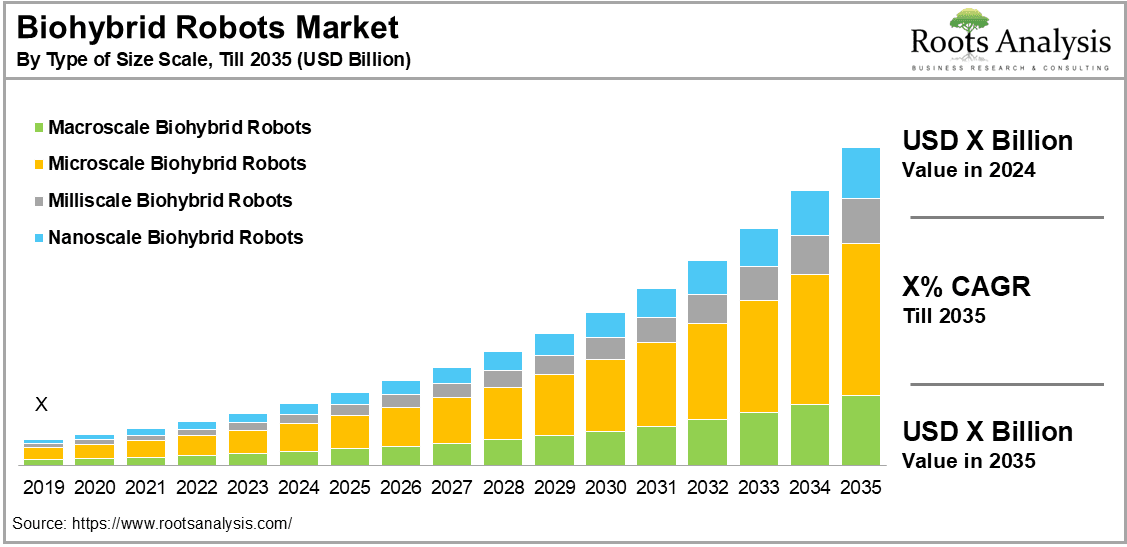
The biohybrid robots market size is projected to grow from USD X billion in 2024 to USD X billion by 2035, representing a CAGR of X%, during the forecast period till 2035.
 |
To learn more about this report, request a free sample copy
The new research study consists of biohybrid robots industry and trends analysis, detailed biohybrid robots market forecast analysis, mega trends, unmet needs, patent analysis, porter five forces, SWOT analysis and value chain analysis.
In 2023 the total count of operational robots reached a new record of 3.9 million robots. Interestingly, Asia has the highest number of robots with 263.4 thousand units. Biohybrid robots represent a groundbreaking fusion of biological and synthetic components, designed to harness the unique advantages of living tissues while enhancing robotic capabilities. These robots incorporate muscle-driven robots as actuators, allowing them to exhibit movements that mimic natural biological functions. It is worth highlighting that there are numerous biohybrid robot application across various industries including healthcare, agriculture, environmental science, and defense.
Furthermore, biohybrid robots market offers various features including ability to self-repair, biodegradable nature, and multifunctionality—enabling them to perform tasks ranging from drug delivery and environmental monitoring to intricate surgical procedures. It is worth noting that utilization of robots is on surge due to rapid penetration of internet and technologies across the globe.
The biohybrid robots market is emerging as a critical component in the global shift towards innovation and digital advancement to reach higher efficiency. Artificial intelligence and diverse material for manufacturing of biohybrid robots has played a pivotal role in unlocking its full potential, which improves personalization capabilities. Additionally, ongoing research across various universities such as University of Illinois and Cornell University to manufacture biohybrid robots are a key modern shift. Consequently, with continuous technological advancements, as the demand for technological utilization to automate continues to grow, the biohybrid robots market is anticipated to witness noteworthy growth during this forecast period. Recently, Rob Shepherd, professor of mechanical and aerospace engineering in Cornell Engineering, mentioned the future capabilities of robots may include the ability to detect soil chemistry in row crops and determine the optimal timing for fertilizer application. This technology could help reduce negative agricultural impacts, such as harmful algal blooms.
The biohybrid robots market research report presents an in-depth analysis of the various companies that are involved in offering biohybrid robots, across different segments, as defined in the table below:
| Key Report Attributes | Details | |
| Forecast Period | Till 2035 | |
| Market Size in 2024 | $ X Billion | |
| Market Size Value by 2035 | $ X Billion | |
| CAGR (Till 2035) | X% | |
| Type of Size Scale |
|
|
| Type of Biological Source |
|
|
| Type of Operating Environment |
|
|
| Type of Powering Source |
|
|
| End-User |
|
|
| Geographical Regions |
|
|
| Leading Market Players |
|
|
| PowerPoint Presentation (Complimentary) |
Available | |
| Customization Scope | 15% Free Customization | |
| Excel Data Packs (Complimentary) |
|
|
Based on the type of size scale, the global biohybrid robots market is split into macroscale biohybrid robots, microscale biohybrid robots, milliscale biohybrid robots and nanoscale biohybrid robots. By 2035, among these categories, the microscale biohybrid robots segment is expected to gain the more than 45% of biohybrid robots market share. Further, this segment is expected to grow with a relatively higher growth rate till 2035. The prominent reason for this dominance includes significant advancements in miniaturized technologies, such as micro-electromechanical systems (MEMS) and nanotechnology, which have enhanced the capabilities of micro-robot components including sensors and actuators.
The biohybrid robots market is segmented into various type of biological source, such as bacterial cells, fungal components, mammalian cells / tissues, marine organisms, plant-based materials and synthetic biology components. By 2035, according to our biohybrid robots market analysis, the fungal components segment will augment the segment's growth with over 65% share in the biohybrid robots market. Additionally, this segment is expected to grow with a relatively higher growth rate over the forecast period. This can be attributed to unique properties and adaptability, which make them highly suitable for integration with synthetic systems. The mycelium of fungi, such as the king trumpet mushroom, can generate electrical signals and respond dynamically to environmental stimuli, enabling innovative applications in robotics and environmental monitoring.
The global biohybrid robots market is fragmented into multiple type of operating environment, namely aerial environment, aqueous environment, industrial settings, in-vivo applications, laboratory settings and terrestrial environment. The laboratory settings segment is anticipated to dominate the segment with more than 45% of market share by 2035. This can be attributed to controlled environments that facilitate rigorous research and development essential for innovating and refining biohybrid technologies, such as biohybrid solar cells. However, the aerial segment is expected to grow with a relatively higher CAGR in the forecasted period. This can be ascribed to rapid advancements in drone technology and aerial imaging are significantly enhancing biohybrid robot applications report across various sectors, including construction, agriculture, and urban planning.
On the basis of the type of power source the biohybrid robots market is bifurcated into ATP-based systems, chemical energy harvesting, external power supply, glucose-powered, hybrid power systems and solar-powered. As per our research, the solar-powered segment is projected to dominate the segment with more than 40% of market share by 2035. Further, this segment is expected to grow with a relatively higher growth rate in the coming years. This can be attributed to increasing environmental concerns, supportive government policies, and significant technological advancements.
Based on the end-user, the global biohybrid robots market is segmented into agricultural sector, defense organizations, educational institutions, environmental agencies, healthcare facilities, industrial manufacturing, pharmaceutical companies and research institutions. According to our analysis, the healthcare facilities is leading the segment with the more than 35% of market shares. This can be attributed to increasing need for self-powered medical devices, which integrate biohybrid technologies to enhance patient care. However, the agricultural sector segment is expected to growth with a relatively higher CAGR in the forecasted period. This can be ascribed to their integration of biohybrid robots, which combine biological materials like mycelium with synthetic systems, allows for enhanced environmental responsiveness and adaptability, making them ideal for precision agriculture.
This segment highlights the distribution of biohybrid robots across various geographical regions, such as North America, Europe, Asia, Latin America, Middle East and North Africa, and the rest of the world. According to our analysis, North America exhibits dominance in the market with over 40% of the biohybrid robots market share in the global marketplace. This can be attributed to its presence of major tech companies and substantial investments in research and development, and a high demand for minimally invasive surgical procedures. However, Asia is projected to drive the market at a relatively higher CAGR during this forecast period due to rising healthcare expenditures and technological advancements such as artificial intelligence and demand for advanced healthcare solutions to enhance biohybrid robot applications in developing countries, such as India, China and Japan.
The “Biohybrid Robots Market, Till-2035: Industry Trends and Global Forecasts" report features an extensive study of the current market landscape, market size and future opportunity within biohybrid robots market, during the given forecast period. The market report highlights the efforts of several stakeholders involved in this rapidly emerging segment of the service providers industry. Key takeaways of the biohybrid robots market report are briefly discussed below.
The increasing focus on automation and operational efficiency, coupled with advancements in technologies, such as AI and integration of biological and synthetic systems, will mark biohybrid robots to be a crucial innovation. Key driving factors include expansion of global robots market, miniaturization, energy efficiency and sustainable solutions. Further, rise in adoption across healthcare robots market and personal use will play a crucial role in shaping the future of technological innovation, where the ability to targeted drug delivery and self-repair mechanisms will be the key to success during this forecast period.
With the presence of several small and large bio-based robot companies, the market is experiencing intense competition and changing market dynamics. From large multinational companies to small biohybrid robot players, companies are striving to enhance their competitive edge. In terms of market share, large enterprises and multinational companies are dominating the market with over 60% of the market share. While biohybrid robot players are continuously improving their products to cater niche markets, or they are offering specialized services. These industry players are focusing on adopting competitive strategies, such as developing innovative biohybrid robot techniques, forming strategic alliances and partnerships to expand and global footprint, investing in recent developments and new feature launches to enhance their biohybrid robot offerings.
Despite strong market growth projection, biohybrid robot market faces numerous challenges including technical issues such as integration of biological and synthetic components, energy efficiency, and the durability of living machine tissues. Notably, operational challenges such as durability and reliability, and high development cost these robots are a few of the major challenges. Additionally, lack of education, acceptance and ethical questions regarding treatment of living organisms can reduce biohybrid robot adoption across other industries. Addressing these mentioned challenges is essential for the expansion of biohybrid robots market growth in the near future.
With respect to regional insights, North America is likely to dominate the market for biohybrid robots. Primarily, due to its high internet penetration, advanced technological infrastructure, and substantial marketing budget is one of the key market drivers. The region's tech-savvy businesses are readily adopting new robotic market trends, driving significant investments in various operations, such as industrial robots and agricultural robots. Additionally, strategic collaborations between government and private sectors facilitate the development of cutting-edge technologies, further solidifying North America's leadership in this evolving field. Notably, there has been a strong funding attraction in the region, one of the examples is in September 2024, Engineers from Cornell University and Florence University developed a groundbreaking biohybrid robot powered by living fungi, specifically the king trumpet mushroom.
The market report presents an in-depth analysis, highlighting the capabilities of various companies engaged in this domain, across different segments. Amongst other elements, the market report includes:
At Roots Analysis, we genuinely care about your success and understand that your business requirements are unique. While our robotic systems market research report provides valuable insights, we recognize that they might not cover every aspect you need to make well-informed strategic decisions. To account for that, we offer 15% free report customization tailored to your specific needs. Whether you require additional quantitative analysis, qualitative insights, or any other information related to the biohybrid robots market, reach out us today at: support@rootsanalysis.com