
Lowest Price Guaranteed
Slides
178
Last Updated
July 2026
View Count
21156
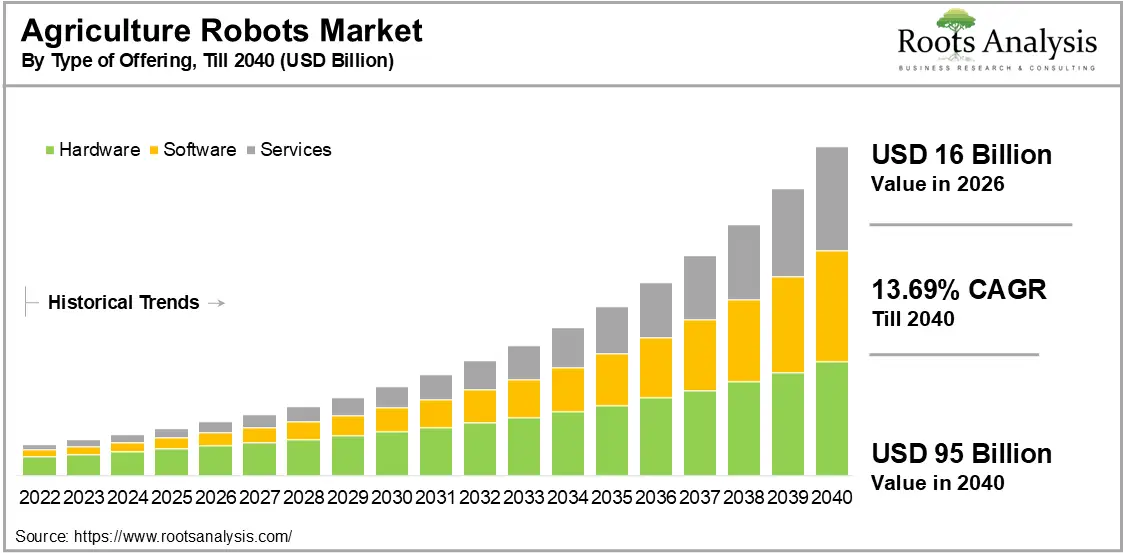
The agriculture robots market size is projected to grow from USD 16 billion in 2026 to USD 95 billion by 2040, representing a CAGR of 13.69%, during the forecast period till 2040.
To learn more about this report, request a free sample copy
The new research study consists of agriculture robots industry and trends analysis, detailed market forecast analysis, and provide actionable strategic recommendations. Currently, the total world’s population is more than 8 billion and according to estimates this is expected to reach 10 billion by 2050, creating the need to increase food production. Agriculture robots are powering the future of robotics industry through efficiency and innovation. The development of autonomous tractors is a logical extension of precision agriculture and robotic field solutions.
It is worth highlighting that there are numerous agricultural robots applications across agriculture industry including planting, harvesting, weeding, and automated crop monitoring. Few of the major advantages of these robots include enhanced operational efficiency, reduced labor costs, and improved safety as they take over repetitive or hazardous tasks such as fertilizer sprays. Furthermore, agriculture robots market offers various features including advanced sensor technologies and artificial general intelligence, computer vision and adapt to dynamic farming environmental conditions. It is worth noting that utilization of robots in major industries is on surge due to rapid penetration of internet and technologies. Interestingly, there was massive year on year rise of 48% in sales of professional robots, according to International Federation of Robotics.
The agriculture robots market is emerging as a critical component in the global shift towards innovation and digital transformation to reach higher farming efficiency solutions. Artificial intelligence and machine learning has played a pivotal role in unlocking its full potential, which improves precision agriculture solutions and real time analysis of crop health. Additionally, advanced sensors like LiDAR and machine vision, coupled with edge AI, to make real-time decisions are a key modern shift. Consequently, with continuous technological advancements, the agriculture robots market is anticipated to witness noteworthy growth during this forecast period. Recently, in March, SIZA Robotics introduced TOOGO, an autonomous robot designed for vegetable and beet crops, which will be commercially available in 2025. This fully electric machine aims to address labor shortages and rising agricultural costs.
The agriculture robots market report presents an in-depth analysis of the various companies that are involved in offering agriculture robots, across different segments, as defined in the table below:
| Key Report Attributes | Details | |
| Historical Trend | Since 2022 | |
| Forecast Period | Till 2040 | |
| Market Size Value in 2026 | $ 16 Billion | |
| Market Size Value by 2040 | $ 95 Billion | |
| CAGR (Till 2040) | 13.69% | |
| Type of Robot |
|
|
| Type of Offering |
|
|
| Type of Farming Environment |
|
|
| Type of Farm Products |
|
|
| Type of Application |
|
|
| Type of Distribution Channel |
|
|
| Type of Farm Size |
|
|
| Geographical Regions |
|
|
| Leading Market Players |
|
|
| PowerPoint Presentation (Complimentary) |
Available | |
| Customization Scope | 15% Free Customization | |
| Excel Data Packs (Complimentary) |
|
|
Based on the type of robot, the global agriculture robots market is split into automated harvesting systems, driverless tractors, milking robots, unmanned aerial vehicles (UAVs) and other robots. Among these categories, the milking robots segment is expected to gain the maximum market share. Prominent reason for this dominance includes their ability to increase milk yield, reduce labor costs, improve animal welfare, and save time for farmers. However, unmanned aerial vehicles (UAVs) segment is expected to expand with the highest CAGR till 2040. This can be attributed to its ability to perform numerous tasks including crop monitoring, soil analysis, and precision spraying of pesticides and fertilizers.
The global agriculture robot market is segmented into various type of offering, such as hardware, software and services. According to our analysis, the hardware segment will augment the segment's growth with the largest market share in the agriculture robots market. This can be attributed to its critical role in enabling autonomous functionality and ongoing advancements. However, the software segment is anticipated to witness the fastest agriculture robots market growth during forecast period.
The rising demand for robotic process automation, advancements in AI, the proliferation of collaborative robots, and the development of user-friendly software solutions, which facilitate easier implementation, are some of the growth drivers.
The global agriculture robots market is fragmented into multiple types of farming environment, namely indoor and outdoor. The outdoor segment is anticipated to dominate the segment with the highest market share over the next decade. This can be ascribed to the variety of crops grown and the need for agricultural automation market research in labor-intensive tasks. Technological advancements and economic efficiency drive the adoption of robots, including agriculture drones and driverless tractors. However, the indoor segment is expected to grow with the highest CAGR in the forecasted period. This can be attributed to rapid technological advancements, increasing urbanization, and the ability to produce crops year-round.
On the basis of the type of farm product, the agriculture robots market is bifurcated into field crops, fruits and vegetables, livestock and others. As per our research, the field crops segment is projected to hold the majority of the market shares and will drive the segment growth until 2040. This can be attributed to its extensive use of agricultural robots for tasks such as planting, harvesting, and monitoring. However, livestock is expected to grow with the highest CAGR in the forecasted period. This can be ascribed to rising demand for milking robots, which enhance efficiency and reduce labor costs are the driving factors for this segment.
Based on the types of application, the global agriculture robots market is segmented into dairy and livestock management, field farming, harvest management, irrigation management, pruning management, soil management and others. According to our analysis, the field farming segment holds the majority of the market shares and is expected to grow with the fastest CAGR in the forecasted period. The key propelling factor includes rising increasing labor costs, the need for improved productivity, and the growing global population. However, the soil management segment is expected to grow with the highest CAGR in the near future. This can be ascribed to increasing utilization of agriculture robots for tasks consisting fertilizing and weeding.
On the basis of the type of distribution channel, the agriculture robots market is bifurcated into direct sales, indirect sales, leasing / rental model and robot-as-a-service (RaaS). As per our research, the direct sales segment is projected to hold the majority of the market shares and will drive the segment growth until 2040. This can be attributed to its feature manufacturers selling their robots directly to end-users and establishing strong relationship with customers. However, robot-as-a-service (RaaS) is expected to grow at a faster CAGR in the coming years. Prominent reasons for rapid upcoming growth include growing attraction especially in industries looking for scalable solutions and helps businesses to use industrial robots on a subscription basis.
Based on the types of distribution channels, the global agriculture robots market is segmented into small-scale farm, medium-scale farm and large-scale farm. According to our analysis, the large-scale farm is leading the segment with the major market shares and are expected to grow with the fastest CAGR in the forecasted period. This can be attributed to its capacity to invest in advanced agriculture robots, labor shortages, productivity demands, increase economies of scale, and drive business growth.
This segment highlights the distribution of agriculture robots across various geographical regions, such as North America, Europe, Asia, Latin America, Middle East and North Africa, and the rest of the world. According to our analysis, North America exhibits dominance in the market with the majority of the agriculture robots market share in the global marketplace - this can be attributed to its established infrastructure.
However, Asia is projected to drive the market at a higher CAGR during this forecast period due to rising demand for automation and increasing agriculture robots investment opportunities in digital agricultural infrastructure in developing countries, such as India, China and Japan. It is worth highlighting, in May 2024, Niqo Robotics, an agrotech startup from Bengaluru, India secured USD 9 million in funding to enhance its innovative agricultural solutions, particularly its AI-powered Spot Spray Technology for crop care.
The “Agriculture Robots Market, Till-2040: Industry Trends and Global Forecasts “report features an extensive study of the current market landscape, market size and future opportunity within agriculture robots market, during the given forecast period. The market report highlights the efforts of several stakeholders involved in this rapidly emerging segment of the service providers industry. Key takeaways of the agriculture robots market report are briefly discussed below.
The increasing focus on market research agricultural automation and operational efficiency, coupled with advancements in technologies, such as AI in agriculture and machine learning, will position agriculture robots as a crucial innovation in the modern agriculture sector in the modern agriculture sector. Key driving factors include increasing food demand driven by a rising global population, labor shortages in the farming sector and enhanced robotic capabilities.
Modern farm automation systems are increasingly integrating monitoring tools to support targeted application of agri natural enemy pest control solutions. Further, the rise in government support and initiatives promoting agricultural innovation will play a crucial role in shaping the future of technological innovation. Notably, the ability to innovate and gradually improve efficiency, quality and quantity of work will be the key to success during this forecast period.
With the presence of several small and large agriculture robot manufacturing companies, the market is experiencing intense competition and changing market dynamics. From large multinational companies to local agriculture robot manufacturing players, companies are striving to enhance their competitive edge. In terms of market share, large enterprises and multinational companies are dominating the market. While small agriculture robot manufacturing players are continuously improving their products to cater to niche markets, or they are offering specialized services. These industry players are focusing on adopting competitive strategies, such as developing innovative robotic solution techniques, forming strategic alliances and partnerships to expand their portfolios and global footprint, investing in recent developments and new feature launches to enhance their agricultural offerings.
Despite strong market growth projection, agriculture robot market faces numerous challenges including technical issues such as navigation, low battery life and hardware failures of agriculture robots. Notably, operational challenges such as integration with existing systems, cost and scalability of these robots are a few of the major challenges. Additionally, lack of education, acceptance and ethical questions regarding job displacement can reduce agriculture robot adoption across agricultural industry. Addressing these mentioned challenges is essential for expansion of agriculture robots market growth in the near future.
With respect to regional agriculture technology market insights, North America is likely to dominate the market for agriculture robots. Primarily, due to its high internet penetration, advanced technological infrastructure, and substantial marketing budget is one of the key market drivers. The region's tech-savvy businesses are readily adopting new robotic market trends, driving significant investments in agricultural operations. Additionally, labor shortage has further propelled the agriculture robots market, as high labor costs, compelling farmers to seek robotic solutions that can provide consistent and efficient labor support year-round. Notably, there has been a strong funding attraction in the region, with ongoing government support to promote smart robotics in farming market study practices.
One of the recent examples is, in May 2024, The U.S. National Science Foundation (NSF) and the USDA's National Institute of Food and Agriculture (NIFA) have collaborated to enhance research in agricultural robotics through a new initiative. This partnership aims to address agricultural challenges and improve sustainability by soliciting innovative research proposals that leverage robotics technology in the region.
Examples of key agriculture robot manufacturers involved in the agriculture robots market (which have also been captured in this market report, arranged in alphabetical order) include AGCO, Abundant Robots, AgEagle Aerial Systems, AgJunction, Auroras, BouMatic Robots, Clearpath Robotics, Deere & Company, DeLaval, Ecorobotix, GAMAYA, Grownetics, Harvest Automation, Harvest CROO Robotics, Kubota Agricultural Machinery India, Monarch Tractor, Trimble and YANMAR HOLDINGS. This market report includes an easily searchable excel database of all the companies who have adopted the agriculture robots market.