
Lowest Price Guaranteed
Slides
203
Last Updated
May 2025
View Count
15603
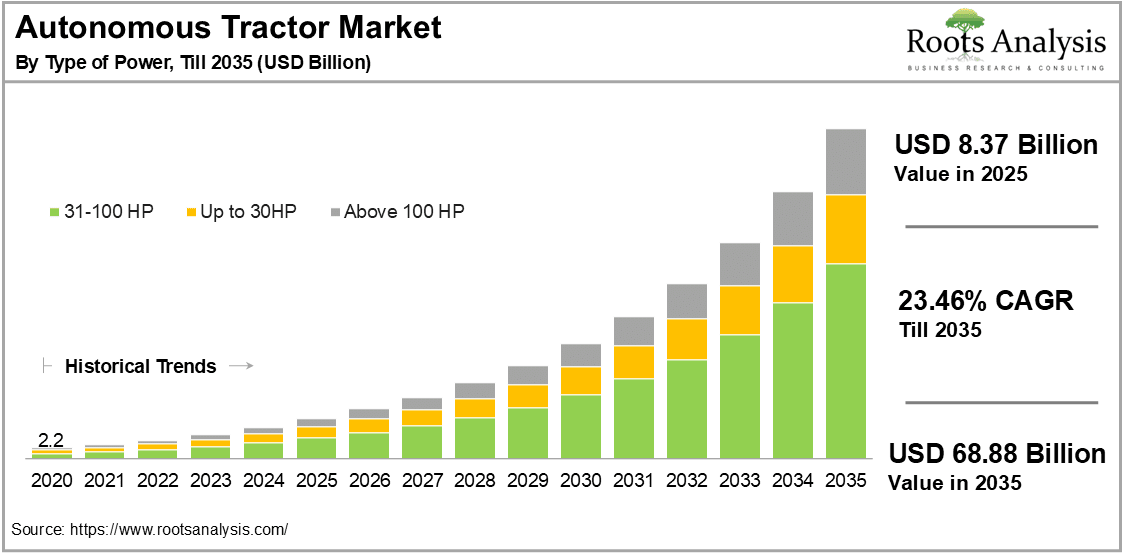
The autonomous tractor market size is projected to grow from USD 8.37 billion in 2025 to USD 68.88 billion by 2035, representing a CAGR of 23.46% during the forecast period till 2035.
 |
The new research study consists of autonomous tractor market and trends analysis, detailed market forecast analysis, and provide actionable strategic recommendations.
The significant advantages of automation and robotics have revolutionized the agriculture industry, with autonomous agricultural machinery similar to that of autonomous tractors. An autonomous tractor is a self-driving tractor equipped with AI, GPS, LiDAR, cameras, and advanced sensors to perform farming operations without human intervention. With the increasing scarcity of laborers and rising wages, the autonomous tractor market is undergoing transformative growth, and several other key factors are multiplying the market scope. Therefore, the demand for autonomous tractors continues to rise as these tractors can navigate fields, plow, plant, spray, and harvest crops autonomously, improving efficiency, and productivity in precision farming.
Continuous innovation in tractor technology and integration of AI & machine learning are advancing the market by providing real-time data analytics in farming and offering higher productivity. Based on autonomy, semi-autonomous tractors are leading the market in terms of revenue. Besides, growing market growth trends in autonomous tractors, such as the development of advanced vision cameras and LiDAR sensors with AI-powered technology. These allow enhanced obstacle detection, and precision navigation and make autonomous tractors safer and more reliable. As a consequence, stakeholders and emerging tech startup companies are investing in the industry to capitalize on the growing demand for sustainable farming equipment.
For instance, in October 2024, Agtonomy, a California-based startup raised $32.8 million in funding to advance its autonomous tractor software for specialty crops such as vineyards. Considering these factors the market is expected to grow exponentially. However, the initial high cost can be a barrier to the extensive adoption of autonomous tractors, and may hinder the limit the market expansion in the long run
The autonomous tractor market report presents an in-depth analysis of the various companies that are involved in offering autonomous tractors, across different segments, as defined in the table below:
| Key Report Attributes | Details | |
| Historical Trend | Since 2020 | |
| Forecast Period | Till 2035 | |
| Current Market Size | $ 8.37 Billion | |
| Market Size Value by 2035 | $ 68.88 Billion | |
| CAGR (Till 2035) | 23.46% | |
| Type of Power |
|
|
| Type of Autonomy |
|
|
| Type of Component |
|
|
| Type of Application |
|
|
| Geographical Regions |
|
|
| Leading Market Players |
|
|
| PowerPoint Presentation (Complimentary) |
Available | |
| Customization Scope | 15% Free Customization | |
| Excel Data Packs (Complimentary) |
|
|
This segmentation of the market for autonomous tractors features a range of power including up to 30, 31-100 HP, and above 100 HP. According to our analysis, the 31-100HP segment is projected to occupy (~47%) of the market share by 2035. Tractors in the 31-100HP range are ideal for medium to large-scale farms that can handle tasks such as tillage, planting spraying, and harvesting efficiency. Thus, their high adoption rate supports the growth of the segment.
Apart from this, up to 30HP is likely to grow steadily at a (25.2%) CAGR driven by soaring demand for innovative crop management solutions for small farm and specialty applications.
On the basis of the type of autonomy, the market is bifurcated into fully autonomous and semi-autonomous. As per market research, currently, semi-autonomous tractors are accelerating the market with over (~64%) share of the market. The segment will likely dominate the market due to cost-effectiveness and practicality. Semi-autonomous tractors are more affordable than fully autonomous models which makes them more accessible for small and mid-sized farms.
While, fully autonomous tractors are gaining traction in the industry and are estimated to rise at (24.84%) CAGR till the forecast period. This can be ascribed to the speedily advancing technology and rising popularity of remote-controlled tractors in the AI-powered tractors market.
The global autonomous tractor market is divided into a wide range of components wherein the camera vision systems lead the segment is anticipated to hold (~31%) of the current market share. This dominance can be attributed to the need for enhanced object detection & safety where camera vision systems allow real-time obstacle detection and prevent collisions with humans, animals, or equipment in the field.
However, GPS systems are also fostering the market and are expected to rise at a notable CAGR of (25.5%) during this projection period driven by the requirement for autonomous navigation where GPS enables precision mapping, obstacle detection, and autonomous movement.
Based on the type of application, the market is split into harvesting, seed sowing, tillage, and others. According to our precision agriculture market analysis, the tillage application is projected to lead the segment by capturing a maximum (43%) revenue share of the market during the forecast period.
Primarily, the high labor cost is the key factor behind the segment growth as tillage is a labor-intensive process and autonomous tractors reduce dependency on manual labor while optimizing fuel consumption, escalating the market expansion. Furthermore, the seed sowing application is substantially bolstering the segment growth and is likely to witness a faster (26.05%) growth rate due to the mounting adoption of tractor automation technology for precision seeding and variable rate planting.
This segment highlights the distribution of the autonomous tractor market across various geographical regions, such as North America, Europe, Asia, Latin America, the Middle East and North Africa, and the rest of the world. As per autonomous farming equipment market research, North America is poised to hold the largest (~45%) of the market share till the forecast period.
Additionally, the agriculture automation market is rapidly evolving in Asia owing to a heightening inclination towards advanced automated and precision agriculture. Governments in China and India are launching smart farming programs to promote the adoption of automated farming technologies for agricultural efficiency improvements. Furthermore, growing demand for food and farmland expansion as well as growth in large-scale commercial farming are anticipated to augment the market demand. Therefore, Asia is estimated to register an excellent (25.77%) CAGR in the upcoming years.
The “Autonomous Tractor Market, Till-2035: Industry Trends and Global Forecasts” report features an extensive study of the current market landscape, market size and future opportunities within the autonomous tractor market, during the given forecast period. The market report highlights the efforts of several stakeholders involved in this rapidly emerging segment of the service providers industry. Key takeaways of the autonomous tractor market report are briefly discussed below.
Significantly, the increasing labor shortage in agriculture and the need for farm productivity enhancement are the main key drivers spurring the autonomous tractor market growth. In the past few decades, the number of skilled laborers has decayed enormously and is pushing the demand for autonomous tractors to decrease dependency on human operators by integrating digital transformation in farming. The growing trend of precision farming is also attributed to the speedy progress of the market as autonomous tractors enable data-driven, GPS-guided farming and improve productivity while reducing input costs.
Moreover, the rising focus on environmental sustainability in agriculture to lessen carbon emissions, soil degradation, and chemical overuse is also fostering market demand. Consequently, these key drivers along with a surge in the adoption of agricultural robotics are expected to multiply the growth of the market in the upcoming decade.
Numerous prominent agricultural machinery giants, technology companies, and innovative startups are changing the competitive landscape of the market through their significant profit revenue in the global marketplace. Leading companies such as John Deere, CHN Industrial, AGCO, Mahindra & Mahindra along with many others are stimulating the market by investing in R&D, developing autonomous and precision farming technology, and offering GPS-guided tractors, AI, and machine learning capabilities.
In addition, startup companies are striving to compete with market competition with their innovative autonomous agricultural machinery and sustainable farming equipment. These companies are employing competitive strategies such as collaboration & partnership, and product differentiation.
Despite the significant growth, the high initial costs and lack of infrastructure are some of the key challenges that can halt the market expansion. Autonomous tractors are expensive to develop and purchase which makes them unaffordable for small and medium-sized farmers. Coupled with this, these tractors rely on advanced sensor technologies which are complex and may not always perform reliably in diverse and unpredictable farming environments. As a result, the high cost of smart farming and its complexity might pose challenges in adopting autonomous technology, and impact the overall growth of the market.
The early adoption of advanced agriculture technology is primarily contributing to North America’s leading position in the global market for autonomous tractors. North America is known for its large-scale farming operations that benefit substantially from autonomous tractors in reducing labor costs and inflating operational efficiency. This is due to the fact that labor costs in the region are relatively higher compared to other regions and autonomous tractors help minimize dependency on manual labor, thus, fueling the adoption of autonomous tractors demand.
Along with this, government policies supporting agricultural automation play a vital role in regional market growth. Besides, the robust presence of market players is strengthening the market position by offering significant funding and advanced agriculture machinery with innovation in tractor technology.
Examples of key players involved in the market for autonomous tractors (which have also been captured in this market report, arranged in alphabetical order) include Autonomous Tractors, CNH Industrial (UK), CLAAS KGaA (Germany), Deere & Company (US), Iseki & Co (Japan), Kubota Corporation (Japan), Mahindra & Mahindra (India), Monarch Tractor (US), SDF Group (Italy), TYM Corporation (South Korea), Yanmar Holdings (Japan). This market report includes an easily searchable excel database of all the companies who have adopted the autonomous tractor market.
The market report presents an in-depth analysis, highlighting the capabilities of various companies engaged in this domain, across different segments. Amongst other elements, the market report includes:
At Roots Analysis, we genuinely care about your success and understand that your business requirements are unique. While our market research reports provide valuable insights, we recognize that they might not cover every aspect you need to make well-informed strategic decisions. To account for that, we offer 15% free report customization tailored to your specific needs. Whether you require additional quantitative analysis, qualitative insights, or any other information related to the autonomous tractor market, reach out us today at: support@rootsanalysis.com