


 Download Free Sample
 Buy Now
Market Size
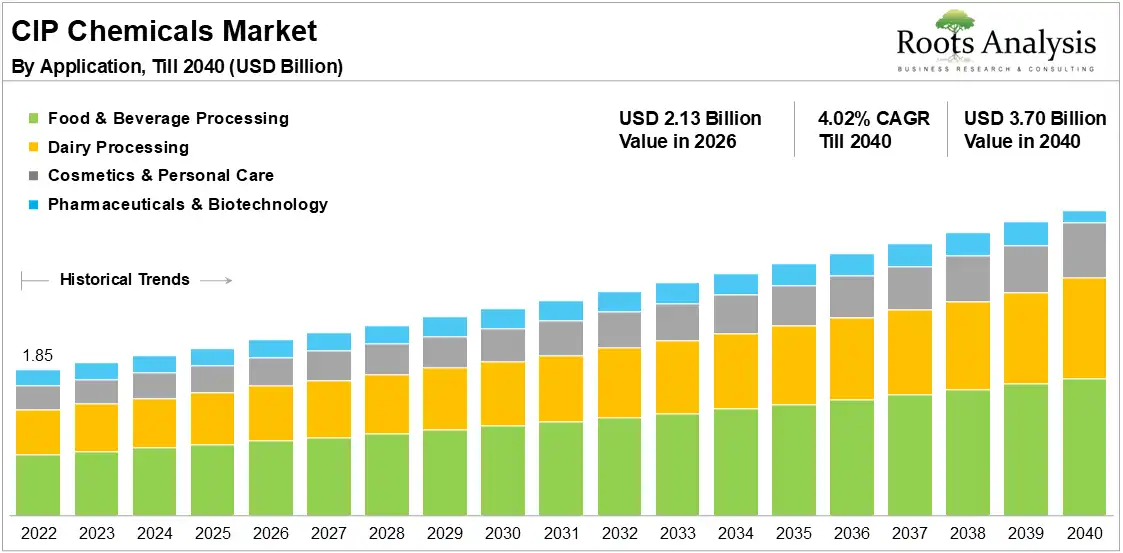
The global CIP chemicals market is projected to reach USD 2.13 billion in 2026 and USD 3.70 billion by 2040, representing a CAGR of 4.02% during the forecast period 2026 to 2040.
See What’s in the Full Report–Request Your Complimentary Insights!
Market Overview
The clean-in-place (CIP) chemicals market offers specialized formulations for sanitizing industrial equipment without manual disassembly. Market expansion is fueled by strict adherence to GMP and FDA guidelines within pharmaceutical and food sectors. As automation accelerates, manufacturers increasingly adopt these solutions to validate cleaning protocols and significantly enhance their operational throughput.
A central application focus involves mitigating microbial risks to prevent expensive product recalls across production lines. This necessity drives investment in sustainable technologies, including advanced enzyme systems and sensor-based dosing, to minimize water and chemical consumption. Consequently, innovations now prioritize balancing superior cleaning efficacy with evolving corporate sustainability objectives and resource efficiency.
The industry is currently shifting from supplying commodity products to providing high-value validation services. Emerging trends highlight bio-based chemistries and digital twin integration for predictive maintenance and optimized cycle design. Supported by persistent regulatory pressure and rising demands for peak efficiency, the long-term outlook for the global CIP market remains robust.
Market Report: Key Takeaways
- Leading Players Competitive Footprint: CIP chemicals industry competitive landscape indicates the presence of leading players, such as AkzoNobel, BASF, Christeyns, ChromaTan, Clariant, DIC, Dohler, Dow, Ecolab, Evonik, Huntsman, Hydrite, Hypha, Kansai Paint, Kemira, Kuraray, Lixol, PPG Industries, Sherwin Williams, and Solenis. These top companies hold strong market positions with extensive geographic presence in various regions.
- Regional Penetration: Rapid industrialization, booming infrastructure projects, and surging demand across food & beverage, pharmaceuticals, dairy, and brewing sectors drive dominance of Asia-Pacific region in the cleaning-in-place chemicals market. Notably, China, India, Japan, and South Korea lead due to production capacities, stringent hygiene regulations, and expanding applications in automated cleaning for processing equipment, high-throughput plants, and compliance-driven sanitation.
- Factors Driving High Share of Acid Cleaners: In CIP chemicals market, based on the distribution by product type, the acid cleaners hold the maximum 41.50% market share. Growth is fueled by tightening regulations regarding wastewater pH levels and the associated costs of effluent treatment.
- Opportunities in CIP Chemicals Market include the transition toward bio-based and sustainable green chemistry, expanding penetration in growth emerging economies, and the development of tailored solutions for bioprocessing and hybrid single-use facilities.
Recent Industry Developments
- November 2025: BASF entered into a joint development agreement with technology firm Quantafuel to optimize chemical recycling processes for mixed plastic waste streams, focusing on scaling up the production of high-quality circular feedstocks.
- September 2025: Ecolab launched the AI-driven CIP IQ system and partnered with 4T2 Sensors. The collaboration integrates fluid sensing technology to cut water usage by 20% and enhance food and beverage production.
- September 2025: SABIC launched a new line of certified circular polymers, derived from advanced recycling of post-consumer plastics aimed at reducing reliance on virgin feedstocks in the consumer packaging and automotive industries.
- August 2025: ExxonMobil and Solvay expanded their strategic partnership to advance the development of solutions for circular plastics, focusing on increasing the availability and quality of recycled content for high-performance applications.
Pay Only for What You Need – The Best Way to Optimize
Market Dynamics
Key Market Drivers
- Intensifying Regulatory Compliance and Hygiene Mandates: Global adherence to rigorous food safety frameworks such as the FSMA in the United States, and HACCP principles, alongside stringent pharmaceutical GMPs, has made high-level hygiene a structural necessity. These non-negotiable standards compel manufacturers to adopt validated CIP processes and specialized chemistries capable of ensuring total microbial control and allergen eradication, shifting the industry toward automated, verifiable sanitation over manual intervention.
- Optimization of Operational Efficiency and Overall Equipment Effectiveness (OEE): In high throughput manufacturing, the CIP cycle represents a critical downtime variable that directly impacts OEE. Industrial operators increasingly prioritize chemical solutions that accelerate cycle times and function across broader temperature ranges to minimize the consumption of water and energy. By reducing cleaning durations, these advanced chemistries serve as vital levers for enhancing plant profitability and maintaining continuous production flows.
- Rising Complexity in Advanced Product Formulations The proliferation of sophisticated product categories, including plant-based proteins, dairy alternatives, and high-viscosity or high-sugar formulations, has introduced resilient residues that bypass the capabilities of traditional cleaning agents. This evolution in the product mix necessitates the use of targeted, high-performance chemistries engineered to manage complex soil loads and mitigate cross-contamination risks, driving market value toward specialized cleaning solutions.
Market Challenges
- Operational Complexity in Multi-Product Manufacturing Environments: Modern facilities frequently utilize shared production lines for a diverse array of products, from varying flavour profiles to different active drug ingredients. The necessity of validating the total removal of allergens or APIs between batches introduces extreme procedural complexity. Managing multiple chemical sets and cleaning protocols within the same system increases the risk of human error and can lead to significant production bottlenecks.
- Technical Skills Gap in Advanced Automation Management: The transition from manual sanitation to sophisticated, sensor-driven CIP systems has outpaced the availability of skilled technical personnel. The industry faces a shortage of operators who are proficient in both chemical safety and digital system troubleshooting. This gap in expertise can lead to improper chemical dosing, system underperformance, and a failure to realize the full ROI of automated cleaning investments.
- The Performance Sustainability Paradox: Manufacturers face a constant tension between the aggressive chemical profiles required for rapid, effective cleaning (high pH, high heat) and the corporate mandate to reduce environmental impact (low heat, biodegradable agents). Reconciling these competing priorities achieving surgical-level cleanliness while reducing effluent toxicity and energy consumption remains a fundamental technical and operational challenge for the industry.
Market Share Insights
Market Share by Form: Liquid CIP Chemicals Dominate the Current Industry
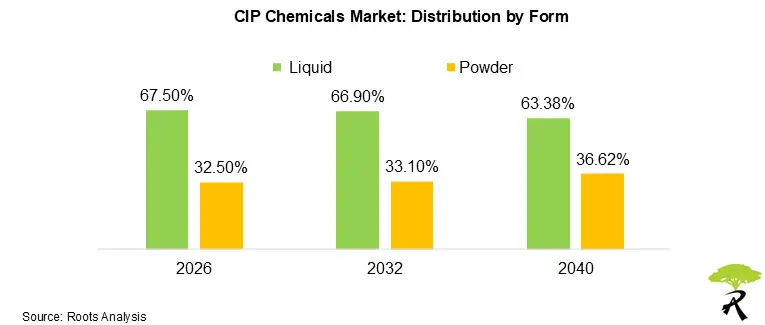
- According to our CIP chemicals market analysis, the liquid form of CIP chemicals dominates the market, capturing a share of 67.50% in 2026. This growth is driven by the intensifying industry-wide transition to "Industry 4.0" automated hygiene systems, which prioritize precision and operational velocity over the raw material cost advantages traditionally offered by powders.
- Liquid segment is further expected to grow during the forecast period because they integrate seamlessly with automated dosing pumps and flow meters, eliminating the dissolution lag and potential nozzle clogging associated with powders. A significant signal of this trend is the expansion of specialized liquid-concentrate production lines by major players (such as Ecolab, BASF, and Alfa Laval) to support "smart" CIP skids, which utilize real-time conductivity sensors optimized for liquid delivery.
Market Share by Geographical Regions: Europe to Dominate the Industry and Asia-Pacific Grow Rapidly Through 2040
- The regional market forecast for CIP chemicals indicates the dominance of Europe, which is expected to hold 31.20% share of the global market. This is driven by stringent hygiene regulations and advanced industry adoption in the region. Key factors include EU directives on food safety, pharmaceutical standards, and sustainability pushes.
- The CIP chemicals market is expected to grow the fastest in Asia-Pacific region, driven by massive capacity expansions in the dairy and beverage sectors across India and Southeast Asia, where stricter food safety regulations are mandating the transition from manual cleaning to automated CIP systems.
Want Information on Specific Region / Segment?
Market Ecosystem Insights
Competitive Footprint of Leading Players in Clean-in-Place Chemicals Industry
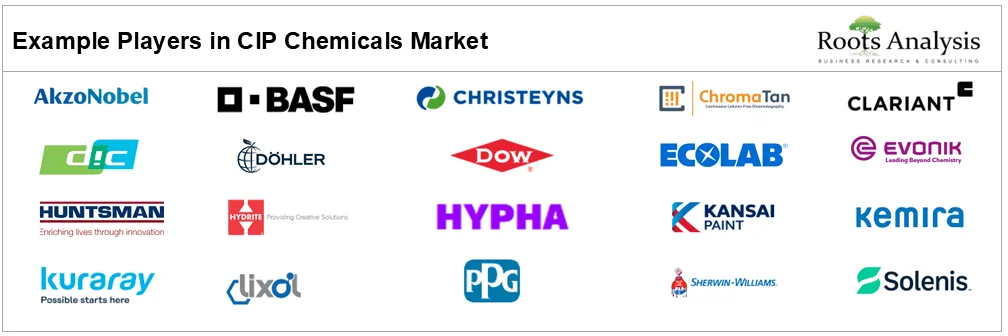
Leading players in the CIP chemicals market include AkzoNobel, BASF, Christeyns, ChromaTan, Clariant, DIC, Dohler, Dow, Ecolab, Evonik, Huntsman, Hydrite, Hypha, Kansai Paint, Kemira, Kuraray, Lixol, PPG Industries, Sherwin Williams, and Solenis which hold strong market positions through their extensive product portfolios and global reach.
Collaborations, product launches, partnerships and expansions remain key growth strategies. For instance, BASF introduced new high-performance surfactants designed specifically for industrial and institutional cleaning, enabling effective CIP processes even under challenging conditions.
Startup Activity and Innovation Hotspots
The startup activity within the CIP chemicals industry is rapidly evolving, as noted in the global CIP chemicals market report, with early-stage companies pioneering disruptive applications focused on advanced CIP-compatible cleaning formulations, such as solutions designed for complex processing environments and high-performance sanitation requirements. Further, startups are also leveraging advanced chemistry to transform chemicals into high-performance, functional components. Innovation hub spots are expanding rapidly mainly in Europe, supported by strong EU regulations and funding initiatives
Innovators are launching sustainable CIP cleaning formulations derived from renewable feedstocks, along with multifunctional additives designed to enhance soil removal efficiency, material compatibility, and residue-free rinsing in high-precision processing environments. Examples of launches include Ecolab’s Synergex, a mixed-peracid sanitizer and disinfectant capable of penetrating biofilms on food contact surfaces without requiring a post-rinse step, thus significantly conserving water. Similarly, Diversey (a Solenis company) has advanced its Divosan range with formulations like Divosan Dew, which are designed to eliminate the need for a final rinse, thereby optimizing cycle times and minimizing chemical residue risks in automated sanitation.
Funding and Investment Momentum
The CIP chemicals market has seen moderate investment momentum. Investment flows primarily from strategic acquisitions, R&D spending on sustainable innovations, and growth in end-use sectors like cosmetics & personal care, and food & beverage processing rather than high-volume venture capital funding for startups. For instance, Sherwin Williams acquired the European industrial coatings business of Sika, in a transaction valued at approximately USD 1.2 billion, to expand its high-value specialty coatings portfolio in the region.
Various venture capital firms are investing in sustainable chemicals companies that are developing bio-based alternatives like enzyme-based cleaners and plant-derived surfactants for clean-in-place applications, supporting R&D efforts for eco-friendly detergents and disinfectants that minimize water use and residues in food, pharma, and dairy processing. Further, government initiatives and grants in the Europe region support sustainability-focused innovations. As a result, projections for the CIP chemicals market indicate accelerated growth, driven by increased funding for bio-based materials.
Unlock Deeper Insights – Schedule Your Personalized Workshop Today!
CIP Chemicals Market: Scope of the Report
| Key Report Attributes | Details | |
| Historical Trend | Since 2022 | |
| Forecast Period | Till 2040 | |
| Market Size 2026 | $ 2.13 Billion | |
| Market Size 2040 | $ 3.70 Billion | |
| CAGR (Till 2040) | 4.02% | |
| Segments Covered |
|
|
CIP Chemicals Market Segmentation
Based on our research, we have segmented the CIP chemicals market into product type, form, application, geographical regions, and key players.
Market Share by Product Type
- Acid Cleaners
- Additives
- Alkaline Cleaners
- Sanitizers & Disinfectants
- Surfactants
Market Share by Form
- Liquid
- Powder
Market Share by Application
- Cosmetics & Personal Care
- Dairy Processing
- Food & Beverage Processing
- Pharmaceuticals & Biotechnology
Market Share by Geographical Regions
- North America
- US
- Canada
- Mexico
- Rest of North America
- Europe
- Austria
- Belgium
- Denmark
- France
- Germany
- Ireland
- Italy
- Netherlands
- Norway
- Russia
- Spain
- Sweden
- Switzerland
- UK
- Rest of Europe
- Asia-Pacific
- Australia
- China
- India
- Japan
- New-Zealand
- Singapore
- South Korea
- Rest of Asia-Pacific
- Latin America
- Brazil
- Chile
- Colombia
- Venezuela
- Rest of Latin America
- Middle East and Africa (MEA)
- Egypt
- Iran
- Iraq
- Israel
- Kuwait
- Saudi Arabia
- UAE
- Rest of MEA


