Electronic Adhesives Market Overview
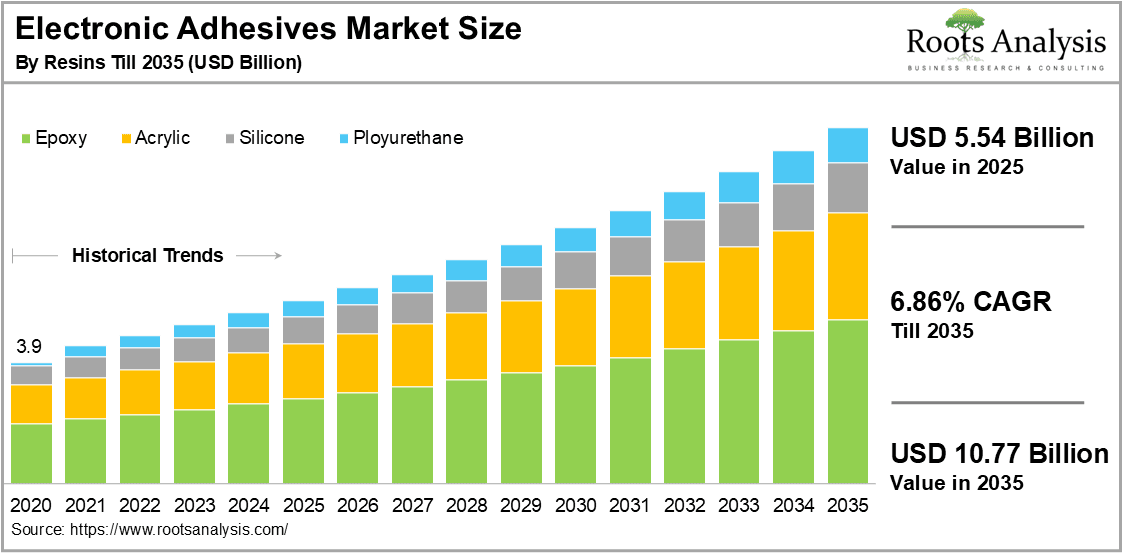
The global electronic adhesives market is projected to reach USD 5.54 billion in 2025 and USD 10.77 billion by 2035. The electronic adhesives market CAGR is represented to be 6.86% during the forecast period.
To learn more about this report, request a free sample copy
The new research study consists of global electronic adhesive industry analysis, mega trends, patent analysis, porter five forces, SWOT analysis, value chain analysis and other strategic frameworks.
Electronic adhesives are specialized bonding agents designed to assemble, protect, and enhance the performance of electronic components and devices. They serve a critical role in electronics manufacturing by providing mechanical support, electrical conductivity or insulation, and protection against environmental stress. The mechanisms by which these adhesives bond materials can include mechanical interlocking, interdiffusion, surface adsorption and reaction, and even electrostatic attraction, allowing them to meet the diverse requirements of modern electronic assemblies.
As the electronics industry evolves, the demands placed on adhesives have become increasingly complex. The rise of miniaturized, high-density devices, such as smartphones, wearables, and medical sensors require miniaturized electronics adhesives that can deliver exceptional performance in limited spaces while withstanding thermal cycling, vibration, and environmental exposure.
In a conversation with AZoM, experts from Master Bond highlighted that, offering such a diverse range of adhesives with unique and customizable properties gives engineers the confidence to meet the increasing challenges associated with the assembly and packaging of complex electronic circuitry. This adaptability is crucial, as engineers must now specify adhesives that not only bond but also provide tailored electrical and thermal properties and even meet biocompatibility or low outgassing standards for sensitive applications.
Electronic Adhesives Market Share Insights
The electronic adhesives market report 2025 presents an in-depth analysis of the various companies that are involved in offering electronic adhesives solutions, across different segments, as defined in the table below:
Electronic Adhesives Market: Report Attributes / Market Segmentations
Electronic Adhesives Market Segmentation
Which Type of Electronic Adhesive Will Dominate the Market?
When it comes to the electronic adhesives market by type, the electrically conductive adhesives segment is set to take the lead, holding a significant share of 57.21% of the market.
Their dominance is being driven by the rapid expansion of consumer electronics, electric vehicles, and renewable energy sectors, where they are used for battery connections, heat sinks, and flexible electronics.
However, it is worth highlighting that the UV curing adhesives market share is likely to witness the fastest CAGR (7.28%) during the forecasted period.
How is the Epoxy Resin Segment Dominating the Market?
Among the resins, the epoxy resin segment really stands out as the leading segment holding a market share of 54%.
According to our electronic adhesives market analysis, this dominance is attributed to their excellent thermal stability, strong cohesive properties, and outstanding electrical insulation, making them the preferred choice of wide range of electronic applications, such as semiconductor packaging, circuit board assembly, and electronic encapsulation.
On the other hand, it is worth highlighting that the acrylic resins segment is likely to witness the fastest CAGR (6.92%) during the forecasted period.
Which Form Type Will have the Fastest CAGR?
When it comes to the global electronic adhesives market, the solid adhesives segment is set to witness the fastest CAGR (8.42%) during the forecasted period.
This segment is gaining traction, particularly in automated manufacturing environments where precise application and minimal waste are priorities. Films and pellets offer advantages in terms of storage, handling, and clean application, and are increasingly used in high-volume or heat-activated bonding processes.
On the other hand, it is worth highlighting that the liquid adhesives segment is expected to dominate the market with a significant share of 67% during the forecasted period.
Which Application Will Dominate the Market?
The surface mounting segment is expected to dominate the market with a significant share of 31% during the forecasted period.
The dominance can be attributed to the critical role of surface mounting adhesives in attaching electronic components directly onto the surface of printed circuit boards, enabling the miniaturization and high-density assembly required in modern electronics such as smartphones, computers, and automotive control units.
On the other hand, the semiconductor segment is set to witness the fastest CAGR (7.97%) during the forecasted period.
Which End-User Industries Will have the Fastest CAGR?
The automotive segment is set to witness the fastest CAGR (7.18%) during the forecasted period.
The surge is fueled by the rapid electrification of vehicles (EVs), the integration of advanced driver-assistance systems, infotainment, connectivity, and safety features. As vehicles become more reliant on electronic components and systems, the demand for high-performance electronic adhesives for automotives with thermal management, vibration resistance, and reliability is accelerating at a record pace.
Consumer electronics segment is expected to dominate the market with a significant share of 30% during the forecasted period.
Which Regions are Expected to See the Highest Demand for Electronic Adhesives?
According to our electronic adhesives market regional analysis, the Asian electronic adhesives market exhibits dominance by capturing 49.86% of the overall current market share. This dominance can be attributed to several factors, including the region’s large and rapidly growing electronics industry, which includes manufacturers of consumer electronics, automotive electronics, and industrial electronics. China, in particular, is a major market for electronic adhesives due to its large electronics manufacturing industry.
Electronic Adhesives Market Key Insights
The “Electronic Adhesives Market: Industry Trends and Global Forecasts, Till 2035” report features an extensive study of the current market landscape, market size, how to evaluate the electronic adhesives market growth and future opportunity within the global electronic adhesives market forecast period. The market report highlights the efforts of several stakeholders involved in this rapidly emerging segment of the service providers industry. Key takeaways of the market report are briefly discussed below.
Electronic Adhesives Market Drivers and Trends
What are the Key Drivers for Growth in the Electronic Adhesives Market?
The electronic adhesives market is experiencing robust growth due to several key drivers. Here are some significant factors contributing to this expansion:
- Miniaturization and Complexity of Electronics: The ongoing trend toward smaller, more complex devices (e.g., smartphones, wearables, IoT devices) drives demand for high-performance adhesives that can reliably bond and encapsulate tiny components.
- Expansion of Consumer Electronics and Automotive Electronics: Rapid proliferation of consumer electronics and the shift toward electric vehicles (EVs) and advanced driver-assistance systems (ADAS) boost demand for electronic adhesives for consumer electronics with superior thermal management, electrical insulation, and durability.
- Growth in 5G and IoT Infrastructure: The rollout of 5G networks and the explosive growth of IoT devices require IoT device adhesives that can withstand high frequencies, thermal cycling, and environmental stress.
- Environmental and Regulatory Pressures: Manufacturers are developing lead-free, solvent-free, and low-VOC adhesives to comply with stricter environmental regulations and sustainability goals.
- Technological Advancements: Innovations in adhesive formulations, such as thermally conductive, flexible, and high-reliability adhesives-are enabling new applications in flexible circuit adhesives, advanced packaging, and wearable devices.
- Asia-Pacific Market Leadership: Asia-Pacific, especially China, Japan, and South Korea, dominates both production and consumption, driven by large-scale electronics manufacturing and R&D investment
What is the Role of Adhesives in Miniaturized and Flexible Electronics?
Adhesives are essential for assembling thinner, lighter, and more flexible electronic devices, enabling precise bonding of microscopic components where traditional soldering is not feasible. Their properties, such as high flexibility, low thickness, and compatibility with dissimilar substrates support the development of miniaturized and wearable electronics, ensuring durability and performance even under harsh conditions.
What are the Advancements in Thermally Conductive Electronic Adhesives?
Recent innovations have led to thermally conductive adhesives that efficiently dissipate heat in densely packed circuits, supporting higher power and miniaturization. These adhesives combine strong bonding with enhanced thermal management, enabling reliable operation of compact devices and critical components in applications like smartphones, EV batteries, and power electronics.
What is the Impact of Low-VOC and Lead-Free Regulations on Adhesives Market?
Stricter environmental regulations are driving the shift toward low-VOC and lead-free adhesives formulations. Manufacturers are developing solvent-free, halogen-free, and eco-friendly products to comply with global standards, reducing environmental impact and improving workplace safety while maintaining high performance for advanced electronics.
What Role Do Electronic Adhesives Play in 5G and IoT Device Manufacturing?
The rollout of 5G and IoT devices demands adhesives with rapid curing, high reliability, and strong electrical or thermal properties. These 5G infrastructure adhesives enable the assembly of high-frequency, miniaturized components and support the mass production of smart devices, sensors, and infrastructure critical for next-generation connectivity.
What are the Future Trends in Electronic Adhesives for Next-Generation Electronics?
The future will see greater emphasis on adhesives tailored for flexible, wearable, and high-density electronics, with advancements in nanomaterial-based formulations and smart adhesives. Trends include increased automation, sustainability, and multifunctional adhesives that provide electrical, thermal, and structural benefits for emerging applications like medical wearables, autonomous vehicles, and advanced communications.
What are the Key Strategies Used by Companies to Gain Electronic Adhesives Market Share?
Electronic adhesives companies are using smart strategies to stay ahead. Big players are focusing on electronic adhesives market opportunities in emerging economies, partnerships, acquisitions, joint ventures, and innovations to strengthen their position in the electronic adhesives competitive landscape 2025 while also investing in R&D to bring innovative and novel products to the market.
Electronic Adhesives Market Challenges
What are the Major Challenges Faced by the Electronic Adhesives Market?
The electronic adhesives market faces several major restraints and challenges that could hinder its growth despite strong demand and expanding applications. Key market restraints include:
- High Testing and Certification Costs: Rigorous performance, durability, and safety testing (e.g., acoustic microscopy, gas chromatography) for electronic adhesives are expensive and can slow market entry.
- Raw Material Price Volatility: Fluctuating prices of key raw materials can impact profit margins and lead to higher consumer prices.
- Rapid Technological Change: Advances in electronic manufacturing methods (e.g., SMT, 3D printing) can reduce demand for traditional adhesives and require constant innovation.
- Performance Demands: The miniaturization of devices requires adhesives with enhanced thermal conductivity, electrical insulation, and reliability in harsh and dynamic conditions.
- Regional Shifts and Competition: Production and demand are shifting toward Asia-Pacific, increasing competition and putting pressure on established players in North America and Europe.
- Environmental Compliance: Keeping pace with evolving environmental regulations (low-VOC, lead-free) requires ongoing R&D and reformulation, increasing costs
Recent Developments in the Electronic Adhesives Market
- In April 2025, Covestro launched an automated laboratory to accelerate the development of coating and adhesive formulations.
- In February 2025, LG Chem announced a partnership with HL Mando, a leading Korean automotive parts maker, to co-develop adhesives for automotive electronic components.
- In February 2025, Henkel expanded the electronic footprint in India with a new engineering center and manufacturing facility in Chennai, Tamil Nadu. The company also announced plans to establish a dedicated adhesive materials manufacturing facility for electronics at its multi-technology site in Kurkumbh, near Pune.
Electronic Adhesives Market Report Coverage
The market report presents a guide to understanding different types of electronic adhesives and their applications, highlighting the capabilities of various companies engaged in this domain, across different segments. Amongst other elements, the market report includes:
- A preface providing an introduction to the full report, electronic adhesives market, 2020-2024 (Historical Trends) and 2025-2035 (Forecasted Estimates).
- An outline of the systematic research methodology adopted to conduct the study on the electronic adhesives market, providing insights on the various assumptions, methodologies, and quality control measures employed to ensure the accuracy and reliability of our findings.
- An overview of economic factors that impact the overall electronic adhesives market, including historical trends, currency fluctuation, foreign exchange impact, recession, and inflation measurement.
- An executive summary of the electronic adhesives market insights captured during our research. It offers a high-level view of the current state of the market and its likely evolution in the mid-long term.
- A detailed assessment of the electronic adhesives market landscape, based on several relevant parameters, including year of experience, company size, location of headquarters, and ownership structure.
- Elaborate profiles of prominent players engaged in the electronic adhesives market, featuring information on their year of establishment, location of headquarters, company size, company mission, company footprint, management team, contact details, financial information, operating business segments, electronic adhesives market portfolio, moat analysis, recent developments, and an informed future of electronic adhesives systems.
- A qualitative assessment of the various megatrends ongoing in the electronic adhesives market, including surge in consumer electronics & IoT devices, automotive electronics & electric vehicles, and 5G, connectivity, & advanced infrastructure.
- An analysis highlighting the key unmet needs across electronic adhesives market industry, featuring market research on electronic adhesives industry analysis generated from real-time data on unmet needs as identified from social media posts, recent publications, industry blogs and the views of key opinion leaders expressed on online platforms.
- An in-depth analysis of various patents that have been filed / granted related to electronic adhesives market and its components, based on various parameters, such as type of patent, patent publication year, patent age and leading players
- A detailed analysis of recent developments in the electronic adhesives market domain, based on relevant parameters such as year of initiative, type of initiative (partnerships and collaborations, expansions, funding and product launches), geographical distribution and most active players (in terms of number of recent developments).
- Key winning strategies framework that helps in analyzing the level of competition within an industry, by tracing the key market activities including partnership, funding, expansion of leading players
- A qualitative analysis highlighting the five competitive forces prevalent in electronic adhesives market industry, including threats for new entrants, bargaining power of suppliers, bargaining power of customers, threats of substitution and rivalry among existing competitors.
- A discussion on affiliated global electronic adhesives market trends 2025, key drivers and challenges, under a SWOT framework, which are likely to impact the industry’s evolution, along with a Harvey ball analysis, highlighting the relative effect of each SWOT parameter on the overall electronic adhesives market.
- A value chain analysis features a discussion on various stakeholders involved in the development of the electronic adhesives market, from suppliers to end-users.
- A detailed estimate of the current market size and the potential growth future of electronic adhesives market initiatives over the next decade. Based on multiple parameters we have provided an informed estimate on the market evolution during the forecast period 2025-2035. The report also features the likely distribution of the current and forecasted opportunity within the electronic adhesives market. Further, in order to account for future uncertainties and to add robustness to our model, we have provided three forecast scenarios, namely conservative, base, and optimistic scenarios, representing different tracks of the industry’s growth.
- Detailed projections of the current and future market across various type of electronic adhesive such as electrically conductive, thermally conductive, UV curing, and other adhesives.
- Detailed projections of the current and future market across various resins, such as acrylic, epoxy, polyurethane, and silicone.
- Detailed projections of the current and future market across various forms, such as liquid, paste, and solid.
- Detailed projections of the current and future market across various applications, such as conformal coatings, encapsulation, integrated circuit, printed circuit boards, semiconductor, surface mounting, wire tracking, and other applications.
- Detailed projections of the current and future market across various enterprises such as large enterprises and small and medium enterprises.
- Detailed projections of the current and future market across various end-use industries, such as automotive, commercial aviation, communications, computer & servers, consumer electronics, industrial and medical.
- Detailed projections of the current and future electronic adhesives market across various geographical regions, such as North America (US, Canada, Mexico and other North American countries), Europe (Austria, Belgium, Denmark, France, Germany, Ireland, Italy, Netherlands, Norway, Russia, Spain, Sweden, Switzerland, UK and other European countries), Asia (China, India, Japan, Singapore, South Korea and other Asian countries), Middle East and North Africa (Egypt, Iran, Iraq, Israel, Kuwait, Saudi Arabia, UAE and other MENA countries), Latin America (Brazil, Chile, Colombia, Venezuela and other Latin American countries) and rest of the world (Australia, New Zealand and other countries).
About Authors
Lead Author: Anmol Bali
Lead Reviewer: Ronit Sharma
Chief Editor: Yash Tyagi
Customization Opportunities
At Roots Analysis, we genuinely care about your success and understand that your business requirements are unique. While our electronic adhesives market research reports provide valuable insights, we recognize that they might not cover every aspect you need to make well-informed strategic decisions. To account for that, we offer 15% free report customization tailored to your specific needs. Whether you require additional quantitative analysis, qualitative insights, or any other information related to the electronic adhesives market, reach out us today at: support@rootsanalysis.com
Frequently Asked Questions
What are electronic adhesives?
Electronic adhesives are specialized bonding agents designed to assemble, protect, and enhance the performance of electronic components and devices.What is the projected size of the global electronic adhesives market by 2032?
The global electronic adhesives market is projected to reach USD 10.77 billion by 2035.What is the expected growth rate of the electronic adhesives market?
The market is forecasted to grow at a compound annual growth rate (CAGR) of 6.8% during the forecasted period.Who are the leading players in the electronic adhesives market?
3M, Alent, Arkema, Atom Adhesives, Avery Dennison, BASF SE, Bondline Electronic Adhesives, Boyd Corporation, Covestro, Cytec Industries, Delo, Dow, Dymax Corporation, Ellsworth Adhesives, Element Solutions, Evonik Industries, Forbo Holding, H.B. Fuller, Henkel, Hitachi Chemical, Huntsman International, Indium Corporation, Jowat, LG Chemical, Loctite, Master Bond, Meridian Adhesives, Mitsui Chemicals, Momentive Performance Materials, Nagase Chemtex, Panasonic, Parker Hannifin, Permabond, Pidilite, Rogers, Sika AG, Shin-Etsu Chemical, Synthomer, ThreeBond, Toyo Polymer, Wacker Chemie, and Xiamen Weldbond New Material.Which industries drive the demand for electronic adhesives?
Key industries include consumer electronics, automotive, telecommunications, medical devices, and aerospace.What are the main types of electronic adhesives used in electronics manufacturing?
The main types are electrically conductive, thermally conductive, UV-curing, epoxy, acrylic, polyurethane, and silicone adhesives.How do environmental regulations impact the electronic adhesives market?
Stringent regulations on hazardous substances (like RoHS and REACH) and the push for low-VOC, lead-free, and halogen-free adhesives are driving manufacturers to develop more sustainable and eco-friendly products.What challenges do manufacturers face in testing and certifying electronic adhesives?
Manufacturers face challenges in ensuring reliability, meeting strict industry standards, and validating performance under diverse environmental and operational conditions.Which regions are expected to see the fastest growth in electronic adhesives demand?
Asia-Pacific is expected to witness the fastest growth, driven by its large electronics manufacturing base and expanding IT infrastructure.How is miniaturization influencing electronic adhesives development?
Miniaturization demands adhesives with high precision, low outgassing, and the ability to bond tiny, densely packed components without compromising reliability.What innovations are shaping the future of electronic adhesives?
Innovations include bio-based and lead-free formulations, UV-curable and thermally conductive adhesives, and advanced materials tailored for flexible, wearable, and high-frequency electronics.