Engineered Wood Market: Industry Trends and Global Forecasts, Till 2035- Distribution by Type of Product (Glulam, I-beams and Cross Laminated, Laminated Veneer Lumber (LVL), Plywood and Timber), Type of Bonding Material (Adhesives / Resins and Wood Fibers / Particles), Area of Application (Construction, Flooring, Furniture, Packaging, Transport and Other Applications), End User (Commercial and Residential) and Geographical Regions
Engineered Wood Market Overview
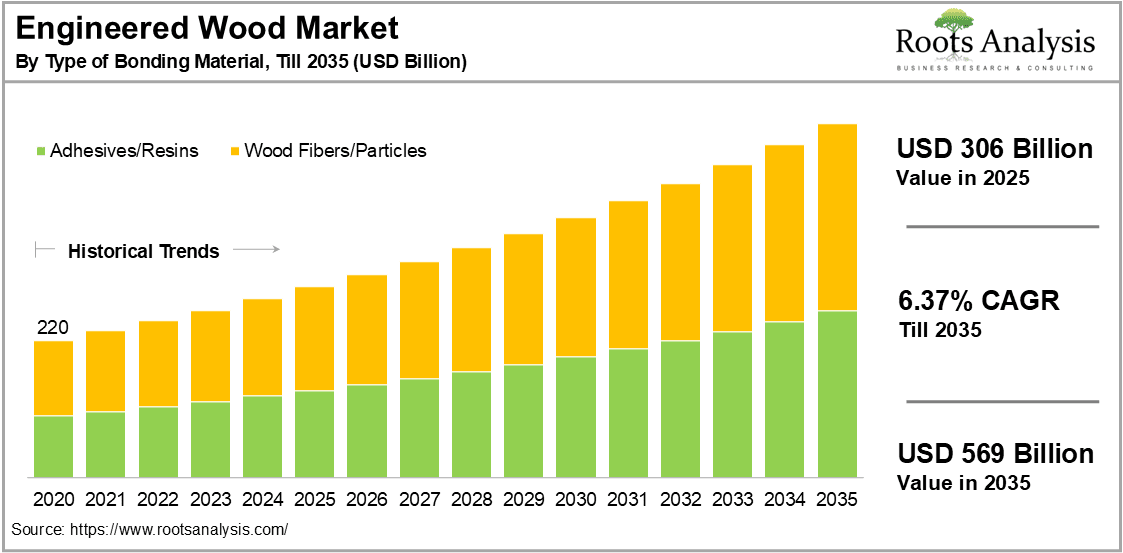
The global engineered wood market is projected to rise from USD 306 billion in 2025 to reach USD 569 billion by 2035, representing a CAGR of 6.37% during the forecast period.
 |
Would Like to Preview the Actual Report?
The new research study consists of engineered wood industry analysis, detailed market forecast analysis, and providing actionable strategic recommendations.
Solid wood used in furniture and construction is one of the major factors contributing to deforestation. Further, these woods are prone to moisture issues that can lead to structural collapse. To overcome these environmental and safety concerns, engineered wood, a type of wood bio-products , is on a surge. By bounding wood fibers or particles with adhesives for secure packaging, engineered wood is manufactured. These offer high moisture resistance and also, they use wood wastage for manufacturing.
Technological advancements in construction techniques such as the development of lightweight materials for weight reduction played a major role in the expansion of the market. Further, the development of prefabricated building materials, such as laminated veneer lumber (LVL) and wood I-joists have framed the market. It is worth highlighting that plywood and oriented strand board (OSB) production for moldability and shape conversion have accelerated the residential and commercial construction application. Moreover, due to cost-effectiveness and extreme easy-to-handle properties, furniture manufacturing with engineered wood is on the rise.
The global engineered wood market size is expected to grow significantly over the forecast period due to the rapidly growing demand for sustainable construction materials. Further, the rising structural applications of engineered wood due to the development of wooden beams and columns will play a major role in market growth. In addition, high durability and strength is majorly boosting architectural design trends in wood construction.
It is worth highlighting that the effortless implementation and energy efficiency as less labor is required will accelerate the engineered wood products market. Consequently, rising investments in development and advancements will contribute to the construction industry trends.
Recently, Martin Simmonite, Senior Vice President of Operations at Wood UK mentioned Wood has a strong track record of delivering low carbon solutions, this innovative project applies full life-cycle engineering and operations capabilities.
Engineered Wood Market Insights
The global engineered wood market research report presents an in-depth analysis of the various companies that are involved in offering engineered woods, as defined in the table below:
Engineered Wood Market: Report Attributes / Market Segmentations
| Key Report Attributes | Details | |
| Historical Trend | Since 2020 | |
| Forecast Period | Till 2035 | |
| Current Market Size | $ 306 Billion | |
| Market Size Value by 2035 | $ 569 Billion | |
| CAGR (Till 2035) | 6.37% | |
| Type of Product |
|
|
| Type of Bonding Material |
|
|
| Area of Application |
|
|
| End User |
|
|
| Geographical Regions |
|
|
| Leading Market Players |
|
|
| PowerPoint Presentation (Complimentary) |
Available | |
| Customization Scope | 15% Free Customization | |
| Excel Data Packs (Complimentary) |
|
|
Engineered Wood Market Segmentation Insights
Market Share by Type of Product
On the basis of the type of product, the engineered wood market is bifurcated into glulam, I-beams and cross laminated, laminated veneer lumber (LVL), plywood and timber. The plywood segment is anticipated to dominate the segment with more than 40% engineered wood market share in 2025. This can be ascribed to the lower manufacturing cost and time in comparison to solid wood. It is worth highlighting that plywood is boiling waterproof, fire retardant and termite proof that makes it ideal for various applications such as building construction and furniture.
On the other hand, the timber segment is expected to witness a relatively faster (6.68%) engineered wood market growth rate by 2035. This can be attributed to its extremely renowned strength and durability that makes them ideal for high-load construction applications. In addition, easy scalability and aesthetic factors will continue to drive the cross-laminated timber (CLT) market .
Have Questions? Let’s Get Them Answered.
Market Share by Type of Bonding Material
Based on the type of bonding material, the global report is segmented into adhesives / resins and wood fibers / particles. According to our analysis, wood fibers / particles are leading the segment with the major market engineered wood market share (50%). This can be due to the sustainability offered by them due to the resource utilization and less environmental impact. Further, easy moldability and shape formation catering designing and user requirements boost sustainable wood materials market.
However, the adhesives / resins are expected to grow with a relatively faster (6.44%) CAGR in the forecasted period. This can be attributed to the durable and strong bond of adhesives and sealants that can effortlessly withstand high stress and various weather conditions.
Market Share by Area of Application
Based on the area of application, the global engineered wood market is segmented into construction, flooring, furniture, packaging, transport and other applications. According to our analysis, construction leads the segment with the major market share (35%). This can be ascribed to their uniform density that resists natural defects such as knots and warping. In addition, dimensional stability and size flexibility that allows easy installations and resists expansion and contraction due to moisture have aided advanced manufacturing technologies in woodworking.
On the other hand, furniture is expected to grow with a relatively higher CAGR of 7.45%. This can be ascribed to the high demand for moisture-proof furniture for bathrooms and basements. Notably, these are lower in cost but can mimic solid wood appearance efficiently, aiding engineered timber industry.
Market Share by End User
Based on the end user, the global market is segmented commercial and residential. According to our analysis, the commercial sub-segment leads the industry with the major market engineered wood market size (with a share of 55%). This can be due to the demand for materials that are cost-effective and lightweight yet are durable and strong. It is worth highlighting that engineered woods are ideal for flooring where foot-traffic is high such as offices, shops and café, fostering engineered wood flooring market.
However, the residential segment is expected to grow with a relatively higher CAGR of 7.61%. This can be due to the wide applications such as flooring, siding and furniture. It is worth highlighting that the design flexibility that offers creativity and adaptability to user requirements is majorly driving the internal engineered wood market growth.
Engineered Wood Market by Geographical Regions
According to our market forecast, Asia exhibits dominance in the market with over 40% of the engineered wood market share in the global marketplace. This can be attributed to the rising research and development in engineered wood production technologies.
However, North America is projected to have highest engineered wood market growth rate (with a CAGR of 7.64%) in the forecast period. Primary reasons for this growth include a high focus on eco-friendly building practices. In addition, North America experiences varying levels of moisture that affect solid wood. It is worth highlighting that US and Canada have high number of red oak trees, these trees grow fast and have bigger pores, making them ideal for engineered wood. The rising research and development in enhanced materials and advanced techniques are anticipated to aid in the expansion .
Your Business is Unique – Why Shouldn’t Your Report Be?
Engineered Wood Market Key Takeaways
The “Engineered Wood Market: Industry Trends and Global Forecasts, Till-2035” market report features an extensive study of the current market landscape, market size and future opportunity within engineered wood market, during the given forecast period. The market report highlights the efforts of several stakeholders involved in this rapidly emerging segment of the service providers industry. Key takeaways of the global engineered wood market report are briefly discussed below.
Key Drivers of Engineered Wood Market
Increasing awareness regarding deforestation for solid wood is majorly driving the engineered wood industry. Further, the swift rise in demand for sustainable building practices is continuously aiding market growth. These offer high durability and strength that can withstand extreme stress and various weather conditions. It is worth highlighting that these are energy efficient and utilize resources and waste to energy that aid eco-friendly building practices. Notably, supportive government regulations and initiatives will play a pivotal role in the growth of the market. Consequently, ongoing partnerships and infrastructure investments among organizations will aid market growth.
Engineered Wood Market Competitive Landscape
With the presence of several small and large engineered wood manufacturers, the competitive landscape of the engineered wood industry is experiencing intense competition and changing market dynamics. From large multinational companies to local engineered wood players, companies are striving to enhance their competitive edge. In terms of market share, large enterprises and multinational companies are dominating the market.
While small engineered wood players are continuously improving their products to cater to niche markets by analyzing consumer preferences, or they are offering specialized services. These industry players are focusing on adopting competitive strategies, such as developing innovative solution techniques, forming strategic alliances and partnerships to expand their portfolios and global footprint, investing in recent developments and new feature launches to enhance their engineered wood offerings.
In April 2025, AHF Products announced the launch of unfinished solid and engineered hardwood floorings, in order to meet the demand for custom flooring options amongst the stakeholders.
Challenges in Engineered Wood Market
Despite the strong market growth projection, numerous market challenges for engineered wood have risen. The most common challenge is the need for specialized installation that may slow down the building process. Additionally, installation flaws can lead to moisture issues such as swelling and warping. It is worth highlighting that low quality materials and design flaws also finite the market growth. Moreover, dynamic costs and building complexities hamper market growth.
Regional Analysis: Asia is Expected to Dominate the Market with the Largest Engineered Wood Market Share
Asia currently holds a substantial share of approximately 45% in the engineered wood market opportunities. This dominance can be attributed to several factors, the major reason is high urbanization and housing demand in emerging economies such as India, China, South Korea and Japan. In addition, this demand requires fast and cost-effective building solutions, that are offered by engineered wood. Further, rapidly rising structural applications of engineered wood for high durability and strength have nurtured dominance.
It is worth highlighting that the high focus on sustainability and environmental concerns will continue to aid the engineered wood market expansion. Notably, the presence of prominent players, such as Action TESA and Shenzhen Risewell are expanding the market through innovation and rapid advancements. Consequently, rapid investments in research and development have played a pivotal role in dominance.
Leading Engineered Wood Manufacturers
Examples of key player involved in the engineered wood market (which have also been captured in this market report, arranged in alphabetical order) include Action TESA, Boise Cascade, Celulosa Arauco Y Constitucion, Egger, Huber Engineered Wood, Kahrs, Kronospan, Louisiana-Pacific, Nordic, Roseburg Forest Products, Shenzhen Risewell, Swiss Krono, Universal Forest Products, West Fraser Timber and WeyerHaeuser. This market report includes an easily searchable excel database of all the companies who have adopted the engineered wood market.
Recent Developments in Engineered Wood
- In June 2025, Zaugg Timber Solutions entered into a lease agreement with Port of Portland in order to develop a manufacturing facility.
- In February 2025, Action TESA, an Indian-based engineered wood company, launched revolutionary mobile experiential Centre “Studio at Wheels 3.0”, in order to achieve sustainable solutions.
- In February 2025, Senvion entered into a strategic collaboration with Voodin Blade Technology in order to integrate engineering wood with the turbine blade design, for tackling blade recyclability.
- In July 2024, John Peachy announced the launch of JP Wood Accents which will engage in production of plank-engineered wooden flooring .
Pay Only for What You Need – The Best Way to Optimize
Engineered Wood Market Report Coverage
The market report presents an in-depth analysis, highlighting the capabilities of various companies engaged in this domain, across different segments. Amongst other elements, the market report includes:
- A preface providing an introduction to the full report, engineered wood market, 2020-2024 (Historical Trends) and 2025-2035 (Forecasted Estimates).
- An outline of the systematic research methodology adopted to conduct the study on the engineered wood market, providing insights on the various assumptions, methodologies, and quality control measures employed to ensure the accuracy and reliability of our findings.
- An overview of economic factors that impact the overall engineered wood market, including historical global engineered wood market trends, currency fluctuation, foreign exchange impact, recession, and inflation measurement.
- An executive summary of the insights captured during our research. It offers a high-level view on the current state of the engineered wood market and their likely evolution in the mid-long term.
- A detailed assessment of the engineered wood market landscape, based on several relevant parameters, including years of experience, company size, location of headquarters, and ownership structure.
- Elaborate profiles of prominent players engaged in the engineered wood market, featuring information on their year of establishment, location of headquarters, company size, company mission, company footprint, management team, contact details, financial information, operating business segments, engineered wood portfolio, moat analysis, recent developments, and an informed future outlook.
- A qualitative assessment of the various megatrends ongoing in the engineered wood industry, including minimizing environmental impact of timber products, enhanced construction materials, moisture resistance and environmental concerns.
- An analysis highlighting the key unmet needs across the engineered wood industry, featuring need for dedicated installation and possible quality degradation.
- An in-depth analysis of various patents that have been filed / granted related to engineered wood and its components, based on various parameters, such as type of patent, patent publication year, patent age and leading players
- A detailed analysis of recent developments in the engineered wood domain, based on relevant parameters such as year of initiative, type of initiative (partnerships and collaborations, expansions, funding and product launches), geographical distribution and most active players (in terms of number of recent developments).
- Key winning strategies framework that helps in analyzing the level of competition within an industry, by tracing the key market activities including partnership, funding, expansion of leading players
- A qualitative analysis, highlighting the five competitive forces prevalent in engineered wood industry, including threats for new entrants, bargaining power of suppliers, bargaining power of customers, threats of substitution and rivalry among existing competitors.
- A discussion on affiliated global engineered wood price trends, key drivers and challenges, under a SWOT framework, which are likely to impact the industry’s evolution, along with a Harvey ball analysis, highlighting the relative effect of each SWOT parameter on the overall engineered wood market.
- A value chain analysis featuring a discussion on various stakeholders involved in the development of the engineered wood market, from engineered wood suppliers to end-users.
- A detailed estimate of the current engineered wood market size and share of the future growth potential of the market over the next decade. Based on multiple parameters we have provided an informed estimate on the market evolution during the forecast period 2025-2035. The report also features the likely distribution of the current and forecasted opportunity within the engineered wood market. Further, in order to account for future uncertainties and to add robustness to our model, we have provided three forecast scenarios, namely conservative, base, and optimistic scenarios, representing different tracks of the industry’s growth.
- Detailed projections of the current and future market across various type of product such as glulam, I-beams and cross laminated, laminated veneer lumber (LVL), plywood and timber.
- Detailed projections of the current and future market across various type of bonding material such as adhesives / resins and wood fibers / particles.
- Detailed projections of the current and future market across various area of application such as construction, flooring, furniture, packaging, transport and other applications.
- Detailed projections of the current and future market across various end-user such as commercial and residential.
- Detailed projections of the current and future engineered wood market across various geographical regions, such as North America (US, Canada, Mexico and other North American countries), Europe (Austria, Belgium, Denmark, France, Germany, Ireland, Italy, Netherlands, Norway, Russia, Spain, Sweden, Switzerland, UK and other European countries), Asia (China, India, Japan, Singapore, South Korea and other Asian countries), Middle East and North Africa (Egypt, Iran, Iraq, Israel, Kuwait, Saudi Arabia, UAE and other MENA countries), Latin America (Brazil, Chile, Colombia, Venezuela and other Latin American countries) and rest of the world (Australia, New Zealand and other countries).
Unlock Deeper Insights – Schedule Your Personalized Workshop Today!
About Authors
Lead Author: Anmol Bali
Lead Reviewer: Prachi Bhalla
Chief Editor: Ronit Sharma
Customization Opportunities
At Roots Analysis, we genuinely care about your success and understand that your business requirements are unique. While our market research reports provide valuable insights, we recognize that they might not cover every aspect you need to make well-informed strategic decisions. To account for that, we offer 10% free report customization tailored to your specific needs. Whether you require additional quantitative analysis, qualitative insights, or any other information related to the market, reach out us today at: support@rootsanalysis.com


