


 Download Free Sample
 Buy Now
Market Size
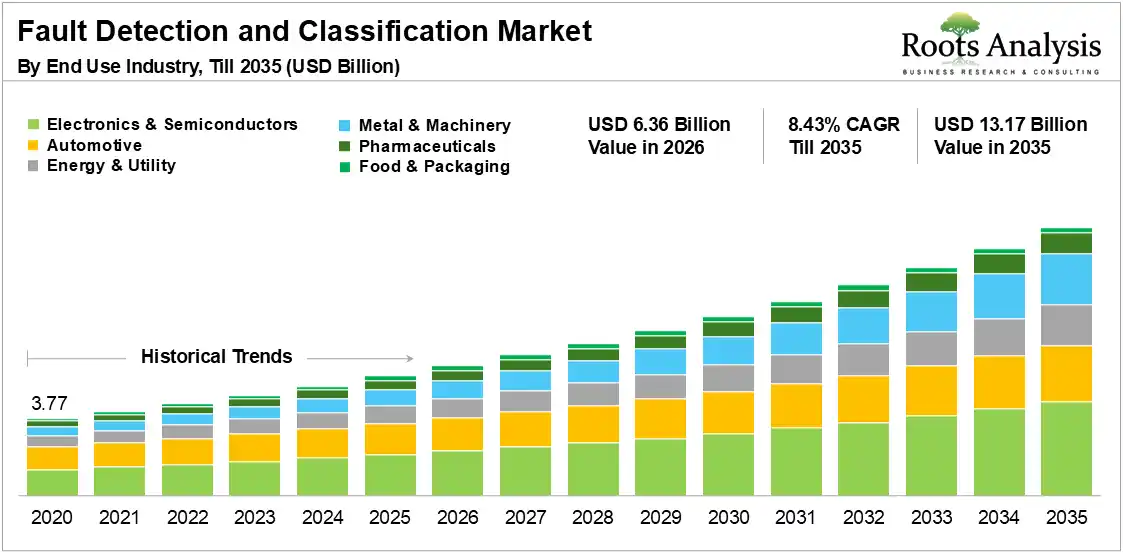
The global fault detection and classification market, valued at USD 6.36 billion in 2026, is projected to reach USD 9.53 billion in 2030 and USD 13.17 billion by 2035, with a CAGR of 8.43% during the forecast period 2026 to 2035.
See What’s in the Full Report–Request Your Complimentary Insights!
Market Report: Key Takeaways
- In terms of component, hardware secures 50% of the overall revenue share of the global market.
- In terms of end use industry, electronics & semiconductors hold the largest share (31%) of fault detection and classification market.
- In terms of leading region, Asia-Pacific holds the largest share with 36% share of the market.
- Key market drivers are the advances in AI, machine learning and data analytics, leading to enhanced FDC accuracy, speed, and adaptability.
Market Overview
Fault detection and classification refer to advanced technological processes designed to identify, categorize, and analyze abnormalities or faults in real-time across various operational systems. By leveraging sophisticated data analysis techniques, FDC systems continuously monitor equipment and process parameters to detect deviations from normal performance, enabling early fault identification and classification. These systems often incorporate AI, machine learning, and deep learning algorithms to enhance process monitoring and fault diagnosis accuracy and provide predictive insights for maintenance, thus preventing production defects and minimizing downtime.
FDC finds extensive applications across multiple industrial sectors, where operational reliability and quality assurance are critical. FDC solutions for semiconductor process monitoring play a pivotal role by monitoring wafer fabrication processes, equipment health, and detecting process drifts to ensure precision and yield improvement. Beyond semiconductors, it is deployed in industrial FDC solutions, including manufacturing process control, energy production, automotive assembly, and critical infrastructure monitoring. These systems support real-time process optimization, predictive maintenance using FDC analytics in industrial automation, and control adjustments that uphold production efficiency and compliance with safety regulations.
The growth of the fault detection and classification market is driven by a confluence of factors including the increasing complexity of manufacturing systems, the rising adoption of Industry 4.0 and digital transformation initiatives. Further AI-driven fault detection and classification systems in manufacturing and integration of IoT technologies are enabling smarter, self-learning systems. Demand for operational excellence continues to propel investments in FDC solutions that optimize processes, reduce waste, and enhance productivity.
Pay Only for What You Need – The Best Way to Optimize
Recent Developments
- In October 2025, an independent researcher Soujanya Reddy Annapareddy was awarded 2025 Global Recognition Award for the contributions made in AI framework which enables the real-time fault detection on the resource-constrained devices.
- In August 2025, IIT Madras announced the development of AI framework for the detection of faults in gearbox in cars, pumps and heavy industrial machines.
Market Share Insights
Hardware Components to Lead the FDC Market
According to the FDC market report, hardware sub-segment is set to dominate the current market with a market share of 50%. This dominance is due to the essential role of physical sensors, imaging devices, embedded systems, and processors in capturing real-time operational data necessary for fault detection and diagnosis across a wide range of industrial applications. Hardware forms the foundational layer of FDC systems, enabling early detection of anomalies through measurements such as vibration, temperature, and pressure.
The software component in the fault detection and classification market is expected to have the fastest CAGR over the forecast period. While hardware currently holds the largest market share, software is growing rapidly due to increasing adoption of AI-based fault diagnostics, machine learning algorithms, and advanced data analytics integrated with predictive maintenance systems.
Electronics & Semiconductors Sub-Segment to Shape the Future of Market
The electronics & semiconductor sub-segment will have the maximum market share (31%) during the current year. This growth is due to the high precision and operational efficiency demanded by semiconductor manufacturing processes. The complexity and miniaturization of electronic devices require advanced fault detection systems to ensure quality, reduce defects, and prevent costly downtime. The semiconductor industry’s need for real-time fault detection technology and classification is critical because faults can have very high-cost implications, driving strong adoption in the fault detection systems market.
Regional FDC Market Forecast Suggests Dominance of Asia-Pacific
Asia-Pacific currently dominates the market with a share of 36%. The region’s expanding manufacturing sector, driven by industrialization & increased automation, demands robust FDC solutions to enhance production efficiency and product quality. Moreover, heightened competition pushes companies to adopt advanced technologies including FDC to stay competitive.
Additionally, government initiatives and investments in Industry 4.0 technologies, coupled with a growing awareness of the benefits of FDC systems are fueling adoption. Asia-Pacific’s dynamic economic landscape and the need for operational excellence further contribute to market growth. The Chinese government invests USD 1 billion in the development of a new Industrial Internet of Things (IoT) platform.
Want Information on Specific Region / Segment?
Market Dynamics
Market Drivers
- Growth in Industrial Automation and IoT Connectivity: This growth has driven the adoption of FDC systems by enabling real-time data collection from sensors, PLCs, and IIoT platforms, supporting advanced anomaly detection in manufacturing and predictive maintenance.
- Tighter Regulatory and Quality Compliance Requirements: Increasingly stringent industry regulations like GMP, FDA, ISO, and automotive standards mandate rigorous equipment monitoring, quality control with FDC systems, and pushing FDC adoption for traceability.
- Advances in AI, Machine Learning, and Data Analytics: These technologies have enhanced FDC accuracy, speed, and adaptability, allowing proactive diagnostics and reducing false alarms compared to traditional rule-based methods.
Market Challenges
- Scarcity of Industry-specific Domain Expertise: Poor or faulty sensor data, inaccurate measurements, and incomplete process information weakens FDC performance. Maintaining high data quality and deploying strong modeling approaches for sensor data fault detection are critical to ensure dependable fault detection and classification.
- Change Management and Workforce Training: Effective model development requires deep operational knowledge; however, a shortage of skilled practitioners can limit success, especially in fast-paced or specialized industries.
- Keeping Pace with Rapid Process Changes and Upgrades: Frequent process changes, equipment upgrades, and new production lines demand continual FDC system updates. Agility and scalability are essential for maintaining accurate fault coverage and system effectiveness.
Key Market Insights
Competitive Landscape of Key Market Players
The competitive landscape of the FDC market is characterized by a diverse set of key players that focus on advanced technological innovation, system integration, and industry-specific solutions. Prominent companies leading this market include Siemens, known for its comprehensive FDC platforms for industrial automation, IoT-enabled fault classification solutions, and KLA, which specializes in semiconductor process inspection and defect detection technologies.
The market also includes global players, such as Amazon Web Services (AWS) which offer cloud-based scalable analytics and machine learning for fault classification, and OMRON, recognized for its machine vision and automation expertise in manufacturing fault detection. These players differentiate themselves through continuous R&D investments, strategic collaborations, and the ability to provide end-to-end hardware and software solutions tailored to sectors such as semiconductor manufacturing, industrial automation, and predictive analytics for FDC.
What is the Regulatory Compliance for FDC in Critical Infrastructure?
Fault detection and classification systems in critical infrastructure such as power transmission, distribution, and industrial plants must comply with stringent regulatory mandates. These include real-time monitoring, fault reporting, safety standards, and energy efficiency requirements enforced by governmental agencies and industry bodies. Regulatory frameworks drive the adoption of advanced FDC systems to ensure grid stability, reduce downtime, and meet reliability benchmarks. Utilities and industries often must submit compliance reports and implement approved procedures for fault supervision and restoration to avoid penalties and ensure operational continuity.
What is the Cost-Benefit Analysis of Advanced FDC Technologies?
Investing in advanced FDC technologies yields substantial cost benefits, such as-
- Reduced unplanned downtime with the help of early fault detection.
- Minimized equipment damage, preventing costly repairs and replacements.
- Optimized maintenance schedules as it supports predictive rather than reactive maintenance.
- Extended asset life and enhanced overall production efficiency.
- Improved safety compliance and reduced risks associated with operational interruptions.
- Minimized productivity loss, leading to higher throughput and consistent product quality.
What are the Cybersecurity Considerations in Fault Detection and Classification Systems?
FDC systems increasingly rely on cloud computing, IoT devices, and real-time data exchange, opening new cybersecurity vulnerabilities. Protection against cyber-attacks, data breaches, and unauthorized access is critical to maintaining system integrity and operational safety. Cybersecurity measures include encryption, secure authentication, network segmentation, and intrusion detection systems tailored for industrial control environments. Given the critical nature of monitored infrastructure, ensuring end-to-end security and regular system audits is vital to prevent manipulation or disruption of fault detection capabilities, which could lead to severe operational and safety consequences.
Market Segmentation
FDC Market: Scope of the Report
| Key Report Attributes | Details | |
| Historical Trend | Since 2020 | |
| Forecast Period | Till 2035 | |
| Market Size 2026 | Since 2020 | |
| Market Size 2035 | USD 6.36 Billion | |
| CAGR (Till 2035) | USD 13.17 Billion | |
| Segments Covered |
|
|
| Key Players Profiled |
|
|
| PowerPoint Presentation (Complimentary) |
Available | |
| Customization Scope | 15% Free Customization | |
| Excel Data Packs (Complimentary) |
|
|
Market Segments
Based on the research, we have segmented the fault detection and classification market into component, type of hardware, fault type, technology, application, end use industry, geographical regions, and leading players.
By Component
- Hardware
- Services
- Software
By Type of Hardware
- Actuators
- Detectors
- Communication Interfaces
- Control Units
- Sensors
- Others
By Fault Type
- Contamination Faults
- Dimensional Faults
- Electrical Faults
- Mechanical Faults
- Process Variability
- Surface Defects
- Others
By Technology
- Machine Learning Algorithm
- Statistical Methods
- Sensor Data Analysis
- Others
By Application
- Manufacturing
- Packaging
By End Use Industry
- Automotive
- Electronics & Semiconductors
- Energy & Utility
- Food & Packaging
- Metal & Machinery
- Pharmaceuticals
By Geographical Regions
- North America
- US
- Canada
- Mexico
- Rest of North America
- Europe
- Austria
- Belgium
- Denmark
- France
- Germany
- Ireland
- Italy
- Netherlands
- Norway
- Russia
- Spain
- Sweden
- Switzerland
- UK
- Rest of Europe
- Asia-Pacific
- Australia
- China
- India
- Japan
- New-Zealand
- Singapore
- South Korea
- Rest of Asia-Pacific
- Latin America
- Brazil
- Chile
- Colombia
- Venezuela
- Rest of Latin America
- Middle East and Africa (MEA)
- Egypt
- Iran
- Iraq
- Israel
- Kuwait
- Saudi Arabia
- UAE
- Rest of MEA
Have Questions? Let’s Get Them Answered.


