
Lowest Price Guaranteed
Slides
232
Last Updated
March 2026
View Count
12523
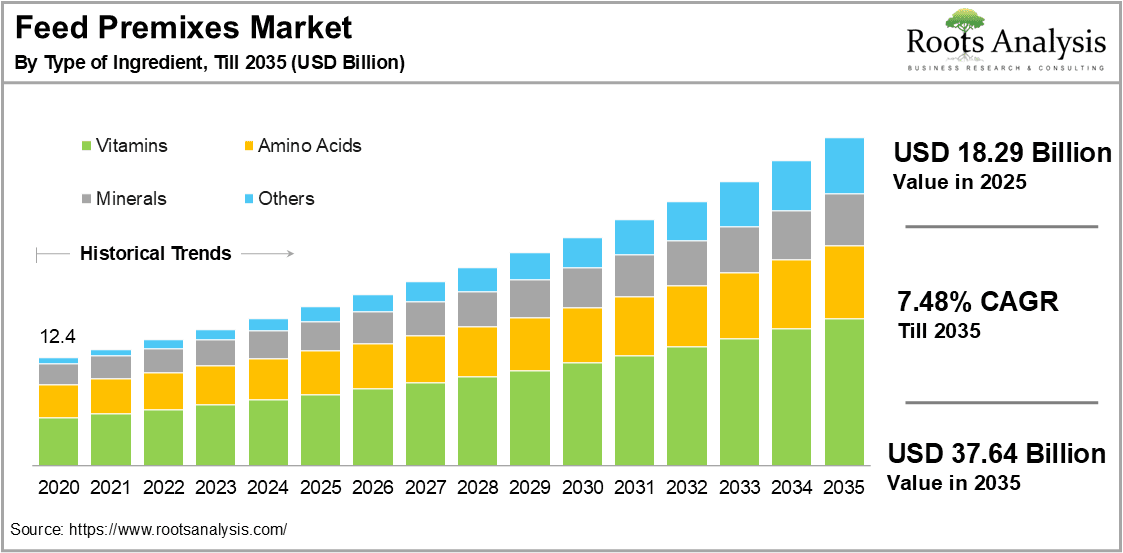
The feed premixes market size is projected to grow from USD 18.29 billion in 2025 to USD 37.64 billion by 2035, representing a CAGR of 7.48% during the forecast period till 2035.
 |
The new research study consists of feed premixes market and trends analysis, detailed market forecast analysis, and provide actionable strategic recommendations.
With the expanding global population, the need for food production, especially, nutritious food production has boosted the demand for agricultural supplies and livestock feed. The growing consumption of animal-based protein has scaled up the feed premixes market. Feed premixes refer to a uniform mixture of micronutrients, nutraceuticals, vitamins, minerals, amino acids, and other feed additives that are blended with a carrier substance similar to wheat flour or rice bran to ensure even distribution in animal feed. It is a sort of supplement of livestock, poultry, aquaculture, and pets to provide them with essential nutrients that may be lacking in their regular feed.
Feed premixes incorporate a variety of ingredients from vitamins and minerals to amino acids and probiotics, which play a critical role in animal health, growth, productivity, and overall performance. The purpose of feed premixes is to provide animals with balanced nutrition and ensure they receive all essential nutrients in the right proportions even if their base diet is deficient. These feed premixes are available in dry and liquid form which are easy to use, offer uniform nutrient distribution, support sustainable agriculture, and can be formulated to meet specific nutritional requirements.
As an effect, expanding livestock, swine, ruminants, aquaculture, poultry, and pets due to inflating demand for meat production and heightening awareness of animal health and nutrition multiplying the scope of the premix concentrate animal feed market. The increasing number of livestock in developing nations and expanding production plants are further likely to widen the prospect of the market. Companies are striving to leverage this opportunity by investing in production plants and supporting the market expansion. For instance, in December 2024, Cargill invested USD 15 million in China to advance its Tianjin facility with a piglet feed production line and reinforce its young animal nutrition capabilities.
Furthermore, the market faces some challenges, including fluctuation in raw material prices and regulatory concerns, which require innovation and strategic planning to overcome these challenges and maintain the market's sustainable growth rate throughout this forecast period.
The feed premixes market report presents an in-depth analysis of the various companies that are involved in offering feed premixes, across different segments, as defined in the table below:
| Key Report Attributes | Details | |
| Historical Trend | Since 2020 | |
| Forecast Period | Till 2035 | |
| Current Market Size | $ 18.29 Billion | |
| Market Size Value by 2035 | $ 37.64 Billion | |
| CAGR (Till 2035) | 7.48% | |
| Type of Ingredient |
|
|
| Type of Form |
|
|
| Type of Livestock |
|
|
| Geographical Regions |
|
|
| Leading Market Players | ||
| PowerPoint Presentation (Complimentary) |
Available | |
| Customization Scope | 15% Free Customization | |
| Excel Data Packs (Complimentary) |
|
|
The global feed premixes market is categorized into a variety of ingredients wherein vitamins dominate the segment and are poised to capture a significant (~39%) share of the market by 2035. Vitamins such as Vitamin A, Vitamin D, Vitamin E, and B play pivotal roles in supporting immune function, reproduction, growth, and overall metabolic processes in animals. Thus, the vitamin ingredients are used in feed premixes for all livestock species similar to poultry, swine, and ruminants, boosting the growth of the segment.
Additionally, amino acids which are known as building blocks of protein are likely to register a faster (9.20%) CAGR during this forecast period. This growth can be ascribed to the importance of amino acids including lysine, methionine, and threonine which are crucial for protein synthesis, growth, and muscle development. As many livestock diets are plant-based and may lack sufficient essential amino acids, supplementation is necessary.
Based on the type of form, the market features a dry and liquid form of feed premixes. As per our feed premixes market research, the dry-form segment fosters the market growth with (~62%) of the market share and will continue to lead the segment till 2035. Dry premixes are in powder or granular form which are easy to handle and generation has a longer shelf life compared to liquid forms which reduces the risk of nutrient degradation over time. Also, they are more cost-efficient and versatile in mixing with other feed ingredients, thereby, lifting the market scope.
However, liquid premixes are used in specific applications where precise dosing or rapid absorption of nutrients is required. They are often used in milk replacers for young animals or in liquid feed systems. Hence, the liquid form of premixes is expected to grow at a steady (9.54%) growth rate during this projection timeframe.
The distribution of the market for feed premixes is segmented into multiple types of livestock such as aquatic animals, equine, pets, poultry, ruminants, and swine. According to our feed premixes market analysis, poultry livestock has been holding a leading position and is expected to hold the maximum (~39%) of the market share till 2035.
The key driving factor of the segment’s growth is the high demand for poultry products such as meat and eggs which are the most widely consumed animal proteins around the world due to their affordability, nutritional value, and versatility in diets. Furthermore, the swine segment is predicted to grow at a higher CAGR of (10.67%) due to being the second-largest consumer of feed premixes driven by a greater demand for pork globally.
This segment highlights the distribution of the feed premixes market across various geographical regions, such as North America, Europe, Asia, Latin America, the Middle East and North Africa, and the rest of the world. In terms of market revenue, Asia is projected to dominate the market with a (~47%) share of the market by 2035.
Besides this, North America is the second leading region and is anticipated to foster the market demand at a faster (11.61%) CAGR throughout this forecast period. North America has a highly developed and technologically advanced livestock industry particularly, in the US and Canada as well as the region is one of the major producers of poultry swine, cattle, and aquaculture products. In addition, farmers and producers are well-informed about the benefits of feed premixes driven by the strict regulations on animal feed and food safety which mandate the use of safe and nutritious feed additives, magnifying the market demand.
Moreover, large-scale commercial farming and the presence of prominent industry players and their collaboration and partnership efforts for global expansion, magnify the market position. For instance, in January 2024, Cargill opened an advanced premix plant in Vietnam, aiming to broaden its production capacity. The new facility is over nine times larger than its predecessor and doubles its annual output to 40,000 tons, enhancing feed production efficiency.
The “Feed Premixes Market, Till-2035: Industry Trends and Global Forecasts” report features an extensive study of the current market landscape, market size and future opportunities within the feed premixes market, during the given forecast period. The market report highlights the efforts of several stakeholders involved in this rapidly emerging segment of the service providers industry. Key takeaways of the feed premixes market report are briefly discussed below.
Several significant key drivers including mounting demand for animal protein, expanding livestock production, and growing emphasis on animal health and nutrition are amplifying the feed premixes market growth. Worldwide, with the growing population, the demand for meat, dairy, eggs, and other protein-rich products continues to rise. This trend is particularly, strong in emerging economies where rising incomes and urbanization are driving dietary shifts towards higher protein consumption.
In turn to this, the expansion of the livestock industry especially, in Asia remarkably contributes to the feed premixes market demand. Also raising awareness among farmers and producers about the importance of animal nutrition in ensuring optimal health, growth, and productivity, boost the growth of the industry during this projection timeframe.
Several large global companies and small and medium-sized region manufacturers such as Cargill, ADM, BASF, DSM-Firmenich, Land O Lakes, Godrej Agrovet, Phibro Animal Health, and others are operating in the market and stimulating the market development. These key players gain a significant competitive edge by catering to the local market with customized solutions tailored to regional livestock needs.
Smaller companies are focusing on specific segments such as organic feed premixes, species-specific formulations, or premium products for high-value livestock. Other companies are constantly striving to secure a major market stake by employing competitive strategies including product innovation, strategic partnership & collaboration, precision nutrition, and expansion in emerging markets.
The cost of raw materials such as vitamins, minerals, amino acids, and other additives used in premixes is highly volatile. Also, the feed industry is subject to string regulations regarding the safety, quality, and labeling of feed premixes. Compliance with these regulations which vary across regions, can increase operational costs and complexity for manufacturers. As a result, fluctuations in the price of raw materials and stringent regulatory requirements can pose substantial challenges to the expansion of the market.
Having a large number of livestock, Asia is projected to lead the market for feed premixes with over (~47%) of the current market share. According to a report, India and China own the largest cattle inventory which accounts for around 33% of the world’s inventory. This is due to the fact that these countries raise the demand for animal protein and higher consumption of meat, dairy and other animal-based products which drive the substantial need for feed premixes to enhance animal nutrition and productivity.
Governments in the region are promoting the use of high-quality feed additives to ensure food security and meet the growing demand for animal products. Therefore, with the increasing focus on modern animal husbandry practices, farmers and feed manufacturers are increasingly adopting feed premixes to improve animal health and growth rate, especially in the poultry and swine industry, thereby solidifying the growth of the market in the global landscape.
Examples of key players involved in the market for feed premixes (which have also been captured in this market report, arranged in alphabetical order) include Agrifirm (Netherlands), Agrofeed (Hungary), Archer Daniels Midland (US), BASF (Germany), BEC Feed Solutions (Australia), Cargill (United States), Corbion (Netherlands), DLG (Denmark), InVivo (France), Kemin Industries (US), KG Group (Lithuania), Koninklijke (Netherlands), Lallemand (Canada), Land O’Lakes (US), Lexington Enterprises (US), Nutreco (Netherlands), and Phibro Animal Health (US). This market report includes an easily searchable excel database of all the companies exwho have adopted the feed premixes market.
The market report presents an in-depth analysis, highlighting the capabilities of various companies engaged in this domain, across different segments. Amongst other elements, the market report includes:
At Roots Analysis, we genuinely care about your success and understand that your business requirements are unique. While our market research reports provide valuable insights, we recognize that they might not cover every aspect you need to make well-informed strategic decisions. To account for that, we offer 15% free report customization tailored to your specific needs. Whether you require additional quantitative analysis, qualitative insights, or any other information related to the feed premixes market, reach out us today at: support@rootsanalysis.com