


 Download Free Sample
 Buy Now
Glass Ceramics Market Outlook
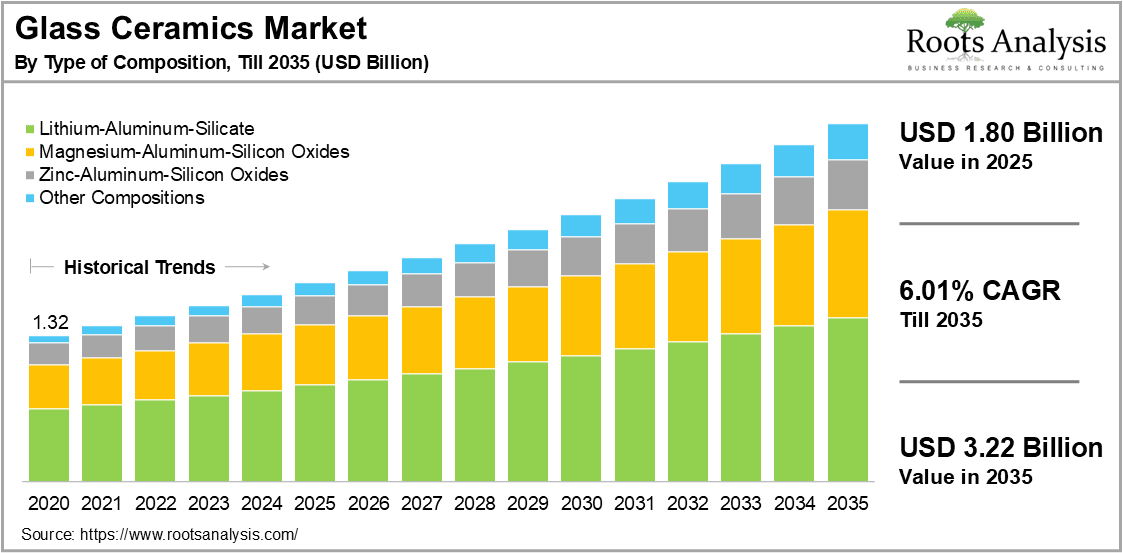
The global glass ceramics market is expected to rise from USD 1.80 billion in 2025 to USD 2.55 billion by 2030, and USD 3.22 billion by 2035, representing an overall CAGR of 6.01% till 2035.
 |
See What’s in the Full Report–Request Your Complimentary Insights!
Glass ceramics are high-performance polycrystalline materials formed through the controlled crystallization of base glass, known for their low thermal expansion, high toughness, and excellent thermal shock resistance.
These materials, including oxide varieties like silicate and borate, and non-oxide types such as chalcogenide, have found broad applications across commercial, industrial, biomedical, and advanced optics sectors. Notably, their effective noise reduction properties and cost efficiency make them ideal for construction purposes as compared to traditional materials.
According to Dr. Anil Kumar, Professor at the Indian Institute of Technology (IIT) Roorkee and a leading materials science expert, “Advancements in glass ceramics technology are pivotal for modern construction and healthcare applications, offering durability and efficiency unmatched by conventional materials."
The global demand for glass ceramics is fueled largely by rapid urbanization and infrastructure development, especially in key regions like Asia where construction activities are booming. However, the industry faces challenges from escalating energy costs in glass ceramics manufacturing process, which could impact pricing and supply chains.
In essence, industry leaders emphasize sustainable production practices and innovation to address these concerns while meeting growing market needs. Further, continuous R&D efforts are critical in reducing production costs and enhancing material performance, thereby driving further market growth globally.
Recent Developments in Glass Ceramics Market
- In May 2025, new laboratory-grade CMMs, were launched at Control 2025, the annual international trade fair for quality assurance with Altera SF machines which incorporate glass-ceramic optical scales that have zero thermal expansion materials.
- In April 2025, Corning announced the launch of Gorilla Glass Ceramic, a new glass ceramic material designed to improve drop performance on rough surfaces.
- In August 2024, the launch of Xiaomi 15 Ultra was announced with ceramic, glass and faux leather back panels.
Glass Ceramics Market Segmentation Insights
The glass ceramics market report presents an in-depth analysis of the various companies that are involved in offering glass ceramics solutions and services, across different segments, as defined in the table below:
Glass Ceramics Market: Report Attributes / Market Segmentations
| Key Report Attributes | Details | |
| Historical Trend | Since 2020 | |
| Forecast Period | Till 2035 | |
| Market Size 2025 | $ 1.80 Billion | |
| Market Size 2035 | $ 3.22 Billion | |
| CAGR till 2035 | 6.01% | |
| Type of Composition |
|
|
| Areas of Application |
|
|
| Type of Enterprise |
|
|
| Geographical Regions |
|
|
| Leading Market Players |
|
|
| PowerPoint Presentation (Complimentary) | Available | |
| Customization Scope | 15% Free Customization | |
| Excel Data Packs (Complimentary) |
|
|
Want Information on Specific Region/Segment?
Glass Ceramics Market Share Insights
Which Type of Composition Will Dominate the Glass Ceramics Market?
When it comes to the global glass ceramics market, the lithium-aluminum-silicate sub-segment is set to take the lead, currently holding a significant market share of over 51.2%.
The growth of lithium-aluminum-silicate glass ceramics sub-segment is due to its thermal stability and widespread use in cookware and glass ceramics electronics market. Further, its near-zero thermal expansion, high strength, and versatility in applications like cookware, cooktops, and dental restorations also fuel the market growth.
Advancements in lithium-aluminum-silicate glass ceramics, as well as their established use in household and industrial products further ensures market leadership. However, it is worth highlighting that the magnesium-aluminum silicon oxides segment is likely to witness the fastest CAGR of around 6.6% during the forecasted period.
Which Areas of Application will Witness the Fastest Growth Rate?
When it comes to the areas of application, the electrical & electronics sub-segment is likely to grow at a faster pace, with a projected CAGR of 7.2% during the forecast period. On the other hand, the building and construction ceramics sub-segment dominates the current glass ceramics market size, capturing a share of 35.22%.
The glass ceramics electronics market growth is fueled by demand for glass ceramics in semiconductors, insulators, and 5G components. Further, the proliferation of consumer electronics sector along with the ongoing technological advancements support the rapid growth.
Why is Asia Leading the Glass Ceramics Market?
According to our regional analysis, the Asian glass ceramics market currently exhibits dominance with 37.69% of overall market share. This regional glass ceramics market growth is mainly due to its robust construction sector (e.g., India’s USD 25.95 billion FDI in construction from 2020–2021), expanding electronics industry (e.g., China’s USD 112 billion electronics sector), and the use of glass ceramics for aerospace growth. Government policies and skilled labor availability are further enhancing the region’s leadership.
Unlock Deeper Insights–Schedule Your Personalized Workshop Today!
Glass Ceramics Market Key Takeaways
The “Glass Ceramics Market: Industry Trends and Global Forecasts, Till 2035” report features an extensive study of the current market landscape, glass ceramics market size and future opportunity within the glass ceramics solutions market, during the forecast period. The market report highlights the efforts of several stakeholders involved in this rapidly emerging segment of the service providers industry. Key takeaways of the market report are briefly discussed below.
Glass Ceramics Market Drivers and Challenges
What are the Key Glass Ceramics Market Drivers?
The glass ceramics market is witnessing significant growth. Here’s how:
- Expansion in Building and Construction: Increasing use of glass ceramics for countertops, wall claddings, and flooring due to durability, aesthetic appeal, and thermal stability.
- Growth in Consumer Electronics: Demand for abrasion-resistant glass ceramics in smartphone screens and protective covers, benefiting from thermal shock resistance and mechanical strength.
- Increasing Sales of Kitchen Appliances: Glass ceramics’ heat resistance and robustness is increasing the glass ceramics market opportunities in kitchen appliance manufacturing.
- Government Initiatives: Policies promoting renewable energy and electronics manufacturing boost demand for advanced glass ceramics.
What are the Key Drivers for Glass Ceramics in Building and Construction Industry?
- Sustainability and Eco-Friendliness: Glass ceramics manufacturing process includes 100% recycled glass, a lower energy footprint due to low-temperature sintering, and they are fully recyclable, supporting green building certifications and circular economy goals.
- Durability and Performance: They offer high durability, resistance to weathering, and fire protection (preventing fire and smoke spread for extended periods), making them ideal for demanding glass ceramics building applications like facades, cladding, and fire-rated doors and windows.
- Aesthetic Versatility: Building and construction ceramics provide unique design possibilities, including a range of colors, translucency, and surface finishes, enabling creative architectural solutions for both interiors and exteriors.
What are the Main Challenges in Glass Ceramics Manufacturing Process?
The manufacturing process of glass ceramics faces several obstacles that could hinder its growth. A few of the glass ceramics market challenges are:
- High Production Costs: Complex manufacturing processes and advanced technology requirements increase capital and operational expenses.
- Raw Material Price Fluctuations: Variability in prices of silica, alumina, lithium, and other oxides affects production costs and supply stability.
- Complex Manufacturing Process: Precise control over melting, shaping, and ceramization stages is essential, demanding skilled labor and advanced equipment.
- Limited Accessibility for SMEs: High investment barriers restrict participation of smaller manufacturers.
- Environmental Concerns: Energy-intensive production and ecological impact require sustainable practices, which may increase costs.
Glass Ceramics Market Trends
What are the Key Strategies Used by Companies to Gain Glass Ceramics Market Share?
Companies in the glass ceramics market are using smart strategies to stay ahead. Big players are focusing on partnerships, acquisitions, joint ventures, and innovations to strengthen their position while also investing in R&D to bring innovative and novel products to the market.
Launching new technologies and expanding into regions with innovations, technological advancements are the key moves helping them capture more market share. For instance, in January 2025, Samsung S25 Ultra introduced Corning Gorilla Armor 2, the industry’s first anti-reflective glass ceramic for mobile devices.
In reference to this, David Velasquez, Vice President and General Manager at Corning Gorilla Glass commented that “Gorilla Armor 2 is set to offer consumers an unparalleled user experience with the first durable, optically advanced glass ceramic cover material ever used on a Galaxy mobile device.”
What is the Impact of Glass Ceramics in Consumer Electronics and Semiconductors?
- Glass ceramics in consumer electronics and semiconductors offer excellent thermal shock resistance and low thermal expansion, ensuring device stability and reliability during rapid temperature changes.
- Their durability and ability to withstand high temperatures make them ideal for substrates and components in advanced electronic devices.
- They enhance product longevity and support the miniaturization, and performance demands of modern electronics.
What is the role of Glass Ceramics in Aerospace Thermal Protection Systems?
Glass ceramics play a crucial role in aerospace thermal protection systems by providing lightweight, heat-resistant shielding that protects spacecraft and high-speed vehicles from extreme temperature fluctuations during atmospheric re-entry and flight.
Pay Only for What You Need–The Best Way to Optimize
Glass Ceramics Market Report Coverage
The market report presents an in-depth analysis, highlighting the capabilities of various companies engaged in this domain, across different segments. Amongst other elements, the market report includes:
- An Infographic Executive Summary
- Market Landscape of Leading Players
- Company Competitiveness Analysis
- Startup Ecosystem Analysis
- Value Chain Analysis
- Company Profiles
- Key Winning Strategies
- In-depth View of Recent Developments
- Mega Trends
- Unmet Needs Analysis
- Patent Analysis
- Market Forecast and Opportunity Analysis
- Porter’s Five Forces Analysis
- SWOT Analysis`
About Authors
Lead Author: Anmol Bali
Lead Reviewer: Yash Tyagi
Chief Editor: Ronit Sharma
Customization Opportunities
At Roots Analysis, we genuinely care about your success and understand that your business requirements are unique. While our market research reports provide valuable insights, we recognize that they might not cover every aspect you need to make well-informed strategic decisions. To account for that, we offer 15% free report customization tailored to your specific needs. Whether you require additional quantitative analysis, qualitative insights, or any other information related to the market report, reach out us today at: support@rootsanalysis.com


