


 Download Free Sample
 Buy Now
Market Size
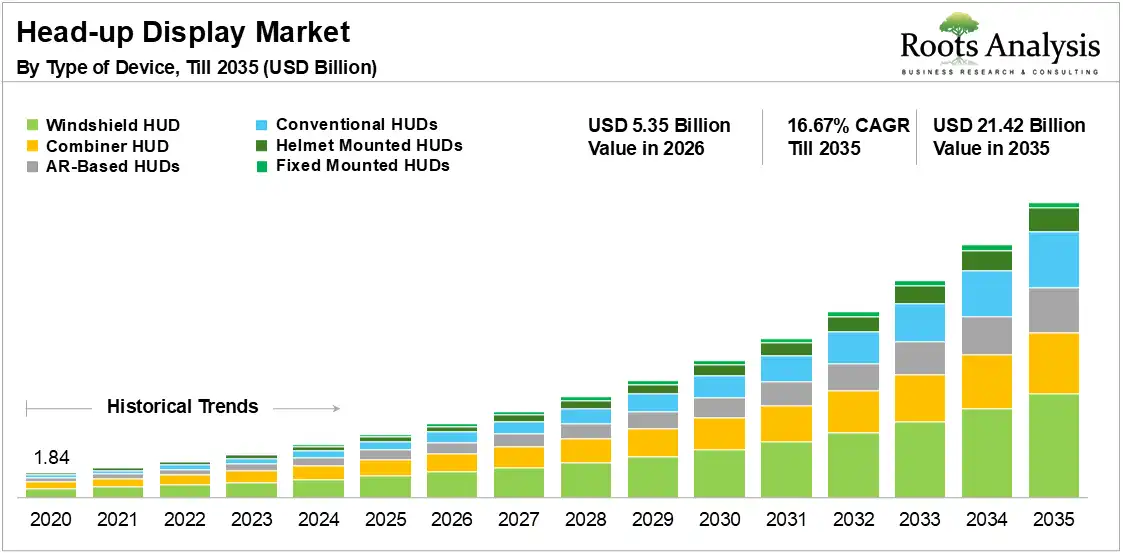
The global head-up display market, valued at USD 5.35 billion in 2026, is projected to reach USD 11.56 billion in 2030 and USD 21.42 billion by 2035, with a 16.67% CAGR during the forecast period 2026 to 2035.
See What’s in the Full Report - Request Your Complimentary Insights!
Market Report: Key Takeaways
- In terms of component, the video generator secured the maximum of the overall revenue share of the global market.
- Automotive sector holds the largest share (57.60%) of the application area in HUD market.
- In terms of leading region, North America holds the largest share with 34.17% share of the market.
- Key market driver is the rapid growth of connected and autonomous vehicles, along with advances in display technology.
Market Overview
A head-up display (HUD) is transparent windshield projection system that present essential data directly within the user’s line of sight without requiring them to look away from their usual viewpoint.
Originally developed for military aviation, HUD technology enhances situational awareness by overlaying critical information, such as speed, navigation, and system status onto the real-world scene seen through the windshield or a dedicated transparent screen. This allows users to maintain focus on their environment while accessing pertinent information, improving safety and efficiency.
These systems have found widespread applications beyond head-up display for aviation, notably in the automotive industry. Moreover, HUDs are used in other domains, such as marine navigation, industrial machinery, sports, and augmented reality wearable devices, helping users integrate digital content with their physical surroundings for enhanced interaction and decision-making.
The growth of the HUD market is driven by advancements in display technologies, such as augmented reality (AR) HUDs in next-gen vehicles and holographic projection, which enrich the user experience with immersive and interactive features.
Increasing emphasis on safety in automotive and aerospace sectors fuels HUD adoption, as these systems reduce cognitive load and visual distraction for operators.
Additionally, the push towards autonomous and connected cars is accelerating the HUD integration with ADAS and driver assistance systems for seamless access to navigation aids.
As product miniaturization and cost-effectiveness improve, HUD technology is becoming accessible to a broader range of vehicles and applications, further propelling market expansion.
Recent Developments
- In June 2025, Electric vehicle manufacturer XPeng collaborated with Huawei to integrate innovative augmented reality head-up displays (AR HUD) into XPeng’s vehicles.
- In January 2025, BMW announced a new iDrive operating system with an eye-catching centerpiece: a 3D heads-up display (HUD) that stretches from pillar to pillar along the windshield.
- In January 2025, Hyundai Mobis debuted with holographic heads-up display, a windshield display technology, which projected driving information across the windshield, specific to drivers’ and passengers’ needs.
Market Dynamics
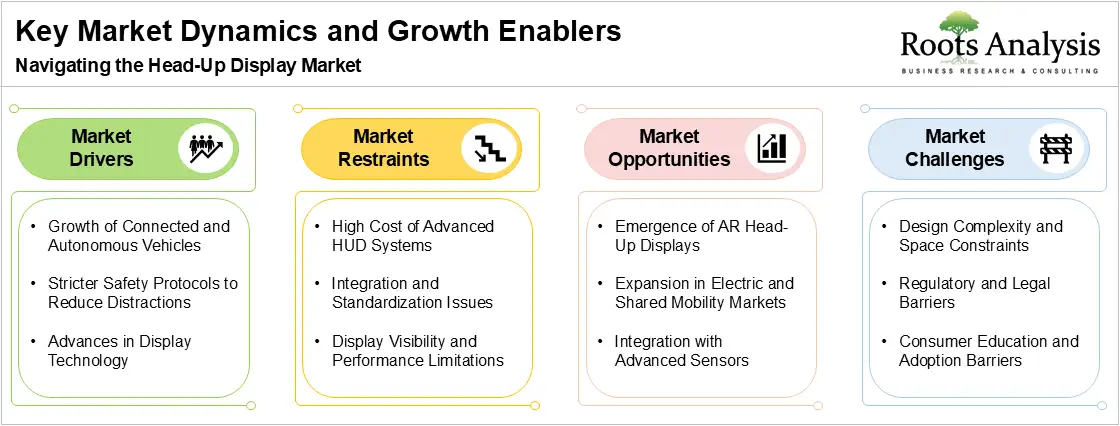
The industry is set to witness a lucrative growth phase, with the automotive head-up display market shaped by a dynamic interplay of drivers, restraints, opportunities, and challenges that will influence its trajectory in the coming years.
Key Market Drivers
- Growth of Connected and Autonomous Vehicles: HUDs are increasingly integrated into new vehicle models to present critical information (speed, navigation, ADAS alerts) clearly and safely, supporting the shift toward connected, semi-autonomous, and autonomous vehicles.
- Stricter Safety Protocols to Reduce Distractions: Stringent global safety regulations from agencies like NHTSA, Euro NCAP, and UNECE encourage automakers to adopt HUDs as standard or premium features to reduce driver distraction and improve ergonomics.
- Advances in Display Technology: Innovations in augmented reality HUDs, micro-LED, holographic, and windshield projection technologies allow for richer, clearer, and more customizable displays, expanding HUD applications beyond automotive into aviation, rail, and marine segments.
Pay Only for What You Need – The Best Way to Optimize
Key Market Challenges
- Design Complexity and Space Constraints: Integrating HUD components into increasingly compact and varied dashboard spaces, especially for next-gen AR HUDs, presents packaging and thermal management challenges.
- Regulatory and Legal Barriers: Differing regional standards and regulations for field of view, brightness, and UI elements complicate global rollout, approvals, and cross-market use.
- Consumer Education and Adoption Barriers: HUDs are sometimes seen as gimmicks or distracting, particularly by older users, and lack of awareness of safety and functional benefits may slow wider adoption.
Market Segmentation
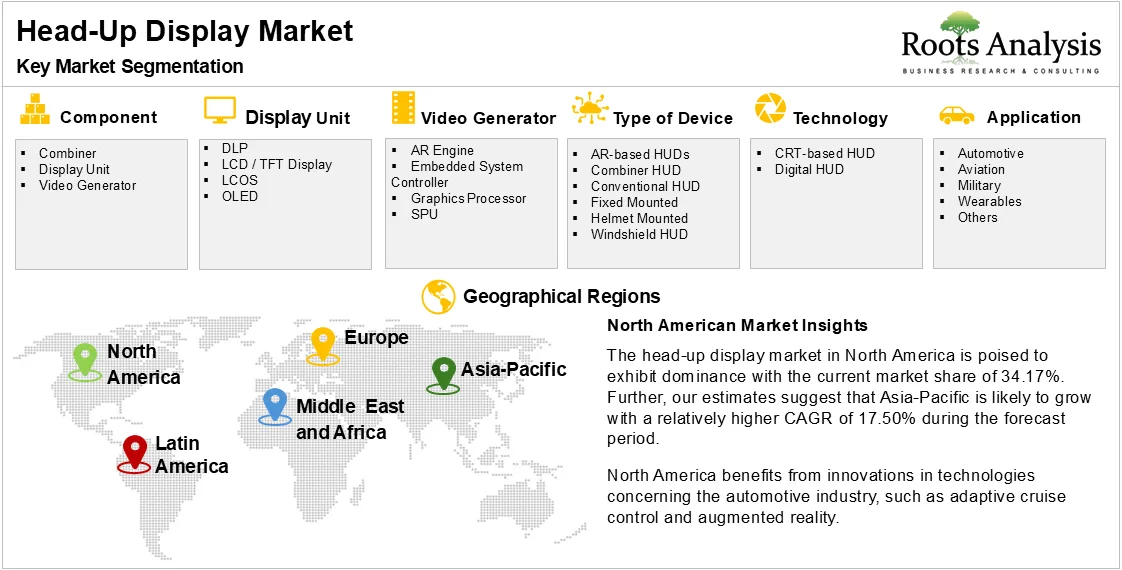
The head-up display market report presents an in-depth analysis of the various companies that are involved in offering portable HUD solutions, across different segments, as in the figure below:
Market Share Insights
Which Component is Expected to Have the Fastest Growth in the Forecast Period?
Our head-up display market forecast estimates suggest that the video generator sub-segment is set to have the fastest CAGR during the forecast period.
This sub-segment forms the backbone of HUD functionality as it generates, processes, and renders the images and information projected onto the windshield or combiner. With the increasing adoption of advanced HUDs, especially AR-enabled systems, the need for high-performance processors capable of managing complex visual overlays, real-time navigation, and safety alerts is becoming more critical.
Additionally, as HUDs expand beyond luxury vehicles into mid-range segments, cost-optimized processors with strong computing power are in high demand to support large-scale adoption.
Application Market Share Leader and Fastest Growing Segment
As per our head-up display industry analysis, the automotive sub-segment is expected to hold the largest market share of 57.6% in 2026.
The automotive head-up display market trends and forecasts suggest that the popularity of this sub-segment is due to wide adoption of HUDs in mid-range and luxury vehicles. This adoption is aimed at improving driver safety, navigation, and infotainment experiences. This dominance is bolstered by the global push toward HUD integration with ADAS, making vehicles smarter and safer.
On the other hand, the wearables segment is projected to have the fastest CAGR (19.41%) due to HUD adoption in aviation and commercial aircraft, as well as industrial, and consumer electronics applications. The growing use of wearable technology, such as hands-free augmented reality displays in these applications are increasingly valued for their enhanced operational efficiency and immersive media experiences.
Regional Forecast Estimates: North America Leads the Head-up Display Market, Fueled by Rising Safety Concerns
North America is projected to hold the most substantial share (34.17%) during the current global year. The region is witnessing rapid growth in the head-up display market driven by rising safety concerns and increasing fatalities.
Further, the presence of large technology companies and huge investments made towards the R&D of this technology are also major factors driving growth in North America.
Furthermore, recent HUD market growth in electric and autonomous vehicles and innovations in technologies concerning the automotive industry, such as adaptive cruise control and augmented reality, are the major head-up display user experience trends that would lead to a significant rise in the demand for the overall U.S. market.
For instance, in July 2025, HOLOGRAPHIC display pioneer Envisics created a state-of-the-art Augmented Reality Head-Up Display to be installed in American car maker Cadillac’s new luxury SUVs, the VISTIQ and electric LYRIQ-V.
Want Information on Specific Region / Segment?
Key Market Insights
Which are the Top Players in the Head-up Display Market?
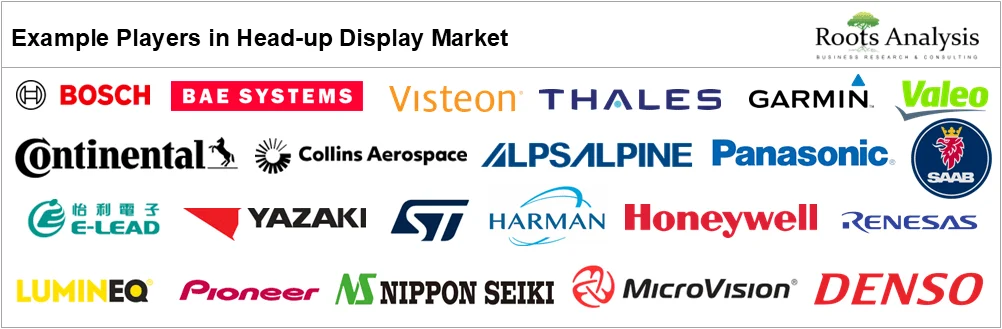
Examples of leading head-up display manufacturers (which have also been captured in this market report, arranged in alphabetical order) include ALPS ALPINE, BAE Systems, Bosch, Collins Aerospace, Continental, DENSO, E-LEAD ELECTRONIC, Elbit Systems, Garmin, HARMAN, Honeywell, HUDWAY, Lumineq, MicroVision, Nippon Seiki, Panasonic Holdings (formerly Panasonic Corporation), Pioneer, Renesas Electronics, Saab, STMicroelectronics, Thales, Valeo, Visteon, WayRay, and Yazaki.
What Strategies are the Companies Using to Gain HUD Market Share?
Companies in the head-up display (HUD) market are employing several key strategies to gain market share. They are heavily investing in research and development to innovate and integrate advanced technologies like laser-based projection technology in head-up displays, augmented reality (AR), artificial intelligence (AI), and high-resolution waveguide optics, which enhance user experience and safety.
Collaborations and partnerships with automotive OEMs help in co-developing customized HUD solutions that meet specific vehicle requirements and regulatory standards, facilitating broader adoption especially in mid-range and luxury vehicles.
For instance, in December 2024, Eastman, Covestro, and Ceres partnered to advance holographic transparent displays, a new head-up display technology enables multiple displays in various positions in a single windshield.
In this context, Günther Walze, Head of Holographic Lightguiding at Covestro stated, “our Bayfol HX enables next-generation truly transparent projection displays for windshields while meeting the high automotive safety requirements. With the necessary establishment of hologram mastering and scalable mass-production replication equipment by Ceres, combined with Eastman’s windshield lamination technology, this innovation is ready for deployment to end customers.”
Smartphone Connectivity with In-Vehicle HUD Systems
Smartphone connectivity enables seamless integration between the HUD and the driver’s mobile device via Bluetooth or Wi-Fi. This allows projection of navigation, calls, messages, and media controls directly on the HUD, reducing driver distraction.
Voice control and app integration enhance hands-free operation and personalized user experience. Connectivity with vehicle diagnostics (OBD-II) further enriches real-time data display in smartphone connectivity HUD.
Aftermarket Head-up Display Solutions for Cars
Aftermarket HUD solutions offer cost-effective upgrades for vehicles without factory-installed HUDs. These devices often connect via the OBD-II port and pair with smartphones to display customizable data such as speed, navigation, and alerts.
They enhance driver safety and convenience without requiring major modifications and are gaining popularity for older vehicles seeking modern technology integration.
Motorcycle and Helmet-Integrated Head-up Displays
Motorcycle HUDs integrated into helmets provide riders with critical information like speed, navigation prompts, and hazard alerts without requiring them to look away from the road.
These lightweight, rugged systems improve safety and situational awareness in dynamic riding conditions. Growing adoption is driven by enhanced AR capabilities and demand for safer, connected riding experiences.
Regulatory Standards for Automotive HUD Safety
Automotive HUD systems must comply with stringent safety standards to ensure they do not distract drivers or impair visibility. Regulations govern aspects such as brightness, contrast, information display limits, and placement within the driver’s line of sight.
Compliance with standards from bodies like SAE and ISO ensures HUDs enhance safety while meeting legal requirements across global markets.

Head-up Display Market: Scope of the Report
| Key Report Attributes | Details | |
| Historical Trend | Since 2020 | |
| Forecast Period | Till 2035 | |
| Market Size in 2026 | $ 5.35 Billion | |
| Market Size in 2035 | $ 21.42 Billion | |
| CAGR (2026-2035) | 16.67% | |
| Segments Covered |
|
|
Unlock Deeper Insights – Schedule Your Personalized Workshop Today!
Market Segments
Based on the research, we have segmented the head-up display market into component, display unit, video generator, type of device, technology, application, geographical regions, and key players.
By Component
- Combiner
- Display Unit
- Video Generator
By Display Unit
- DLP
- LCD / TFT Display
- LCOS
- OLED
By Video Generator
- Augmented Reality Engine
- Embedded System Controller
- Passenger Graphics Processor
- Passenger Signal Processing Unit
By Type of Device
- AR-based Head-Up Displays
- Combiner HUD
- Conventional Head-Up Displays
- Fixed Mounted
- Helmet Mounted
- Windshield HUD
By Technology
- CRT-based HUD
- Digital HUD
By Application
- Automotive
- Mid-Range Vehicles
- Luxury Vehicles
- Aviation
- Military
- Wearables
- Others
By Geographical Regions
- North America
- US
- Canada
- Mexico
- Rest of North America
- Europe
- Austria
- Belgium
- Denmark
- France
- Germany
- Ireland
- Italy
- Netherlands
- Norway
- Russia
- Spain
- Sweden
- Switzerland
- UK
- Rest of Europe
- Asia-Pacific
- Australia
- China
- India
- Japan
- New-Zealand
- Singapore
- South Korea
- Rest of Asia-Pacific
- Latin America
- Brazil
- Chile
- Colombia
- Venezuela
- Rest of Latin America
- Middle East and Africa (MEA)
- Egypt
- Iran
- Iraq
- Israel
- Kuwait
- Saudi Arabia
- UAE
- Rest of MEA


