
Lowest Price Guaranteed
Slides
212
Last Updated
August 2026
View Count
39444
The age of general-purpose humanoid robotics has arrived, driven by advances in simulation and physical AI.
-Deepu Talla, vice president of robotics and edge AI at NVIDIA
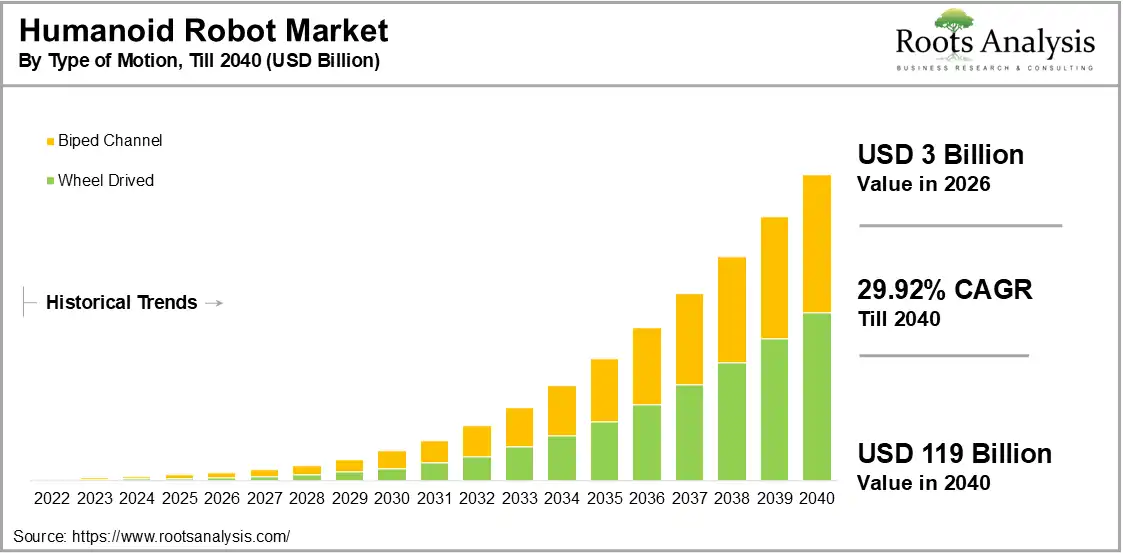
The global humanoid robot market size is expected to rise from USD 3 billion in 2026 to USD 12 billion by 2030, and USD 119 billion by 2040, representing an overall CAGR of 29.92% till 2040.
To learn more about this report, request a free sample copy
The new research study consists of industry trends, detailed market analysis, key market trends of the Humanoid Robot Market, SWOT analysis and value chain analysis.Humanoid robots are anticipated to live and work closely with humans in the day-to-day world and serve the needs of physically disabled people. These robots are expected to manage the wide variety of duties and objects encountered in dynamic, unstructured environments.
Humanoid robots are proficient service providers created to mimic human interaction and motion. Similar to all service robots, these also deliver value by automating tasks leading to cost savings and increased productivity. A specialized type of advanced humanoid robot, called android, is known to exhibit human-like behavior. These robots are programmed to talk with a computerized voice, run, jump and even climb stairs in ways similar to humans. As human-machine symbiosis progresses, brain-computer interface innovations are shaping the future of assistive robotics and neural control.
Further, considering the fact that humanoid robots are types of mobile robots, they can navigate their environment autonomously, making them particularly useful for a wide range of applications. These can perform a variety of jobs ranging from industrial tasks to household chores. It is interesting to note that the emergence of biohybrid robots reflects a shift toward human-mimetic machines that combine living cells with synthetic components.
The global humanoid robot market is witnessing a significant growth, fueled by several key drivers. There is a prominent expansion in the capabilities and humanoid robot applications across diverse industries due to the rapid advancement in humanoid robot technology. In addition to this, the rising demand of industrial automation and labor scarcity, paired with the need for increased efficiency is further driving the market. Apart from this, significant investments in research and humanoid robot development are further fueling market growth. For instance, in February 2024, prominent investors like NVIDIA, Jeff Bezos, Open AI and Microsoft came together to fund Figure AI, a humanoid robot developing startup, with a funding of USD 675 million to accelerate its research and development. With such a rise in investment activity, humanoid robot market is likely to experience an exponential growth by next decade.
The market report presents an in-depth analysis of the various service providers that are involved in humanoid robot market, across different segments, as defined in the table below:
| Key Report Attributes | Details | |
| Historical Trend | Since 2022 | |
| Base Year | 2025 | |
| Forecast Period | Till 2040 | |
| Market Size Value in 2026 | $ 3 Billion | |
| Market Size Value by 2040 | $ 119 Billion | |
| Growth Rate | CAGR of 29.92% from 2026 to 2040 | |
| Type of Humanoid Robot |
|
|
| Type of Component |
|
|
| Type of Hardware |
|
|
| Type of Motion |
|
|
| End Use Industry |
|
|
| Type of Organization |
|
|
| Geographical Regions |
|
|
| Leading Market Players |
|
|
| PowerPoint Presentation (Complimentary) |
Available | |
| Customization Scope | 15% Free Customization | |
| Excel Data Packs (Complimentary) |
|
|
Currently, industrial humanoid robots dominate the humanoid robots market, accounting for 100% market share. This is largely driven by their role in manufacturing, automotive assembly, and production-line automation.
However, this dominance is expected to decline during the forecast period due to the exceptionally high CAGR (till 2040) of the household humanoid robots sub-segment. Growing consumer acceptance, reduced hardware costs, and integration with smart cities ecosystem will drive this transition, making domestic humanoids a mainstream reality.
The humanoid robotics market is currently hardware-centric, fueled by demand for actuators, sensors, servos, and control systems vital for humanoid performance.
Software sub-segment is expected to grow the fastest (with a CAGR of 52.05%) during the forecast period. With advancements in machine learning, natural language processing (NLP), computer vision, and cloud robotics, software intelligence will be the primary differentiator.
Cognitive capabilities, such as contextual decision-making, real-time adaptability, personalization, and learning from human interaction will transform humanoids from mechanical machines into meaningful human companions and workforce augmenters.
Within the hardware segment, actuators dominate the humanoid market, accounting for 51.09% of current market share, because they are essential for enabling human-like movement and interaction, acting as the robot’s muscles.
Further, Advances in actuator technology improve precision, strength, and energy efficiency, directly enhancing robot performance. As a result, their critical role and high cost make them a key focus for innovation and market growth in humanoid robotics.
On the contrary, sensors sub-segment is expected to be the fastest-growing hardware category (having a CAGR of 48.78%). This is due to the increasing adoption of 3D vision, LiDAR, and AI-powered sensors, which enable humanoids to become more aware, responsive, and suitable for applications in industries such as healthcare and personal assistance.
The biped humanoid robots category is witnessing rapid acceleration and is expected to grow at a faster pace (CAGR of 54.90%) during the forecast period. This is because biped designs mimic human locomotion and are increasingly being preferred for applications requiring human-like mobility in unstructured environments.
It is imperative to note that, currently the wheel-driven humanoid robots sub-segment holds the largest market share (85.34%), and this trend is unlikely to change during the forecast period. This is a result of their cost-effectiveness, energy efficiency, and easier navigation in industrial settings.
In terms of end-use industries, automotive / production sub-segment is expected to dominate humanoid robot demand, capturing 33.89% share within the current market. This dominance is primarily linked to the sector’s high reliance on automation for tasks, such as precision assembly, welding, quality inspection, and material handling.
With rising emphasis on operational efficiency, worker safety, and production scalability, automotive manufacturers are investing in humanoid robots that can collaborate on factory floors and adapt to dynamic manufacturing environments.
At the same time, emerging demand for personal care and service applications, such as elderly care, healthcare support, and customer interaction in retail and hospitality, is set to accelerate rapidly in the coming years.
While automotive continues to hold the largest share, service-focused industries will play a defining role in shaping the long-term expansion and diversification of the humanoid robots market.
The global humanoid robot market is fragmented into multiple types of enterprise namely large and small and medium enterprise. The large enterprise segment is anticipated to dominate the segment with the highest market share over this forecast period. However, small and medium enterprise segments are expected to witness the fastest growth rate until 2040. This is ascribable to their agility, innovation, focus on niche markets, and ability to adapt to changing customer preferences and market conditions.
The Asia-Pacific region holds leadership in humanoid robotics by capturing 73.48% share within the current humanoid market. This dominance is linked to heavy investments by robotics giants in Japan, China, and South Korea, combined with government-backed AI initiatives, and rapid technology adoption across service and industrial domains.
Meanwhile, Europe is expected to witness fastest growth rate. The inclination towards humanoids in European region stems from increased R&D investments, rising adoption in healthcare, elder care, cobots, and smart city infrastructure programs.
With regulatory support for safe AI, ethical deployment, and sustainability-driven robotics adoption, Europe is likely to emerge as a key growth hub in the humanoid robots market.
The expansion of the humanoid robot market trends are being fueled by several factors including, wide utilization of humanoid robots for surveillance and security such as detecting unauthorized intrusion and terrorist activities. Furthermore, the new-age technological advancements in humanoids, including facial and emotional recognition, are a growing global market trend. Similarly, the recent and rapid technological advancements in AI and ML have led to the integration of these robots in multiple industries including education and entertainment.
With the presence of several established robotics manufacturers and emerging startups, the market is experiencing intense competition and changing market dynamics. From large multinational companies to local players, companies are striving to enhance their competitive edge. In terms of market share, large enterprises and multinational companies are dominating the market. The key players are using strategies such as partnerships, acquisitions, ventures, humanoid robot innovations, novel product launches, R&D and geographical expansions in an attempt to solidify their position in the industry. For instance, in January 2023, Aeo, a dual-arm humanoid robot by Aeolus Robotics, was launched for a range of service duties such as, delivery, security, eldercare, operating kiosks, and ultraviolet germicidal cleaning.
Despite the exceptional growth, the humanoid robot market is facing a few challenges. The most prominent one includes high initial cost which limits the affordability for many potential users. More restraints including public perception and acceptance, ethical considerations, cyber threat vulnerabilities, along with stringent government regulations persist in this industry.
Asia-Pacific currently holds a substantial share in the humanoid robot market opportunity. This dominance can be attributed to the robust technological ecosystem with leading companies and institutions actively developing humanoid robotics technology. Apart from this, the strong investment in research and humanoid robot development, coupled with technological innovations are also the factors influencing the growth of this market in North America.
Examples of key service providers involved in the humanoid robot market (which have also been captured in this market report, arranged in alphabetical order) include Agility Robotics, Advanced Telecommunications Research Institute International (ATR), AvatarMind Robot , Boston Dynamics, DST Robot, Engineered Arts, EZ-Robot, FANUC, Figure AI, Furhat Robotics, GITAI, Hajime Research Institute, Hanson Robotics, Honda Motor, HYULIM Robot, Instituto Italiano Di Technologia (IIT), Kawada Robotics, Kindred, KUKA Robotics, Macco Robotics, National Aeronautics and Space Administration (NASA), PAL Robotics, Promobot, Qihan Technology, Robo Garage, ROBOTIS, Sanbot, Samsung Electronics, Shadow Robot Company, SoftBank Corporation, SoftBank Robotics, Tesla, Toshiba, UBTECH Robotics, Willow Garage, WowWee, and Unitree. This market report includes an easily searchable Excel database of all the companies who offer humanoid robot products.