Carbon Footprint Management Startups 2025

.png)

Published: September 2025
Carbon footprint management is the process of measuring, tracking, and actively reducing greenhouse gas emissions generated by individuals, organizations, or products throughout their entire life cycles. A central component of this process is carbon accounting, which involves systematically identifying emission sources, quantifying their impact using standardized tools and reporting frameworks, and compiling this data for analysis. Carbon accounting ensures transparency and enables organizations to set benchmarks, monitor progress, and make informed decisions about emission reduction efforts to achieve carbon neutrality. Key strategies in carbon footprint management include enhancing energy efficiency, switching to renewable energy, reducing waste, optimizing supply chains, and participating in carbon offset projects. Ultimately, effective carbon footprint management and accounting help mitigate climate change, demonstrate organizational responsibility, and support the transition to a more sustainable future.
In September 2025, AkzoNobel, Arkema and BASF announced a strategic partnership to decrease the carbon footprint of architectural powder coatings, through the usage of supplier-specific product carbon footprint (PCF) data.
Roots Analysis has conducted an exhaustive study on trends in Carbon Footprint Management Market featuring the current market landscape and future opportunities for the companies engaged in offering carbon accounting software / services, over a span of 10 years.
Interested in exploring novel carbon footprint management solutions and their applications?
Top 6 Carbon Accounting Startups Accelerating Net Zero in 2025 and Beyond
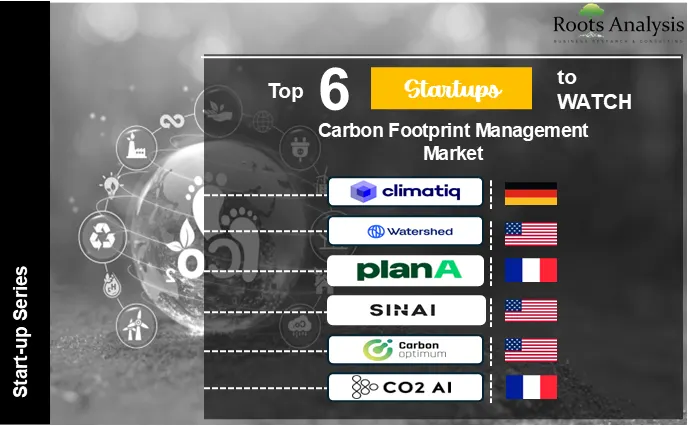
The following figure presents the key startups to watch in carbon footprint management market:
1. Climatiq
Established in 2021, Climatiq offers an AI-powered carbon emission reduction platform that automates the collection and analysis of carbon emissions data, with prime focus on the hard-to-track Scope 3 emissions. Further, they integrate data from NGOs, IPCC, universities, and more to streamline ESG-aligned reporting. It is worth highlighting that in June 2025, Climatiq raised USD11.6 million in Series A funding, highlighting strong investor confidence in carbon-data infrastructure.
2. Watershed
Established in 2019, Watershed provides a subscription-based carbon emissions dashboard enabling corporates to measure, report, and reduce their carbon emissions. Moreover, following a significant USD 100 million funding round in 2024, Watershed has become the most valuable climate-software company tracking 1% of global CO2 emissions and is on a target to eliminate 500 MtCO2e by 2030.
3. Plan A
Plan A founded in 2017, offers certified, AI-powered carbon management solutions, helping businesses measure, report, and lower their carbon emissions with speed and accuracy. Further, it integrates data collection, calculation, reporting, and guiding net-zero emission.
4. CO2 AI
Established in 2020, CO2 AI delivers an AI- platform for enterprise-scale measurement and reduction of carbon across scope 1 2 3 emissions.
5. Sinai Technologies
Sinai Technologies based in San Francisco, US, founded in 2017, is an enterprise grade AI-powered platform integrating carbon accounting with financial planning, scenario modeling, and execution management, ideal for large, carbon-intensive organizations.
6. Carbon Optimum
Carbon Optimum, founded in 2018, is a cleantech startup that uses patented photobioreactor (PBR) technology to capture CO2 emissions from heavy-emitting industries and convert them into valuable biomass, producing commodities like fertilizer, carbon-negative fuels, and nutrients. Their modular, scalable system uses wastewater and microalgae, avoiding competition for arable land and fresh water while fitting large impact into a compact footprint.
Want to Explore Key Players in the Carbon Footprint Management Industry?
Let us dive deep into the details of the key players in the carbon footprint market.
- EcoAct: EcoAct is dedicated to accelerating global climate action through innovative solutions and community engagement. Leveraging its global presence in Europe, the company offers holistic solutions for carbon reduction, and tailored decarbonization strategies in order to achieve its clients’ (government and organization’s) climate ambitions.
- Optimum Energy: Optimum Energy is a privately-held company, offering various solutions and services focused on reducing carbon emissions. It is worth highlighting that the company’s patented cloud-based software solution can significantly reduce energy usage in heating and cooling systems, by up to 50%, thereby contributing to a sustainable future.
- SAP: SAP claims to be a global leader offering advanced carbon management solutions to measure, monitor, and reduce their environmental impact across the value chain. It is worth highlighting that SAP’s sustainability footprint management (SFM), previously known as product footprint management, has emerged as an advanced solution for various organizations to accurately calculate a range of carbon metrics, including product carbon footprint (PCF), corporate carbon footprint (CCF), and emissions from transportation activities, fostering more sustainable operations.
Future Perspectives
As industries worldwide strive for sustainability amidst escalating environmental challenges, the carbon footprint management market is rapidly emerging as a pivotal force in shaping eco-conscious business strategies. Innovations in data analytics, cloud-based monitoring systems, and AI-driven reporting are enabling organizations to accurately track emissions and optimize reduction efforts in real time, fostering both regulatory compliance and competitive advantage. With the expansion of robust regulatory frameworks and stakeholder pressure for transparency, solutions such as automated carbon accounting and blockchain-based tracking are being increasingly adopted. This dynamic landscape is not only driving operational efficiencies but also empowering companies to embed climate responsibility into the core of their operations, setting new benchmarks for sustainable growth in a carbon-constrained future.
What About the Future Outlook of Carbon Footprint Management Market Around the World?
The above presentation features trends related to carbon footprint management market, which we have highlighted in our report. If you're interested, you can download the Sample Report on this topic by Roots Analysis. For personalized assistance in identifying the most relevant solutions based on your specific criteria, please don't hesitate to reach out to us at sales@rootsanalysis.com.
Sources
1. https://www.sweep.net/insights/sec-and-carbon-emissions-get-ready-for-disclosure
2. https://www.businessinsider.com/climatiq-pitch-deck-funding-series-a-carbon-accounting-2025-6
3. https://watershed.com/blog/series-c
4. https://www.sciencedirect.com/science/article/pii/S2211467X24002177
5. https://www.sciencedirect.com/science/article/pii/S0890838924002208
6. https://www.sciencedirect.com/science/article/pii/S1057521923003629