Key 5 Approved Compliment Inhibitors

.png)

Published: August 2026
Complement inhibitor drugs are a class of therapeutic agents designed to modulate the activity of the complement system, a critical component of the innate immune response involved in pathogen defense, inflammation regulation, and immune surveillance. By targeting specific components of the complement cascade, these inhibitors help prevent excessive complement activation, thereby reducing tissue inflammation, minimizing immune-mediated damage, and regulating abnormal immune responses against self-antigens and foreign antigens.
The therapeutic potential of complement inhibitors has gained substantial attention due to their ability to address diseases associated with uncontrolled complement activation, including hematological disorders, renal diseases, autoimmune conditions, and inflammatory disorders. These therapies offer significant clinical benefits, such as reduced organ damage, improved disease management, and enhanced patient outcomes, driving increased interest among pharmaceutical companies, academic institutions, and healthcare organizations.
The complement inhibitor market has witnessed remarkable expansion, with more than 30 complement inhibitor therapies already commercialized across global markets. In parallel, over 155 therapeutic programs targeting different components of the complement pathway are currently under development, with a significant proportion advancing through clinical development stages. This growing pipeline highlights the increasing focus on developing next-generation complement-targeted therapies with improved efficacy, safety profiles, and broader disease applications.
The domain is further supported by rising investments, strategic partnerships, licensing agreements, and manufacturing capacity expansions aimed at accelerating innovation and addressing production challenges associated with complex biologics. Collectively, these advancements position complement inhibitors as a rapidly evolving therapeutic category, with the potential to become key contributors to the next generation of precision immunotherapies.
Roots Analysis has conducted an exhaustive study of the complement inhibitors featuring the current market landscape and future opportunities for developers engaged in healthcare, over the span of next 9 years.
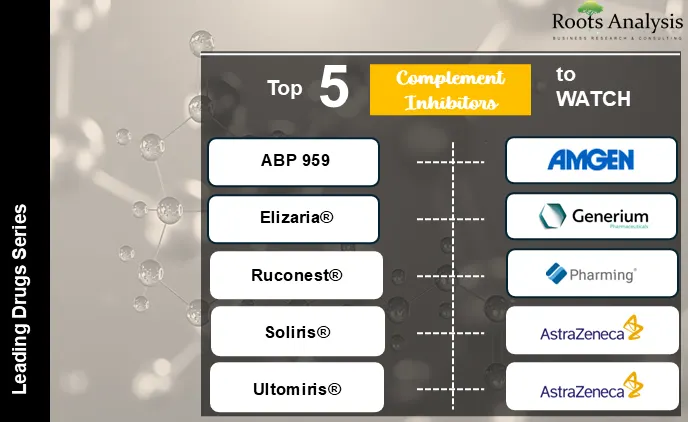
Key Five Approved Complement Inhibitors
- ABP 959
- Elizaria®
- Ruconest®
- Soliris®
- Ultomiris®
Interested in exploring all 90+ complement inhibitors, along with their recent initiatives?
Discover Below the Details on Key 5 Approved Complement Inhibitors
Let us dive deep into the details of the key 5 approved complement inhibitors. It is essential to note that the selection of key approved complement inhibitors can differ substantially according to the defined criteria.
1. ABP 959
The section provides information on various parameters, with details on list of developer, type of biologic, target pathway, type of therapy, dosing frequency, route of administration and target indication.
- Developer: Amgen
- Type of Biologic: Monoclonal Antibody
- Target Pathway: Terminal Pathway
- Type of Therapy: Monotherapy
- Dosing Frequency: Single Dose
- Route of Administration: Intravenous
- Target Indication: Paroxysmal Nocturnal Hemoglobinuria and Atypical Hemolytic Uremic Syndrome
2. Elizaria®
The section provides information on various parameters, with details on list of developer, type of biologic, target pathway, type of therapy, dosing frequency, route of administration and target indication.
- Developer: Generium
- Type of Biologic: Monoclonal Antibody
- Target Pathway: Terminal Pathway
- Type of Therapy: Monotherapy
- Dosing Frequency: Once Weekly
- Route of Administration: Intravenous
- Target Indication: Paroxysmal Nocturnal Hemoglobinuria and Atypical Hemolytic Uremic Syndrome
Recent Developments
To know more about the recent initiatives of Elizaria® and other complement inhibitors, access full report.
3. Ruconest®
The section provides information on various parameters, with details on list of developer, type of biologic, target pathway, type of therapy, dosing frequency, route of administration and target indication.
- Developer: Pharming
- Type of Biologic: Glycoproteins
- Target Pathway: Classical Pathway and Lectin Pathway
- Type of Therapy: Monotherapy
- Dosing Frequency: Twice Daily / Thrice Daily
- Route of Administration: Intravenous
- Target Indication: Common Variable Immunodeficiency and Hereditary Angioedema
Recent Developments
In the first quarter of 2026, Ruconest® generated revenues of USD 58.4 million, representing a 15% decline compared with the first quarter of 2025. The decrease was primarily attributed to anticipated inventory reductions and the planned discontinuation of commercial operations in non-US markets.
To know more about the recent initiatives of Ruconest® and other complement inhibitors, access full report.
4. Soliris®
The section provides information on various parameters, with details on list of developer, type of biologic, target pathway, type of therapy, dosing frequency, route of administration and target indication.
- Developer: AstraZeneca
- Type of Biologic: Monoclonal Antibody
- Target Pathway: Terminal Pathway
- Type of Therapy: Monotherapy / Combination Therapy
- Dosing Frequency: Multiple Dose
- Route of Administration: Intravenous
- Target Indication: Paroxysmal Nocturnal Hemoglobinuria, Neuromyelitis Optica, Atypical Hemolytic Uremic Syndrome, Myasthenia Gravis and Hemolytic Uremic Syndrome
Recent Developments
In June 2026, US Prescribing Information for Soliris® was updated to refresh safety and clinical guidance, including reinforcement of meningococcal infection risk management, vaccination requirements, and adverse reaction information.
To know more about the recent initiatives of Soliris® and other complement inhibitors, access full report.
5. Ultomiris®
The section provides information on various parameters, with details on list of developer, type of biologic, target pathway, type of therapy, dosing frequency, route of administration and target indication.
- Developer: AstraZeneca
- Type of Biologic: Antibody
- Target Pathway: Terminal Pathway
- Type of Therapy: Monotherapy / Combination Therapy
- Dosing Frequency: Multiple Dose
- Route of Administration: Intravenous
- Target Indication: Neuromyelitis Optica, Paroxysmal Nocturnal Hemoglobinuria, Generalized Myasthenia Gravis, Atypical Hemolytic Uremic Syndrome and Thrombotic Microangiopathy
Recent Developments
In July 2026, Ultomiris® underwent a regulatory product information update in the European Union, reflecting ongoing maintenance of prescribing information and safety guidance.
To know more about the recent initiatives of Ultomiris® and other complement inhibitors, access full report.
What About Other Complement Inhibitors Around the World?
The above article features the complement inhibitors selected from a pool of over 90 complement inhibitors that we have compiled. If you're interested, you can download the Sample Report on this topic by Roots Analysis. For personalized assistance in identifying the most relevant solutions based on your specific criteria, please don't hesitate to reach out to us at sales@rootsanalysis.com.
Sources: