Live Cell Encapsulation Market Trends


Published: October 2026
Live cell encapsulation is an advanced bioengineering approach in which viable cells are enclosed within semi-permeable polymeric membranes or hydrogel matrices, allowing the exchange of oxygen, nutrients, waste products and therapeutic molecules while protecting the encapsulated cells from the host immune system. Technology has emerged as a promising approach for cell-based therapies, regenerative medicine and sustained therapeutic delivery, particularly in areas such as diabetes, oncology, neurological disorders and tissue regeneration.
Over the years, advances in biomaterials, stem cell biology, cell engineering and device design have contributed to the evolution of live cell encapsulation technologies. Traditionally, alginate-based microcapsules have been extensively investigated for encapsulating pancreatic islets; however, the field is increasingly shifting toward tissue engineering, stem-cell-derived cell products, advanced hydrogels and implantable macroencapsulation devices. These innovations are aimed at addressing several limitations associated with conventional cell transplantation, including immune rejection, limited donor-cell availability, poor oxygenation and fibrotic overgrowth.
Given the growing pipeline of cell-based therapies, increasing investment in regenerative medicine and the emergence of encapsulated cell products entering clinical development, the live cell encapsulation market is anticipated to witness significant growth in the coming years.
Roots Analysis has conducted an exhaustive study of the live cell encapsulation market Treatment Trends featuring the current market landscape and future opportunities for developers engaged in healthcare, over the span of next 9 years. In this article, we have highlighted some of the live cell encapsulation market trends that are likely to shape the evolution of this industry.
Want to Explore the Competitive Landscape and Live Cell Encapsulation Market Trends?
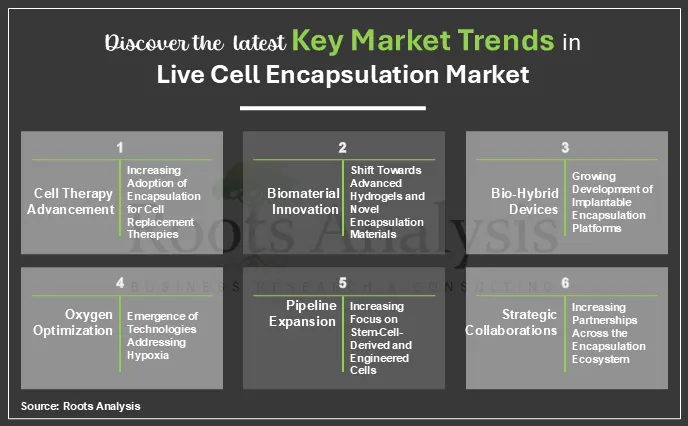
Latest Trends in Live Cell Encapsulation Market That Are Likely to Shape the Market
1. Cell Therapy Advancement: Increasing Adoption of Encapsulation for Cell Replacement Therapies
The increasing development of cell-based therapies is emerging as one of the major drivers of the live cell encapsulation market. Encapsulation provides a physical barrier around therapeutic cells while allowing the passage of essential nutrients and therapeutic molecules. This characteristic makes technology particularly attractive for cell replacement therapies in which transplanted cells need to remain functional for extended periods. Type 1 diabetes has remained one of the most extensively investigated applications, particularly for encapsulated pancreatic islets and insulin-producing cells. However, the therapeutic landscape is gradually expanding toward stem-cell-derived islet cells, engineered therapeutic cells and other regenerative cell populations. Researchers and biotechnology companies are increasingly exploring encapsulation as a strategy to enable transplantation without, or with reduced dependence on, systemic immunosuppression.
For instance, several encapsulation-based approaches have been investigated to protect insulin-producing cells from immune-mediated destruction while maintaining glucose-responsive insulin secretion. Historical clinical studies with alginate-encapsulated islets have demonstrated the feasibility of the approach, although long-term cell survival and fibrosis remain important challenges. Consequently, increasing clinical development of cell replacement therapies is expected to create significant opportunities for developers of encapsulation materials, devices and manufacturing technologies.
For instance, in August 2026, CellFiber entered into a collaboration with Tidewave Bio with an aim to evaluate CellFiber’s closed, automated 3D cell-culture platform for scalable manufacturing of Tidewave’s off-the-shelf solid-tumor immunotherapy.
2. Biomaterial Innovation: Shift Towards Advanced Hydrogels and Novel Encapsulation Materials
The development of advanced biomaterials is transforming the live cell encapsulation landscape. Conventional alginate has historically been one of the most widely investigated materials because of its biocompatibility, ability to form hydrogels and suitability for generating semi-permeable capsules. However, limitations associated with mechanical stability, immune interactions and long-term fibrosis have encouraged researchers to investigate alternative materials and engineered formulations. Current research is increasingly focused on synthetic polymers, hybrid biomaterials, modified alginates and advanced hydrogel systems designed to provide improved permeability, mechanical properties and biocompatibility. These materials are being engineered to facilitate oxygen and nutrient transport while limiting immune-cell and antibody penetration.
In addition, the incorporation of extracellular-matrix-like components and bioactive molecules into hydrogel systems is being investigated to improve cell survival and functionality. Such innovations are particularly relevant for encapsulating stem-cell-derived products and engineered therapeutic cells. Therefore, continued development of biomaterials capable of supporting long-term cell viability is expected to remain a key focus area within the live cell encapsulation market.
3. Bio-Hybrid Devices: Growing Development of Implantable Encapsulation Platforms
The live cell encapsulation field is increasingly moving beyond standalone microcapsules toward sophisticated bio-hybrid implantable devices. These systems combine living therapeutic cells with engineered materials or devices designed to support long-term cell survival and controlled therapeutic activity. Bio-hybrid devices are particularly attractive for applications where continuous secretion of therapeutic proteins is desirable. Instead of repeatedly administering conventional medicines, encapsulated cells can potentially function as biological factories capable of producing therapeutic molecules over an extended period.
For instance, in August 2026, Persista Bio received a USD 65,000 FuzeHub Manufacturing Grant to add custom cell-capsule manufacturing capability for its O2Line technology. The fully implantable membrane encapsulation system is designed to support therapeutic cells for type 1 diabetes without immunosuppression.
4. Oxygen Optimization: Emergence of Technologies Addressing Hypoxia
Maintaining adequate oxygen availability represents one of the major technical challenges associated with cell encapsulation. Following implantation, encapsulated cells may experience limited oxygen and nutrient availability, particularly when the device or capsules are located away from highly vascularized tissue. This can result in reduced cell viability and impaired therapeutic activity. Consequently, developers are increasingly incorporating oxygen-management technologies into encapsulation platforms. These include oxygen-generating materials, improved membrane architectures, optimized implantation sites and device designs intended to facilitate oxygen transport.
For instance, in March 2026, researchers at MIT reported an implantable device that encapsulates pancreatic islet cells while incorporating an onboard oxygen generator. In preclinical studies, the system enabled the encapsulated cells to survive and function in mice for at least 90 days, highlighting the potential of integrated oxygen-generation technologies to overcome a longstanding limitation of encapsulated cell therapies.
5. Pipeline Expansion: Increasing Focus on Stem-Cell-Derived and Engineered Cells
The limited availability of donor-derived cells has historically represented a major challenge for cell replacement therapies. This limitation has encouraged companies and academic researchers to explore stem-cell-derived and genetically engineered cell populations that can potentially provide a more scalable and consistent source of therapeutic cells.
Stem-cell-derived pancreatic islet cells are among the most prominent examples. By combining these cells with encapsulation technologies, developers aim to create off-the-shelf therapeutic products that can be manufactured at scale while reducing dependence on donor organs. At the same time, engineered cells capable of secreting therapeutic proteins are being evaluated for applications extending beyond diabetes. Encapsulated engineered cells may serve as localized sources of cytokines, growth factors, enzymes or other therapeutic molecules, potentially reducing systemic exposure.
In May 2026, researchers at Rice University, the University of Texas MD Anderson Cancer Center and clinical collaborators conducted a first-in-human trial of AVB-001, an investigational therapy consisting of encapsulated engineered cells designed to continuously produce IL-2 within the abdominal cavity. This development illustrates the expanding application of encapsulated engineered cells beyond traditional islet transplantation.
6. Strategic Collaborations: Increasing Partnerships Across the Encapsulation Ecosystem
Over the years, the live cell encapsulation market has witnessed increasing collaboration among biotechnology companies, academic institutions, material developers and clinical research organizations. Such partnerships enable stakeholders to combine expertise in cell biology, biomaterials, device engineering, manufacturing and clinical development. Collaborations are particularly important because successful encapsulated cell therapies require the integration of several technologies. Cell viability and functionality must be maintained during encapsulation, manufacturing, storage and implantation, while the encapsulation material must provide sufficient permeability and immunoprotection.
For instance, in April 2026, Atelerix entered into a collaboration with JH Health to expand the distribution and use of its non-cryogenic hydrogel encapsulation and cell-preservation technology in the Middle East.
Conclusion
The live cell encapsulation market is evolving rapidly as advances in cell therapy, biomaterials, tissue engineering and implantable device technologies converge. The field is moving beyond conventional alginate-based microcapsules toward advanced hydrogels, engineered cells, stem-cell-derived products and sophisticated bio-hybrid implantable devices. At the same time, developers are increasingly focusing on overcoming longstanding technical barriers, including hypoxia, immune-mediated damage, fibrotic overgrowth, limited cell availability and difficulties associated with long-term cell functionality. Innovations such as integrated oxygen-generation systems and improved biomaterial formulations are therefore expected to play an important role in improving the durability and therapeutic performance of encapsulated cells.
The emergence of clinical-stage and approved encapsulated-cell products further demonstrates the growing translational potential of this technology. With increasing investments, strategic collaborations and expansion of applications across diabetes, oncology, regenerative medicine and therapeutic protein delivery, live cell encapsulation is expected to become an increasingly important enabling technology within the broader cell therapy ecosystem.
To know more about live cell encapsulation trends, access full report: https://www.rootsanalysis.com/reports/live-cell-encapsulation-market.html
Sources:
- https://pmc.ncbi.nlm.nih.gov/articles/PMC11053880/
- https://lifescienceventures.cornell.edu/2026/08/25/persista-bio-advances-cell-encapsulation-technology-with-fuzehub-grant/
- https://news.mit.edu/2026/implantable-islet-cells-could-control-diabetes-without-insulin-injections-0326
- https://news.rice.edu/news/2026/first-human-trial-demonstrates-promise-implantable-cytokine-factories-ovarian-cancer
- https://www.atelerix.co.uk/2026/04/atelerix-forms-strategic-partnership-with-jh-health-ltd-to-expand-non-cryogenic-cell-preservation-capabilities-in-the-middle-east/?srsltid=AfmBOopZ6WNihLjFrkJVofoKsQw51zKQZzB_N_bqu-0k-6skFbG4J5bP