


 Download Free Sample
 Buy Now
Market Outlook
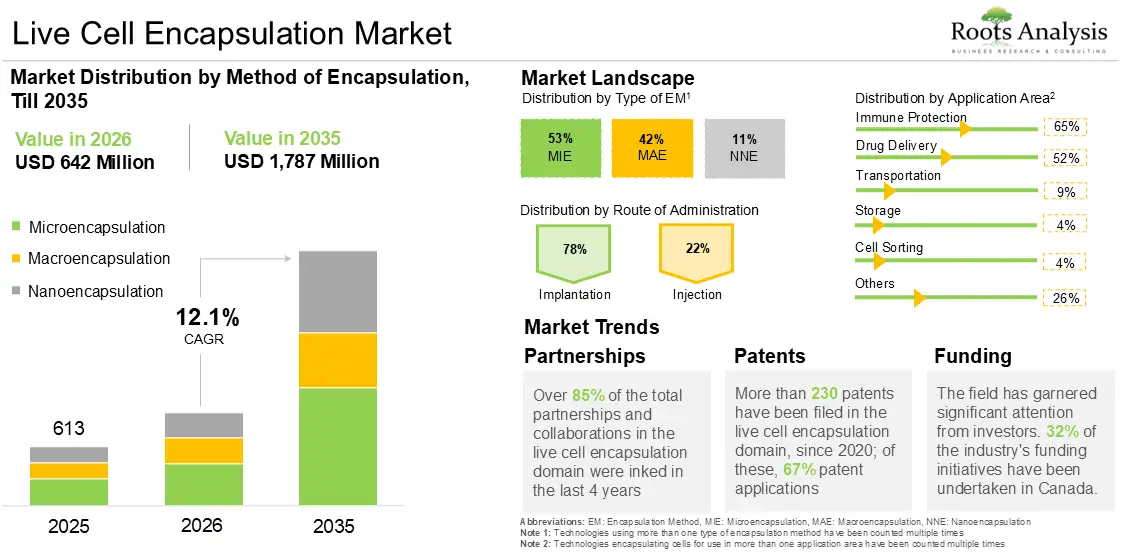
The global live cell encapsulation market, valued at USD 613 million in 2025, is projected to reach USD 642 million in 2026 and USD 1,787 million by 2035, representing a CAGR of 12.1% during the forecast period 2026 to 2035.
See What’s in the Full Report – Request Your Complimentary Insights!
Market Report: Key Takeaways
Market Size & Trends
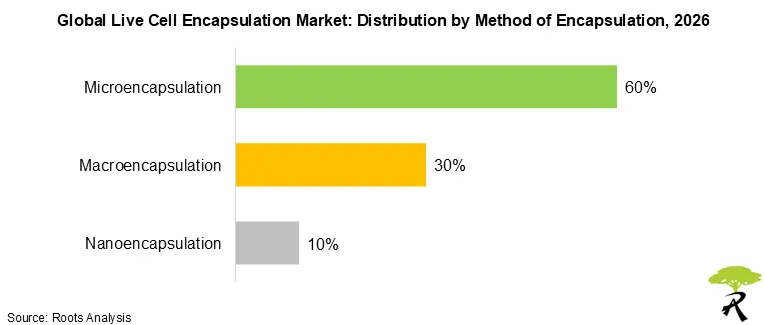
- With respect to method of encapsulation, microencapsulation dominates (60%) the current market.
- Based on the type of manufacturing technique, electrostatic dripping captures the largest share (40%) of the current market; this trend is unlikely to change in the future.
- Amongst the type of encapsulation material, alginate-based microcapsules capture the most (45%) of the current market.
- Based on the application area, drug delivery captures the largest share (40%) of the current market.
- In terms of therapeutic area, metabolic disorders are likely to hold the highest share (over 40%) of the future market share.
- Based on the type of payment, upfront payments capture the largest share (over 85%) of the current market.
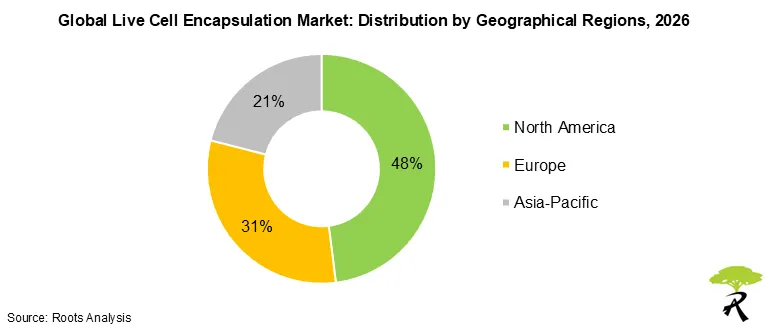
- In terms of geographical regions, North America currently holds the highest market share (close to 50%).
Key Market Statistics
- Market Size in 2026: $642 Million
- Estimated Market Size in 2035: $1,787 Million
- CAGR (2026-2035): 12.1%
- North America: Largest market in 2026
- Asia-Pacific: Fastest growing region
Market Introduction
Cell encapsulation is a bioengineering technique that involves immobilizing cells within a semi-permeable polymeric membrane or hydrogel capsule, such as those made from alginate or other biocompatible materials. This semi-permeable barrier allows the bidirectional diffusion of essential molecules, including oxygen, nutrients, growth factors, and therapeutic products like insulin or other proteins. The primary goal is to protect transplanted cells from the host's immune rejection, enabling their long-term survival and function without requiring immunosuppressive drugs.
Notably, the concept of cell encapsulation has been explored since the 1930s for applications in tissue engineering, cell therapy, and controlled delivery of bioactive molecules, particularly for conditions like type 1 diabetes (via encapsulated pancreatic islets), neurological disorders, and metabolic disorders.
Live cell encapsulation refers to this same core process involving viable, functioning living cells, emphasizing the preservation of cell viability, proliferation, and active secretion of therapeutics post-encapsulation. The technique is particularly valuable in regenerative medicine, where it supports the delivery of stem cells or progenitor cells to repair damaged tissues. It is also widely explored in cancer immunotherapy for delivering immune-modulating cells and in neurological disorders for targeted neuroprotective factor delivery.
Given the various advantages of live cell encapsulation, including immune protection, sustained therapeutic secretion, and reduced need for immunosuppression, the live cell encapsulation market growth is likely to be significant during the forecast period.
Market Segmentation
Based on the research, we have segmented the Live Cell Encapsulation Market Report into method of encapsulation, type of manufacturing technique, type of encapsulation material, application area, therapeutic area and key geographical regions.
By Method of Encapsulation
- Microencapsulation
- Macroencapsulation
- Nanoencapsulation
By Type of Manufacturing Technique
- Electrostatic Dripping
- Simple Dripping
- Coaxial Airflow
- Rotating Disk Atomization
- Other Manufacturing Techniques
By Type of Encapsulation Material
- Alginate-based Microcapsules
- Chitosan
- Medical-grade Plastics
- Silica
- Cellulose Hydrogels
- Red Blood Cells
By Application Area
- Drug Delivery
- Immune Protection
- Probiotics and Functional Food
- Others
By Therapeutic Area
- Metabolic Disorders
- Oncological Disorders
- Neurological Disorders
- Ophthalmic Disorders
- Cardiovascular Disorders
- Nephrological Disorders
- Other Disorders
By Type of Payment
- Upfront Payments
- Milestone Payments
By Key Geographical Regions
- North America
- US
- Canada
- Europe
- France
- Netherlands
- UK
- Belgium
- Asia-Pacific
- Japan
- Singapore
Your Business is Unique – Why Shouldn’t Your Report Be?
Live Cell Encapsulation Market Key Insights
What are the Latest Live Cell Encapsulation Market Trends?
- Integration of Advanced Manufacturing and Scalability: The integration of advanced manufacturing techniques, such as 3D bioprinting, microfluidics, and continuous flow encapsulation, is revolutionizing scalability in live cell therapies by enabling high-throughput production of immunoprotective microcapsules while preserving cell viability and function. These methods address key bottlenecks in traditional batch processes, like inconsistent capsule uniformity and low yields, by leveraging automation for precise alginate or hydrogel matrix formation around therapeutic cells.
- Rising Focus on Regenerative Medicine and Chronic Disease Applications: Live cell encapsulation is increasingly becoming a part of regenerative medicine and tissue engineering to meet the demand for immune-protected cell therapies in high-prevalence conditions like diabetes, cancer, Parkinson's disease, and autoimmune disorders. Hydrogel-based 3D environments better mimic native tissues, support cell proliferation, and enable sustained bioactive molecule secretion. Growing prevalence of target diseases, coupled with the demand for minimally invasive, long-term treatments, is fueling demand and creating opportunities for personalized solutions.
What are the Key Drivers for Market Growth?
The market growth in live cell encapsulation is driven by various factors, including the escalating prevalence of chronic diseases (such as diabetes, cancer, and autoimmune disorders), which heightens the demand for innovative therapeutic solutions like encapsulated cell therapies to replace damaged tissues and improve treatment efficacy. This is further supported by substantial public-private investments in regenerative medicine research, driving advancements in cell-based therapies and enabling the development of scalable encapsulation techniques for clinical applications.
Further, technological progress in biomaterials, microfluidics, and nanoencapsulation accelerates growth by enhancing cell viability, precision, and biocompatibility, making these systems more viable for drug delivery and tissue engineering. This, in turn, positions live cell encapsulation as a cornerstone in addressing unmet medical needs and expanding its global market footprint
Recent Developments in Live Cell Encapsulation Market
- In April 2026, Atelerix signed an agreement with JH Health for the distribution of Atelerix's proprietary hydrogel technology.
- In November 2025, Avant Technologies entered into a strategic joint venture and license agreement with SGAustria aimed at revolutionizing diabetes treatment through innovative stem cell and encapsulation technologies.
- In June 2025, Breakthrough T1D partnered with Stem Cell Network Canada to fund four Canadian projects on manufactured islet therapies using encapsulation as part of Project ACT. This initiative aims to accelerate the development of immune-protected cell therapies for type 1 diabetes.
- In March 2025, Vertex Pharmaceuticals updated VX-264 macroencapsulation trial results, completing Part A with Part B enrollment ongoing in Canada. The therapy utilizes stem cell-derived islets designed to avoid immunosuppression and is being developed in partnership with Lonza to enable scalable manufacturing in support of pivotal approval.
Industry Experts on Live Cell Encapsulation Market
Driven by the growing need for immunoprotective strategies in cell transplantation, expanding applications in regenerative medicine, and continuous innovations in biocompatible biomaterials, the live cell encapsulation domain is poised for notable growth in the near future.
Yuval Avni (Former Chief Executive Officer, Beta-O2 Technologies), stated that, “Live cell encapsulation is likely to emerge among the most lucrative markets within the healthcare industry. Future market opportunities within this domain are likely to be dependent on the cost of the combination product. In addition, devices with more favorable features, such as biocompatibility, retrievability and patient-friendliness, are likely to have higher adoption among patients suffering from insulin-dependent diabetes.”
Discussions with multiple stakeholders in this domain influenced the opinions and insights presented in this study. The market report includes transcripts of the following discussions:
- Founder and Chief Executive Officer, Small Company, US
- Former Chief Executive Officer, Small Company, Israel
In addition, the market report includes transcripts of the following other third-party discussions:
- Chief Executive Officer, Mid-sized Company, US
- Vice President, Medical Oncology, Large Company, US
- Chief Executive Officer, Mid-sized Company, US
Pay Only for What You Need – The Best Way to Optimize
Market Share Insights
Which Type of Manufacturing Technique Accounts for the Largest Live Cell Encapsulation Market Share?
- In 2026, the electrostatic dripping segment occupies the highest live cell encapsulation market share (40%). This dominance is due to its ability to generate highly uniform microcapsules with a narrow size distribution, along with its ability to preserve cell viability, reduce shear stress on encapsulated cells, and align with established regulatory standards.
- It is worth highlighting that the market share for coaxial airflow is likely to grow at a relatively higher growth rate (CAGR of 13.0%), during the forecast period. This is likely due to its advantages in providing ultra-low shear forces, which are essential for encapsulating delicate cell strains while maintaining high viability rates.
Will Microencapsulation Segment Hold the Highest Share in the Future?
- In 2026, the microencapsulation segment occupies the highest live cell encapsulation market share (60%) and is likely to grow at a relatively higher CAGR (11.8%), during the forecast period.
- This is likely due to its increased applications, controlled release capabilities, and improved compatibility with various polymers.
Market Share by Type of Encapsulation Material: Alginate-based Microcapsules Segment to Hold the Highest Revenue
- In 2026, alginate-based microcapsules are likely to capture majority of the live cell encapsulation market size (with a share of 45%). This is due to its biocompatibility, ionic gelation under physiological conditions that preserves high cell viability, proven clinical track record in applications like islet transplantation for diabetes, low immunogenicity and cost-effectiveness.
- It is worth highlighting that the market share for medical-grade plastics is likely to grow at a relatively higher CAGR (13.0%), during the forecast period.
Will Drug Delivery Segment Hold the Highest Share in the Future?
- In 2026, drug delivery occupies the highest share in the overall market and is likely to grow at a higher CAGR (12.3%) during the forecast period.
- This is likely due to the fact that it enables controlled release of therapeutic molecules from encapsulated live cells, offering enhanced efficacy and improved patient compliance.
Which Therapeutic Area Accounts for the Largest Live Cell Encapsulation Market Share?
- In 2026, the metabolic disorders segment occupies the highest live cell encapsulation market share (42%) and is likely to grow at a higher CAGR (12.3%) during the forecast period.
- This is likely due to the rising global prevalence of metabolic conditions and the growing clinical advancement of encapsulated islet cell and beta-cell therapies for type 1 diabetes.
Regional Analysis: Which Regions are Showing the Fastest Growth in Live Cell Encapsulation Industry?
North America: Dominating the Market by Securing Highest Share
According to our live cell encapsulation market forecast, North America is likely to capture the highest share (nearly 50%) in 2026. This is due to the region’s advanced healthcare and research infrastructure, substantial public-private investments, and strong government funding, including support from the NIH and FDA.
Furthermore, it benefits from a high concentration of leading biotechnology and pharmaceutical companies, along with favorable regulatory pathways for cell-based therapies with focus on innovation in personalized and regenerative medicine.
Asia-Pacific: An Emerging Growth Spot
The market in Asia-Pacific is likely to grow at a higher CAGR (11.84%), during the forecast period till 2035, as per our live cell encapsulation market analysis. This growth is due to the expanding healthcare infrastructure, cost-effective clinical trial environments, growing demand for advanced cell-based therapies, and increasing awareness among patients and healthcare providers. Further, the growth in this region is also supported by strategic R&D initiatives in key countries like China, Japan, India, and South Korea.
Get an Instant Quote in 10 Minutes. Lowest Price Guaranteed
Scope of Live Cell Encapsulation Market Report
| Key Report Attribute | Details | |
| Forecast Period | Till 2035 | |
| Market Size 2026 | $ 642 Million | |
| Market Size 2035 | $ 1,787 Million | |
| CAGR (till 2035) | 12.1% | |
| Segments Covered |
|
|
| Key Players Profiled |
|
|
| PowerPoint Presentation (Complimentary) |
Available | |
| Customization Scope | 15% Free Customization | |
| Excel Data Packs (Complimentary) |
Available | |


