Microbial Fermentation CDMO: Trends Reshaping Outsourced Biomanufacturing


Published:
Microbial fermentation CDMOs provide outsourced development and manufacturing services for drug substances made in bacterial, yeast and fungal expression systems. Their remit increasingly spans strain development, upstream process design, scale-up, purification, technology transfer and GMP production. This model is particularly relevant for recombinant proteins, enzymes, peptides, plasmid DNA, cytokines, virus-like particles and other products for which microbial hosts offer an established manufacturing route.
The sector is evolving from standalone fermentation capacity to integrated, development-led partnerships. Drug developers are seeking providers that can translate an early expression construct into a scalable, commercially viable process. This is consistent with the wider expansion of biopharmaceutical contract manufacturing.
Manufacturing economics remains central to supplier selection. Higher titers, robust host strains, intensified upstream operations and fit-for-purpose downstream purification can reduce material consumption, shorten manufacturing campaigns and improve facility utilization. These capabilities become more consequential as programs progress from clinical supply to commercial volumes.
Recent investment activity also shows that microbial manufacturing is being planned as part of a broader drug-substance-to-drug-product offering. In June 2025, WuXi Biologics began construction of a Chengdu microbial manufacturing site designed around a 15,000 L fermenter, with commercial production targeted by the end of 2026. The project also includes a dual-chamber lyophilization line and vial-filling capability.
Roots Analysis has conducted an exhaustive study on Microbial Fermentation CMO Market trends featuring the current market landscape and future opportunity for the companies engaged in offering services for microbial fermentation contract manufacturing, till 2035. In this article, we have highlighted some of the latest trends that are likely to shape the evolution of the market.
Want to explore the latest Microbial Fermentation CDMO Market Trends??
Latest Microbial Fermentation CDMO Market Trends that are Likely to Shape the Market
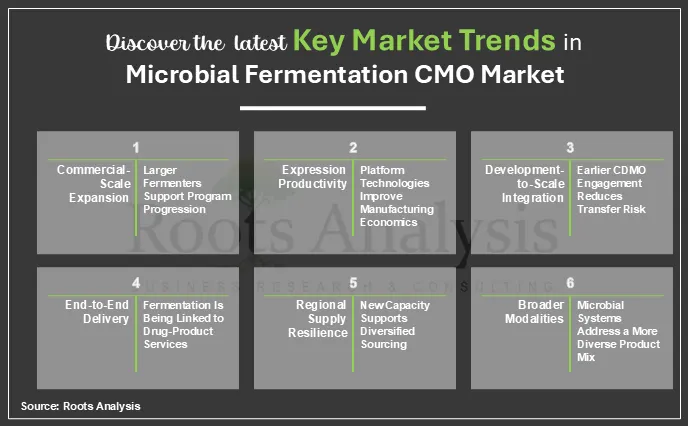
1. Commercial-Scale Expansion: Larger Fermenters Support Program Progression
The availability of commercial-scale fermentation capacity is becoming a decisive differentiator, particularly for products that must move rapidly from late-stage supply into repeatable commercial campaigns. Purpose-built GMP capacity can reduce the need for a disruptive manufacturing handoff as demand rises.
WuXi Biologics’ Chengdu project illustrates this direction. The company stated that the site’s 15,000 L fermenter is intended to support 80-110 drug-substance batches annually, with potential expansion to 60,000 L. Such investments strengthen the ability of microbial fermentation CDMOs to compete for programs requiring dependable, high-volume supply and a defined scale-up pathway.
2. Expression Productivity: Platform Technologies Improve Manufacturing Economics
Microbial expression platforms are advancing beyond host selection toward repeatable approaches to strain engineering and process optimization. The commercial value lies in achieving higher productivity without compromising downstream recoverability, enabling CDMOs to improve cost of goods and accelerate development across client programs.
WuXi Biologics reports that its EffiX microbial expression platform has achieved titers above 15 g/L for certain non-monoclonal-antibody recombinant proteins. While productivity must be assessed product by product, such platform capabilities show how CDMOs are differentiating through proprietary development know-how as well as fermentation volume.
3. Development-to-Scale Integration: Earlier CDMO Engagement Reduces Transfer Risk
Sponsors increasingly expect a single partner to connect strain selection, medium development, feeding strategy, fermentation scale-up and downstream recovery. Integrating these activities early enables process choices to be assessed against commercial equipment, raw-material availability and intended batch size before the process reaches a late-stage transfer point.
This approach is particularly valuable for complex recombinant products, where an upstream adjustment can influence purification performance, yield and overall process economics. The resulting business case favors microbial fermentation CDMOs that can retain process knowledge from development through commercial manufacturing.
4. End-to-End Delivery: Fermentation Is Being Linked to Drug-Product Services
The competitive boundary is shifting from drug-substance fermentation alone to coordinated delivery through final dosage form. CDMOs that can align microbial drug-substance output with formulation, lyophilization and aseptic filling can simplify supply-chain governance and reduce interfaces for sponsors. This is closely connected with the growing demand for biologics fill-finish manufacturing services.
WuXi Biologics’ planned Chengdu configuration pairs microbial fermentation with dual-chamber lyophilization and vial filling. For customers, the value proposition is not merely fewer vendors, but a more coordinated route for managing timelines, batch scheduling and drug-substance-to-drug-product transfer.
5. Regional Supply Resilience: New Capacity Supports Diversified Sourcing
Supply resilience is influencing where fermentation capacity is built and how sponsors qualify manufacturing partners. Regional production networks can reduce concentration risk, provide alternatives for programs requiring local supply and support more flexible allocation of development and commercial work.
In India, the government’s Production Linked Incentive scheme for bulk drugs has supported investment in domestic fermentation-related capacity, reflecting policy interest in strengthening local manufacturing capabilities. For microbial fermentation CDMOs, this environment may create opportunities to establish regionally anchored capacity while supporting globally diversified supply strategies.
6. Broader Modalities: Microbial Systems Address a More Diverse Product Mix
Microbial fermentation is no longer discussed only in the context of conventional recombinant proteins. CDMOs are positioning microbial systems for peptides, antibody fragments, enzymes, cytokines, plasmid DNA and virus-like particles. This diversification broadens the addressable opportunity but also raises the importance of host-specific development, specialized purification and flexible production planning.
WuXi Biologics identified these product categories as targets for its Chengdu site, underlining how suppliers are building portfolios around molecular diversity rather than a single expression-system niche. Providers best positioned to benefit will be those able to match the host, process and facility strategy to each program’s technical and commercial requirements.
Conclusion
The microbial fermentation CDMO sector is becoming more capability-led and integrated. Commercial-scale investment, higher-productivity expression platforms, earlier development engagement, connected fill-finish services and geographically diversified capacity are reshaping partner selection. Collectively, these trends are likely to increase the value of CDMOs that can convert microbial process innovation into reliable, commercial-ready supply.
Browse our full report on Microbial Fermentation CMO Market trends: https://www.rootsanalysis.com/reports/microbial-contract-biomanufacturing-market.html
Sources:
1. https://www.wuxibiologics.com/press-release/wuxi-biologics-kicks-off-construction-of-microbial-manufacturing-site-for-commercial-production-in-chengdu/
2. https://www.fda.gov/regulatory-information/search-fda-guidance-documents/q13-continuous-manufacturing-drug-substances-and-drug-products
3. https://www.fda.gov/media/190208/download
4. https://www.pib.gov.in/PressReleasePage.aspx?PRID=2158120&lang=2®=3
5. https://www.rootsanalysis.com/reports/biopharmaceutical-contract-manufacturing-market/250.html