mRNA Manufacturing Industry Analysis

.png)

Published: September 2025
Messenger RNA (mRNA), is a single-stranded molecule that is produced during transcription; it contains specific regions, such as 5′ cap, coding region, and poly(A) tail. These regions play an essential role in ensuring effective translation through ribosomes, by facilitating the export of mRNAs from the nucleus and maintaining their stability. Together, they enable cells to swiftly modify protein synthesis in response to changing internal and external signals, and support their overall growth and adaptation.
Manufacturing of mRNA refers to the cutting-edge biotechnological processes which help in the production of mRNA molecules in vitro by using a DNA template, specialized enzymes, and controlled reaction conditions. The typical workflow associated with mRNA manufacturing includes designing and amplifying a plasmid DNA template, employing in vitro transcription to synthesize mRNA, and then purifying the product to remove any unwanted substances. Once the mRNA is purified, it may be chemically capped and formulated with lipid nanoparticles to enhance stability and facilitate delivery into human cells.
As denoted by the success of mRNA-based COVID-19 vaccines, mRNA-based products allow for rapid development and scale-up, making it an attractive strategy for creating vaccines and therapeutics targeting a wide range of diseases. The process of manufacturing mRNA is inherently flexible, highly scalable, and largely free from the risks associated with traditional systems. This enables quicker response for emerging health threats and assists in research and development for innovative mRNA-based therapies beyond vaccines.
Roots Analysis has conducted an exhaustive study on mRNA Synthesis and Manufacturing Market featuring the current landscape and future opportunity for the companies engaged in mRNA synthesis and manufacturing domain. In this article, we have highlighted mRNA manufacturing industry analysis and key factors that are likely to shape the evolution of this sector.
Want to Explore the Competitive Landscape, Technological Advancements and mRNA Manufacturing Industry Analysis?
mRNA Manufacturing Industry Analysis and Key Factors Likely to Shape the Market Evolution
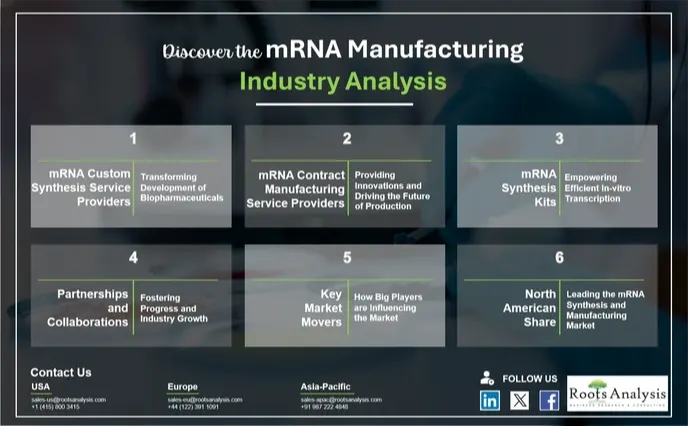
1. mRNA Custom Synthesis Service Providers: Transforming Biopharmaceutical Development
The mRNA manufacturing industry analysis features a presence of close to 55 mRNA custom synthesis service providers, worldwide. Majority of such players (~60%) are headquartered in North America. This is followed by the players headquartered in Europe (~25%) and Asia-Pacific (~20%). Further, these players offer various other services (along with custom synthesis), including mRNA purification (primarily through chromatography and electrophoresis), mRNA modification (5’ modification, 3’ modification and base modification), scale-up, process development and fill-finish. Interestingly, majority (~95%) of the mRNA custom synthesis service providers offer 5’ modifications of mRNA, primarily because it enhances mRNA stability, translation efficiency and reduces chances of immunogenicity.
2. mRNA Contract Manufacturing Service Providers: Driving the Future of Production
Owing to the rising demand for mRNA vaccines, coupled with advancements in mRNA synthesis and manufacturing technologies, close to 45 companies are actively offering mRNA contract manufacturing services. Further, in order to address the demands of customers, players in this domain offer services at different scales of operation (preclinical, clinical and commercial), ensuring flexibility in meeting specific production requirements. mRNA manufacturing industry analysis revealed the presence of nearly 60% companies in this domain, providing services for both drug substances and drug products. This assists in streamlining the overall process of drug development and manufacturing for the clients, thereby reducing the risk of inconsistencies.
3. mRNA Synthesis Kits: Empowering Efficient In-vitro Transcription
The mRNA manufacturing industry analysis signifies that mRNA synthesis kits offer various advantages, such as flexibility and scalability, thereby allowing researchers to generate mRNA molecules with precise modifications, yield, purity and stability. These kits comprise of a variety of components (primarily enzymes), that ensure reliable and reproducible results. Notably, in terms of mRNA synthesis kit providers, the landscape is dominated by the presence of small firms (50%), reflecting a fragmented and innovation-driven nature of this domain.
4. Partnerships and Collaborations: Fostering Progress and Innovation
Based on the mRNA synthesis industry analysis, stakeholders in this domain are known to adopt a variety of partnership models in order to collaborate with other companies / organizations. Such deals are inked to allow companies to expand their respective portfolios, and gain additional capabilities related to mRNA synthesis. Notably, manufacturing agreements, and mergers and acquisitions emerged as the most popular types of partnership models adopted by stakeholders in this domain.
In June 2025, Ethris entered into a collaboration with Thermo Fisher Scientific, combining the former company’s comprehensive mRNA technology platforms with latter’s manufacturing capabilities, advancing mRNA therapeutics from research to clinical stages.
5. Key Market Movers: Look How Big Players are Influencing the Market
Over the last few years, numerous big pharmaceutical companies have marked their presence in the field of mRNA synthesis and manufacturing by partnering with other mRNA drug developers, making investments in this domain, expanding capabilities / facilities and acquiring new firms. Such initiatives help stakeholders engaged in this industry to achieve mutual goals more effectively and improve the overall operational efficiency. Notably, as per the mRNA manufacturing industry analysis, maximum initiatives in this domain have been undertaken by big players in the year 2022. This can be attributed to the increased demand of mRNA for production of COVID-related vaccines and therapeutics, wherein contribution of vaccine development companies is also immense.
6. North America: Leading the mRNA Synthesis and Manufacturing Market
Rising incidence of chronic diseases, increasing need for technical expertise in the domain and development of advanced mRNA technologies have spurred the need for outsourcing mRNA synthesis and manufacturing activities. Further, North America captures majority (~40%) of the market share as per the mRNA manufacturing industry analysis. This can be attributed to several technological advancements and robust research capabilities within this region. Moreover, the advanced healthcare infrastructure and regulatory landscape in North America enables players to meet the required regulatory guidelines.
Conclusion
The mRNA synthesis industry analysis signifies the potential of mRNA therapeutics and vaccines to revolutionize the healthcare domain, thereby opening a whole new range of possibilities in this sector. Notably, the synthesis and manufacturing of mRNA requires technical expertise and infrastructure with larger capacities. As a result, majority of the stakeholders engaged in production of mRNA-based products are outsourcing their operations to contract manufacturing organizations. This will enhance overall efficiency and scalability with faster production and lower costs, enabling the companies to focus on their core competencies while relying on external partners for mRNA production.
As research advances and regulatory frameworks mature, the industry is expected to witness a surge in technological innovations, strategic partnerships and big player initiatives. These trends will not only improve efficiency and scalability of mRNA-based products but also enable broader adoption of these products beyond infectious diseases, to oncology, rare genetic disorders, and other therapeutic areas. The mRNA manufacturing industry analysis marks the market to be positioned as a critical pillar in the future of biopharmaceutical development, with greater emphasis on agility, innovation, and end-to-end manufacturing solutions.
Browse our full report on mRNA Synthesis and Manufacturing Market: https://www.rootsanalysis.com/reports/mrna-synthesis-and-manufacturing-market.html