PD-1 Market: Trends Shaping Next-Generation Cancer Immunotherapy


Published:
The PD-1 market is a cornerstone of modern cancer immunotherapy. PD-1 inhibitors are monoclonal antibodies that reinvigorate antitumor T-cell activity by blocking programmed cell death protein 1 signaling. They are used across solid tumors and hematologic malignancies, either as monotherapy or in combination with chemotherapy, targeted therapies and other immune-modulating agents.
Once dominated by a small number of first-generation products, the market is now diversifying through new entrants, formulation innovation and more selective clinical development. Pembrolizumab and nivolumab remain central commercial assets, while tislelizumab, toripalimab, retifanlimab and penpulimab illustrate the growing role of regionally developed PD-1 antibodies in global oncology markets.
The next generation immune checkpoint inhibitors market is being shaped by the limitations of PD-1 monotherapy as much as by its success. Primary non-response and acquired resistance continue to constrain long-term benefit. Developers are therefore pairing PD-1 blockade with CTLA-4, LAG-3, TIGIT and other immunologic targets, while using biomarker testing to identify patient populations more likely to benefit.
Recent US approvals underline the market’s continued momentum. In April 2025, the FDA approved penpulimab-kcqx for recurrent or metastatic non-keratinizing nasopharyngeal carcinoma and expanded nivolumab-based combination options in biomarker-defined colorectal cancer and first-line hepatocellular carcinoma. In September 2025, FDA approval of subcutaneous Keytruda Qlex introduced a new administration option for pembrolizumab.
Roots Analysis has conducted an exhaustive study on Next Generation Immune Checkpoint Inhibitors Market featuring the current market landscape and future opportunity for the companies engaged in this domain, over a span of many years. In this article, we have highlighted various trends that are likely to shape the evolution of this market.
Want to explore the latest advancements in next generation immune checkpoint inhibitors industry?
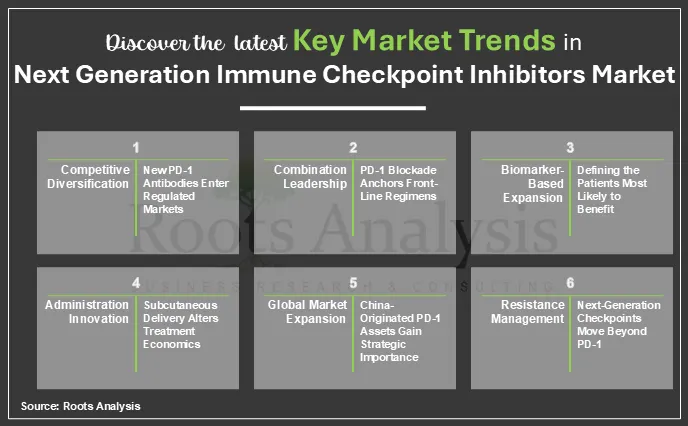
Latest Trends in Next Generation Immune Checkpoint Inhibitors Market That Are Likely to Shape the Market
1. Competitive Diversification: New PD-1 Antibodies Enter Regulated Markets
The PD-1 market is becoming less concentrated as additional antibodies secure approvals in specific, evidence-supported indications. In April 2025, the FDA approved Akeso Biopharma’s penpulimab-kcqx in combination with platinum-based chemotherapy and gemcitabine for first-line recurrent or metastatic non-keratinizing nasopharyngeal carcinoma, as well as monotherapy for previously treated metastatic disease.
This indication-led approach enables new PD-1 products to establish a differentiated role without replicating every incumbent label. It also confirms that clinically competitive PD-1 development is increasingly global, with China-originated assets progressing through US regulatory pathways.
2. Combination Leadership: PD-1 Blockade Anchors Front-Line Regimens
PD-1 inhibitors are increasingly positioned as the backbone of combination treatment. In April 2025, the FDA approved nivolumab plus the CTLA-4 inhibitor ipilimumab for first-line treatment of adults with unresectable or metastatic hepatocellular carcinoma, based on the CHECKMATE-9DW study.
The commercial relevance of PD-1 therapy will therefore depend not only on individual product labels, but also on the combinations that can deliver deeper and more durable responses. This is supporting continued investment in complementary checkpoint targets and combination designs that seek to balance efficacy with immune-related toxicity.
3. Biomarker-Based Expansion: Defining the Patients Most Likely to Benefit
Biomarker-driven use is becoming increasingly important to the PD-1 market. The FDA’s April 2025 approval of nivolumab plus ipilimumab for unresectable or metastatic microsatellite instability-high or mismatch repair-deficient colorectal cancer demonstrates how genomic biomarkers can guide checkpoint inhibitor selection.
In the same regulatory action, FDA converted the accelerated approval of single-agent nivolumab to regular approval for specified previously treated MSI-H / dMMR metastatic colorectal cancer. Such approvals reinforce the importance of diagnostic testing and create a clearer pathway for precision immunotherapy strategies.
4. Administration Innovation: Subcutaneous Delivery Alters Treatment Economics
Drug delivery is emerging as an important source of differentiation in the PD-1 market. In September 2025, the FDA approved Keytruda Qlex, a subcutaneous formulation of pembrolizumab coformulated with berahyaluronidase alfa-pmph, for adult indications covered by the intravenous pembrolizumab regimen.
Subcutaneous administration can reduce treatment time and may improve operational efficiency in oncology practices. As established PD-1 brands face lifecycle and pricing pressures, delivery innovation is likely to become increasingly relevant to provider adoption, product differentiation and market retention.
5. Global Market Expansion: China-Originated PD-1 Assets Gain Strategic Importance
PD-1 development has become a major component of China’s oncology innovation ecosystem. Tislelizumab, toripalimab and penpulimab are examples of antibodies developed in China that have advanced into US or other regulated markets through focused registration programs and global clinical evidence.
This trend is increasing competition for established PD-1 brands while creating licensing, co-development and commercialization opportunities. It may be especially consequential in cancers with substantial disease burden in Asia, including nasopharyngeal and esophageal cancers.
6. Resistance Management: Next-Generation Checkpoints Move Beyond PD-1
The unmet need in PD-1-refractory disease is accelerating development of checkpoint inhibitors directed at non-redundant immune pathways. LAG-3 has provided early clinical validation of this strategy through nivolumab-relatlimab in melanoma, while TIGIT, TIM-3, VISTA and other targets continue to be assessed in combination with PD-1 blockade.
The future PD-1 market is therefore likely to be defined by platform strategies rather than stand-alone antibodies. Companies able to combine PD-1 therapy with validated companion mechanisms, predictive biomarkers and rational treatment sequencing may be better positioned to address resistance and preserve clinical differentiation.
Conclusion
The PD-1 market remains a high-value segment of cancer immunotherapy, but its competitive dynamics are changing. New antibody entrants, biomarker-defined use, front-line combinations and subcutaneous administration are broadening the role of PD-1 blockade. Future opportunities are likely to arise from strategies that overcome resistance, improve treatment convenience and establish clinically differentiated combinations within the next generation immune checkpoint inhibitors market.
Browse our full report on Next Generation Immune Checkpoint Inhibitors Market: https://www.rootsanalysis.com/reports/next-generation-immune-checkpoint-inhibitors-market.html
Sources:
- https://www.fda.gov/drugs/resources-information-approved-drugs/fda-approves-penpulimab-kcqx-non-keratinizing-nasopharyngeal-carcinoma
- https://www.fda.gov/drugs/resources-information-approved-drugs/fda-approves-nivolumab-ipilimumab-unresectable-or-metastatic-msi-h-or-dmmr-colorectal-cancer
- https://www.fda.gov/drugs/resources-information-approved-drugs/fda-approves-nivolumab-ipilimumab-unresectable-or-metastatic-hepatocellular-carcinoma