Prefilled Syringes Market Trends: Innovation in Biologic Drug Delivery


Published:
Prefilled syringes are ready-to-administer drug-delivery systems that combine a measured dose with a sterile primary container. They can reduce preparation steps, support dose accuracy and facilitate convenient administration in hospitals, clinics and home-care settings. Their role is expanding as pharmaceutical companies seek delivery formats that improve usability and help manage the complexity of injectable therapies.
The prefilled syringes market is closely linked to the growth of biologics, including monoclonal antibodies, vaccines and other injectable specialty medicines. Many therapies require precise dosing, protection from contamination and reliable compatibility with autoinjectors or safety systems. As a result, drug developers increasingly assess the syringe, elastomer components and delivery device as an integrated combination-product system.
Recent market evolution has centered on enabling self-administration and accommodating high-concentration biologics. Subcutaneous delivery is becoming more important for chronic conditions because it can reduce the need for infusion-center visits. This is increasing demand for prefilled syringes that support low injection force, robust container integrity and consistent performance in automated or manual injection devices.
Manufacturing capacity, material selection and regulatory readiness are also reshaping supplier strategies. Glass and polymer syringe platforms are being optimized to address breakage resistance, extractables and leachables, silicone-related risks, tungsten control and cold-chain requirements. At the same time, leading suppliers are investing in ready-to-fill formats, integrated safety systems and device-compatible syringe configurations.
Roots Analysis has conducted an exhaustive study on Prefilled Syringes Market featuring the current market landscape and future opportunity for the companies engaged in this domain, over a span of many years. In this article, we have highlighted various trends that are likely to shape the evolution of this market.
Want to explore the latest advancements in prefilled syringes industry?
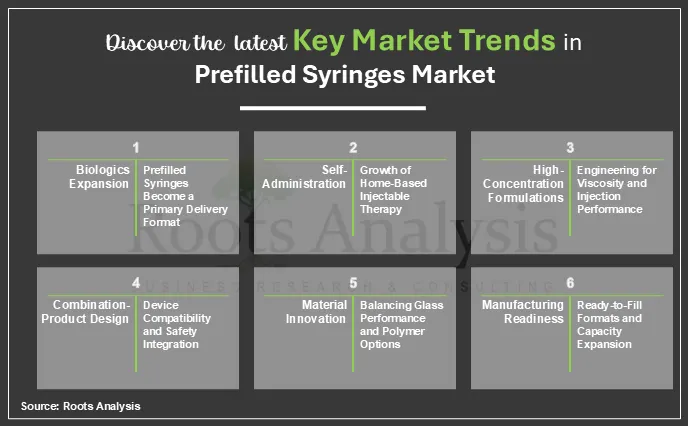
Latest Trends in Prefilled Syringes Market That Are Likely to Shape the Market
1. Biologics Expansion: Prefilled Syringes Become a Primary Delivery Format
The increasing use of biologic drugs is a central growth driver for the prefilled syringes market. Monoclonal antibodies, vaccines and other complex injectables often require sterile, accurate and user-friendly administration formats. Prefilled syringes can reduce drug-handling steps and support more standardized delivery compared with vial-and-syringe preparation.
SCHOTT Pharma, Gerresheimer and Stevanato Group offer prefillable syringe platforms designed for injectable pharmaceutical products. For drug developers, selecting a syringe platform early can improve compatibility testing, streamline device development and support a more efficient pathway toward commercialization.
2. Self-Administration: Growth of Home-Based Injectable Therapy
Healthcare systems are increasingly shifting suitable chronic therapies from infusion centers and clinics to home-based administration. Prefilled syringes are central to this transition because they can be supplied as standalone devices or integrated into autoinjectors and safety systems that simplify use for patients and caregivers.
This trend is particularly relevant for autoimmune diseases, metabolic disorders and oncology supportive care, where patients may require repeated injections. The commercial value of prefilled syringes is therefore extending beyond primary packaging to include patient experience, adherence and the operational efficiency of outpatient care pathways.
3. High-Concentration Formulations: Engineering for Viscosity and Injection Performance
High-concentration biologic formulations can reduce injection volume, but they may also increase viscosity and create challenges related to injection force, glide performance and delivery time. Prefilled syringe designs must therefore be evaluated with the complete delivery system, including the needle, elastomer components and autoinjector mechanism.
Suppliers are developing syringe and component platforms that support reliable delivery of more demanding formulations. This is likely to increase demand for advanced siliconization approaches, low-friction components and device-specific performance testing, especially as more biologics transition to subcutaneous administration.
4. Combination-Product Design: Device Compatibility and Safety Integration
The prefilled syringe is increasingly treated as part of a combination product rather than a passive container. Drug developers must consider container-closure integrity, dose accuracy, needle shielding, activation force and human-factors performance when pairing a syringe with an autoinjector, wearable injector or passive safety device.
BD’s Neopak™ prefillable syringe platform and safety-system portfolio illustrate the market’s progression toward integrated drug-delivery solutions. The ability to offer a validated syringe-device combination can reduce development complexity and may differentiate suppliers serving self-injection and high-value biologic programs.
5. Material Innovation: Balancing Glass Performance and Polymer Options
Glass remains widely used in prefilled syringes because of its established regulatory history and barrier properties. However, breakage resistance, sensitivity to siliconization, delamination risk and compatibility with certain products are sustaining interest in advanced glass processing and polymer alternatives.
The market is consequently seeing greater use of carefully engineered glass syringe systems and cyclic olefin polymer platforms for selected applications. Material selection is increasingly based on the drug formulation, route of administration, device requirements and storage conditions, rather than a one-size-fits-all packaging decision.
6. Manufacturing Readiness: Ready-to-Fill Formats and Capacity Expansion
Pharmaceutical companies are seeking packaging formats that reduce handling, simplify aseptic fill-finish operations and improve line efficiency. Nested, ready-to-fill prefilled syringes can support automated processing and help minimize human intervention during filling and assembly.
This requirement is encouraging suppliers to expand high-quality manufacturing capacity and offer more standardized, device-compatible platforms. In a market where packaging changes can require substantial validation work, reliable supply, strong change-control practices and technical support are becoming as important as the syringe design itself.
Conclusion
The prefilled syringes market is evolving from a primary-packaging segment into an essential part of injectable drug delivery. Growth in biologics, home-based care and high-concentration subcutaneous formulations is driving demand for syringe systems that combine safety, compatibility and user convenience. Suppliers that can provide scalable manufacturing, materials expertise and integrated device support are expected to be best positioned to capture future opportunities.
Browse our full report on Prefilled Syringes Market: https://www.rootsanalysis.com/reports/prefilled-syringes-market/284.html
Sources:
1. https://www.schott-pharma.com/en/pharmaceutical-packaging/syringes
2. https://www.stevanatogroup.com/en/products-services/drug-delivery-systems/prefillable-syringes.html
3. https://www.gerresheimer.com/en/products-services/pharma/prefillable-syringes/