Rapid Transfer Port Technology: Trends in Aseptic Technology

.png)

Published: August 2026
Rapid Transfer Port (RTP) technology has emerged as a critical solution for the aseptic fill finish manufacturing and sterile transfer of materials between controlled processing environments in pharmaceutical manufacturing. Designed to facilitate closed-system material transfer without compromising aseptic conditions, rapid transfer port solutions help maintain sterility while reducing the risk of cross-contamination and operator exposure. By enabling reliable and efficient transfer operations, RTP technology plays a vital role in supporting product quality, process consistency, and regulatory compliance in modern pharmaceutical manufacturing.
The pharmaceutical industry's shift toward biologics, antibody-drug conjugates (ADCs), cell and gene therapies, high-potency active pharmaceutical ingredients (HPAPIs), and sterile injectables has placed sterility assurance and contamination control at the center of manufacturing strategy and rapid transfer port technology has emerged as a critical enabler of this shift. At the same time, global regulatory frameworks around aseptic processing are reinforcing this momentum, pushing manufacturers to adopt closed-system material transfer as a baseline expectation rather than a differentiator. Consequently, continuous innovations in rapid transfer port technology, including automation-ready platforms, single-use RTP systems, advanced docking and sealing mechanisms, and compatibility with vaporized hydrogen peroxide (VHP) bio-decontamination, are enhancing operational efficiency, manufacturing flexibility, and sterility assurance.
Roots Analysis has conducted an exhaustive study on Rapid Transfer Port Market featuring the current landscape and future opportunity for the companies engaged in rapid transfer port domain. In this article, we have highlighted the key trends and technological advancements that are expected to shape the future of rapid transfer port technology across the global pharmaceutical and biotechnology industries.
Want to Explore the Competitive Landscape, Technological Advancements in the Rapid Transfer Port Technology?
Rapid Transfer Port Technology Trends Transforming Aseptic and High-Containment Pharmaceutical Manufacturing
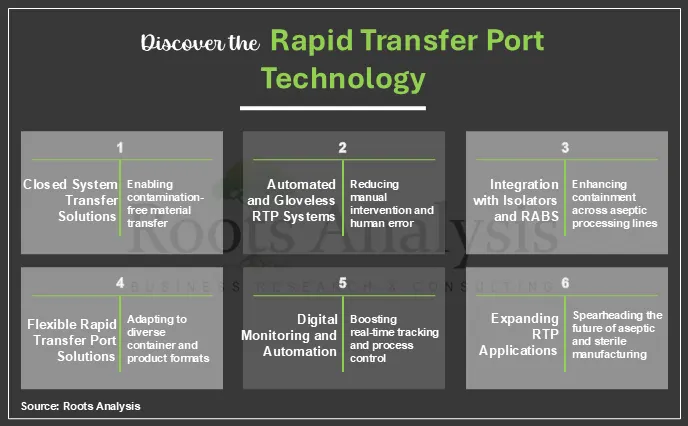
1. Increasing Adoption of Closed-System Transfer Solutions Strengthening Contamination Control
Rapid Transfer Port (RTP) technology is witnessing increasing adoption across pharmaceutical and biopharmaceutical manufacturing facilities, driven by the growing need for secure, aseptic material transfer in sterile processing environments. The expanding cytotoxic drugs and HPAPI manufacturing have increased the need for closed transfer systems that minimize human intervention and maintain product integrity. RTP systems are now widely integrated into isolators, restricted access barrier systems (RABS), and other controlled environments to support stringent contamination control strategies. For instance, DPTE® technology by Getinge enables secure sterile transfer between different classified areas, while RTP solutions offered by Ecolab support aseptic processing requirements across pharmaceutical manufacturing workflows.
2. Increasing Shift Toward Automated and Gloveless RTP Systems to Reduce Human Intervention
The pharmaceutical industry is increasingly adopting automated and gloveless RTP systems to improve manufacturing efficiency, streamline material transfer operations and reduce reliance on manual handling. Modern RTP solutions are being equipped with automated docking mechanisms, robotic integration, sensor-based monitoring and digital control capabilities that enable faster, more consistent transfer processes while minimizing operational downtime. These next-generation systems are also designed for seamless integration with automated fill / finish lines and advanced isolator platforms, supporting the industry's transition toward smart, highly automated pharmaceutical manufacturing. Technologies such as DPTE®-EXO Alpha Port by Getinge facilitate safe and closed-system transfer of pharmaceutical materials in isolator-based manufacturing environments.
3. Expanding Integration of RTP Technology with Advanced Aseptic Manufacturing Infrastructure
The growing deployment of isolators, Restricted Access Barrier Systems (RABS), and modular aseptic manufacturing platforms is driving the integration of rapid transfer port technology across modern pharmaceutical facilities. Its standardized design and compatibility with a wide range of processing equipment make RTP systems well suited for multi-product facilities, allowing manufacturers to optimize space utilization, simplify facility expansion and improve operational flexibility. For example, Biosafe® Rapid Transfer Port by Sartorius is widely used in pharmaceutical isolators and barrier systems to facilitate secure and repeatable transfers between different processing zones.
4. Rising Demand for Flexible RTP Solutions in Biologics and Advanced Therapy Manufacturing
The rapid growth of biologics, personalized medicine, and advanced therapies is increasing demand for flexible RTP solutions capable of supporting diverse manufacturing requirements. Unlike conventional pharmaceutical manufacturing, cell and gene therapy production often involves smaller batch sizes, complex workflows, and highly sensitive biological materials, requiring adaptable transfer technologies. RTP systems are being designed with modular configurations to accommodate different container sizes, transfer volumes, and manufacturing environments. For instance, specialized containment transfer solutions from Extract Technology are used in high-containment pharmaceutical applications.
5. Advancement of Smart RTP Systems Through Digital Monitoring and Process Automation
Technological advancements are transforming RTP systems from passive transfer components into intelligent solutions integrated with automation and digital monitoring capabilities. Modern RTP technologies increasingly incorporate sensors, electronic controls, and automated verification mechanisms to monitor critical transfer parameters such as connection status, system integrity, and transfer completion. These digital capabilities improve traceability, support data integrity requirements, and enable better control over aseptic manufacturing operations. The integration of RTP systems with manufacturing execution systems (MES) and automated production platforms is expected to further enhance process visibility and operational efficiency across pharmaceutical facilities.
6. Expansion of RTP Applications Across High-Containment and Emerging Pharmaceutical Segments
Beyond conventional sterile manufacturing, rapid transfer port technology is expanding into high-containment applications such as radiopharmaceutical production, oncology drug manufacturing, and handling of highly potent compounds. The increasing focus on operator safety and environmental protection has accelerated the adoption of closed transfer solutions capable of preventing exposure to hazardous materials. Companies such as Sartorius provide containment transfer technologies designed for pharmaceutical environments requiring strict isolation and protection. As pharmaceutical manufacturing continues to shift toward more complex molecules and advanced therapies, RTP systems are expected to become an essential component of future aseptic and containment-based production facilities.
Conclusion
Rapid Transfer Port technology is evolving as a critical enabler of modern aseptic manufacturing by facilitating secure, sterile and contamination-free transfer of materials across controlled environments. The growing adoption of biologics and potent pharmaceutical compounds is accelerating the need for advanced closed-system transfer solutions that reduce manual intervention. Continuous advancements in automation, digital monitoring and integration with isolators and RABS are further strengthening the capabilities of RTP systems by improving operational efficiency. The combined influence of technological innovation, increasing demand for flexible manufacturing solutions, and the shift toward automated aseptic processing is shaping the future of RTP technology, making it an essential component for efficient, reliable, and next-generation pharmaceutical manufacturing workflows.
To know more about the rapid transfer port technology, access full report: https://www.rootsanalysis.com/reports/rapid-transfer-port-market.html
Sources:
- https://health.ec.europa.eu/system/files/2022-08/20220825_gmp-an1_en_0.pdf
- https://ispe.org/publications/guidance-documents/sterile-product-manufacturing-facilities-third-edition
- https://www.cytivalifesciences.com/en/us/products/items/single-use-filling-needle-assembly-p-54216
- https://castus.pro/en/news/rapid-transfer-port/
- https://www.rommelag.com/en/glossary/rapid-transfer-ports-rtp