Recent Trends in Atrial Fibrillation Treatment Market

.png)

Published: August 2026
Atrial fibrillation (AF) is one of the most common cardiac arrhythmias and is characterized by irregular electrical activity in the atria, which can impair cardiac function and substantially increase the risk of thromboembolic complications, including stroke. The burden of the disease continues to increase with aging populations and the growing prevalence of associated conditions, such as hypertension, obesity, diabetes and heart failure. In fact, the Heart Rhythm Society noted in 2026 that more than 40 million individuals worldwide are living with atrial fibrillation.
The treatment landscape for atrial fibrillation has evolved considerably over the years. Conventional management has largely relied on rate-control and rhythm-control drugs, anticoagulants for stroke prevention, electrical cardioversion and catheter ablation. However, treatment strategies are increasingly shifting from long-term symptom management toward earlier rhythm control, durable arrhythmia suppression and more individualized stroke-prevention approaches. The growing clinical adoption of minimally invasive procedures is also increasing the role of device-based treatments alongside pharmaceutical therapies.
Technological advances in electrophysiology have further accelerated this transition. In particular, pulsed field ablation (PFA) is emerging as an important alternative to conventional thermal ablation technologies. At the same time, left atrial appendage closure devices are being evaluated in progressively broader patient populations, while pharmaceutical developers are investigating next-generation anticoagulants intended to reduce bleeding complications associated with existing therapies. These developments are expanding the range of treatment choices available to clinicians and patients.
Further, atrial fibrillation is increasingly being managed as a chronic cardiovascular condition rather than as an isolated rhythm disorder. Contemporary treatment pathways incorporate stroke prevention, rhythm management, management of associated cardiovascular and metabolic conditions and regular reassessment. The 2024 ESC guidelines formalized this concept through the AF-CARE framework, placing comorbidity and risk-factor management alongside stroke prevention and rate / rhythm control.
Roots Analysis has conducted an exhaustive study on the Atrial Fibrillation Market, featuring the current market landscape and future opportunities for companies developing drugs and devices for atrial fibrillation. In this article, we have highlighted some of the recent trends in atrial fibrillation treatment market that are likely to influence the evolution of this therapeutic landscape.
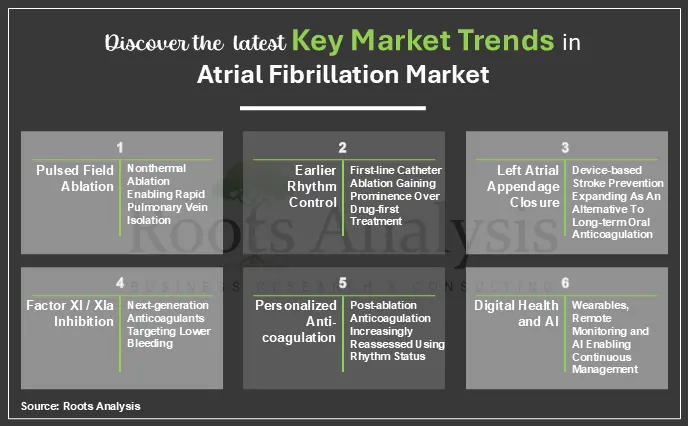
Want to explore the latest trends in Atrial Fibrillation Treatment Market?
Latest Trends in Atrial Fibrillation Treatment Industry that are Likely to Shape the Market
1. Pulsed Field Ablation: Redefining Catheter-Based Treatment of Atrial Fibrillation
Among the most prominent recent trends in atrial fibrillation treatment market is the rapid adoption of pulsed field ablation. Unlike radiofrequency and cryoablation, which rely on thermal energy, PFA uses short electrical pulses to selectively disrupt myocardial cells through irreversible electroporation. The tissue-selective nature of this approach is intended to limit collateral injury to structures surrounding the heart while enabling rapid pulmonary vein isolation.
Commercial availability of PFA systems is also expanding. For instance, in December 2025, the US FDA approved Abbott's Volt PFA System for the treatment of symptomatic, recurrent, drug-refractory paroxysmal or persistent atrial fibrillation. Further, the Heart Rhythm Society and European Heart Rhythm Association released a dedicated scientific statement on PFA in February 2026, reflecting how rapidly the technology has moved into contemporary electrophysiology practice. As additional systems enter the market and clinical experience increases, PFA is expected to remain a major focus of innovation within catheter-based AF treatment.
2. Earlier Rhythm Control: Moving Catheter Ablation Up the Treatment Pathway
A notable shift is occurring in when interventional rhythm-control therapies are being used. Traditionally, catheter ablation was commonly considered after patients experienced inadequate response or intolerance to antiarrhythmic drugs. However, accumulating clinical evidence and evolving guidelines are supporting earlier rhythm-control intervention in selected patients. The 2024 ESC guidance already recognizes catheter ablation as a first-line rhythm-control option for suitable patients with paroxysmal atrial fibrillation.
More recently, clinical evidence has begun extending this discussion to persistent atrial fibrillation. In the 2026 AVANT GUARD study, first-line PFA achieved treatment success at 12 months in an estimated 56% of previously untreated patients with persistent AF, compared with 30% receiving antiarrhythmic-drug therapy. Although patient selection and long-term outcomes will continue to influence treatment decisions, such findings are challenging the conventional drug-first treatment sequence and could expand the addressable population for catheter ablation technologies.
3. Left Atrial Appendage Closure: Expanding Device-Based Approaches for Stroke Prevention
Stroke prevention remains one of the fundamental objectives of atrial fibrillation treatment, with direct oral anticoagulants representing the standard pharmacological approach for many patients. However, long-term anticoagulation can be associated with bleeding risk, adherence requirements and drug-related limitations. As a result, left atrial appendage closure (LAAC) is gaining attention as a non-pharmacological strategy for reducing thromboembolic risk.
Importantly, the clinical focus of LAAC is beginning to extend beyond patients who are unable to tolerate long-term anticoagulation. In March 2026, results from the 3,000-patient CHAMPION-AF trial demonstrated that LAAC with the WATCHMAN FLX device was non-inferior to non-vitamin K antagonist oral anticoagulant therapy for the trial's composite efficacy endpoint at three years and was associated with fewer non-procedural bleeding events. Although anticoagulants continue to represent an important standard of care and broader treatment decisions require individualized assessment, such evidence is expanding discussion around device-based stroke prevention among patients who are otherwise suitable for oral anticoagulant therapy.
4. Next-Generation Anticoagulants: Factor XI Inhibition Aims to Reduce Bleeding Burden
Pharmaceutical innovation in atrial fibrillation is increasingly focused on developing anticoagulants that can prevent thromboembolic events without substantially increasing bleeding risk. One of the most actively investigated approaches involves inhibition of coagulation factor XI / XIa. Unlike conventional anticoagulants that interfere with pathways essential to physiological hemostasis, factor XI inhibition is being investigated as a means of more selectively suppressing pathological thrombosis.
Abelacimab represents one of the prominent candidates within this emerging class. Results from the AZALEA-TIMI 71 trial, published in 2025, showed lower major or clinically relevant non-major bleeding with once-monthly abelacimab than with daily rivaroxaban among patients with atrial fibrillation and moderate-to-high stroke risk. Although definitive evidence regarding stroke-prevention efficacy remains essential before such therapies can alter routine practice, ongoing development of factor XI / XIa inhibitors illustrates the industry's growing effort to improve the therapeutic balance between thrombosis prevention and bleeding risk.
5. Personalized Anticoagulation: Reassessing Lifelong Therapy Following Successful AF Ablation
Another emerging trend is the movement toward more individualized anticoagulation strategies after successful catheter ablation. Traditionally, the decision to continue oral anticoagulation after ablation has primarily been guided by a patient's underlying thromboembolic risk rather than the apparent success of rhythm-control treatment. However, recent studies are evaluating whether long-term anticoagulant exposure can be reduced in carefully selected patients who remain free from recurrent atrial fibrillation.
For instance, the ALONE-AF trial evaluated patients who remained arrhythmia-free for one year after catheter ablation and found a lower rate of the composite endpoint of stroke, systemic embolism and major bleeding among patients assigned to discontinue oral anticoagulation, largely due to fewer major bleeding events. Additional studies, including OCEAN, are contributing evidence to this evolving treatment question. Importantly, this does not establish anticoagulant discontinuation as appropriate for all post-ablation patients; rather, it is accelerating research into treatment models in which rhythm status, stroke risk and bleeding risk are considered together.
6. Digital Health and AI Integration: Enabling Continuous and Personalized AF Management
Digital technologies are increasingly extending atrial fibrillation treatment beyond episodic hospital and clinic visits. Wearable ECG devices, smartwatches, mobile applications, implantable rhythm monitors and artificial intelligence-enabled platforms can provide longitudinal information on arrhythmia recurrence, AF burden, treatment adherence and cardiovascular risk factors. Such information has particular relevance following catheter ablation and in patients requiring dynamic reassessment of rhythm-control or anticoagulation strategies.
The American College of Cardiology highlighted this trend in July 2026, noting that digital health and AI could support personalized and longitudinal delivery of atrial fibrillation care. Digital interventions are increasingly being evaluated not only for arrhythmia detection but also for medication management, lifestyle modification, remote patient engagement and integrated cardiovascular risk-factor control. Further, ongoing studies are investigating continuous monitoring using implantable loop recorders and smartwatches to guide individualized anticoagulation strategies following successful ablation. Consequently, integration of therapeutic interventions with continuous digital monitoring is likely to become an increasingly important component of comprehensive AF management.
Conclusion
The recent trends in atrial fibrillation treatment market indicate a broader transition from predominantly pharmacological and reactive management toward earlier, more personalized and technology-enabled intervention. Pulsed field ablation is rapidly reshaping the electrophysiology landscape, while emerging clinical evidence is supporting greater consideration of catheter ablation earlier in the treatment pathway. Simultaneously, advances in left atrial appendage closure are expanding device-based options for stroke prevention.
The pharmaceutical landscape is also evolving, particularly through the development of factor XI / XIa inhibitors intended to improve the safety profile of anticoagulation. Further, evidence surrounding anticoagulant discontinuation after successful ablation is stimulating interest in more individualized treatment strategies rather than a uniform approach to lifelong therapy.
Looking ahead, these developments are likely to converge with continuous rhythm monitoring, wearable injectors and AI-enabled patient-management platforms. This integration could allow clinicians to select therapies according to changing AF burden, thromboembolic risk, treatment response and associated cardiovascular conditions. Collectively, these trends are expected to strengthen the role of minimally invasive procedures, next-generation anticoagulants and digitally supported personalized care in shaping the future atrial fibrillation treatment market.
Browse our full report on Atrial Fibrillation Market: https://www.rootsanalysis.com/reports/atrial-fibrillation-market.html
Sources:
1. https://corporate.qiagen.com/English/newsroom/press-releases/press-release-details/2026/QIAGEN-Showcases-QIAsprint-Connect-High-Throughput-Automation-System-for-Labs-Worldwide-at-SLAS-2026/default.aspx
2. https://www.accessdata.fda.gov/scripts/cdrh/cfdocs/cfpma/pma.cfm?id=P250022
3. https://www.hrsonline.org/resource/2024-ehra-hrs-aphrs-lahrs-expert-consensus-statement-on-catheter-and-surgical-ablation-of-atrial-fibrillation/
4. https://www.acc.org/latest-in-cardiology/articles/2026/03/25/21/27/sat-930am-championaf-acc-2026