Recent Trends in Contract Manufacturing of Biologics

.png)

Published: March 2026
Biopharmaceuticals are the medicinal products that are either manufactured using living organisms or semi-synthesized from biological sources. These macromolecules often defy the conventional chemical synthesis methods, compelling industry players to invest in advanced biotech platforms for their scalable production.
The rising prevalence of chronic diseases and shift towards advanced therapeutic modalities have significantly boosted demand for biologics. Consequently, numerous developers outsource manufacturing operations to third-party providers, enabling them to meet escalating needs of the industry. Further, outsourcing business operations to third party developers and manufacturers provides excellent opportunities to access greater production capabilities and / or new products.
To capitalize on this surge and attract more clients, the smaller service providers are rapidly enhancing their capabilities and / or partnering with other players in order to expand their existing offerings.
Roots Analysis has conducted an exhaustive study on Biologics Contract Manufacturing Market featuring the current market landscape and future opportunity for the companies engaged in contract manufacturing of biologics, over a span of many years. In this article, we have highlighted some of the biologics contract manufacturing market trends that are likely to shape the evolution of biologics contract manufacturing market.
Want to explore the latest advancements in biologics contract manufacturing??
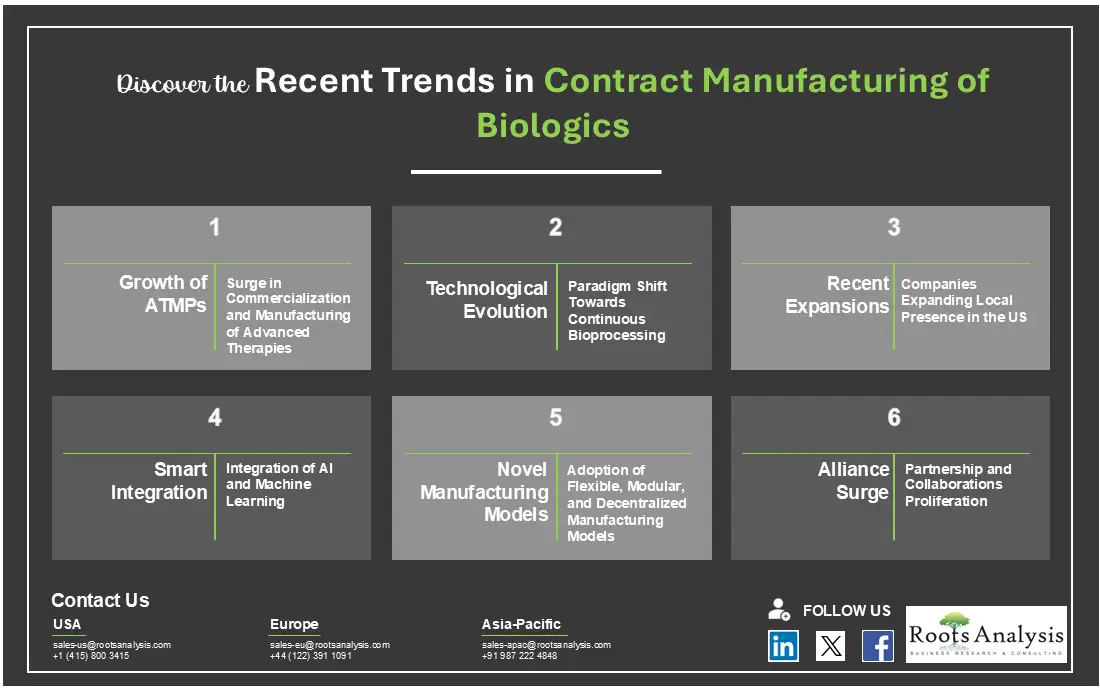
Latest Trends in Biologics Contract Manufacturing Market that are Likely to Shape the Market
1. Surge in Commercialization and Manufacturing of Advanced Therapies
The surge in commercialization and manufacturing of advanced therapies represents a pivotal trend in biologics contract manufacturing market. This is primarily driven by the rapid advancements in cell and gene therapies, CAR-T therapies, and other ATMPs entering late-stage clinical trials and commercial phases. Examples of such therapies which have received regulatory approval recently include exa-cel, Beqvez and Aucatzyl. Further, as biotech innovators prioritize speed-to-market, CDMOs are scaling up specialized infrastructure like modular cleanrooms, viral vector manufacturing suites, and cryopreservation systems to handle complex, patient-specific modalities that traditional facilities can't accommodate.
2. Paradigm Shift Towards Continuous Bioprocessing
One very recent and innovative development in the biologics contract manufacturing market is the accelerating shift towards continuous and intensified bioprocessing. Notably, this technique is rapidly transitioning from an emerging innovation in 2025, to a standard practice in 2026. This shift is primarily due to the fact that continuous bioprocessing techniques help in addressing intensifying pricing pressures by boosting productivity and reducing costs for production of complex biologics and advanced therapies.
Recently, Enzene Biosciences, a subsidiary of Alkem Laboratories, has fully implemented its EnzeneX™ platform, which is the world's first validated fully-connected continuous manufacturing (FCCM™) technology for commercial biologics production. This innovation allows for end-to-end continuous processing of monoclonal antibodies and other biologics, significantly reducing production timelines and overall manufacturing costs, when compared to traditional batch methods.
3. Companies Expanding Local Presence in the US
Many contract manufacturing organizations developing biologics such as, vaccines, antibodies, and cell and gene therapies, are building / expanding their manufacturing facilities right in the US. This is likely being done in order to avoid President Trump's high tariffs on imported pharmaceutical products and supplies from places like China, Canada, or Mexico, which can add up to 100% extra costs.
Recently, in January 2026, Samsung Biologics entered into an agreement with GSK in order to acquire its Human Genome Sciences facility located in Rockville, Maryland. Through this agreement, the company marks its presence in the US biopharma manufacturing market. Additionally, in May 2025, Taiwan-based company, Bora Biologics, announced the expansion of its US FDA-registered commercial manufacturing facility in San Diego, US.
4. Integration of AI and Machine Learning
The integration of ML and AI in healthcare has significantly resulted in enhanced efficiency, quality, and agility across various processes. These technologies enable real-time process monitoring, predictive maintenance, and automated quality control, which reduces the downtime and minimizes variability in biopharmaceutical production. Additionally, AI-driven data analytics also helps in anticipating equipment failures and streamlining supply chain logistics at an early stage, thereby ensuring smoother operations.
5. Adoption of Flexible, Modular, and Decentralized (Point-of-Care) Manufacturing Models
The adoption of flexible, modular, and decentralized (point-of-care) manufacturing models in biologics contract manufacturing market, is revolutionizing biopharmaceutical production by enabling scalable, adaptable facilities that can be rapidly deployed near patients or clinical sites. This also helps in reducing logistical complexities for personalized therapies like CAR-T cells and gene treatments, which are generally not stable at room temperature. These models leverage prefabricated, plug-and-play cleanrooms, single-use technologies, and portable bioreactors to shift from centralized mega-plants to distributed networks, thereby slashing lead times and minimizing cold-chain risks, while complying with stringent GMP standards.
6. Partnership and Collaborations Proliferation
The biologics contract manufacturing market has witnessed significant partnership activity over the past few years, attributing to the rapidly growing pipeline of biologics. Further, these collaborations allow big pharma players to handle surging demand from complex drug pipelines without massive infrastructure investments, while local firms gain access to cutting-edge technologies and expertise. For instance, in December 2025, Recipharm (Sweden) signed a partnership agreement with Infant Bacterial Therapeutics (Sweden) for the commercial production of its drug substance, IBP-9414. Overall, this trend fosters innovation through shared resources, quicker turnaround times, and customized solutions that align with diverse regulatory landscapes worldwide.
Conclusion
The biologics contract manufacturing market is set for rapid growth in the years ahead, fueled by surging pipelines of advanced therapies, biosimilars, and monoclonal antibodies that require specialized, scalable production capabilities amid rising research and development costs and capacity shortages. Although hurdles like supply chain fragility and regulatory stringency remain, CDMOs are countering with breakthroughs in single-use systems, continuous bioprocessing, and AI-optimized platforms that boost yields, cut timelines, and ensure GMP compliance.
Moreover, the boom in decentralized, point-of-care models and strategic partnerships between biotech firms, big pharma players, and CDMOs is fortifying global resilience, while heightened focus on ATMPs and oncology fuels demand for modular facilities and viral vector expertise. Companies are ramping up investments in flexible infrastructure and digital twins for predictive manufacturing. In the end, these dynamics herald a new era of agile, collaborative ecosystems via CDMO expansions and tech synergies, delivering faster commercialization and equitable access to next-generation biologics.
Browse our full report on Biologics Contract Manufacturing Market:
https://www.rootsanalysis.com/reports/biopharmaceutical-contract-manufacturing-market/250.html
Sources
- https://www.enzene.com/news/governor-murphy-inaugurates-new-us-continuous-biomanufacturing-facility-of-india-based-enzene/
- https://cleanroomtechnology.com/samsung-biologics-enters-us-biopharma-manufacturing-market-with
- https://www.biospectrumasia.com/news/40/26084/taiwans-bora-biologics-expands-manufacturing-facility-in-us.html
- https://www.sciencedirect.com/science/article/pii/S0168365925001701
- https://www.recipharm.com/press-releases/infant-bacterial-therapeutics-ab-secures-partnership-recipharm-advanced-bio-commercial-production-drug-substance