Small Molecule API Manufacturing Process: Key Trends and Technologies Shaping the Industry


Published: September 2026
The small molecule active pharmaceutical ingredient (API) manufacturing landscape is undergoing a significant transformation, driven by the increasing complexity of drug molecules, stringent quality requirements, demand for cost efficient production, and growing emphasis on manufacturing sustainability. Traditionally, small molecule APIs have been manufactured through multi step batch synthesis involving chemical reactions, isolation, purification, drying and milling. However, advances in process chemistry and manufacturing technologies are enabling manufacturers to improve process efficiency, product quality and scalability.
At the same time, the adoption of continuous flow chemistry is gaining momentum across API manufacturing, particularly for complex and hazardous chemical transformations. Compared with conventional batch processing, flow based approaches can offer improved reaction control, enhanced process safety, reduced manufacturing footprints and greater flexibility in scale up. Recent industry research also highlights the growing application of flow chemistry across API and raw material manufacturing.
The increasing integration of process analytical technology (PAT), automation, artificial intelligence (AI), digital twins and advanced process control is further reshaping the domain. AI and machine learning are increasingly being explored for real time process monitoring, anomaly detection, predictive maintenance and advanced process control within pharmaceutical contract manufacturing environments.
Overall, the combination of advanced process chemistry, continuous manufacturing, digitalization and sustainable production approaches is redefining the small molecule API manufacturing process and creating opportunities for pharmaceutical companies and CDMOs to improve manufacturing efficiency and resilience.
Roots Analysis has conducted an exhaustive study of the Small Molecule API Manufacturing Market featuring the current market landscape and future opportunities for developers engaged in healthcare, over the span of next 9 years. In this article, we have highlighted some of the small molecule API manufacturing market Trends that are likely to shape the evolution of this industry.
Want to Explore the Competitive Landscape and Small Molecule API Manufacturing Market Trends?
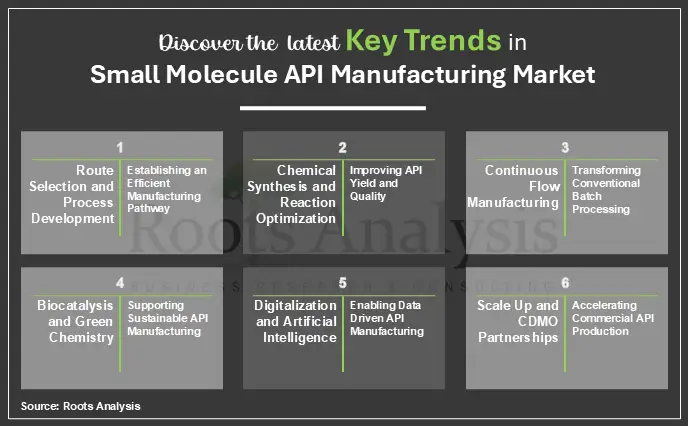
Small Molecule API Manufacturing Trends and Key Factors Likely to Shape the Overall Market Evolution
1. Route Selection and Process Development: Establishing an Efficient Manufacturing Pathway
The small molecule API manufacturing process begins with the identification and optimization of a suitable synthetic route. During early development, manufacturers evaluate different reaction pathways based on factors such as yield, purity, number of synthetic steps, raw material availability, reaction safety, scalability, cost and environmental impact. Process chemists increasingly focus on developing commercially viable routes rather than simply achieving successful synthesis at laboratory scale. Route optimization can involve reducing the number of reaction steps, improving reaction yields, replacing hazardous reagents, minimizing solvent consumption and developing more efficient isolation and purification procedures. The growing complexity of small molecule pipelines is further increasing the importance of process development. Molecules containing multiple functional groups, stereochemical centers or challenging chemical transformations can require sophisticated process chemistry approaches before being transferred to commercial manufacturing.
2. Chemical Synthesis and Reaction Optimization: Improving API Yield and Quality
Chemical synthesis represents one of the core stages of small molecule API manufacturing. Depending on the molecular structure, the manufacturing process may involve several reactions, including coupling, oxidation, reduction, hydrogenation, alkylation, acylation and other transformations. During process development, manufacturers optimize critical reaction parameters such as temperature, pressure, reaction time, reagent concentration, solvent selection and mixing conditions. The objective is to maximize conversion and selectivity while limiting the formation of impurities and unwanted by products. Increasingly, manufacturers are also evaluating continuous flow systems for reactions that require tight control of temperature, pressure or reaction time. Flow systems can improve heat and mass transfer and may offer particular advantages for hazardous or highly exothermic reactions. Recent industry literature highlights the potential of flow chemistry to improve safety, efficiency and flexibility in API manufacturing while enabling certain chemistries that may be difficult to perform using conventional batch processes.
3. Continuous Flow Manufacturing: Transforming Conventional Batch Processing
One of the most significant developments in the small molecule API manufacturing process is the transition from conventional batch processing toward continuous and hybrid manufacturing approaches. In conventional batch manufacturing, individual reaction stages are performed sequentially in large reactors, followed by isolation and subsequent processing. Continuous manufacturing, in contrast, enables materials to move continuously through processing units under controlled conditions. Hybrid approaches can combine continuous reaction steps with conventional batch isolation and purification operations. The adoption of continuous flow technology can provide several advantages, including improved process control, reduced equipment footprint, enhanced safety and potentially shorter manufacturing timelines. Recent research indicates that flow technology can be applied across several unit operations traditionally used in this domain, while hybrid processes can integrate continuous and batch operations depending on product and process requirements. The continued development of modular continuous manufacturing platforms is therefore expected to support the broader adoption of flow based API production, particularly for complex, high value and hazardous chemistry.
4. Biocatalysis and Green Chemistry: Supporting Sustainable API Manufacturing
Sustainability is becoming increasingly important across the small molecule API manufacturing process. Manufacturers are therefore exploring green chemistry principles to reduce waste generation, energy consumption, hazardous reagent use and solvent requirements. Biocatalysis is emerging as an important approach, particularly for stereoselective transformations and the synthesis of structurally complex molecules. Enzymatic reactions can provide high selectivity and may reduce the number of synthetic steps required for certain APIs. Recent industry analyses identify biocatalysis as a manufacturing approach capable of supporting stereoselective reactions, complex transformations and multi-step API production while potentially reducing solvent and energy requirements and improving selectivity and yield. The combination of biocatalysis with continuous flow systems may further strengthen the sustainability and efficiency of API production by enabling controlled, integrated processing of complex chemical transformations.
5. Digitalization and Artificial Intelligence: Enabling Data Driven API Manufacturing
Digitalization is increasingly becoming an integral component of modern small molecule API manufacturing. Manufacturers are adopting automation, process analytical technology (PAT), machine learning and advanced data analytics to obtain greater visibility into manufacturing operations. Artificial intelligence and deep learning can support real time process monitoring, predictive maintenance, anomaly detection, inferential measurements and advanced process control. These capabilities can help manufacturers identify process deviations earlier and improve consistency between manufacturing batches. Digital twins and computational models are also being explored to simulate manufacturing processes and optimize operating conditions before implementing changes at production scale. Recent research highlights the increasing application of AI enabled digital technologies across pharmaceutical development and manufacturing, although regulatory alignment, data quality and infrastructure remain important considerations. Consequently, the integration of AI, PAT and automation is expected to become increasingly important for improving process understanding, quality control and operational efficienc.
6. Scale Up and CDMO Partnerships: Accelerating Commercial API Production
The transition from laboratory scale synthesis to commercial API production represents another critical stage in the small molecule API manufacturing process. Scale up requires manufacturers to evaluate changes in mixing, heat transfer, reaction kinetics, equipment configuration, impurity formation and process safety. Pharmaceutical companies are increasingly relying on contract development and manufacturing organizations with specialized process development, analytical and commercial manufacturing capabilities. Such partnerships can provide access to specialized equipment, experienced process chemists, manufacturing capacity and regulatory expertise. The increasing complexity of small molecule pipelines is also encouraging CDMOs to invest in advanced manufacturing capabilities, including high containment facilities, continuous processing, flow chemistry and specialized process development infrastructure.
For instance, In March 2026, HRV Global Life Sciences entered into a collaboration with Shodhana Laboratories in order to co-develop, manufacture and supply a pipeline of high-science APIs. The partnership combines HRV's market access and AI-enabled API platform with Shodhana's process chemistry expertise and GMP manufacturing infrastructure.
Conclusion
The small molecule API manufacturing process is evolving from conventional, batch based chemical production toward a more integrated, flexible and technology driven manufacturing ecosystem. Route optimization, advanced chemical synthesis, efficient purification and crystallization remain fundamental to API production, while continuous flow chemistry and process intensification are introducing new opportunities to improve manufacturing efficiency and safety. At the same time, biocatalysis and green chemistry are supporting the industry's transition toward more sustainable production, while AI, PAT, automation and digital technologies are enabling greater process visibility and control. Continuous manufacturing research has particularly highlighted the potential to improve safety, efficiency and flexibility in API production. Considering these developments, the future of small molecule API manufacturing is likely to be characterized by greater integration of advanced process chemistry, continuous manufacturing, digital technologies and sustainable production approaches. These developments are expected to enable pharmaceutical companies and CDMOs to manufacture increasingly complex APIs while improving quality, scalability, cost efficiency and supply chain resilience.
To know more about the complement inhibitors market trends, access full report: https://www.rootsanalysis.com/reports/small-molecule-api-manufacturing-market.html
Sources:
1. https://www.news-medical.net/whitepaper/20260608/Why-route-selection-is-key-to-successful-API-scale-up.aspx
2. https://pmc.ncbi.nlm.nih.gov/articles/PMC12051753/
3. https://www.sciencedirect.com/science/article/abs/pii/S0263876225000036
4. https://synthinkchemicals.com/green-chemistry-approaches-in-api-impurity-synthesis/
5. https://www.sciencedirect.com/science/article/pii/S0378517326001304
6. https://www.linkedin.com/pulse/how-integrated-api-manufacturing-cdmo-partnerships-accelerate-mzqlc/