Systemic Lupus Erythematosus Market Treatment Trends

.png)

Published: October 2026
Systemic lupus erythematosus (SLE) is a chronic and complex autoimmune disorder characterized by abnormal activation of the immune system, resulting in inflammation and tissue damage across multiple organs, including the skin, joints, kidneys, cardiovascular system, lungs, and nervous system. The heterogeneous nature of SLE, differences in disease severity and organ involvement, and the occurrence of recurrent disease flares have historically made disease management challenging. Conventional treatment has primarily relied on hydroxychloroquine, corticosteroids, immunosuppressive agents, and other symptomatic therapies to control inflammation and prevent organ damage. However, prolonged corticosteroid exposure is associated with substantial adverse effects, while a considerable proportion of patients continue to experience inadequate disease control or treatment-related complications. Consequently, there is an increasing shift toward targeted therapies that address specific immune pathways implicated in SLE pathogenesis.
The systemic lupus erythematosus treatment landscape has therefore evolved considerably with the introduction and growing adoption of biologic therapies targeting key immune mechanisms, including B-cell activating factor and type I interferon signaling. In parallel, pharmaceutical and biotechnology companies are investigating novel approaches directed toward B-cell depletion, plasma-cell targeting, FcRn inhibition, and other immune pathways. Recent clinical and regulatory developments have also expanded treatment options for lupus nephritis, one of the most serious manifestations of SLE, while advances in subcutaneous formulations and self-administration technologies are improving treatment convenience. Furthermore, emerging modalities such as CAR-T and other cellular immunotherapies are being evaluated for patients with severe, treatment-refractory disease, with the potential to achieve deeper and more durable disease control. These developments, together with the growing emphasis on steroid-sparing treatment, remission, organ protection, and patient-centric care, are expected to significantly influence the evolution of the SLE treatment market.
Roots Analysis has conducted an exhaustive study of the systemic lupus erythematosus market Treatment Trends featuring the current market landscape and future opportunities for developers engaged in healthcare, over the span of next 9 years. In this article, we have highlighted some of the Complement Inhibitors Drugs Market Trends that are likely to shape the evolution of this industry.
Want to Explore the Competitive Landscape and Systemic Lupus Erythematosus Market Treatment Trends?
Latest Trends in Systemic Lupus Erythematosus Market That Are Likely to Shape the Market
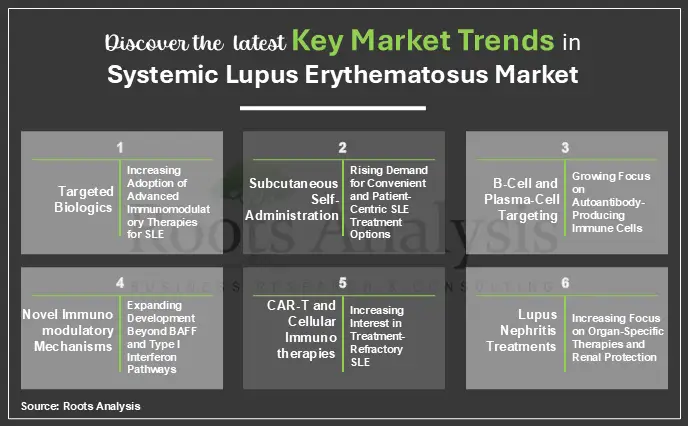
1. Targeted Biologics: Increasing Adoption of Advanced Immunomodulatory Therapies for SLE
One of the major trends shaping the SLE drugs market is the increasing adoption of targeted biologic therapies that act on specific immune pathways involved in disease progression. Historically, SLE treatment has relied heavily on corticosteroids and broad immunosuppressive agents, which can effectively control inflammation but may be associated with long-term safety concerns. As a result, treatment approaches are increasingly incorporating biologics, particularly for patients who do not achieve adequate disease control with conventional therapies or require corticosteroid reduction.
For example, GSK’s Benlysta (belimumab) targets B-cell activating factor, while AstraZeneca’s Saphnelo (anifrolumab) blocks the type I interferon receptor. By targeting disease-associated immune mechanisms, these therapies provide a more focused approach to controlling abnormal immune activity. Growing clinical evidence demonstrates reductions in disease flares, improved disease control, and corticosteroid-sparing effects is further supporting their adoption.
On the other hand, the increasing focus on treat-to-target strategies is shifting SLE management from short-term symptom control toward sustained remission or low disease activity, prevention of organ damage, and improved quality of life. Consequently, targeted biologics are expected to gain greater importance as treatment decisions increasingly prioritize durable disease control with reduced reliance on long-term corticosteroid therapy.
2. Subcutaneous Self-Administration: Rising Demand for Convenient and Patient-Centric SLE Treatment Options
The SLE treatment market is increasingly moving toward therapies that can be administered subcutaneously or can be self-administered by patients at home. Traditional intravenous biologic treatments require patients to visit hospitals or infusion centers, which can be inconvenient and time-consuming. Therefore, subcutaneous formulations and delivery devices are proven to offer a more convenient alternative to improve access to biologic therapies. The availability of both intravenous and subcutaneous formulations gives patients and healthcare professionals flexibility in selecting the most suitable method of treatment administration. This trend is expected to become increasingly important as drug developers place greater emphasis on patient convenience, ease of administration, and treatment flexibility when developing and differentiating SLE drug. Hence, pre-filled syringes, autoinjector, and other patient-friendly drug delivery technologies are expected to play an increasingly important role in the SLE treatment market.
For Example, In April 2026, FDA announced the approval of Saphnelo for once-weekly subcutaneous self-administration using the Saphnelo Pen in adults with SLE receiving standard therapy. The approval was supported by positive Phase III TULIP-SC results, which showed that subcutaneous anifrolumab significantly reduced disease activity compared with placebo.
3. B-Cell and Plasma-Cell Targeting: Growing Focus on Autoantibody-Producing Immune Cells
B-cell and plasma-cell targeted therapies are emerging as an important area of development in the SLE drugs treatment landscape, driven by increasing evidence of their contribution to disease pathogenesis. B cells play multiple roles in SLE, including the production of pathogenic autoantibodies, antigen presentation, and activation of other immune cells, making them an attractive therapeutic target. Accordingly, B-cell-depleting and B-cell-modulating therapies are being investigated, particularly for patients with active, refractory, or inadequately controlled diseases. On the other hand, growing research interest is focused on plasma cells, which are responsible for the sustained production of antibodies, including pathogenic autoantibodies implicated in SLE. Consequently, therapies designed to directly target plasma cells are being explored as a complementary approach to B-cell-directed treatment. The expanding development of therapies targeting both B cells and plasma cells highlights the broader shift toward mechanism-based treatment strategies in SLE and may help address persistent disease activity in patients who respond inadequately to conventional or existing B-cell-targeted therapies.
4. Novel Immunomodulatory Mechanisms: Expanding Development Beyond BAFF and Type I Interferon Pathways
The SLE treatment pipeline is increasingly expanding beyond established therapeutic targets, particularly the BAFF and type I interferon pathways, as drug developers seek to address the complex and heterogeneous immunological mechanisms underlying the disease. This diversification is broadening the competitive landscape and creating opportunities for therapies with differentiated mechanisms of action. Among the emerging approaches, FcRn inhibition has gained attention due to its potential to reduce circulating pathogenic IgG autoantibodies and subsequently limit disease activity, while also offering the potential for corticosteroid-sparing effects.
On the other hand, various pipeline programs are targeting mechanisms associated with B-cell differentiation, plasma-cell biology, immune-cell signaling, and autoantibody production. Biogen's litifilimab represents another differentiated approach, targeting BDCA2-positive plasmacytoid dendritic cells to modulate type I interferon signaling, with development spanning multiple lupus manifestations. The continued expansion of these mechanisms is expected to contribute to a more segmented and competitive SLE treatment market, in which therapeutic selection may increasingly be influenced by disease phenotype, organ involvement, biomarker profile, treatment history, and patient characteristics. From a market perspective, therapies demonstrating differentiated efficacy in specific patient subgroups could gain a competitive advantage by addressing unmet needs that remain inadequately served by conventional immunosuppressive approaches.
5. CAR-T and Cellular Immunotherapies: Increasing Interest in Treatment-Refractory SLE
The emergence of CAR-T cell therapy is becoming an increasingly important trend in the SLE treatment pipeline, particularly as developers seek therapeutic approaches capable of achieving deeper and more sustained immune modulation than conventional pharmacological treatments. Unlike therapies that require continuous or repeated administration, CAR-T approaches are designed to selectively deplete pathogenic immune-cell populations and may potentially induce a functional reset of the dysregulated immune system. This approach is generating growing interest for patients with severe and treatment-refractory SLE, where existing therapies may provide inadequate or transient disease control.
Additionally, the development of both autologous and allogeneic CAR-T platforms is expanding the potential competitive landscape for cellular therapies in SLE. CD19-targeted CAR-T therapies are being evaluated to eliminate B-cell populations implicated in autoantibody production, while BCMA-directed approaches are being explored to address antibody-producing plasma cells. Supporting this potential, a Phase I study published in Nature Medicine in 2025 evaluated the co-infusion of CD19- and BCMA-targeting CAR-T cells in 15 patients with treatment-refractory SLE, with 80% achieving both LLDAS and DORIS remission by Week 12. During the same year, a Phase I study also evaluated YTS109, a hypoimmune allogeneic CD19-targeting T-cell product, in patients with severe refractory SLE complicated by lupus nephritis. In addition, the Phase I/IIa CASTLE basket trial evaluated zorpocabtagene autoleucel, an autologous CD19 CAR-T therapy, in treatment-resistant systemic autoimmune diseases, including SLE.
6. Lupus Nephritis Treatments: Increasing Focus on Organ-Specific Therapies and Renal Protection
Lupus nephritis is emerging as a key area of innovation within the SLE treatment market, primarily due to the severity of renal involvement and its potential to cause irreversible kidney damage and progression to end-stage kidney disease. Consequently, drug developers are increasingly incorporating lupus nephritis into broader SLE development strategies while also pursuing therapies specifically designed to improve renal outcomes. The expanding treatment landscape includes targeted therapies that can be used alongside established backbone treatments such as glucocorticoids and mycophenolate, reflecting a gradual shift toward combination regimens aimed at achieving deeper disease control while reducing long-term treatment burden. From a market perspective, therapies demonstrate improvements in complete renal response, prevention of renal flares, preservation of kidney function, and reduction in corticosteroid exposure are likely to gain increasing importance. The availability of targeted options is also contributing to greater differentiation among competing products, with dosing frequency, durability of response, and organ-specific efficacy becoming relevant factors in treatment positioning. In addition, companies developing therapies for broader SLE populations are increasingly evaluating their candidates in lupus nephritis, thereby expanding the addressable market and supporting the development of organ-specific treatment strategies and endpoints.
Conclusion
The systemic lupus erythematosus treatment market is undergoing a significant transition from broad immunosuppression toward targeted, mechanism-driven and increasingly personalized treatment strategies. The growing adoption of biologics, expansion of self-administered formulations, increasing emphasis on B-cell and plasma-cell depletion, development of novel immunomodulatory mechanisms, and emergence of CAR-T therapies are collectively reshaping the competitive landscape. At the same time, the increasing emphasis on remission and low disease activity, coupled with efforts to minimize long-term corticosteroid exposure, is changing the definition of successful SLE treatment. The recent regulatory progress of therapies such as Gazyva and the expansion of Saphnelo into self-administered subcutaneous treatment demonstrate how the market is moving toward both improved efficacy and greater patient convenience.
As the clinical pipeline continues to mature, competition is expected to increasingly center on durable remission, organ protection, steroid-sparing effects, convenient administration, and the ability to address specific SLE patient subgroups. In particular, advances in B-cell depletion, FcRn inhibition, plasma-cell targeting, and cellular immunotherapy could introduce new treatment paradigms for patients who remain inadequately controlled with currently available therapies. These developments are expected to support continued expansion and diversification of the SLE treatment market over the coming years.
To know more about the systemic lupus erythematosus trends, access full report: https://www.rootsanalysis.com/reports/systemic-lupus-erythematosus-market.html
Sources: