


 Download Free Sample
 Buy Now
Market Outlook
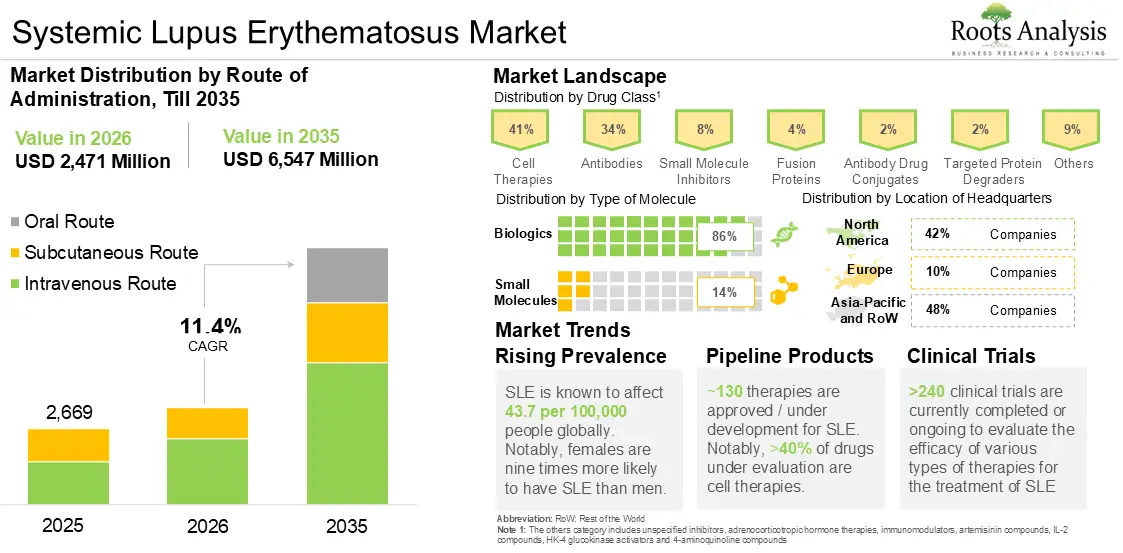
The global systemic lupus erythematosus market size, valued at USD 2,669 million in 2025, is projected to reach USD 2,471 million in 2026 and USD 6,547 million by 2035, representing a CAGR of 11.4% during the forecast period 2026 to 2035.
See What’s in the Full Report – Request Your Complimentary Insights!
Market Report: Key Takeaways
Market Size & Trends
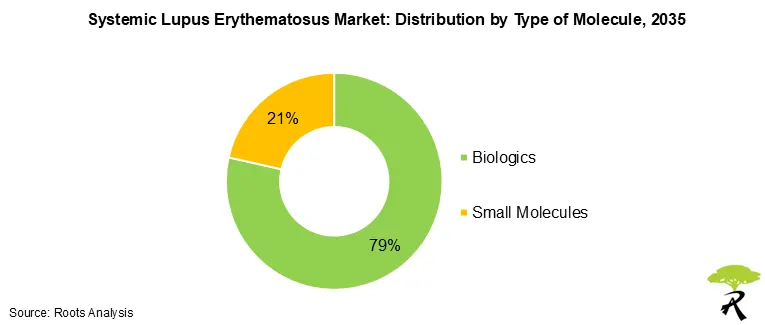
- In terms of type of molecule, biologics are anticipated to hold the highest share (nearly 80%) of the future market.
- With respect to drug class, monoclonal antibodies dominate (nearly 95%) the current market.
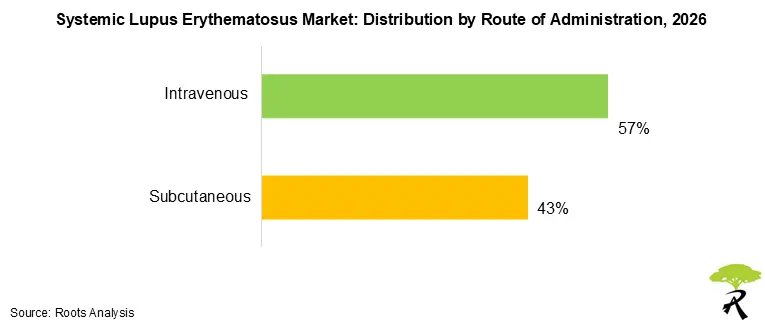
- Based on the route of administration, intravenous route captures the largest share (close to 70%) of the current market; this trend is unlikely to change in the future.
- Amongst the types of therapy, combination therapies capture the most (nearly 95%) of the current market.
- In terms of geographical regions, North America currently holds the highest market share (above 80%).
Key Market Statistics
- Market Size in 2026: $2,471 Million
- Estimated Market Size in 2035: $6,547 Million
- CAGR (2026-2035): 11.4%
- North America: Largest market in 2026
- Europe: Fastest growing region
Unlock Deeper Insights – Schedule Your Personalized Workshop Today!
Market Introduction
Lupus is a chronic inflammatory autoimmune disease having a broad range of clinical presentations, affecting multiple organ systems. The Lupus Foundation estimates that approximately 1.5 million Americans and at least 5 million people globally have some form of lupus. There are primarily four types of lupus, namely neonatal, discoid, drug-induced and systemic lupus erythematosus.
Systemic Lupus Erythematosus (SLE) is a chronic rheumatic illness characterized by multiorgan involvement, wherein immune system of the body mistakenly attacks healthy tissues, affecting skin, joints, kidneys, brain and other organs. Notably, the cause of SLE is not clearly known; it can occur due to multiple factors, such as genetic, environmental, hormonal or certain medications. Moreover, the disease can affect any age group, however, the onset usually occurs at the age of 15-44. The disease has strong female predilection in adults, with women having 9-13 times more chances of having SLE than men. However, this ratio reverses in case of children, wherein males have two to three times more probability of having SLE as compared to females. In fact, as per studies, the estimated prevalence of systemic lupus erythematosus is 43.7 per 100,000 people, affecting roughly 3.6 million worldwide.
To address the heterogeneity of the disease mentioned above, several promising advancements are underway for the diagnosis and treatment of systemic lupus erythematosus. Currently, only three drugs have been approved for SLE, namely Benlysta (GlaxoSmithKline), Saphnelo (AstraZeneca) and Ta’ai (RemeGen), till date that can be used in conjunction with standard of care treatments. Further, several firms and researchers are investigating the potential of targeted biologics to effectively manage and treat myriads of disease manifestations. Given the continuous research and development activity, ongoing pace of innovation and advancements in diagnostic tools, the systemic lupus erythematosus market is likely to witness significant growth during the forecast period.
Market Segmentation
Based on the research, we have segmented the systemic lupus erythematosus (SLE) market into type of molecule, drug class, route of administration, type of therapy and geographical regions.
By Type of Molecule
- Biologics
- Small Molecules
By Drug Class
- Monoclonal Antibodies
- Fusion Proteins
- Inhibitors
- Immunomodulators
By Route of Administration
- Intravenous
- Subcutaneous
- Oral
By Type of Therapy
- Monotherapies
- Combination Therapies
By Geographical Regions
- North America
- US
- Canada
- Europe
- UK
- Germany
- France
- Italy
- Spain
- Rest of Europe
- Asia-Pacific
- China
- Japan
- South Korea
- Australia
- Middle East and North Africa
- Saudi Arabia
- UAE
- Latin America
- Brazil
- Argentina
Want Information on Specific Region / Segment?
Systemic Lupus Erythematosus Market Key Insights
What are the Key Drivers for Systemic Lupus Erythematosus Market Growth?
- Rapid Adoption of Targeted Biologics: The conventional SLE treatments, such as corticosteroids, antimalarials and immunosuppressants pose significant side effects in long-term use. This has resulted in shift towards targeted therapies, such as monoclonal antibodies, B-cell inhibitors and cell therapies. For instance, monoclonal antibodies, such as Benlysta and Saphnelo generated sales worth USD 2.7 billion. The transition towards these highly potent biological interventions results in enhanced efficacy, steroid sparing benefits and positive patient outcomes for managing various clinical manifestations, thus positively shaping the landscape of systemic lupus erythematosus market.
- Approval of User-Friendly Subcutaneous Formulations: In December 2025, Saphnelo received approval in the EU for subcutaneous self-administration as a new pre-filled pen for adult patients suffering from systemic lupus erythematosus. Moreover, the subcutaneous administration of the drug has shown significant reduction in disease activity compared to placebo in participants with active, autoantibody-positive SLE while receiving standard of care therapies.
- Anticipated Approval of Late-Stage Drugs: It is worth noting that several drugs are being tested in late-stage clinical trials for the treatment of systemic lupus erythematosus. Notable examples include Deucravacitinib (developed by Bristol Myers Squibb), Litifilimab (developed by Biogen) and Upadacitinib (developed by AbbVie). These drugs possess novel mechanisms that are anticipated to overcome high placebo response rates serving as more targeted, safer and steroid sparing alternatives.
- Strategic Partnership and Investment Activity: Given the complex nature of SLE therapy development, several pharma companies / research institutions are forging alliances among themselves. These collaborations / investments are aiding in accelerating innovation, expanding clinical trials and broadening geographical reach in the systemic lupus erythematosus market. One such example includes Royalty Pharma’s USD 250 million R&D fund for Biogen’s monoclonal antibody program, litifilimab.
What are the Main Challenges for Market Growth?
- Complex Diagnosis and Delayed Treatment: The difficulties in SLE diagnosis and delays in treatment hinder market growth, allowing irreversible organ damage and reducing overall patient pool entering the treatment funnel. According to the Lupus Foundation of America, SLE’s broad range of non-specific symptoms, often mimicking other disorders causes an average delay of nearly seven years to correctly identify the condition. Moreover, low public awareness leads to disease diagnosis in advanced stages.
- Low Success Rate of Clinical Modalities: SLE drug development has one of the highest failure rates amongst autoimmune disorders with numerous promising candidates failing in late-stage clinical trials despite early success, hindering the entry of startups in systemic lupus erythematosus industry. Such examples include rituximab, abatacept, epratuzumab and others that showed efficacy in Phase II but failed Phase III trials. This is due to disease heterogeneity, endpoint challenges and trial design issues discouraging drug development in the SLE space.
Recent Developments in Systemic Lupus Erythematosus Market
- In April 2026, Genentech announced that the U.S. Food and Drug Administration has accepted its supplemental Biologics License Application (sBLA) for Gazyva for the treatment of systemic lupus erythematosus (SLE).
- In March 2026, Johnson & Johnson announced that nipocalimab has received fast track designation from the USFDA, as a potential treatment for adults with systemic lupus erythematosus, a debilitating autoantibody-driven condition affecting an estimated 3-5 million people globally.
- In April 2025, Pfizer collaborated with Flagship Pioneering in order to discover potential selective inhibitors for autoimmune diseases, including lupus, diabetes, rheumatoid arthritis and multiple sclerosis.
Industry Experts on Systemic Lupus Erythematosus Market
Owing to the rising disease prevalence and lack of selective treatment approaches, several researchers and industry stakeholders are prioritizing the development of different types of targeted systemic lupus erythematosus drugs.
Rob Lenz (Senior Vice President, Global Development at Amgen), stated that, “Systemic Lupus Erythematosus is an area with significant need for new therapies for those living with the condition, but one that has been challenging to address given the complexity of this autoimmune disease.”
Market Share Insights
Which Type of Molecule Accounts for the Largest Share in the Systemic Lupus Erythematosus Market?
- Currently, only biologics have been approved for systemic lupus erythematosus, since these molecules can target the underlying biological pathways associated with systemic lupus erythematosus. Notably, over 40% of the therapies approved / being evaluated for SLE are cell therapies being investigated in phase I / Phase II clinical trials.
- The small molecules segment is likely to grow at a higher CAGR (33.3%) during the forecast period. This is due to their ease of administration, lower production costs, accessibility and established drug profiles of these molecules.
Regional Analysis: Which Regions are Showing the Fastest Growth in Systemic Lupus Erythematosus Market?
North America: Dominating the Market by Securing Highest Share
According to our projections, North America is likely to capture over 80% of the systemic lupus erythematosus market share in 2026. This is due to high disease prevalence, rapid adoption of targeted biologics and availability of reimbursement policies in the region. Further, we anticipate that Europe would grow at a relatively faster pace (20.8%) till 2035, driven by anticipated drug approvals in the region.
Which Drug Class Accounts for the Largest Systemic Lupus Erythematosus Market Share?
- In 2026, the monoclonal antibodies segment occupies majority (~95%) share. This dominance is primarily due to the label expansions of two approved drugs, namely Benlysta and Saphnelo which improve disease activity, reduce organ damage and lowers the need for steroid doses.
- It is worth highlighting that the market share for inhibitors is likely to grow at a relatively higher CAGR, during the forecast period. This is likely due to the anticipated approval of oral small molecule inhibitors, such as Cenerimod, Deucravacitinib and Upadacitinib for the treatment of systemic lupus erythematosus.
Which Route of Administration Accounts for the Largest Share of Market?
- In 2026, therapies delivered intravenously capture the largest market share (close to 70%) as most of the currently approved drugs and approvals anticipated in near term can be administered through intravenous route.
- The therapies administered through oral route are likely to grow at a higher CAGR (47.3%) during the forecast period. This is a result of their non-invasive nature, convenience of drug administration and increased patient compliance as compared to other routes.
Amongst Monotherapy and Combination Therapy, Which Segment Holds the Highest Share in the SLE Market?
- In 2035, the combination therapies segment is likely to occupy a higher systemic lupus erythematosus market forecast size (with >55% share).
- It is worth noting that the market share of monotherapies is likely to grow at a relatively higher growth rate. This is because they do not require integration of standard of care treatments and most of such treatments are cell therapies that are single intravenous infusions.
Get an Instant Quote in 10 Minutes. Lowest Price Guaranteed
Scope of Systemic Lupus Erythematosus Market Report
| Key Report Attribute | Details | |
| Historical Trend | Since 2023 | |
| Forecast Period | Till 2035 | |
| Market Size 2026 | $ 2,471 Million | |
| Market Size 2035 | $ 6,547 Million | |
| CAGR (Till 2035) | 11.4% | |
| Segments Covered |
|
|
| Key Players |
|
|
| PowerPoint Presentation (Complimentary) |
Available | |
| Customization Scope | 15% Free Customization | |
| Excel Data Packs (Complimentary) |
Available | |


