Medical Adhesives Market Size and Overview
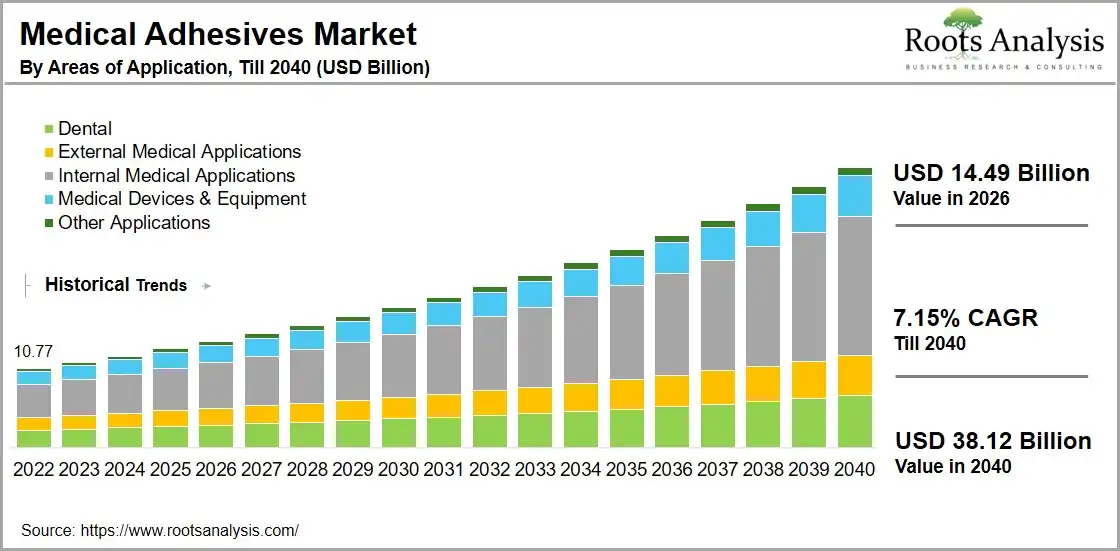
The global medical adhesives market is projected to rise from USD 14.49 billion in 2026 to USD 38.12 billion by 2040, representing a CAGR of 7.15% during the forecast period.
To learn more about this report, request a free sample copy
The research study includes industry analysis, key trends, patent insights, Porter’s Five Forces, SWOT, and value chain analysis.
Medical adhesives are specialized substances used to bond biological tissues and securely attach medical devices to the body. These adhesives, which can be natural or synthetic, play a pivotal role in modern healthcare by providing safe, biocompatible, and reliable bonding solutions.
Their applications are diverse, ranging from wound closure and surgical procedures to the attachment of medical devices, such as bandages, electrodes, patches, ostomy supplies, and wearable health monitors.
Several factors are significantly contributing to the growth of the global medical adhesives industry. The increasing adoption of minimally invasive surgeries, rising demand for advanced wound care, and the proliferation of wearable medical technology are key drivers.
Additionally, growing healthcare awareness, an aging global population, and continuous advancements in adhesive formulations, such as the development of skin-friendly and bio-based medical adhesives, are further propelling market expansion. These trends underscore the critical role medical adhesives play in enhancing patient outcomes and supporting innovation in healthcare delivery.
Medical Adhesives Market Share Insights
The medical adhesives market report 2026 presents an in-depth analysis of the various companies that are involved in offering medical adhesives solutions, across different segments, as defined in the table below:
Medical Adhesives Market: Report Attributes / Market Segmentations
| Key Report Attributes |
Details |
| Historical Trend |
Since 2022 |
| Forecast Period |
Till 2040 |
| Market Size 2026 |
USD 14.49 Billion |
| Market Size 2040 |
USD 38.12 Billion |
| CAGR till 2040 |
7.15% |
| Type of Resin |
- Natural
- Semi Synthetic & Synthetic
|
| Type of Technology |
- Solvent based
- Solids and Hot Melts
- Water based
|
| Areas of Application |
- Dental
- External Medical Applications
- Internal Medical Applications
- Medical Devices & Equipment
- Other Applications
|
| Type of Enterprise |
- Large Enterprises
- Small and Medium Enterprises
|
| Geographical Regions |
- North America
- US
- Canada
- Mexico
- Other North American countries
- Europe
- Austria
- Belgium
- Denmark
- France
- Germany
- Ireland
- Italy
- Netherlands
- Norway
- Russia
- Spain
- Sweden
- Switzerland
- UK
- Other European countries
- Asia
- China
- India
- Japan
- Singapore
- South Korea
- Other Asian countries
- Latin America
- Brazil
- Chile
- Colombia
- Venezuela
- Other Latin American countries
- Middle East and North Africa
- Egypt
- Iran
- Iraq
- Israel
- Kuwait
- Saudi Arabia
- UAE
- Other MENA countries
- Rest of the World
- Australia
- New Zealand
- Other countries
|
| Leading Market Players |
- 3M
- Adhezion Biomedical
- Arkema
- Ashland
- Avery Dennison
- B Braun Melsungen
- B Fuller
- Baxter International
- Biocoral
- Bostik
- Boyd
- Chemence
- Cohera Medical
- Covidien
- Cryolife
- Cyberbond
- Dow
- Dymax
- Ethicon
- G A Lindberg
- Gem Srl
- Glue Dots
- Glustitch
- HB Fuller
- Henkel
- Itac
- Johnson & Johnson
- Masterbond
- Meyer-Haake
- Panacol-Elosol
- Permabond
- Scapa
|
PowerPoint Presentation
(Complimentary) |
Available |
| Customization Scope |
15% Free Customization |
Excel Data Packs
(Complimentary) |
- Competitive Landscape
- Company Competitive Analysis
- Patent Analysis
- Funding Analysis
- Recent Developments
- Market Forecast and Opportunity Analysis
|
Medical Adhesives Market Segmentation
Which Type of Resin Will Dominate the Medical Adhesives Market?
The synthetic resins segment, particularly acrylics, is set to take the lead, holding a significant share of 87.21% of the market by 2040.
Acrylic adhesives hold the largest market share due to their exceptional bonding properties, versatility, and widespread use in both internal and external medical applications, including dental adhesives and medical device assembly.
However, the natural resin segment is expected to grow at a strong CAGR of around 8.4% during the forecast period.
How is the Water-based Segment Dominating Type of Technology?
Among the types of technology, the water-based segment really stands out as the leading segment holding a market share of 54%.
This dominance is driven by their biocompatibility, lower toxicity, and increasing regulatory preference for safer, environmentally friendly solutions. Water-based adhesives are widely used in medical device assembly, wound care, and other healthcare applications due to their safety profile and versatility.
On the other hand, hot-melt adhesives segment is likely to witness the fastest CAGR (8.34%) during the forecasted period.
Which Area of Application will have the Fastest CAGR?
The internal medical applications segment is set to witness the fastest CAGR (8.75%) during the forecasted period. It is worth highlighting that this segment will also have a significant market share of 56%.
This rapid growth of internal medical adhesives is attributed to the increasing use of surgical adhesives, tissue regeneration, and wound closure, where they offer advantages over traditional methods like sutures and staples, such as reduced infection risk and faster operating times.
Which Regions are Expected to See the Highest Demand for Medical Adhesives?
According to our regional analysis of the medical adhesives industry, the Asian region exhibits dominance by capturing 49.86% of the overall current market share. This dominance is driven by robust demand for medical products that will drive the regional market. Rapid industrialization has raised consumer expenditure in the region, resulting in more people affording medical and healthcare facilities. Moreover, rising advancements in the medical and healthcare adhesives market in the region have promoted medical tourism in emerging economies, including China and India.
Medical Adhesives Market Trends and Key Insights
Medical Adhesives Market Drivers and Trends
What are the Key Drivers of Growth in the Medical Adhesives Market?
The medical adhesives market is experiencing robust growth due to several key drivers. Here are some significant factors contributing to this expansion:
- Rising Surgical Procedures: Increasing surgical volumes, especially minimally invasive surgeries, drive demand for advanced wound closure adhesives, tissue bonding adhesives, and internal applications.
- Technological Advancements: Development of biocompatible, antimicrobial, and waterproof adhesives enhances healing, reduces scarring, and expands use in complex procedures.
- Growth in Medical Devices: Expanding use of adhesives in assembling and bonding medical devices, catheters, biosensors, and wearable health devices.
- Chronic Disease Prevalence: Higher incidence of chronic wounds (e.g., diabetic ulcers, pressure sores) increases demand for skin-friendly and long-lasting adhesives.
- Healthcare Infrastructure Expansion: Rising healthcare spending, especially in Asia-Pacific, and favorable government policies boost medical adhesives market growth in emerging economies.
- Shift from Traditional Methods: Adhesives increasingly replace sutures and staples due to benefits like faster application, reduced infection risk, and improved patient comfort.
- Demand for Bio-based Adhesives: Growing preference for eco-friendly and bio-based formulations to meet regulatory and sustainability goals.
What are the Drivers for Medical Adhesives Demand in Minimally Invasive Surgeries?
- Smaller Incisions and Less Tissue Trauma: Minimally invasive surgeries use tiny incisions, requiring adhesives that can bond tissues quickly and securely without large wounds.
- Faster Recovery and Reduced Pain: Minimally invasive surgery adhesives help seal wounds effectively, contributing to quicker healing, less postoperative pain, and shorter hospital stays.
- Lower Risk of Infection: Smaller wounds sealed with medical adhesives reduce infection risks compared to traditional sutures or staples.
- Improved Cosmetic Outcomes: Adhesives minimize scarring and provide better aesthetic results, which is important for patient satisfaction.
What is the Impact of Biocompatible Adhesives on Surgical Outcomes?
Biocompatible adhesives positively impact surgical outcomes by enabling rapid and effective wound closure, reducing operative time, and minimizing blood loss and postoperative complications. Their ability to form strong, seamless bonds with living tissue supports faster healing and lowers infection risk, while also decreasing the need for sutures and drains.
What is the Role of Medical Adhesives in Medical Device Assembly?
Medical adhesives play a critical role in medical device assembly by securely bonding a wide variety of substrates such as plastics, metals, and elastomers, ensuring device integrity and performance. Medical device bonding adhesives enable rapid, reliable, and automated assembly processes for products like catheters, syringes, and electronic medical devices, while meeting stringent biocompatibility and sterilization standards. Adhesives also help distribute stress evenly across joints, fill irregular gaps, and support miniaturization and complex device designs.
What are the Key Strategies Used by Companies to Gain Medical Adhesives Market Share?
Medical adhesives companies are using smart strategies to stay ahead. Big players are focusing on medical adhesives market opportunities in emerging economies, partnerships, acquisitions, joint ventures, and innovations to strengthen their position in the medical adhesives competitive landscape 2026 while also investing in R&D to bring innovative and novel products to the market.
For instance, in October 2024, Solventum released a new double-coated silicone tape for sensitive skin wearables. In reference to this, Chad Reed, director of Medical Technologies OEM, Solventum, commented that adhesive solutions for patients with sensitive skin meet essential healthcare needs. The 2487 Hi-Tack Silicone Tape is safe for patients of all ages, including pediatric, and those with chronic conditions that compromise skin integrity.
What are the Advancements in Antimicrobial and Waterproof Medical Adhesives?
Recent advancements in antimicrobial adhesives include the integration of nanomaterials, such as silver nanoparticles, ZnO quantum dots, and PL-CDs, which provide efficient, broad-spectrum antibacterial properties while maintaining biocompatibility and physical strength.
What is the Comparison of Synthetic VS Natural Medical Adhesives?
Synthetic medical adhesives offer superior strength, durability, and versatility, making them ideal for external applications, medical device assembly, and situations requiring long-term performance. Natural adhesives are more biocompatible and biodegradable, making them suitable for sensitive and internal applications, but they generally have lower mechanical strength and durability, and may pose allergy risks
Medical Adhesives Market Challenges
What are the Key Challenges for Medical Adhesives Manufacturers?
The medical adhesives market faces several major restraints and challenges that could hinder its growth despite strong demand and expanding applications. Key market restraints include:
- Regulatory Compliance: Strict government regulations regarding safety, biocompatibility, and environmental impact can slow product approvals and market entry.
- High Cost of Advanced Materials: Bio-based and specialty adhesives can be expensive, limiting adoption in cost-sensitive markets.
- Supply Chain Disruptions: Events like the COVID-19 pandemic have highlighted vulnerabilities in raw material supply and manufacturing continuity.
- Product Performance Limitations: Achieving the right balance of adhesion strength, flexibility, and biocompatibility for diverse applications remains technically challenging.
- Competition from Alternatives: Traditional closure methods (sutures, staples) and alternative adhesives still compete in some applications, especially where cost is a concern.
- Awareness and Training: Adoption of new adhesive technologies requires training for healthcare professionals and awareness of best practices.
Recent Developments in the Medical Adhesives Market
- In January 2026, Henkel signed a definitive agreement to acquire ATP Adhesive Systems, a specialist in high-performance water-based specialty tapes. This acquisition expands Henkel’s Adhesive Technologies portfolio into sustainable, water-based bonding solutions for the medical and automotive sectors.
- In January 2026, The FDA granted greenlight for RevBio’s pivotal clinical trial investigating its cranial flap bone glue. This follows previous successful clinical milestones for the company’s regenerative bone adhesive technology.
- In October 2025, RevBio was awarded a USD 2.2 million Phase II grant from the National Institutes of Health (NIH). The funding is designated for the further development of the minimally invasive use of TETRANITE®, a regenerative bone adhesive, to treat complex spine fractures.
Frequently Asked Questions
What are medical adhesives?
Medical adhesives are specialized substances designed to bond or join biological tissues and to attach medical devices securely to the body.What is the projected size of the global medical adhesives market?
Currently, the medical adhesives market size and forecast are estimated to be worth USD 14.49 billion in 2026.What is the expected growth rate of the medical adhesives market?
The market is forecasted to grow at a compound annual growth rate (CAGR) of 7.15% during the forecasted period. Which key players dominate the medical adhesives market globally?
3M, Adhezion Biomedical, Arkema, Ashland, Avery Dennison, B Braun Melsungen, B Fuller, Baxter International, Biocoral, Bostik, Boyd, Chemence, Cohera Medical, Covidien, Cryolife, Cyberbond, Dow, Dymax, Ethicon, G A Lindberg, Gem Srl, Glue Dots, Glustitch, HB Fuller, Henkel, Itac, Johnson & Johnson, Masterbond, Meyer-Haake, Panacol-Elosol, Permabond, Scapa.Which applications drive the demand for medical adhesives?
Dental, external medical adhesives applications, internal medical applications, medical devices & equipment, are driving the demand.What are the main types of medical adhesives used in healthcare?
The main types are acrylic, silicone, polyurethane, and epoxy-based adhesives, with acrylic and silicone being the most widely used due to their versatility and biocompatibility.How do medical adhesives benefit wound closure and surgical procedures?
Medical adhesives enable strong tissue bonding, reduce scarring, enhance healing, and offer a less invasive alternative to traditional sutures and staples.Which regions are expected to see the fastest growth in the medical adhesives market?
Asia-Pacific is expected to see the fastest growth, driven by its large population, rising healthcare spending, and increasing adoption of advanced medical technologies.How is the rise of minimally invasive surgeries impacting the market?
The growing use of minimally invasive surgeries is a major driver, as these procedures require advanced adhesives for tissue sealing and wound closure, leading to increased demand.How do regulatory requirements affect the medical adhesives industry?
Stringent regulations ensure product safety and efficacy, often resulting in longer approval times and higher R&D costs for manufacturers.What innovations are shaping the future of medical adhesives?
Bio-based and skin-friendly adhesives, smart adhesives for drug delivery and monitoring, and adhesives designed for use in minimally invasive and single-use medical devices.