


 Download Free Sample
 Buy Now
Market Size
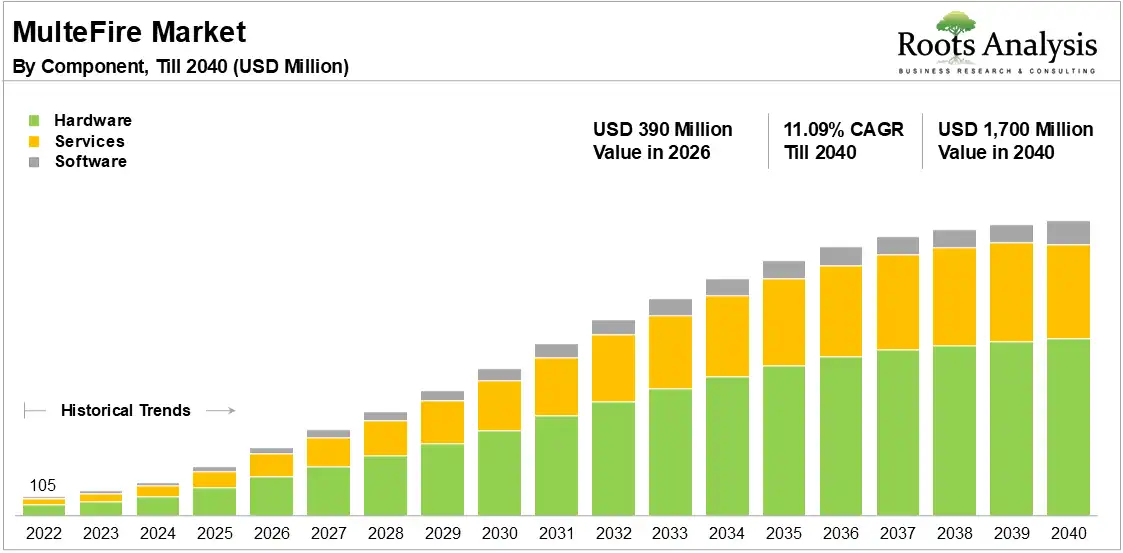
The MulteFire market is projected to reach USD 390 million in 2026 and USD 1,700 million by 2040, representing a compounded annual growth rate (CAGR) of 11.09% during the forecast period 2026 to 2040.
See What’s in the Full Report – Request Your Complimentary Insights!
Market Overview
The MulteFire market comprises wireless communication solutions based on the MulteFire alliance (MFA) specification, which allows LTE technology to function entirely within unlicensed spectrum bands, including the global 5 GHz range. These solutions enable enterprise customers and specialized service providers to deploy high-performance private networks with simplified infrastructure. By providing secure, consistent connectivity where licensed spectrum is unavailable, MulteFire delivers significant value to industrial environments and enterprise campuses requiring seamless mobility and extensive coverage.
MulteFire market outlook is primarily fueled by the growing demand for robust industrial internet of things (IIoT) connectivity that outperforms conventional Wi-Fi in reliability and quality of service (QoS), supporting mission critical applications (such as manufacturing automation, logistics, and smart port operations) through private, and high-performance wireless networks.
Innovation trends now emphasize integrating MulteFire within converged architectures alongside 5G Non-Public Networks (NPNs) rather than relying on standalone deployments. The market trajectory is currently being influenced by the rise of Wi-Fi 6E/7 and shared spectrum options like CBRS, which compete for enterprise private network dominance. Consequently, large industrial operators are strategically planning hybrid architectures that leverage MulteFire’s unlicensed capabilities alongside new 5G NPN investments for enhanced redundancy and mobility, ensuring continued relevance in specialized industrial niches.
Market Report: Key Takeaways
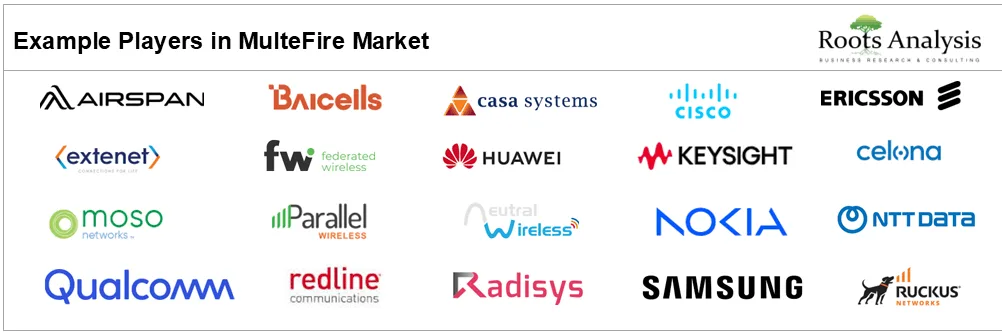
- Leading Players Competitive Footprint: MulteFire manufacturers like Airspan, Baicells, Casa Systems, CELONA, Cisco, Ericsson, ExteNet, Federated Wireless, Huawei, Keysight, Moso Networks, Neutral Wireless, Nokia, NTT DATA, Parallel Wireless, Qualcomm, Radisys, Redline Communications, RUCKUS Networks, Samsung hold strong market positions with extensive geographic presence in various regions.
- Startups are responding to rising demand for private wireless connectivity through MulteFire, enabling scalable deployment of secure, low-latency networks for industrial IoT. Early adoption is concentrated in manufacturing, logistics, campuses, and smart infrastructure where reliable, high-performance connectivity is critical for mission-critical and high-device-density environments.
- Regional Penetration and Adoption Trend: Rapid industrialization, increasing infrastructure investments, and the expansion of smart manufacturing are driving MulteFire adoption in Asia Pacific. In Europe, pilot private network deployments in countries such as the Netherlands and France are supporting regional growth, backed by EU digitalization initiatives and strong R&D in industrial IoT, automation, and secure enterprise connectivity.
- Industrial IoT and Manufacturing holds Highest Market Segment: Amongst the MulteFire applications, industrial IoT and manufacturing holds the maximum market share of 35.50% in 2026. Market growth is driven by the technology's ability to deliver LTE/5G-grade performance within unlicensed spectrum, effectively bypassing the complexities and costs associated with mobile network operators.
- Opportunities in the MulteFire Market include growth across digital manufacturing & logistics, traffic offloading in dense venues, private network models and expanding connectivity solutions for underserved and emerging regions.
- Funding and Investment Momentum: The MulteFire market is witnessing growing momentum driven by investments in private wireless infrastructure, industrial IoT connectivity, and shared spectrum technologies. Venture capital, strategic telecom players, and government-backed digitalization programs support scalable deployments, pilot networks, and ecosystem development aimed at delivering secure, cost-efficient, and high-performance enterprise connectivity solutions.
Pay Only for What You Need – The Best Way to Optimize
Recent Industry Developments
- January 2026: Nokia expanded its industrial portfolio with a new range of fieldrouters (FRRO505) featuring MX Boost capabilities. This innovation integrates MulteFire with Wi-Fi to provide deterministic, ultra-reliable private wireless connectivity for high-density logistics and mining environments.
- October 2025: Ericsson and e& signed a strategic Memorandum of Understanding (MoU) during GITEX Global to drive digital transformation. The collaboration focuses on deploying Ericsson Private 5G (EP5G) solutions, bridging the gap between legacy unlicensed systems and next-generation private networks.
- May 2025: Qualcomm accelerated the adoption of MulteFire-enabled small cells through its Dragonwing RAN platforms. This initiative targets neutral host providers and enterprises, streamlining the deployment of cellular-grade connectivity in unlicensed 5GHz spectrum for global industrial hubs.
- January 2025: The MFA (MulteFire Alliance) initiated a critical workgroup to establish Uni5G Technology Blueprints. These standards focus on the coexistence of MulteFire with Next-Gen Wi-Fi and 5G NR-U, ensuring seamless resource management and mobility in shared spectrum ecosystems.
Market Dynamics
MulteFire Market Drivers
- Acceleration of Enterprise Digitalization and IIoT Integration: Industrial IoT connectivity market growth is driven by Industry 4.0 adoption (including automation, robotics, and large-scale M2M communication) requiring secure, low-latency, and deterministic networks. MulteFire addresses Wi-Fi limitations by providing reliable performance and mobility, ensuring stable IIoT operations where connectivity disruptions can cause costly downtime and productivity losses.
- Democratization of Private LTE Through Spectrum Accessibility: MulteFire facilitates the deployment of high-performance private cellular networks by bypassing the capital-intensive requirement for licensed spectrum acquisition. This framework effectively lowers structural barriers for non-telecom entities (such as industrial manufacturers, logistics hubs, and healthcare providers) allowing them to implement dedicated, sovereign connectivity tailored to internal operational requirements without traditional regulatory overhead.
- Superior Mobility and High-Performance Connectivity Over Wide Areas: MulteFire delivers stronger link budgets, higher throughput, and lower latency than Wi-Fi, making it ideal for expansive industrial environments. It supports autonomous vehicles, and mobile workforces with seamless handovers, ensuring uninterrupted connectivity across campuses and warehouses where persistent, high-speed, and reliable data transmission is essential.
Market Restraints
- Device Ecosystem Immaturity and Premium Hardware Costs: The MulteFire ecosystem for compatible hardware remains narrow compared to the massive, commodity-scale Wi-Fi market. Standard consumer electronics lack native MulteFire support, necessitating the use of specialized modules or dedicated end user equipment. This limited scale increases per-unit hardware costs and complicates deployment strategies, particularly for enterprises managing bring your own device (BYOD) environments.
- Technological Fragmentation and Competition from Alternative Standards: Enterprises face a complex decision-making landscape due to the emergence of competing connectivity standards. MulteFire faces significant pressure from the citizens broadband radio service (CBRS) in the North American market, which offers a structured shared-licensed model, as well as the rapid evolution of Wi-Fi 6 and Wi-Fi 7, which continue to close the gap on latency and throughput performance.
- Regulatory Divergence and Jurisdictional Constraints: The global commercialization of MulteFire is challenged by fragmented regulatory frameworks regarding unlicensed cellular operations. Varied regional requirements for spectrum sharing and technical compliance force vendors to adapt products to specific markets, increasing the complexity of R&D and slowing the adoption of unified, and multi-regional connectivity solutions.
Get an Instant Quote in 10 Minutes. Lowest Price Guaranteed
Market Share Insights
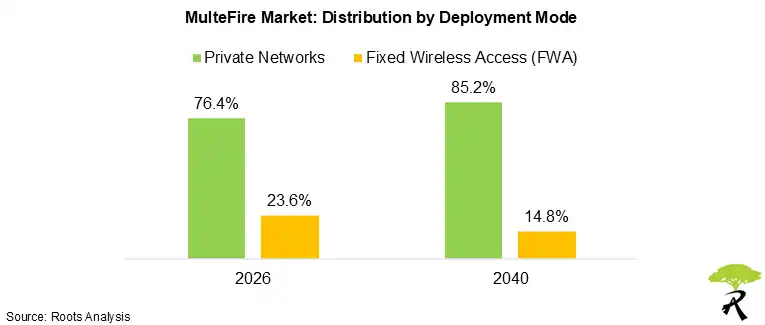
Market Share by Deployment Mode: Private Networks Hold the Largest Market Share
- According to our 2026 MulteFire market analysis, Private Networks hold a commanding 76.4% market share. This dominance is fueled by a surging industrial demand for "plug-and-play" simplicity combined with the deterministic reliability and security inherent in LTE/5G-grade protocols.
- The latest MulteFire market forecast indicates that private deployments are the primary growth engine because they operate entirely in unlicensed spectrum (5 GHz and 3.5 GHz CBRS). This allows enterprises to bypass the significant financial and regulatory hurdles of acquiring licensed spectrum, accelerating time-to-market for digital transformation projects.
- The private network segment remains the fastest-evolving vertical, characterized by a robust double-digit CAGR. This momentum is sustained by the decreasing cost of MulteFire-certified small cells and the maturation of ecosystems for Autonomous Mobile Robots (AMRs) and Automated Guided Vehicles (AGVs), applications where Wi-Fi often falls short of mission-critical requirements.
Market Share by Geographical Regions: North America to Dominate the Industry while Asia Pacific Growing Rapidly Through 2040
- North America: Regional analysis indicates that North America currently holds the largest market share at 36.4%. This dominance is rooted in the maturity of the Citizens Broadband Radio Service (CBRS) framework, particularly the General Authorized Access (GAA) tier. The region’s early-mover advantage is further solidified by extensive pilot deployments across maritime ports, defense logistics, and large-scale warehouse automation.
- The Asia-Pacific MulteFire market is projected to be the fastest-growing geographical segment, with a CAGR exceeding 13% through 2026. This explosive growth is fueled by aggressive smart factory expansions and high IoT device density across China and Southeast Asia.
- Growth in the APAC region is underpinned by strategic policy tailwinds that favor cost-efficient unlicensed spectrum models. By prioritizing spectrum democratization over expensive licensed acquisitions, regional regulators are enabling a new wave of industrial stakeholders to deploy cellular-grade connectivity with significantly lower capital expenditure (CAPEX).
Want Information on Specific Region / Segment?
Market Ecosystem Insights
Leading Players Competitive Footprint
The competitive landscape for MulteFire and unlicensed private wireless solutions is characterized by rapid consolidation and a technical pivot toward 5G Advanced. Industry leaders, including Nokia, Ericsson, Qualcomm, Samsung, Cisco, and Huawei, maintain dominant positions by integrating unlicensed spectrum capabilities into their broader 5G RAN portfolios. Emerging specialists such as Celona, Federated Wireless, and Betacom are further disrupting the market with "Network-as-a-Service" (NaaS) models, while recent acquisitions, such as Aviat Networks' integration of Redline Communications, highlight a shift toward unified mission-critical data infrastructure.
Strategic collaborations are currently the primary engine for market scalability:
- Nokia continues to strengthen its regional footprint through a strategic partnership with GlobalConnect, delivering AI-enhanced private 5G solutions across the Nordics. This collaboration leverages high-capacity fiber backhaul to support low-latency unlicensed cellular applications in Denmark and Norway.
- Qualcomm has redefined the hardware standard with the Snapdragon X80 5G Modem-RF System. As a 3GPP Release 18-ready platform, the X80 introduces sophisticated support for 5G NR-U (Unlicensed) and AI-driven spectrum management, significantly boosting the performance and reliability of private networks in dense industrial environments.
- Lumine Group, following its acquisition of Casa Systems’ RAN assets, has emerged as a key player in managing legacy and next-generation cloud-native small cell deployments, ensuring continuity for enterprises transitioning from MulteFire LTE to 5G-ready unlicensed architectures.
Startup Activity and Innovation Hotspots
Startup activity within the unlicensed spectrum ecosystem is accelerating as firms pivot toward cost-efficient, autonomous private wireless solutions. Innovation is currently concentrated in Network-in-a-Box (NIB) architectures, edge-computing integration, and AI-driven spectrum management. These advancements enable rapid, scalable connectivity for industrial automation, smart logistics, and secure enterprise campuses.
- Deployment Excellence: Commercially deployable solutions are increasingly leveraging standardized small cell modules to reduce time-to-market. For instance, Extenet has launched a strategic initiative to deploy Converged Private Wireless networks across major US logistics and transportation hubs. Their approach specializes in the seamless integration of CBRS and unlicensed spectrum to support high-density, mission-critical data transport.
- Specialized Use Cases: Startups are also disrupting niche markets through portable innovation. Neutral Wireless has successfully demonstrated the viability of portable private 5G solutions for live global broadcasts. By utilizing unlicensed spectrum, they provide high-bandwidth, ultra-low-latency connectivity in remote environments where traditional licensed spectrum is inaccessible.
Funding and Investment Momentum
The market has matured into a strategic growth sector, attracting significant capital from venture firms, utility giants, and sovereign wealth funds. Investment has shifted from early-stage pilots to the deployment of enterprise-grade managed networks.
- Strategic Consolidation: In a landmark move to unify global infrastructure, NTT DATA has transitioned to a private ownership model under NTT to accelerate its Edge-to-Cloud managed services. Through a deep-tier alliance with Dell Technologies, the firm is strengthening its ability to deploy full-stack private networks that leverage unlicensed spectrum for global industrial clients.
- Research & Sustainability: Government grants and private R&D investments are increasingly tied to 5G Advanced and sustainability-focused connectivity. Keysight Technologies recently expanded its strategic investment in its Finland R&D facility, focusing on the validation of unlicensed 5G NR-U and integrated sensing technologies. These tools are critical for enterprises seeking to audit and optimize the performance of high-density, shared-spectrum environments.
Would Like to Preview the Actual Report?
MulteFire Market: Scope of the Report
| Key Report Attributes | Details | |
| Historical Trend | Since 2022 | |
| Forecast Period | Till 2040 | |
| Market Size 2026 | $ 390 Million | |
| Market Size 2040 | $ 1,700 Million | |
| CAGR (Till 2040) | 11.09% | |
| Segments Covered |
|
|
Market Segmentation
Based on the research, we have segmented the MulteFire Market into component, deployment mode, application, geographical regions, and key players.
Market Share by Component
- Hardware
- Services
- Software
Market Share by Deployment Mode
- Fixed Wireless Access (FWA)
- Private Networks
Market Share by Application
- Enterprise Connectivity
- Healthcare
- Industrial IoT and Manufacturing
- Public Safety and First Responders
- Residential Fixed Wireless Access (FWA)
- Smart Cities
Market Share by Geographical Regions
- North America
- US
- Canada
- Mexico
- Rest of North America
- Europe
- Austria
- Belgium
- Denmark
- France
- Germany
- Ireland
- Italy
- Netherlands
- Norway
- Russia
- Spain
- Sweden
- Switzerland
- UK
- Rest of Europe
- Asia-Pacific
- Australia
- China
- India
- Japan
- New-Zeeland
- Singapore
- South Korea
- Rest of Asia-Pacific
- Latin America
- Brazil
- Chile
- Colombia
- Venezuela
- Rest of Latin America
- Middle East and Africa (MEA)
- Egypt
- Iran
- Iraq
- Israel
- Kuwait
- Saudi Arabia
- UAE
- Rest of MEA


