


 Download Free Sample
 Buy Now
Market Size
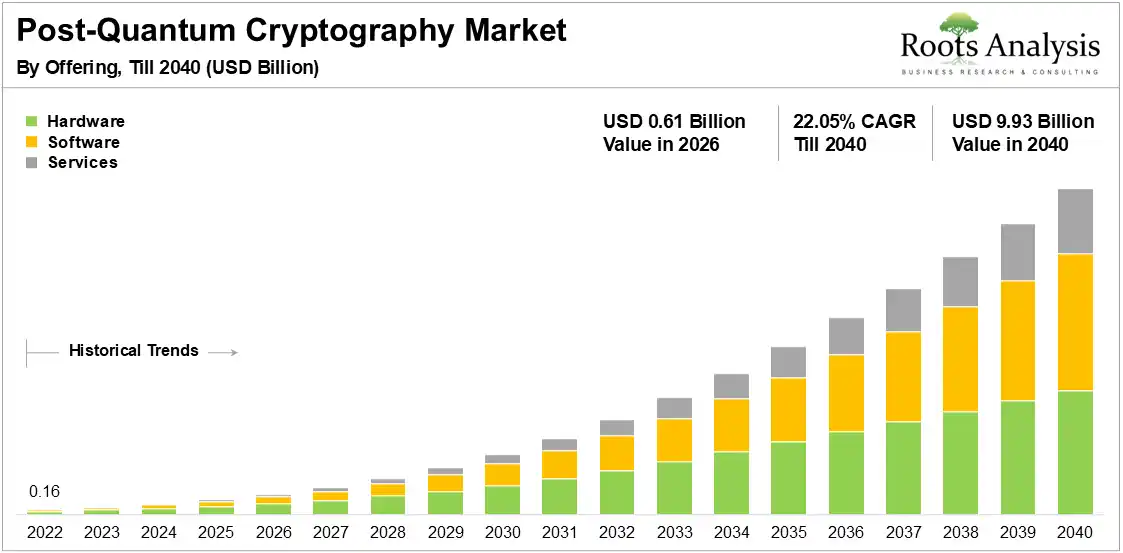
The global post-quantum cryptography market size is projected to grow from USD 0.61 billion in 2026 to USD 9.93 billion by 2040, representing a CAGR of 22.05% during the forecast period 2026 to 2040.
See What’s in the Full Report – Request Your Complimentary Insights!
Market Report: Key Takeaways
- Based on offerings, hardware dominates the market, capturing a 52.0% share in 2026, and services sub-segment is also projected to grow at a leading 26.7% CAGR through 2040 for complex algorithmic migration support.
- In terms of type, lattice-based cryptography adoption commands the industry (50.0%) in 2026 and is poised to simultaneously experience a higher 24.1% CAGR till 2040 by anchoring standardized cryptographic protocols.
- Evaluating deployment mode, on-premises architecture captures a 57.4% share in 2026, whereas cloud experiences faster growth (23.0% CAGR) through 2040 resolving distributed scalability constraints.
- Among applications, network security maintains a 28.0% share in 2026; however, endpoint security projects faster growth at a higher 24.5% CAGR till 2040 driving remote device fortification.
- Based on organization size, large enterprises secure a 75.0% share in 2026. Conversely, small and medium enterprises (SMEs) are projected to grow at a 22.9% CAGR through 2040, expanding foundational supply chain resilience.
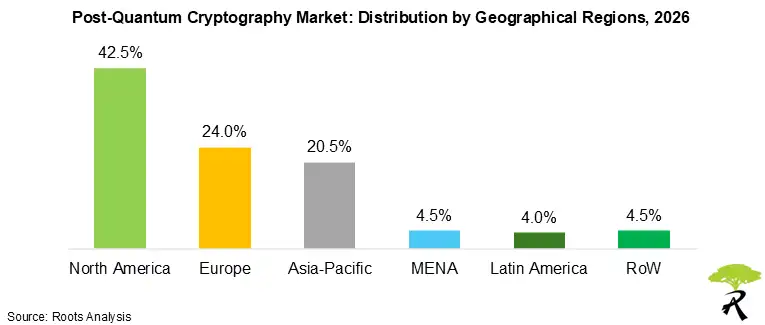
- Post-quantum cryptography regional market outlook indicates dominance of North America, which holds the largest share (42.5%) in 2026. Conversely, Asia-Pacific showcases faster growth at a 24.5% CAGR till 2040 expanding localized digital defense capabilities.
- In terms of end user vertical, BFSI sector secures a 28.0% share in 2026. Conversely, government and defense sectors are projected to grow at a 25.0% CAGR through 2040, driven by systemic macro mega trends in classified digital sovereignty.
Post-Quantum Cryptography Market Outlook
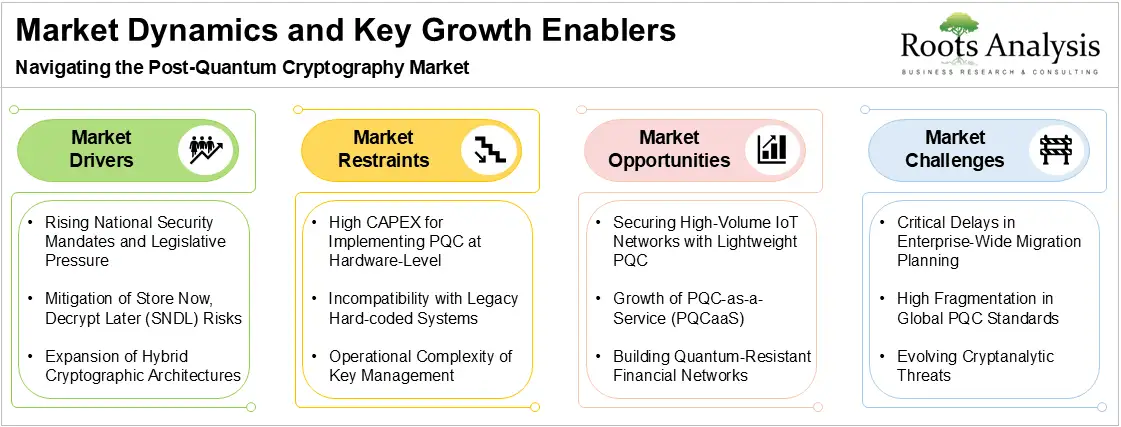
The post-quantum cryptography (PQC) market exhibits a rapid transition from theoretical modeling into an urgent operational deployment phase. Current market dynamics feature a structural realignment toward hybrid quantum cryptography architectures, allowing organizations to overlay quantum-resistant algorithms onto existing enterprise systems. Uncompromising demand strictly favors solutions providing robust cryptographic agility.
Aggressive global regulatory mandates and compressed compliance timelines act as primary growth accelerators. For instance, the European Union directive requiring member states to initiate critical sector transitions by late 2026 dictates immediate procurement cycles. Further, hardware efficiency enables edge-network deployments and is influencing the PQC ecosystem, exemplified by MIT’s microchip innovation (engineered for implantable biomedical devices) in April 2026.
Future projections anticipate an accelerating deployment trajectory as enterprises formally pivot from vulnerability auditing to structured migration. The planned 2027 finalization of supplementary NIST specifications, specifically FN-DSA for compact signatures, unlocks expansive deployments across bandwidth-constrained networks. This long-term growth restructures the global digital trust ecosystem for post-quantum resilience.
Post-Quantum Cryptography Market Growth Drivers, Restraints, Challenges and Opportunities
Pay Only for What You Need – The Best Way to Optimize
Post-Quantum Cryptography Market Size Estimation Methodology
- To define the foundational market scope, we categorized post-quantum cryptography (PQC) into core functional components, including specialized hardware like hardware security modules (HSMs) and quantum-safe chips, software libraries and protocols, and professional migration consulting services. We systematically mapped these elements to address the urgent transition required across highly regulated sectors, such as government, finance, and healthcare, where long-term data sensitivity is paramount.
- We subsequently analyzed the technology adoption cycles and demand-side vulnerabilities, specifically focusing on the escalating threat of harvest now, decrypt later (HNDL) attacks. By evaluating S-curve progressions for the multi-year transition to quantum-resistant architectures and benchmarking historical cryptographic migrations (such as the shift from SHA-1 to SHA-2), we established realistic implementation timelines while accounting for mandatory compliance deadlines like the US Post-Quantum Cryptography Cybersecurity Preparedness Act.
- Following this analysis, we gathered vital supply-side metrics, including anticipated average selling prices (ASPs) for PQC software licenses and premium hardware modules, alongside the production capacities of specialized manufacturers. This intelligence was collected through primary research with Chief Information Security Officers (CISOs) and cryptography experts to validate the pace of organizational crypto-agility, and rigorously cross-validated against secondary sources such as patent filings, academic publications, government R&D budgets, and official NIST standardization timelines.
- Synthesizing these triangulated insights, we calculated the global post-quantum cryptography market size and projected the long-term commercial opportunity. This was achieved through a robust hybrid forecasting methodology that integrated a top-down analysis of broader global cybersecurity spending with a bottom-up assessment of specific PQC pilot projects, ultimately multiplying estimated deployment volumes across prioritized industry verticals by the projected pricing for integrated quantum-safe solutions.
- The total projected market value was then systematically allocated across distinct market segments, distributing revenue by component type, deployment environment, and specific end-use industry. Furthermore, geographic market distribution was determined by weighing regional factors such as digital infrastructure maturity, national security priorities, and the dense concentration of global data centers and financial hubs.
- Finally, in order to assess the sensitivity of our assumptions, we conducted a multivariate sensitivity and scenario analysis (base, optimistic, and conservative) on some of the most important parameters of our forecast methodology, evaluating the potential market impact of variable adoption rates, shifts in global standardization timelines, and the potential acceleration of quantum computer development, often referred to within the industry as “Q-Day” projections.
Post-Quantum Cryptography Market Share Insights
Market Share by Offerings: PQC Hardware to Dominate the Industry in 2026
- Hardware commands the post-quantum cryptography market with a definitive 52.0% share in 2026, sustained by irreplaceable HSMs across banking and defense infrastructure. NIST’s 2025 migration guidance directly accelerates massive enterprise hardware refresh cycles, while the UK NCSC’s staged deployment milestones structurally reinforce deeply long-lived physical roots of trust driving immediate compliance-focused procurement.
- The market growth trajectory is also driven by immediate integration realities across advanced silicon manufacturing. For instance, in April 2026, Microchip Technology officially launched the TS1800 Platform Root of Trust controller, permanently anchoring quantum hardware capabilities, to establish key enterprise hardware roots of trust and bare-metal physical infrastructure component configurations.
By Type: Lattice-Based Quantum-Safe Cryptography Holds Largest Market Share
- Lattice-based cryptography commands a dominant 50.0% market share because robust mathematical structures resist advanced quantum decryption. The formal August 2024 NIST standardization of ML-KEM acts as a decisive regulatory mandate, aggressively accelerating global deployment readiness and compelling regulated enterprises to execute massive, highly efficient infrastructure upgrades without computational performance degradation.
- Further, the direct manufacturing integration across network security environments drive the growth trajectory for lattice-based cryptography. For instance, in April 2026, Cisco integrated lattice-based ML-KEM algorithms into core Secure Firewall platforms, establishing formidable structural defensibility by providing uninterrupted quantum-safe corporate protection directly at the foundational hardware and secure boot layer.
Want Information on Specific Region / Segment?
Post-Quantum Cryptography Regional Market Outlook
North America Captures the Largest Market Share in 2026
- North America commands a dominant 42.5% market share, secured by unparalleled technological infrastructure and proactive sovereign initiatives. Stringent government mandates, specifically the NIST standardization directives, directly accelerate seamless cryptographic integration across defense and cloud sectors, forcing national critical infrastructure networks to execute massive scalable deployment upgrades without any further delay.
- This rapid market growth trajectory is driven by immediate cloud integration realities across complex enterprise networks. For example, in February 2026, Cloudflare officially deployed its advanced post-quantum Secure Web Gateway. This strategic product launch fortifies highly sensitive corporate traffic against imminent data interception vulnerabilities across heavily distributed complex global enterprise architectures.
Asia-Pacific Quantum Commercialization Growth and Superconducting QPU Expansion
- Explosive digital transformation enables the Asia Pacific region to achieve the fastest global growth at a 24.5% CAGR. Further, stringent sovereign directives across Japan and South Korea aggressively fund advanced quantum secure telecommunications, structurally mandating early network pilot programs to seamlessly transition into secure virtualized commercial mobile ecosystems by 2030.
- Regional telecommunication operators directly accelerate this software expansion by breakthroughs in hybrid PQC for 5G / 6G networks. For instance, in February 2026, SK Telecom officially published its comprehensive 6G white paper, embedding resilient post quantum cryptography directly into cloud native radio access networks securing critical regional mobile communications.
PQC Market Share Analysis by End User Vertical
- BFSI commands a dominant 28.0% market share because securing high-value global transactions demands structurally resilient infrastructure. Maturing data privacy catalysts and strict regulatory mandates directly force financial institutions into immediate cryptographic adoption. For instance, in September 2025, JPMorgan Chase successfully launched advanced quantum-safe threshold ML-DSA signatures for public decentralized blockchains.
- PQC market opportunity in government and defense sectors is growing the fastest at 25.0% CAGR. This market growth trajectory is driven by complex integration realities within classified military networks. In November 2025, the US Department of Defense mandated sweeping cryptographic hardware inventories, establishing absolute structural defensibility for vendors capable of protecting bare metal cloud systems against future quantum threats.
Market Ecosystem Analysis
Post-Quantum Cryptography Market Competitive Landscape and Strategic Consolidation
The competitive landscape for post-quantum cryptography exhibits aggressive consolidation as vendors race to secure vulnerable enterprise ecosystems. Hardware integration heavily dominates current strategic pivots, directly forcing software providers into strategic alliances. This massive commercial realignment establishes crypto-agility as the absolute baseline for modern organizational survival. Quantum-resistant cryptography market share is dominated by incumbent players and startups, including Crypto4A Technologies, DigiCert, IBM, Microsoft, Palo Alto Networks, PQShield, Quantinuum, Quantum Dice, QuSecure, SandboxAQ, and SEALSQ.
Post-Quantum Cryptography Market Dominant Enterprises and Hyperscale Infrastructure Scaling
- Top-tier hyperscale providers aggressively dictate the commercial transition toward quantum-resistant architectures. In March 2026, Microsoft embedded post-quantum capabilities directly into the core SymCrypt library for Windows Server deployments, establishing baseline compliance across global IT estates.
- Simultaneously, IBM successfully deployed the IBM Quantum Safe Remediator onto the International Space Station in April 2026, fundamentally proving terrestrial-to-orbit hybrid cryptographic execution.
- Complementing these software-defined architectures, original equipment manufacturers physically anchor cryptographic moats directly into edge endpoints. SEALSQ officially launched the Quantum Shield QS7001 chip in October 2025, embedding NIST-standardized algorithms into bare-metal silicon. Furthermore, Palo Alto Networks deployed post-quantum TLS support across PAN-OS management planes, neutralizing imminent data harvesting vulnerabilities within enterprise firewalls.
Post-Quantum Cryptography Market Agile Startups and Accelerated Investment Ecosystems
- Venture capital injections directly fuel disruptive startups targeting specific cryptographic supply chain vulnerabilities. In April 2025, SandboxAQ closed a USD 150 million Series E funding extension, rapidly scaling proprietary artificial intelligence-driven quantitative platforms for biopharma and finance.
- This software momentum runs parallel to physical infrastructure catalysts, where specialized innovators aggressively capture manufacturing supply chains. PQShield entered the Tech Nation Future Fifty 2026 cohort in March 2026, expanding global intellectual property deployment across automotive sectors. Quantum Dice accelerated the commercialization of self-certifying hardware random number generators following a late 2025 grant.
- Concurrently, QuSecure advanced the QuProtect R3 platform, providing critical infrastructure sectors with frictionless algorithmic remediation without forcing legacy network downtime.
Post-Quantum Cryptography Market Trends
Quantum-Resistant Ecosystem: NIST Standardization and Vulnerability Mitigation
- The profound NIST PQC standardization impact on cybersecurity market growth directly neutralizes imminent Shor’s algorithm cybersecurity risks, accelerating urgent enterprise procurement.
- Enforcing strict FIPS 203, 204, and 205 compliances fundamentally dictates rapid lattice-based cryptography adoption, embedding resilient mathematical defenses across highly vulnerable global governmental information architectures.
- The supplementary integration of code-based and hash-based signatures permanently authenticates critical software supply chains, finalizing a deeply diversified, quantum-resistant institutional data protection posture.
Post-Quantum Infrastructure: Service Delivery and Migration Economics
- Addressing the massive next-gen cryptography market opportunity directly reveals prohibitive public key infrastructure (PKI) migration costs, immediately forcing corporate capital reallocation toward fully automated cryptographic agility solutions.
- Analyzing the complex quantum key distribution (QKD) vs. PQC market dynamic, commercial deployments strictly favor PQC architecture, urgently demanding comprehensive hardware security modules PQC readiness for bare-metal integrations.
- Consequently, leading cybersecurity vendors accelerate robust post-quantum cryptography-as-a-service (PQCaaS) deployments, fundamentally bypassing localized hardware constraints and delivering frictionless, cloud-native algorithmic remediation across distributed networks.
Your Business is Unique – Why Shouldn’t Your Report Be?
Market Access Considerations
Cryptographic Ecosystem Hybrid Implementation and Legacy Interoperability
Market entry necessitates supporting hybrid transition models, thereby seamlessly layering quantum-resistant algorithms over classical encryption. This dual-track architecture guarantees immediate backward compatibility, mitigating unproven algorithmic performance risks. Consequently, vendors mastering seamless legacy orchestration command total preference within risk-averse, highly regulated financial and healthcare procurement cycles.
Quantum Quantum-Resistant Sector Talent Scarcity and Execution Scaling
A profound deficit of specialized cryptographers throttles rapid product development and customer deployment timelines. This intellectual capital concentration heavily raises profitability barriers for emerging industry entrants. Scaling commercial operations require deploying automated abstraction tools, directly eliminating complex knowledge bottlenecks restricting lucrative mass-market adoption.
Long-term Data Liability and ROI Justification
Commercialization velocity relies entirely upon quantifying long-term intellectual property shelf-life against data interception vectors. The imminent harvest-now-decrypt-later threat forces a structural paradigm shift toward proactive, multi-decadal risk mitigation. Vendors executing sophisticated economic threat modeling decisively differentiate their sales pipelines, accelerating immediate capital expenditure across targeted aerospace verticals.
How Stakeholders Benefit from the Key Focus Areas of Our Post-Quantum Cryptography Industry Report
As post-quantum cryptography rapidly accelerates the obsolescence of classical encryption, securing future-proof cryptographic infrastructure becomes an immediate enterprise imperative. This comprehensive PQC market report equips C-suite executives and investors with definitive, actionable intelligence to navigate complex algorithmic transitions, optimize strategic capital allocation, and ensure multi-decadal organizational resilience.
- Unmet Needs in PQC and Key Infrastructure Gaps: Our analysis meticulously maps critical vulnerabilities within existing IT infrastructures, pinpointing acute migration bottlenecks and areas where institutional demand severely outpaces current vendor capabilities. By exposing these white spaces, stakeholders can confidently prioritize product development, accelerate targeted market entry, and capture high-value commercial opportunities in data-sensitive sectors.
- Funding and Venture Investment Opportunities in PQC Industry: The report provides comprehensive analytical assessment of global capital flows, venture funding, and institutional investments defining the quantum-secure ecosystem. By tracking exact liquidity patterns and risk-return profiles, corporate strategists and venture capital firms can accurately benchmark financial positioning, isolate highly scalable product segments, and validate long-term portfolio growth potential.
- Technology Innovation and Adoption Trends: By tracking pivotal advancements in standardization efforts and deployment readiness, theglobal post-quantum cryptography industry analysis report translates complex technical milestones into actionable commercial timelines. We evaluate real-world adoption catalysts and integration hurdles, empowering technology leaders to strictly align their R&D pipelines with imminent regulatory mandates and actual enterprise procurement cycles.
- PQC Market Competitive Landscape and Industry Analysis: This section evaluates emerging innovators / startups and entrenched incumbents, profiling specific differentiation strategies and market share trajectories. Executives gain unparalleled clarity into proprietary product portfolios and vendor positioning, enabling highly informed partnership selections, robust competitive benchmarking, and decisive defensive strategies against aggressive market consolidation.
- Mapping Strategic Partnerships and Ecosystem Synergies: Navigating the post-quantum transition requires extensive ecosystem collaboration. Our research isolates critical technology alliances, academic collaborations, and industry consortia propelling quantum-resistant cryptography market growth. Stakeholders can leverage these insights to identify lucrative co-development pathways, secure essential strategic partnerships, and fundamentally accelerate their global go-to-market execution.
- Post-Quantum Cryptography Market Forecast and Geographic Expansion Opportunities: The report presents highly granular, data-driven post-quantum cryptography market segmentation across critical industry verticals, specialized applications, deployment modes, geographical regions and other key segments. By highlighting concentrated regulatory influences and localized demand variations, the report empowers global strategists to optimize resource allocation, refine international expansion models, and precisely target the most profitable regional growth avenues.
Have Questions? Let’s Get Them Answered.
Post-Quantum Cryptography Market: Scope of the Report
| Key Report Attributes | Details | |
| Forecast Period | Till 2040 | |
| Market Size 2026 | USD 0.61 Billion | |
| Market Size 2040 | USD 9.93 Billion | |
| CAGR (Till 2040) | 22.05% | |
| Segments Covered |
|
|
| Geographical Regions Covered |
|
|
| Key Sections Covered |
|
|
Post-Quantum Cryptography Market Segmentation
The global post-quantum cryptography industry report presents an in-depth analysis, highlighting the capabilities of various stakeholders, based on different segments such as offering, type, deployment mode, application, organization size, end user vertical, geographical regions, and key players.
Market Share by Offering
- Hardware
- Hardware Security Modules (HSMs)
- Crypto Accelerators & Processors
- Secure Elements & TPMs
- Software
- Libraries & SDKs
- VPN & Encryption Tools
- Authentication & PKI Systems
- Services
- Consulting & Risk Assessment
- Migration & Integration
- Managed Services
Market Share by Type
- Code-based Cryptography
- Hash-based Cryptography
- Isogeny-based Cryptography
- Lattice-based Cryptography
- Multivariate Polynomial Cryptography
Market Share by Deployment Mode
- Cloud
- On-Premises
Market Share by Application
- Data Security
- Endpoint Security
- Identity and Access Management
- Network Security
- Web Security
Market Share by Organization Size
- Large Enterprises
- Small and Medium Enterprises (SMEs)
Market Share by End User Vertical
- Automotive
- BFSI
- Energy and Utilities
- Government and Defense
- Healthcare
- IT and ITeS
- Manufacturing
- Retail and e-Commerce
- Others
Market Share by Geographical Regions
- North America
- US
- Canada
- Mexico
- Rest of North America
- Europe
- Austria
- Belgium
- Denmark
- France
- Germany
- Ireland
- Italy
- Netherlands
- Norway
- Russia
- Spain
- Sweden
- Switzerland
- UK
- Rest of Europe
- Asia-Pacific
- Australia
- China
- India
- Japan
- New-Zealand
- Singapore
- South Korea
- Rest of Asia-Pacific
- Latin America
- Argentina
- Brazil
- Chile
- Colombia
- Venezuela
- Rest of Latin America
- Middle East and North Africa (MENA)
- Egypt
- Iran
- Iraq
- Israel
- Kuwait
- Saudi Arabia
- UAE
- Rest of MENA
- Rest of the World


