


 Download Free Sample
 Buy Now
Market Size
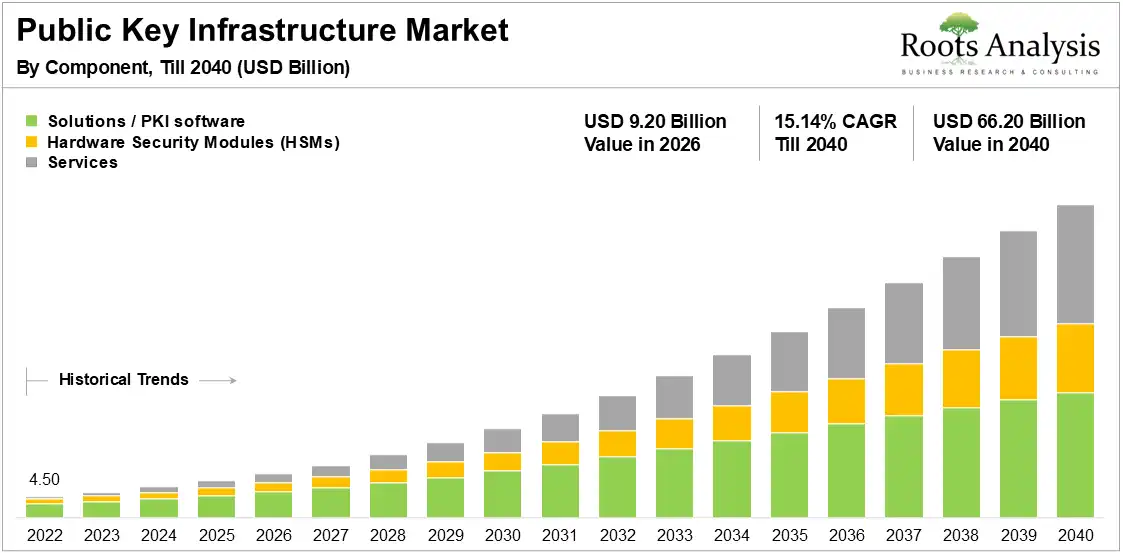
The global public key infrastructure market size is projected to grow from USD 9.20 billion in 2026 to USD 66.20 billion by 2040, representing a CAGR of 15.14% during the forecast period 2026 to 2040
See What’s in the Full Report – Request Your Complimentary Insights!
Market Report: Key Takeaways
- In terms of components, solution / PKI software holds a 45.0% share in 2026, while services segment is expected to grow at a CAGR of 18.7% through 2040.
- In 2026, cloud-native vs on-premises PKI market share comparison indicates dominance of on-premises deployment (42.0%), whereas cloud-based PKI market outlook project a higher 18.2% CAGR through 2040 ensuring operational agility.
- Based on applications, web security & e-commerce security commands a 28.5% share in 2026, while IoT & device identity management applications are projected to expand at a 20.8% CAGR till 2040.
- By organization size, large enterprises account for the 2026 majority (72.0%) navigating complex perimeters, though resource-constrained SMEs adopt solutions rapidly at an 18.6% CAGR till 2040.
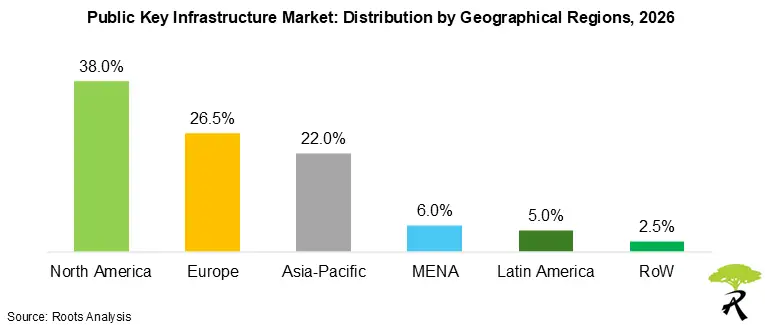
- Geographically, North America maintains the highest 2026 share (38.0%) via mature digital networks; however, the Asia-Pacific region presents the fastest growth opportunity, scaling at an 18.6% CAGR through 2040.
- In 2026, BFSI sector holds the dominant position in the PKI market, accounting for 26.5% share. Conversely, automotive & transportation vertical is projected to grow at a higher CAGR of 20.3% till 2040.
Public Key Infrastructure Market Overview
Public key infrastructure has transitioned from a static compliance utility into the definitive authentication backbone for enterprises. Zero Trust architecture acts as the primary catalyst, forcing organizations to replace manual certificate lifecycles with automated, dynamic orchestration to secure highly complex hybrid cloud perimeters.
Stringent data sovereignty regulations, such as GDPR, HIPAA, PCI-DSS, and India's DPDPA, and expansive IoT ecosystems are rapidly accelerating this cryptographic modernization. Validating this massive structural shift, WISeKey Arabia expanded its strategic joint venture in January 2025 to deploy sovereign, quantum-resistant digital identities across Saudi Arabia’s heavily scaled smart city infrastructure.
The market’s next defining growth phase will be shaped by post-quantum cryptography migration. Google Cloud’s February 2025 integration of FIPS-compliant algorithms, alongside NIST’s March 2025 standardization of the HQC fallback algorithm, definitively signals the commercial acceleration of quantum-safe architectures, ensuring sustained market expansion.
PKI Market Growth Drivers, Restraints, Challenges and Opportunities
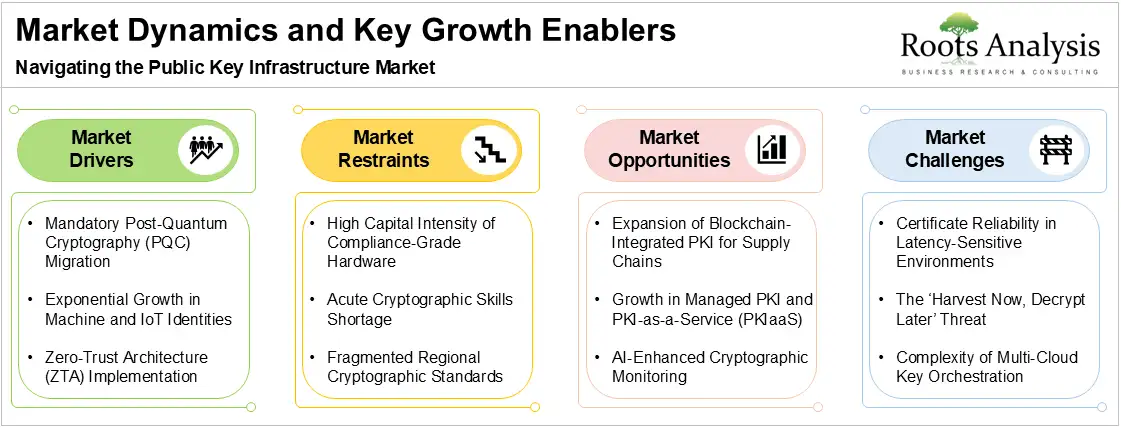
The public key infrastructure ecosystem balances intense capital constraints against the urgency of neutralizing deferred quantum decryption threats. While fragmented regional standards complicate integrations, AI enhanced cryptographic monitoring and blockchain integrated supply chains represent strategic avenues for achieving highly resilient multi-cloud enterprise orchestration.
Pay Only for What You Need – The Best Way to Optimize
Public Key Infrastructure Market Size Estimation Methodology
- To establish a baseline, we defined the market scope by categorizing core public key infrastructure (PKI) components into hardware security modules (HSMs), software management platforms, and services (consulting, integration, managed, support). We then systematically mapped these elements across on-premises, cloud-based, and hybrid deployment models.
- Next, we analyzed demand-side dynamics and historical technology adoption cycles, evaluating the proliferation of digital identities, expanding IoT ecosystems, and the integration of Zero Trust Architectures within highly regulated sectors like BFSI and healthcare. This allowed us to understand the industry’s transition from manual certificate management to automated certificate-lifecycle management (CLM) amid the challenges of shortened SSL / TLS certificate lifespans.
- Following this, we gathered critical supply-side metrics, including annual recurring revenue (ARR), certificate issuance volumes, and prevailing average selling prices (ASPs), through primary research with Chief Information Security Officers (CISOs) and PKI administrators. We triangulated these enterprise-level insights on certificate density and renewal rates with secondary sources, leveraging regulatory filings, CA/Browser Forum white papers, and government digital identity mandates such as eIDAS.
- Leveraging these triangulated data points, we calculated the global PKI market size and projected the future market opportunity. This was achieved through a robust hybrid forecasting model that combined bottom-up vendor revenue aggregations with top-down cyber security and identity and access management (IAM) spending trends, factoring in technical inflection points like the enterprise-wide adoption of post-quantum cryptography (PQC) and the expansion of machine-to-machine (M2M) authentication.
- The total projected market value was then systematically distributed across distinct market segments, allocating revenue by component type, deployment model, and vertical industry, as well as across key geographic regions influenced by localized data sovereignty laws, IT infrastructure maturity, and industry-specific compliance requirements.
- Finally, in order to assess the sensitivity of our assumptions, we conducted a multivariate sensitivity and scenario analysis (base, optimistic, and conservative) on some of the most important parameters of our forecast methodology, evaluating the potential market impact of decentralized identity (DID) technology disruptions, fluctuating IT budgets, the adoption pace of automation tools, and global semiconductor supply chain constraints affecting hardware-based PKI deployments.
Public Key Infrastructure Market Share Insights
Which PKI Component Dominates Market in 2026?
- The solutions & PKI software commands the market with a 45.0% share in 2026, serving as the essential orchestration layer for machine identities and zero-trust architecture. This structural dominance is strictly required to avert catastrophic service outages amidst an unprecedented explosion of decentralized network endpoints and automated integrations.
- Impending regulatory shifts, specifically the CA/B Forum mandate aggressively compressing public TLS certificate lifespans to forty-seven days, render manual tracking obsolete. A November 2025 SwissSign assessment highlights that this severe operational risk forces massive enterprise capital strictly toward automated cryptographic discovery software platforms.
- Services represent the fastest-expanding sector (CAGR of 18.7%), propelled entirely by the extreme technical complexity of the mandatory global transition to quantum cryptography and PQC. As regulatory bodies actively deprecate classical encryption algorithms, internal IT teams lack the highly specialized cryptographic agility required for seamless compliance.
- A January 2026 joint report from Europol and FS-ISAC prioritizing post-quantum cryptography migration across financial institutions underscores this commercial inflection point. The framework explicitly establishes the immediate necessity of utilizing external managed service ecosystems to actively mitigate imminent quantum decryption threats.
PKI Market Revenue Forecast by Applications: Web Authentication Resilience and IoT Security-by-Design
- Web & e-commerce security (capturing 28.5% share) commands the dominant market position in 2026, functioning as the foundational infrastructure of the global digital economy. Nearly all top-tier enterprise websites depend exclusively on TLS encryption to establish absolute trust, ensuring sustained high-volume issuance across traditional perimeters.
- Aggressive browser mandates actively reinforce this structural dominance, specifically Google Chrome’s June 2026 deadline requiring strictly dedicated TLS hierarchies. This policy enforces a massive global migration toward purpose-built, isolated PKI roots, permanently establishing a non-negotiable compliance floor for commercial web authentication.
- IoT & device identity management application is expected to experience the fastest growth (having a higher CAGR of 20.8%) during the forecast period, driven by international legislation eliminating unsecured hardware. The EU Cyber Resilience Act and US IoT Cybersecurity Improvement Act legally mandate verifiable digital identities and IoT security architectures before products enter commercial markets.
- This immense regulatory pressure fundamentally transforms the manufacturing supply chain, accelerating the integration of standardized trust protocols like Matter. Consequently, manufacturers directly embed cryptographic certificates into silicon during production, scaling decentralized IoT zero-trust ecosystems to defend critical infrastructure against sophisticated botnets.
Want Information on Specific Region / Segment?
PKI Industry Forecast by Geographical Regions
North America Market Growth Trajectory: High-Assurance Cryptography and Zero-Trust Dominance
- North America dictates the market trajectory, capturing a 38.0% share as the global epicenter for high-assurance cryptographic standards. Established hyperscale cloud ecosystems and rigorous federal cybersecurity frameworks provide unmatched infrastructure readiness, empowering organizations to seamlessly execute industrial-scale, automated certificate-lifecycle integrations across complex corporate perimeters.
- Demonstrating this strict regulatory posture, the US National Security Agency’s CNSA 2.0 framework aggressively mandates post-quantum cryptographic signatures for enterprise software and firmware entering 2026 and beyond. Concurrently, regional IT sectors actively deploy CISA-aligned zero-trust architectures, enabling North American institutions to permanently secure machine identities across production-scale workloads.
Asia-Pacific Market Growth: Public Key Infrastructure Industry to Grow at a Higher CAGR through 2040
- The market in Asia-Pacific region is projected to grow rapidly (at a 16.2% CAGR) during the forecast period. This growth is propelled by rapid digitalization and sovereign digital identity mandates. Serving as the global IoT manufacturing hub, the region requires billions of unique device certificates to satisfy strict localized cybersecurity frameworks.
- Validating this rapid structural expansion, emerging economies aggressively bypass legacy infrastructure utilizing scalable, mobile-first cryptography. This shift is signified by India’s November 2025 Digital Personal Data Protection rules and Aadhaar-linked eSign architectures, which, alongside China’s sovereign cryptography laws, cement regional commercial maturity.
Market Ecosystem Analysis
Public Key Infrastructure Market Competitive Landscape
The competitive landscape is fragmented between established giants consolidating identity management suites and agile innovators pioneering quantum-resistant protocols. Strategic acquisitions and rapid product iterations dictate market dominance, forcing vendors to bridge the persistent gap between legacy hardware compliance and cloud-native operational agility.
Dominant Industry Leaders: Accelerating Global Cryptographic Infrastructure
- Market leaders are aggressively scaling automated certificate-lifecycle management to counteract compressing validity periods. In February 2026, AppViewX released its Spring update for the CERT+ platform, specifically engineered to orchestrate the impending CA/B Forum 47-day certificate lifespan mandate. This capability acts as a major market catalyst, eliminating manual renewal failure points across complex perimeters.
- Simultaneously, legacy infrastructure players are consolidating control over decentralized identities. Following its acquisition, CyberArk successfully integrated Venafi’s expansive machine identity management into its central Identity Security Platform by early 2026. This structural consolidation provides enterprises with unified governance, effectively replacing disparate hardware-centric administration with seamless, highly automated multi-cloud cryptographic orchestration.
Startups Pioneering Post-Quantum Resilience and Autonomous Orchestration
- Venture capital is flowing heavily toward agile innovators solving emerging post-quantum vulnerabilities and operational bottlenecks. In January 2026, Project Eleven secured USD 20 million Series A to commercialize quantum-resilient cryptographic tools, directly addressing structural decryption risks within institutional digital assets and decentralized networks. This strategic funding accelerates the commercial transition from vulnerable legacy systems toward crypto-agile software architecture.
- Paralleling this momentum, Evertrust closed a EUR 10 million Series A in December 2025 to rapidly scale its automated Horizon and Stream platforms. By hyper-automating certificate lifecycles across complex environments, Evertrust explicitly targets multi-cloud enterprises, shifting revenue strictly away from labor-intensive administration toward highly efficient SaaS-driven orchestration models.
Public Key Infrastructure Market Trends & Opportunities
Post-Quantum Cryptography and Trust Ecosystem Commercialization
- The severe impact of post-quantum cryptography on PKI market growth forces a complete restructuring of the foundational root certificate authority (CA) hierarchy across global digital infrastructures.
- This transition empowers the expansive trust service providers (TSPs) ecosystem to monetize critical migration consulting, replacing legacy FIPS 140-2 compliant hardware with agile, quantum-safe hybrid solutions.
Zero-Trust Identity Orchestration and Operational Scalability
- Ubiquitous zero-trust architecture (ZTA) implementation drastically expands digital certificate issuance volume, unlocking massive commercial opportunities for vendors delivering highly scalable, automated certificate provisioning software platforms.
- Concurrently, decentralized IoT device identity management demands unprecedented cryptographic scale, actively shifting enterprise capital directly toward autonomous orchestration networks to prevent catastrophic security perimeter outages.
Your Business is Unique – Why Shouldn’t Your Report Be?
Market Access Considerations: Structural Barriers and Expansion Dynamics
Regulatory Sovereignty and Jurisdictional Compliance Frameworks
Navigating fragmented legal frameworks like eIDAS 2.0 and stringent data localization laws acts as an absolute prerequisite for regional commercialization. Vendors lacking established compliance credentials face massive entry barriers, heavily favoring legacy providers capable of underwriting rigorous, highly secure government infrastructure audits.
Infrastructure Cost and Deployment Scalability
The immense capital expenditure required to secure on-premises root authorities historically restricted enterprise-grade cryptographic adoption strictly to highly resourced, large-scale organizations. This persistent economic barrier is rapidly dissolving via scalable managed services, empowering agile vendors to capture vast mid-market revenue pools previously deemed inaccessible.
Decentralized Interoperability and Ecosystem Integration
Commercial scalability depends entirely on native integration capabilities across decentralized IT environments, multi-cloud architectures, and deeply established enterprise identity management systems. Vendors isolated within proprietary cryptographic silos are systematically excluded from procurement cycles, making robust API architecture strictly mandatory for frictionless global endpoint provisioning.
PKI Software Supply Chain Integrity and SBOM Mandates
Global cybersecurity regulations now mandate cryptographically signed software bill of materials (SBOMs), transforming supply chain security into a strict market access barrier. PKI vendors must seamlessly embed identity issuance into high-velocity continuous integration / continuous developer (CI / CD) pipelines. Platforms lacking these frictionless integrations are systematically excluded from lucrative enterprise procurement cycles.
How Stakeholders Benefit from the Key Focus Areas of Our Public Key Infrastructure Industry Report
The public key infrastructure (PKI) market is expanding rapidly as enterprise security mandates pivot toward zero-trust and quantum-safe architectures. This comprehensive intelligence equips strategic planners with authoritative market drivers, granular forecasts, and actionable trend evaluations, empowering executives to execute secure digital transformations across complex hybrid environments.
- Public Key Infrastructure Market Landscape and Competitive Dynamics: The report maps established certificate authorities, identity orchestration giants, and evolving ecosystem consolidation strategies. Stakeholders utilize these precise competitive benchmarks to identify critical whitespace, optimize commercial entry frameworks, and proactively navigate the structural shift from legacy hardware toward agile SaaS-driven identity management.
- Unmet Needs and Operational Gaps in Public Key Infrastructure: This section identifies severe inefficiencies within manual certificate lifecycles, multi-cloud integration friction, and acute cryptographic engineering talent shortages. Strategy leaders leverage these verified operational gaps to align product development with urgent compliance demands, targeting underserved enterprise segments possessing massive commercial monetization upside.
- Technology Innovation and Adoption Trends: Detailed coverage of post-quantum cryptography migrations, automated lifecycle management, and scalable IoT device identity clarifies exact technological trajectories. Decision-makers evaluate proven commercial traction, ensuring enterprise security investments strictly align with validated adoption patterns to maximize operational resilience and prevent catastrophic cryptographic outages.
- Funding and Investment Opportunities in PKI Industry: Comprehensive financial analysis highlights capital flow trends, venture hotspots, and high-growth segments within quantum-resilient infrastructure. Stakeholders gain absolute clarity regarding private equity concentration, empowering investors to strategically allocate capital toward scalable automation platforms and rapidly execute lucrative consolidation strategies across the trust ecosystem.
- Partnership and Collaboration Trends in PKI Market Ecosystem: The intelligence examines high-impact strategic alliances, interoperability consortiums, and hyperscaler integrations accelerating cryptographic modernization. Corporate development teams utilize this analytical perspective to pinpoint synergistic technology partners, rapidly facilitating go-to-market execution and unlocking alternative revenue streams through shared trust frameworks and standardized API architectures.
- PKI Industry Forecast and Geographic Coverage: Detailed PKI market segmentation and analysis across components, deployment modes, applications, organization sizes, regional maturity, and industry verticals provides absolute clarity regarding structural demand. This exhaustive foundation strictly guides tactical resource prioritization, ensuring targeted regional market entries and highly localized commercial scaling operations execute flawlessly on a global scale.
Have Questions? Let’s Get Them Answered.
Public Key Infrastructure Market: Scope of the Report
| Key Report Attributes | Details | |
| Forecast Period | Till 2040 | |
| Market Size 2026 | USD 9.20 Billion | |
| Market Size 2040 | USD 66.20 Billion | |
| CAGR (Till 2040) | 15.14% | |
| Segments Covered |
|
|
| Geographical Regions Covered |
|
|
| Key Sections Covered |
|
|
PKI Market Segmentation
The public key infrastructure (PKI) market report presents an in-depth analysis, highlighting the capabilities of various stakeholders, based on different segments such as component, type of solution / PKI software, deployment mode, application, organization size, vertical, geographical regions, and key players.
Market Share by Component
- Hardware Security Modules (HSMs)
- Solutions / PKI software
- Services
- Consulting
- Integration
- Managed
- Support
Market Share by Type of Solution / PKI Software
- Certificate Authority (CA) Software
- Certificate-Lifecycle Systems
- Public Key Management Solutions
- Registration Authority (RA) Software
Market Share by Deployment Mode
- Cloud
- On-Premises
- Hybrid
Market Share by Application
- Authentication & Access Control
- Code Signing & Software Integrity
- Email Security & Document Signing
- IoT & Device Identity Management
- Payment Processing & Mobile Wallets
- Web & e-Commerce Security
Market Share by Organization Size
- Large Enterprises
- Small and Medium Enterprises (SMEs)
Market Share by Vertical
- Automotive & Transportation
- BFSI
- Education
- Government & Defense
- Healthcare & Life Sciences
- IT & Telecom
- Manufacturing & Industrial
- Media & Entertainment
- Retail & e-Commerce
- Others
Market Share by Geographical Regions
- North America
- US
- Canada
- Mexico
- Rest of North America
- Europe
- Austria
- Belgium
- Denmark
- France
- Germany
- Ireland
- Italy
- Netherlands
- Norway
- Russia
- Spain
- Sweden
- Switzerland
- UK
- Rest of Europe
- Asia-Pacific
- Australia
- China
- India
- Japan
- New-Zealand
- Singapore
- South Korea
- Rest of Asia-Pacific
- Latin America
- Argentina
- Brazil
- Chile
- Colombia
- Venezuela
- Rest of Latin America
- Middle East and North Africa (MENA)
- Egypt
- Iran
- Iraq
- Israel
- Kuwait
- Saudi Arabia
- UAE
- Rest of MENA
- Rest of the World


