


 Download Free Sample
 Buy Now
Market Size
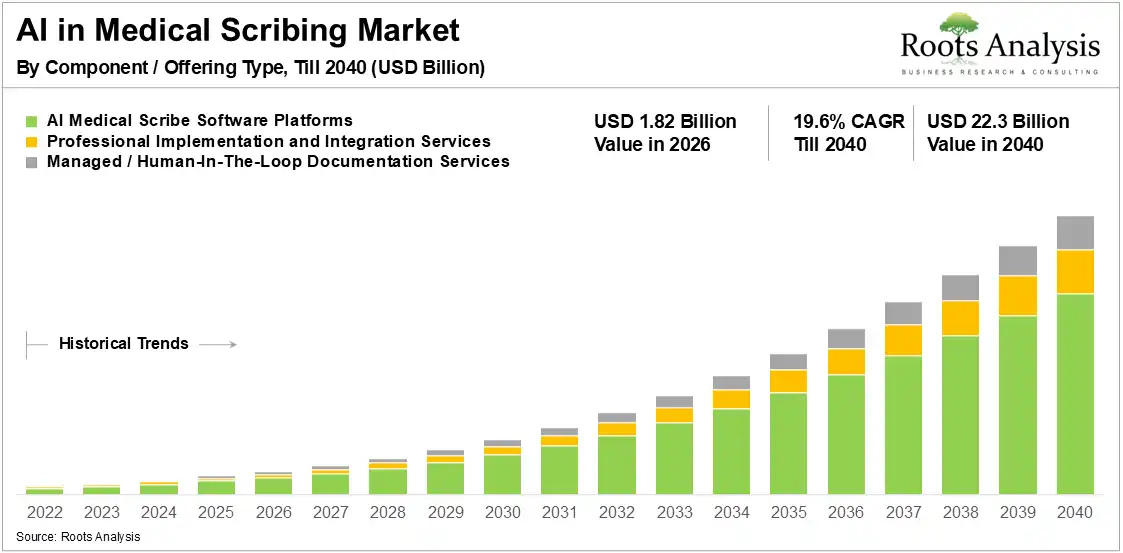
The global AI in medical scribing market reached USD 1.82 billion in 2026 and is projected to reach USD 22.3 billion by 2040, growing at a CAGR of 19.6% over the forecast period 2026 to 2040, driven by clinician burnout reduction and EHR-native ambient documentation.
See What’s in the Full Report – Request Your Complimentary Insights!
Market Report: Key Takeaways
- Based on Component / Offering Type, AI medical scribe software platforms is both the dominant and fastest-growing category, holding 72.0% share in 2026 and expanding at 20.3% CAGR through 2040, driven by recurring SaaS adoption.
- Based on Deployment Model, Cloud-based / SaaS deployment captures 76.0% market share in 2026, whereas Hybrid deployment registers a 21.3% CAGR through 2040, driven by data-governance requirements.
- Based on Technology Layer, Automatic speech recognition captures 29.0% market share in 2026, whereas large language models / generative AI registers a 24.0% CAGR through 2040, driven by structured clinical automation.
- Based on Application / Workflow, General clinical documentation captures 40.0% market share in 2026, whereas pre-visit chart summarization and visit preparation registers a 23.8% CAGR through 2040, driven by encounter intelligence expansion.
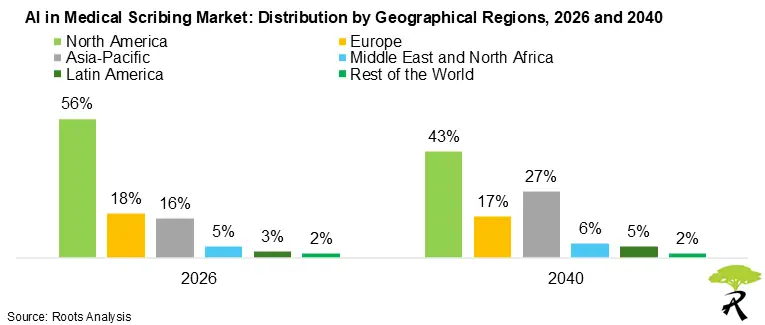
- Based on Geography, North America captures 56.0% market share in 2026, whereas Asia-Pacific registers a 24.2% CAGR through 2040, driven by localized digital-health acceleration.
AI in Medical Scribing Market Outlook
Ambient clinical documentation is moving from transcription replacement to EHR-integrated clinical workflow automation. Hospitals first bought AI medical scribe software to reduce note burden and after-hours charting. Demand now centers on structured outputs, specialty templates, order staging, coding support, and pre-visit intelligence. The AI medical scribing market now shifts from point solutions toward enterprise platforms. These platforms connect ambient capture, large language models, and clinical documentation integrity.
Growth comes from physician burnout pressure, electronic health record workload reduction, and stricter governance around consent, privacy, and medical-device oversight. In July 2026, Australia’s federal health department warned clinicians about privacy, consent, data security, and oversight risks as GP use increased. Microsoft launched Dragon Copilot in March 2025, combining voice AI, ambient documentation, information retrieval, and task automation for clinicians. These pressures make compliance-ready automation central to purchasing decisions.
Through 2040, the market remains high growth as general documentation gives ground to specialty documentation, pre-visit preparation, and generative AI workflow layers. Large language models expand fastest among technology layers, while hybrid deployment gains share where governance controls matter. In June 2026, Abridge announced a broader healthcare intelligence platform and NVIDIA collaboration for clinical conversation foundation models. The outlook favors EHR-native vendors with compliance depth.
AI in Medical Scribing Market Dynamics
AI in Medical Scribing Market Drivers
Clinician documentation burden and EHR-native workflow demand push hospitals toward ambient clinical documentation. Hospitals and health systems hold majority of share in 2026 because they control EHR integration, governance, and enterprise rollout. General clinical documentation holds 40.0% share because buyers first target physician note burden. Mayo Clinic expanded Abridge enterprise-wide in January 2025, beginning with more than 2,000 physicians.
AI in Medical Scribing Market Restraints
Privacy, consent, and clinical oversight requirements slow adoption where ambient recording touches sensitive patient conversations. Australia’s July 2026 federal warning highlighted data security and medical device oversight risks as GP usage increased. On-premise and private cloud deployment loses share because custom infrastructure raises cost and slows model updates. These constraints favor vendors with documented governance controls and health-system compliance workflows.
AI in Medical Scribing Market Opportunities
Generative AI creates expansion beyond note drafting into pre-visit intelligence, coding, orders, and follow-up workflows. Pre-visit chart summarization and visit preparation grows at 23.8% CAGR, the fastest application category through 2040. DeepScribe introduced SmartPrep for oncology workflows in April 2026, showing how specialty context can raise product value. Specialty depth can separate premium platforms from basic transcription tools.
AI in Medical Scribing Market Challenges
Competitive differentiation becomes harder as cloud-based software platforms capture 76.0% deployment share in 2026. Automatic speech recognition still leads technology layers at 29.0%, but large language models grow faster at 24.0% CAGR. Vendors must prove accuracy, clinical safety, specialty coverage, and EHR interoperability together. Buyers will penalize tools that create review burden, coding risk, or disconnected outputs.
AI in Medical Scribing Market Size Estimation Methodology
- As a starting point, exact-scope secondary sources measured AI medical scribe software, ambient documentation, and generative AI clinical documentation. Broader clinical-documentation automation and cloud-transcription sources were treated only as upper-bound context. The base year was normalized against 2025 and 2026 anchors, then aligned with the 2026 to 2040 horizon. Historical values were back-cast to 2022 using adoption signals from enterprise health-system deployments and funding activity.
- Moving forward, segment shares were built from technology-layer evidence, deployment patterns, and named enterprise rollouts. Automatic speech recognition, natural language processing, large language models, EHR integration, and coding AI were mapped separately. This prevented mature speech-capture revenue from overstating the faster generative AI clinical documentation layer. Vendor pages and product launches helped separate documentation-only tools from broader clinical workflow platforms.
- Building on this, end-user demand was weighted using hospital deployment counts, health-system rollout evidence, specialty coverage, and care-setting intensity. Hospitals received the largest 2026 weight because enterprise buyers control procurement, governance, and EHR integration. Ambulatory clinics, specialty practices, telehealth providers, and care-management organizations were modeled with different adoption curves. Emergency departments received separate treatment because throughput pressure changes adoption economics.
- Drawing upon these, regional allocation used digital-health adoption, EHR maturity, policy oversight, and localization requirements. North America received the strongest current weighting because named large health-system deployments cluster there. Asia-Pacific received the highest growth curve because public systems are localizing AI scribes for emergency care, multilingual documentation, and productivity pressure. Europe was modeled with stronger governance friction because privacy scrutiny affects procurement cycles.
- The projected value was then calculated by applying segment-specific growth rates to the normalized base. The AI medical scribing market forecast used higher growth for large language models, pre-visit intelligence, hybrid deployment, and Asia-Pacific adoption. Lower growth was assigned to on-premise infrastructure and managed human-in-the-loop documentation services. Annual values were smoothed to avoid unrealistic step-changes that deployment evidence did not support.
- Finally, the forecast was stress-tested against venture funding, product launch cadence, regulatory warning signals, and commercial deployment evidence. Funding rounds supported platform expansion assumptions, while privacy and consent risks moderated adoption speed. The final model prioritized recurring software revenue, EHR-native integration, specialty depth, and compliance readiness. Sensitivity checks tested whether coding automation or specialty documentation could raise long-term share faster.
AI in Medical Scribing Market Share Insights
Market Share by Component / Offering Type
According to our analysis, AI medical scribe software platforms lead because recurring SaaS licensing scales faster than services-heavy documentation models. Microsoft launched Dragon Copilot in March 2025, combining voice dictation, ambient listening, generative AI, and clinical safeguards.
Further, AI medical scribe software platforms will also grow fastest as buyers shift from transcription support to workflow automation. Ambience Healthcare raised USD 243 million in July 2025 to scale documentation, coding, and CDI workflows for health systems.
Market Share by End User / Care Setting
Hospitals and health systems lead because enterprise buyers’ control EHR integration, governance, procurement, and clinician enablement. Mayo Clinic expanded Abridge enterprise-wide in January 2025, starting with more than 2,000 physicians.
Telehealth / virtual care providers will grow fastest as remote clinicians need automated notes, summaries, and instructions. Included Health reported in May 2025 that over 540 clinicians used its custom ambient scribe at least once.
Want Information on Specific Region / Segment?
Regional Analysis: North America Leads the Market and Asia-Pacific is Likely to Register Higher CAGR
Presently, North America holds 56.0% share in 2026. The region leads because health systems have mature EHR estates, deep vendor ecosystems, and stronger digital-health capital access. Abridge reported in February 2025 that it had surpassed 100 deployments at large U.S. health systems.
On the contrary, Asia-Pacific registers a 24.2% CAGR through 2040. Growth will accelerate as public systems localize AI scribes for emergency care, multilingual documentation, and hospital productivity. New Zealand’s Ministry of Health announced in October 2025 a rollout of AI scribes to 1,000 emergency clinicians.
Market Ecosystem Analysis
Six Tier 1 leaders anchor most enterprise activity, while 11 specialists and eight emerging vendors contest specialty and regional segments. The dominant dynamic is platform convergence, as ambient notes, dictation, orders, coding, and CDI move into unified clinical workflow platforms. The primary commercial force is enterprise workflow ownership, not transcription price, because buyers now reward EHR integration and revenue-cycle lift. Competitive advantage is shifting from ASR accuracy toward governed, EHR-embedded automation with clinician review preserved.
- Microsoft launched Dragon Copilot in March 2025 as an all-in-one assistant combining dictation, ambient listening, and generative AI. The move pressures standalone scribes because enterprise buyers can upgrade existing Microsoft voice documentation estates. It strengthens cloud SaaS, EHR workflow, referral-letter, and after-visit-summary applications. Microsoft expanded Dragon Copilot in October 2025 with nurse documentation and partner-agent capabilities. That broadens competition from physician notes into multi-role clinical workflow orchestration.
- Oracle reported in March 2025 that its Clinical AI Agent supported more than 30 medical specialties. The capability strengthens specialty-specific documentation and raises the bar for EHR-native AI assistants. Oracle added automated order creation in February 2026 for labs, imaging, prescriptions, refills, and follow-ups. This shifts competition from note generation into orders and post-visit workflow automation.
- Suki became the first ambient AI vendor integrated with MEDITECH Expanse documentation APIs in July 2025. The integration removes copy-paste workflows and strengthens EHR interoperability for community hospitals and ambulatory networks. It pressures EHR-agnostic competitors to prove deeper write-back capability, not only transcription quality.
- Abridge raised $300 million in Series E funding in June 2025, backed by Andreessen Horowitz and Khosla Ventures. The company linked the raise to new products and revenue-cycle intelligence embedded earlier in clinical conversations. This strengthens enterprise health-system positioning across clinical documentation, coding support, and specialty workflows.
- Ambience Healthcare raised $243 million in Series C funding in July 2025, with backing from Oak HC/FT and Andreessen Horowitz. Its platform spans documentation, coding, payment, referrals, pre-visit summaries, and orders. This pressures scribe-only vendors by shifting buyer evaluation toward clinical and administrative automation depth.
- IKS Health announced in September 2025 that Scribble Now was natively integrated across RCM, coding, and clinical documentation. The launch positions IKS around encounter-to-reimbursement automation, not only managed documentation support. It strengthens managed services, clinical coding, and revenue-integrity applications for enterprise care settings.
- Accurx and Tandem Health launched Accurx Scribe across NHS users in April 2025. The rollout targets 98% of GP practices using Accurx, then hospitals, community care, and mental health. It strengthens European primary care, referral, follow-up, and EHR write-back workflows.
- Scribeberry said in May 2025 that it was selected for Canada Health Infoway’s AI Scribe Program. Mutuo Health said in May 2025 that AutoScribe was also pre-qualified for the same national program. These selections accelerate Canadian primary care adoption and raise requirements around privacy, cybersecurity, usability, and EMR connectivity.
- Solventum gained MEDITECH Alliance Accelerator status in January 2026 for Fluency Align within Expanse documentation workflows. The move strengthens specialist competition in hospital EHR environments where ambient AI must support embedded clinical workflow. It pressures smaller vendors that lack validated integration pathways into established health-system technology stacks.
Startup Companies and their Key Highlights
- Ambience Healthcare
- Event type and funding amount: $243 million Series C funding
- Month and year: July 2025
- Lead investor or strategic partner name: Oak HC/FT and Andreessen Horowitz
- Stated purpose of the event: Scale its AI platform for health systems
- Market implication: Accelerates documentation, coding, CDI, inpatient, emergency department, and ambulatory subspecialty automation
- Nabla
- Event type and funding amount: $70 million Series C funding
- Month and year: June 2025
- Lead investor or strategic partner name: HV Capital
- Stated purpose of the event: Deliver agentic AI into clinical workflows and expand beyond ambient documentation
- Market implication: Accelerates clinical workflow agents, coding, billing support, and repetitive task automation for care teams
- Heidi Health
- Event type and funding amount: $65 million Series B funding
- Month and year: October 2025
- Lead investor or strategic partner name: Point72 Private Investments
- Stated purpose of the event: Expand global reach, office locations, workforce, and local market support
- Market implication: Accelerates international adoption across the United States, Canada, United Kingdom, Australia, and other markets
- Freed
- Event type: Series A financing
- Month and year: March 2025
- Lead investor or strategic partner name: Sequoia Capital
- Stated purpose of the event: Transform medical scribing and return time to clinicians
- Market implication: Strengthens the independent clinic and SMB physician practice segment with style-aware AI documentation
- Scribeberry
- Event type: Canada Health Infoway AI Scribe Program vendor selection
- Month and year: May 2025
- Stated purpose of the event: Support funded AI scribe access for Canadian primary care clinicians
- Market implication: Accelerates Canadian primary care adoption through public procurement and national-scale vendor validation
AI in Medical Scribing Market Trends / Opportunities
AI in Medical Scribing Market: EHR-Native Ambient Platforms Raising Enterprise Switching Costs
Enterprise buyers increasingly favor ambient clinical documentation tools that sit inside existing EHR workflows. Cloud-based SaaS deployment holds 76.0% share in 2026. Nabla’s December 2025 LCMC Health rollout integrated ambient AI into Epic across a multi-hospital network. EHR-native distribution raises switching costs, shortens rollout friction, and helps integrated vendors defend enterprise accounts.
Unified voice AI platforms are replacing separate dictation, ambient listening, and task-support tools. Microsoft launched Dragon Copilot in March 2025 to combine Dragon Medical One and DAX ambient AI. The launch added information retrieval and task automation for clinicians. Consolidated workflow scope improves cross-selling and compresses room for single-function transcription vendors.
AI in Medical Scribing Market: Specialty Intelligence Creating Premium Clinical Use Cases
Specialty-specific documentation is gaining share as buyers move beyond general SOAP-note automation. Oncology grows from 9.0% in 2026 to 12.0% share by 2040. DeepScribe introduced SmartPrep for oncology pre-visit intelligence in April 2026. Specialty intelligence supports premium pricing where clinical context affects productivity, quality, and risk.
Behavioral health documentation requires sensitive summarization, specialty-aware language, and careful review workflows. Behavioral health and psychiatry register the fastest specialty CAGR at 22.7%. The American Psychiatric Association published AI scribe assessment resources in July 2025. Specialty validation can become a procurement advantage for vendors serving psychiatry and therapy settings.
Generative AI Workflow Expansion Turning Documentation Vendors into Clinical Automation Platforms
Generative AI layers are shifting revenue from transcripts toward structured clinical actions. Large language models and generative AI grow at 24.0% CAGR, the fastest technology layer through 2040. Abridge announced a broader healthcare intelligence platform and NVIDIA collaboration in June 2026. Foundation-model investment strengthens platform defensibility and enterprise roadmap credibility.
Coding and revenue integrity workflows are becoming adjacent growth paths for AI scribe vendors. Clinical coding and documentation integrity grows at 22.1% CAGR as applications expand beyond visit notes. Suki enhanced its ambient AI platform in October 2025 to automate CPT and E/M coding workflows. Coding automation helps vendors reach revenue-cycle buyers alongside clinical leadership, widening budget ownership beyond clinical IT.
Your Business is Unique – Why Shouldn’t Your Report Be?
Market Access Considerations
Privacy, Consent, and Medical-Device Oversight Controls
Ambient recording makes consent, privacy, data security, and clinical oversight a front-door market access requirement. Australia’s federal health department warned clinicians about privacy, consent, data security, and oversight risks in July 2026. The warning came as AI scribe use among GPs increased. Vendors that document governance, auditability, clinician review, and data-handling workflows can scale faster than simple transcription aids. Weak oversight evidence can delay procurement even when physician demand is strong across ambulatory clinics.
EHR Integration and Interoperability Depth
EHR integration determines whether AI medical scribe software becomes a daily workflow tool or another disconnected application. Cloud-based SaaS deployment holds 76.0% share in 2026 because vendors can update integrations, templates, and models centrally. Nabla’s December 2025 LCMC Health rollout integrated ambient AI into Epic across multiple hospitals. Deep EHR connectivity improves renewal odds, reduces implementation friction, and supports workflow standardization. It also raises barriers for smaller vendors without integration resources or clinical templates.
Specialty Validation and Clinical Review Burden
Specialty accuracy shapes market access because physicians must trust outputs before reducing manual documentation time. Oncology, psychiatry, emergency medicine, and cardiology each require different templates, terminology, and risk controls. The American Psychiatric Association published AI scribe tool assessment resources in July 2025 for psychiatric practices. Vendors with specialty validation reduce review burden and support safer clinician adoption. They also strengthen medical leadership buy-in across high-value practices with complex encounters.
Enterprise Procurement and Implementation Economics
Health-system procurement favors vendors that combine software, implementation support, clinician training, and measurable productivity gains. Hospitals and health systems hold 46.0% share in 2026 because they control governance, EHR integration, procurement, and rollout enablement. Cleveland Clinic selected Ambience after an ambient AI pilot and scaled the platform to thousands of clinicians in June 2026. Pilot-to-scale evidence becomes a key commercialization gate, reduces buyer risk, and strengthens reference-led selling into enterprise accounts.
How Stakeholders Benefit from the Key Focus Areas of Our AI in Medical Scribing Market Report
Physician burnout, EHR workload, and clinician productivity pressure make ambient documentation commercially urgent. This report links AI medical scribe software adoption, clinical workflow automation, and compliance constraints to portfolio, investment, product, and go-to-market decisions.
- Unmet Needs and Market Gaps in AI in Medical Scribing Market: The report identifies gaps between basic transcription tools and EHR-integrated AI medical scribe software. It shows where hospitals need documentation relief, coding support, and pre-visit intelligence rather than standalone note capture. Product and commercial teams can use this to decide which workflows deserve near-term roadmap investment.
- Funding and Venture Investment Opportunities in AI in Medical Scribing Market: The report tracks funding signals that point to platform expansion, enterprise adoption, and competitive pressure. Ambience raised USD 243 million in July 2025 to scale its platform for health systems. Abridge raised USD 250 million in February 2025 to enhance AI-driven medical documentation capabilities. Corporate development teams can use these signals to assess timing, valuation pressure, and partnership targets.
- Technology Innovation and Adoption Trends: The report separates automatic speech recognition, natural language processing, large language models, conversational AI, EHR integration, and coding AI. Large language models grow at 24.0% CAGR, while automatic speech recognition loses share as the market moves toward structured clinical actions. Technology leaders can use this split to prioritize model orchestration, integration depth, and clinical safety controls.
- AI in Medical Scribing Market Competitive Landscape and Industry Analysis: The report maps Tier 1 leaders, Tier 2 specialists, and emerging vendors across documentation, coding, EHR integration, and specialty workflows. Microsoft, Abridge, Oracle, Suki, Ambience, and AWS anchor the enterprise platform layer. Commercial teams can use the analysis to benchmark positioning, refine account targeting, and identify defensible differentiation.
- Mapping Strategic Partnerships and Ecosystem Synergies: The report shows where partnerships connect ambient documentation to EHRs, care management, infrastructure, and specialty clinical intelligence. HealthEdge and Suki introduced ambient clinical intelligence for GuidingCare workflows in January 2026. Business development teams can use this view to identify channel partners, integration priorities, and expansion routes beyond physician notes.
- AI in Medical Scribing Market CAGR and Growth Trends: The report explains why the market grows at 19.6% CAGR from 2026 to 2040. It compares faster categories such as pre-visit intelligence, behavioral health, large language models, and Asia-Pacific adoption with slower service-heavy models. Strategy leaders can use this to prioritize segments, allocate resources, and challenge vendor claims during planning.
AI in Medical Scribing Market: Scope of the Report
| Key Report Attributes | Details | |
| Forecast Period | Till 2040 | |
| Market Size 2026 | USD 1.82 Billion | |
| Market Size 2040 | USD 22.3 Billion | |
| CAGR (Till 2040) | 19.6% | |
| Segments Covered |
|
|
| Geographical Regions Covered |
|
|
| Key Sections Covered |
|
|
Market Segmentation
The AI in Medical Scribing Market report presents an in-depth analysis, highlighting the capabilities of various stakeholders, based on different segments, such as component / offering type, deployment model, technology layer, application / workflow, end user / care setting, specialty coverage, geographical regions, and leading players.
By Component / Offering Type
- AI Medical Scribe Software Platforms
- Professional Implementation and Integration Services
- Managed / Human-In-The-Loop Documentation Services
By Deployment Mode
- Cloud-based / SaaS Deployment
- On-Premise / Private Cloud Deployment
- Hybrid Deployment
By Technology Layer
- Automatic Speech Recognition
- Natural Language Processing / Natural Language Understanding
- Large Language Models / Generative AI
- Conversational AI / Voice AI Assistants
- EHR Integration and Interoperability Engines
- Clinical Coding and Revenue Integrity AI
By Application / Workflow
- General Clinical Documentation
- Specialty-Specific Clinical Documentation
- Emergency Department Documentation
- Pre-Visit Chart Summarization and Visit Preparation
- Clinical Coding and Documentation Integrity
- Orders, Referrals, After-Visit Summaries and Follow-Up Workflows
By End User / Care Setting
- Hospitals and Health Systems
- Ambulatory Clinics and Physician Practices
- Specialty Practices
- Emergency Departments and Urgent Care Centers
- Telehealth / Virtual Care Providers
- Payer and Care-Management Organizations
By Specialty Coverage
- Primary Care / Family Medicine
- Internal Medicine
- Emergency Medicine
- Oncology
- Cardiology
- Behavioral Health / Psychiatry
- Surgery / Orthopedics
- Other Specialties
By Geographical Regions
- North America
- US
- Canada
- Mexico
- Rest of North America
- Europe
- Austria
- Belgium
- Denmark
- France
- Germany
- Ireland
- Italy
- Netherlands
- Norway
- Russia
- Spain
- Sweden
- Switzerland
- UK
- Rest of Europe
- Asia-Pacific
- China
- India
- Japan
- Singapore
- South Korea
- Rest of Asia-Pacific
- Latin America
- Argentina
- Brazil
- Chile
- Colombia
- Venezuela
- Rest of Latin America
- Middle East and Africa (MEA)
- Egypt
- Iran
- Iraq
- Israel
- Kuwait
- Saudi Arabia
- UAE
- Rest of MEA
- Rest of the World


