


 Download Free Sample
 Buy Now
Market Size
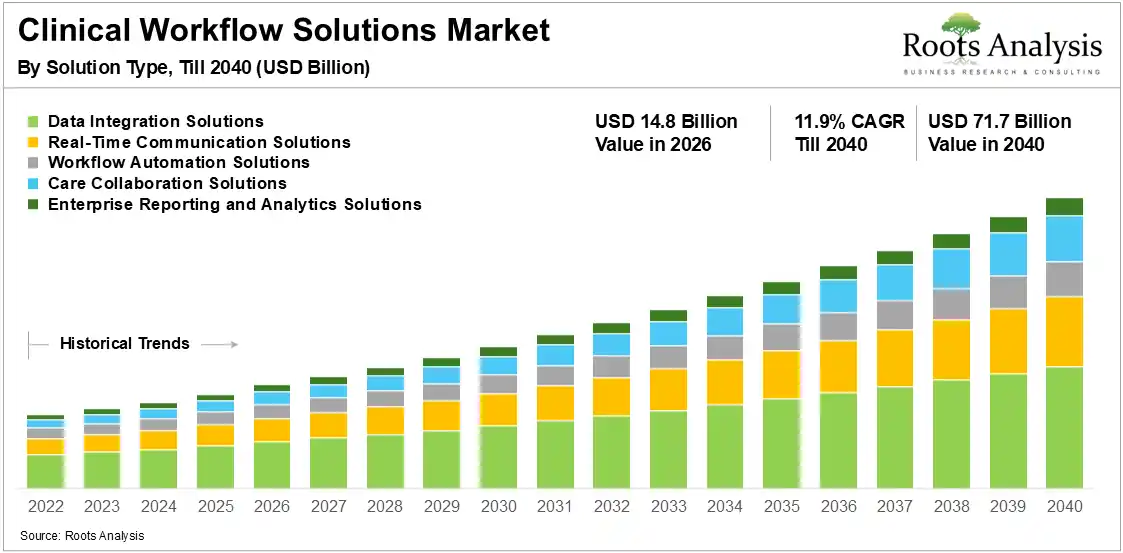
The global clinical workflow solutions market is expected to rise from USD 14.8 billion in 2026 to reach USD 71.7 billion by 2040, growing at a CAGR of 11.9% over the forecast period 2026 to 2040, driven by EHR-integrated automation, cloud deployment, and AI-enabled documentation.
See What’s in the Full Report – Request Your Complimentary Insights!
Market Report: Key Takeaways
- Based on solution type, Data Integration Solutions capture 28.5% market share in 2026, whereas Workflow Automation Solutions register a 14.5% CAGR through 2040, driven by automation of documentation, routing, and administrative workflows.
- Based on deployment mode, Cloud-Based Deployment is both the dominant and fastest-growing category, holding 52.0% share in 2026 and expanding at 13.5% CAGR through 2040, driven by scalable AI deployment and lower integration overhead.
- Based on workflow application, Clinical Communication and Alerting capture 23.0% market share in 2026, whereas Clinical Documentation and Note Generation register a 14.2% CAGR through 2040, driven by ambient AI adoption.
- Based on end user, Hospitals capture 55.0% market share in 2026, whereas Ambulatory Care Centers register a 14.1% CAGR through 2040, driven by outpatient digitization and AI-assisted visit workflows.
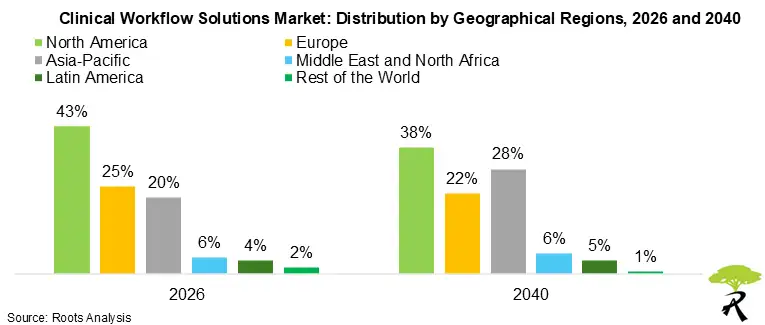
- Based on geography, North America captures 43.5% market share in 2026, whereas Asia-Pacific registers a 14.7% CAGR through 2040, driven by national digital health infrastructure and hospital modernization.
Clinical Workflow Solutions Market Outlook
The clinical workflow solutions market is shifting from fragmented messaging and data tools into AI-enabled operating layers. Hospitals now need platforms that connect EHR data, alerts, documentation, orders, analytics, and capacity decisions. Earlier demand centered on secure communication and basic workflow automation. Current buying priorities favor interoperable software platforms, cloud-based deployment, ambient voice, and workflow orchestration. These tools reduce clinician burden without disrupting existing clinical systems.
Growth now comes from staffing pressure, EHR integration needs, and policy-backed digitization of care delivery. Health systems now tie digital tools to operational recovery targets. NHS England accelerated AI triage, AI notetaking, Single Patient Record, and digital workflow tools in July 2026. That plan linked workflow automation to waiting-time reduction and care access. Microsoft launched Dragon Copilot in March 2025, connecting documentation, information surfacing, and task automation inside clinical workflows.
Through 2040, the market will remain high-growth as automation expands beyond notes into orders, routing, coding, and reporting. Workflow Automation Solutions, Clinical Documentation and Note Generation, and Ambient Voice and Speech Recognition will gain share fastest. Oracle added automated order creation to its Clinical AI Agent in February 2026. That launch showed the move toward action-taking assistants. The outlook remains strong, but adoption will depend on integration depth, governance, and workflow trust.
Clinical Workflow Solutions Market Dynamics
Clinical Workflow Solutions Market Drivers
EHR-integrated automation now drives buying because hospitals must reduce manual work across documentation, alerts, orders, and reporting. Data Integration Solutions hold 28.5% share in 2026. Workflow tools need reliable connections across electronic health records, labs, imaging, revenue, and communication systems. HHS said TEFCA reached nearly 500 million exchanged health records in February 2026. That scale strengthens the interoperability base for clinical workflow automation software.
Clinical Workflow Solutions Market Restraints
Integration risk slows adoption because clinical workflow platforms must write back into systems of record without creating safety gaps. EHR / EMR Integration leads technology enablers with 29.0% share in 2026, but that dependency raises implementation cost. The UK MHRA AI Airlock Sandbox Phase 2 report covered AI medical device learnings from April 2025 to May 2026. The report highlighted regulatory scrutiny for AI-enabled clinical workflows.
Clinical Workflow Solutions Market Opportunities
Cloud-based deployment creates the clearest opportunity because hospitals can scale AI documentation, scheduling, coding, and administrative workflows faster. Cloud-Based Deployment holds 52.0% share in 2026 and grows at 13.5% CAGR through 2040. AWS launched Amazon Connect Health in March 2026 for patient verification, scheduling, documentation, coding, and administrative automation. That launch expanded cloud AI healthcare workflow reach.
Clinical Workflow Solutions Market Challenges
Clinical trust remains the core challenge because AI tools increasingly influence orders, documentation, routing, and follow-up decisions. Oracle added automated order creation in February 2026. The feature enables ambient listening to draft labs, imaging, medications, and appointments. That functionality raises validation, audit, physician oversight, and liability expectations. Vendors that prove safe workflow handoffs will win stronger hospital access.
Clinical Workflow Solutions Market Size Estimation Methodology
- As a starting point, the clinical workflow solutions market forecast used multiple credible secondary sources to build a consensus baseline. The source set included public market estimates, vendor product disclosures, healthcare IT adoption evidence, and segment-level clinical workflow software indicators. Higher-growth software-only estimates were reviewed separately because they overstated the wider enterprise workflow market.
- Moving forward, the model mapped demand across hospitals, ambulatory care centers, long-term care facilities, diagnostic and imaging centers, and specialty clinics. It used EHR integration needs, clinical communication requirements, patient flow complexity, and documentation workload as the main demand variables. Health record exchange volumes, including TEFCA activity, helped validate interoperability-driven demand.
- Building on this, solution-level shares were assigned across five categories. The categories included Data Integration Solutions, Real-Time Communication Solutions, Workflow Automation Solutions, Care Collaboration Solutions, and Enterprise Reporting and Analytics Solutions. The model weighted Data Integration Solutions highest in 2026 because workflow platforms need connected clinical and administrative data. Workflow Automation Solutions received the strongest long-term weight. Orders, notes, routing, and follow-up tasks are moving into AI-assisted workflows.
- Drawing upon these, deployment assumptions were split across cloud-based deployment, on-premises deployment, and hybrid deployment. Cloud growth was benchmarked against vendor launches in imaging cloud services, ambient documentation, and healthcare administrative automation. Hybrid deployment remained stable because hospitals still need local control for sensitive workflows, legacy systems, and phased AI rollouts.
- The projected value was then tested against technology enablers that directly affect adoption speed. These included EHR / EMR Integration, Interoperability APIs / FHIR, Natural Language Processing, and Ambient Voice and Speech Recognition. The model also tracked Machine Learning, Computer Vision / Imaging AI, and Workflow Orchestration Engines. Patent filing volumes, regulatory submission counts, AI medical device sandbox activity, and funding rounds checked innovation depth.
- Finally, regional forecasts were reconciled against healthcare digitization maturity and public digital health infrastructure. North America received the largest near-term weighting because of mature EHR estates and national interoperability momentum. Asia-Pacific received the strongest CAGR weighting because linked health records, ABHA accounts, and hospital modernization create a wider adoption runway. The final CAGR was smoothed to avoid over-weighting narrow ambient AI categories.
Clinical Workflow Solutions Market Share Insights
Market Share by Solution Type
According to our analysis, data Integration Solutions lead because workflow platforms must connect EHR, labs, imaging, revenue, and communication systems. In February 2026, HHS highlighted TEFCA’s national interoperability scale across health information exchange.
Workflow Automation Solutions will expand fastest as providers automate notes, orders, routing, and follow-up tasks. In March 2025, Microsoft launched Dragon Copilot for clinical documentation, information surfacing, and task automation.
Market Share by Workflow Application
Clinical Communication and Alerting lead because hospitals need reliable routing for nurses, physicians, and urgent care teams. In March 2025, Stryker launched Sync Badge for hands-free hospital communication.
Clinical Documentation and Note Generation will grow fastest as ambient AI reduces physician burden. In April 2026, Oracle reported Southwest General generated 81,800 notes using Oracle Health Clinical AI Agent.
Want Information on Specific Region / Segment?
Regional Analysis: North America Leads the Market and Asia-Pacific is Likely to Register Higher CAGR
Presently, North America holds 43.5% share in 2026. North America leads because providers have mature EHR penetration, enterprise interoperability programs, and broad capital access. Large health systems also support vendor ecosystems for ambient AI, care coordination, and secure messaging. In February 2026, HHS reported TEFCA had reached nearly 500 million exchanged health records.
On the contrary, Asia-Pacific will grow at the highest CAGR because digital health infrastructure, hospital modernization, and localized AI adoption are scaling together. India, Japan, China, Singapore, and Australia will support demand for interoperable workflows and capacity optimization. In May 2026, India said ABDM crossed 100 crore linked health records.
Market Ecosystem Analysis
Within the 25-company scope, eight Tier 1 leaders control most enterprise activity across EHR, cloud, monitoring, and communication workflows. Eleven specialists defend narrower workflow positions, while six emerging AI firms compete around ambient documentation, coding, and post-encounter automation. Platform convergence is the dominant consolidation dynamic, as EHR, cloud, communications, and device vendors pull documentation, alerts, orders, and scheduling into unified workflow layers. Competitive advantage is shifting toward vendors that embed AI inside existing clinical systems, reduce context switching, and prove workflow impact without major redesign.
- Microsoft launched Dragon Copilot in March 2025, combining dictation, ambient listening, generative AI, and healthcare safeguards in one clinical workflow assistant. This pressures standalone medical scribe vendors by moving ambient AI into the Microsoft Cloud for Healthcare stack. It strengthens clinical documentation, note generation, EHR integration, and ambient voice recognition segments.
- Oracle Health added order creation capabilities to Clinical AI Agent in February 2026, using ambient listening to draft labs, imaging, prescriptions, and follow-ups. This shifts competition from simple note drafting toward action-ready clinical workflow automation. It strengthens clinical documentation, clinical decision support, scheduling, and referral management applications.
- AWS expanded HealthScribe in February 2025 with a GIRPP behavioral-health note template through its medical scribing APIs. This lowers development barriers for software vendors building cloud-based clinical documentation tools. It strengthens cloud deployment, implementation services, behavioral health documentation, and NLP-enabled note generation.
- Baxter unveiled Voalte Linq in March 2025, a voice-activated wearable device powered by Scotty Assistant for hospital communication. This raises the barrier for pure secure-messaging tools by linking communication to nurse call and connected-care workflows. It strengthens real-time communication, clinical alerting, care coordination, and hands-free workflow activation.
- Philips and Medtronic signed a July 2025 patient-monitoring partnership covering next-generation monitoring technologies and bundled essential supplies. This reinforces Philips’ position in enterprise monitoring by extending validated sensor inputs inside hospital monitoring workflows. It strengthens patient monitoring, alarm management, clinical workflow informatics, and hospital implementation services.
- Stryker launched SmartHospital Platform in March 2026 to connect devices, data, care teams, virtual care, and workflow engines. This makes hardware-software bundling a direct competitive threat to fragmented monitoring and communications stacks. It strengthens patient flow, virtual nursing, clinical communication, alarm filtering, and connected hospital workflow applications.
- TigerConnect launched CareConduit in May 2025 as a cloud-native platform for integrating fragmented hospital systems and automating communications workflows. In October 2025, TigerConnect also secured FDA 510(k) clearance for a cloud-native alarm management solution. These moves pressure legacy messaging vendors and strengthen workflow automation, alarm integration, and real-time communication.
- LeanTaaS launched iQueue for Surgical Clinics in June 2025, extending OR optimization upstream into surgical coordination. This shifts capacity optimization from room-level scheduling toward end-to-end surgical pathway control. It strengthens scheduling, patient flow, capacity management, workflow automation, and EHR-embedded surgical operations.
- InterSystems integrated HealthShare with Google Cloud’s Healthcare API in October 2025 to create AI-ready harmonized health data foundations. Innovaccer launched care-management copilots and agents in April 2025 for EHR-agnostic automation across outreach, documentation, and coordination. Together, they raise the importance of interoperability APIs, care management workflows, and data activation layers.
Startup Companies and their Key Highlights
- Abridge
- Event type and funding amount: $300 million funding round
- Month and year: June 2025
- Lead investor or strategic partner name: Andreessen Horowitz
- Stated purpose of the event: Improve revenue cycles and bridge clinicians with billing teams
- Market implication: Accelerates ambient documentation, care intelligence, and revenue-cycle workflow convergence in U.S. health systems
- Ambience Healthcare
- Event type and funding amount: $243 million Series C
- Month and year: July 2025
- Lead investor or strategic partner name: Oak HC/FT and Andreessen Horowitz
- Stated purpose of the event: Scale its AI platform for health systems
- Market implication: Accelerates documentation, coding, clinical documentation integrity, and workflow automation across ambulatory, emergency, and inpatient settings
- Nabla
- Event type and funding amount: $70 million Series C
- Month and year: June 2025
- Lead investor or strategic partner name: HV Capital
- Stated purpose of the event: Accelerate product development, team growth, and strategic partnerships across new care settings
- Market implication: Accelerates ambient documentation, coding, agentic EHR commands, and broader clinical-role coverage
- Commure
- Event type and funding amount: $200 million growth financing
- Month and year: June 2025
- Lead investor or strategic partner name: General Catalyst’s Customer Value Fund
- Stated purpose of the event: Accelerate its AI-powered revenue cycle management platform
- Market implication: Extends clinical workflow competition into RCM, ambient documentation, practice management, and post-encounter automation
- Suki
- Event type and funding amount: Expanded EHR integration
- Month and year: July 2025
- Lead investor or strategic partner name: MEDITECH
- Stated purpose of the event: Generate and send ambiently generated clinical notes directly into MEDITECH Expanse
- Market implication: Accelerates EHR-integrated ambient documentation for hospitals using MEDITECH Expanse workflows
- DeepScribe
- Event type and funding amount: Product expansion
- Month and year: April 2026
- Stated purpose of the event: Introduce SmartPrep for oncology pre-visit intelligence
- Market implication: Accelerates specialty-specific workflow automation by preparing complex oncology encounters before documentation begins
Clinical Workflow Solutions Market Trends / Opportunities
Clinical Workflow Solutions Market Shift from Documentation Tools to Order Automation Expanding Platform Scope
Ambient documentation is moving into action-taking clinical workflow automation software. Oracle added automated order creation to Clinical AI Agent in February 2026. Its assistant can draft labs, imaging, medications, and follow-up appointments. This shift favors vendors that connect documentation output to downstream clinical tasks.
EHR-native workflows are becoming a competitive requirement rather than an integration feature. Abridge announced inpatient and outpatient order workflows with Epic’s Workshop program in June 2025. Vendors that write back into clinical systems can defend stronger enterprise positioning.
Surgical workflow automation is widening the documentation opportunity beyond clinic visits. Uncovr secured USD 7 million in seed funding for AI surgical documentation in June 2026. Specialty workflow data can create defensible product categories.
Cloud-Based Clinical Workflow Solutions Market Adoption Lowering Integration Barriers for Enterprise AI
Cloud deployment is becoming the default route for scalable healthcare workflow automation. AWS launched Amazon Connect Health in March 2026 for patient verification, scheduling, documentation, coding, and automation. Cloud vendors can compress deployment timelines and expand into operational workflows.
Imaging and pathology workflows are shifting toward cloud-enabled operating models. Philips expanded cloud-enabled digital pathology on HealthSuite in March 2026. That move supports digital workflow efficiency. Enterprise buyers will increasingly compare vendors on integration depth and continuous upgrade capability.
Communication workflow platforms are moving toward cloud-native orchestration. TigerConnect launched CareConduit in May 2025 to unify hospital systems and streamline care communications. Vendors that combine messaging with automation can defend larger workflow budgets.
Interoperability Scale Turning Clinical Workflow Solutions Market Access into an Ecosystem Contest
National interoperability progress is changing the minimum entry requirement for workflow vendors. HHS said TEFCA reached nearly 500 million exchanged health records in February 2026. Vendors with stronger interoperability APIs and FHIR alignment can reach multi-site health systems faster.
Asia-Pacific digital health infrastructure is widening the addressable base for interoperable workflows. India reported 79.91 crore ABHA accounts and 67.19 crore linked health records in August 2025. This scale supports regional demand for care coordination, reporting, patient flow, and clinical decision support tools.
Public digital health records are turning regional scale into workflow software demand. India said ABDM crossed 100 crore linked health records in May 2026. Vendors that localize interoperability and compliance can capture faster Asia-Pacific growth.
Your Business is Unique – Why Shouldn’t Your Report Be?
Market Access Considerations
EHR Write-Back and Interoperability Alignment
Market access depends on whether platforms can connect securely with EHR, labs, imaging, revenue, and communication systems. TEFCA’s scale strengthens expectations for interoperable data exchange across care networks. HHS said TEFCA reached nearly 500 million exchanged health records in February 2026. This raises the bar for vendors without deep integration capability. Strong integration improves commercialization across multi-site systems. It also shortens security reviews when hospitals compare multi-vendor workflow stacks. That capability raises renewal confidence for enterprise buyers.
AI Clinical Governance and Regulatory Readiness
AI-enabled workflow vendors must prove clinical safety, auditability, and oversight before hospitals scale deployment. The UK MHRA AI Airlock Sandbox Phase 2 report covered regulatory sandbox learnings from April 2025 to May 2026. That program signals closer review of AI medical device pathways. Vendors with documented validation workflows will move faster through procurement. Weak governance will limit use in orders, triage, clinical decision support, and autonomous administrative actions. This advantage matters most where AI touches clinical decisions.
Cloud Deployment, Security, and Data Control
Cloud access improves scale, but healthcare buyers still require strong data control, security, and deployment flexibility. Cloud-Based Deployment leads with 52.0% share in 2026, while hybrid deployment remains stable through 2040. Philips expanded cloud-enabled digital pathology on HealthSuite in March 2026. This shows how clinical workflow vendors use cloud infrastructure for efficiency. Data residency needs make hybrid options important during regional expansion and procurement approval. This helps vendors address enterprise buyers and regional compliance teams.
Workflow Proof, Clinician Adoption, and ROI Evidence
Commercial access depends on visible workflow impact, not only technical functionality. Hospitals need proof that tools reduce documentation time, alert friction, and administrative workload. Oracle reported Southwest General generated 81,800 notes using Oracle Health Clinical AI Agent in April 2026. That evidence supports broader rollouts and pricing defense. Shared success metrics help champions secure executive approval for wider deployment and renewal. Procurement teams can then compare pilots using operational metrics.
How Stakeholders Benefit from the Key Focus Areas of Our Clinical Workflow Solutions Market Report
Clinical workflow automation has become commercially urgent because hospitals face staffing pressure, documentation burden, and fragmented digital systems. The report supports decisions on segment prioritization, technology adoption, vendor positioning, and investment timing across enterprise clinical workflow platforms.
- Unmet Needs and Market Gaps in Clinical Workflow Solutions Market: The report identifies where hospitals still struggle across documentation, alerting, care coordination, patient flow, and compliance analytics. Operating teams can use this gap view to decide which workflow problems deserve budget first. Product teams can compare unmet needs against current platform scope. This supports roadmap decisions for AI clinical documentation, communication routing, and patient flow management.
- Funding and Venture Investment Opportunities in Clinical Workflow Solutions Market: The report tracks investment signals across ambient AI, clinical documentation, medical imaging workflow AI, and administrative automation. Capital allocators can compare funding momentum from Commure, Abridge, Nabla, Aidoc, and Uncovr against adoption evidence. This supports decisions on platform bets, minority investments, and acquisition screening. It also separates broad workflow platforms from narrow software-only opportunities.
- Technology Innovation and Adoption Trends: The report explains which enablers are gaining share across EHR integration, FHIR APIs, NLP, ambient voice, imaging AI, and orchestration engines. Technology leaders can use this to plan integration architecture and vendor evaluation criteria. The adoption curve highlights why ambient voice and workflow automation outpace mature communication tools. This supports build, buy, and partner decisions.
- Clinical Workflow Solutions Market Competitive Landscape and Industry Analysis: The report maps Tier 1 Leaders, Tier 2 Specialists, and Emerging or Startup vendors across platform roles. Commercial leaders can compare Epic, Oracle Health, Microsoft, Philips, Baxter, AWS, Stryker, and InterSystems against specialist challengers. This supports positioning, account targeting, partnership screening, and competitor monitoring. It also clarifies which categories are consolidating.
- Mapping Strategic Partnerships and Ecosystem Synergies: The report shows where partnerships connect EHR vendors, cloud platforms, hospital systems, and ambient AI specialists. Business development teams can use this map to identify integration partners and channel routes. The Mayo Clinic and hellocare.ai collaboration highlights demand for inpatient ambient clinical intelligence. This supports partner prioritization and joint-solution planning.
- Clinical Workflow Solutions Market CAGR and Growth Trends: The report explains why the market grows at 11.9% CAGR through 2040. Growth is strongest in cloud deployment, workflow automation, and Asia-Pacific. Strategy teams can use the CAGR view to select segments with durable expansion. Finance teams can compare share shifts against margin potential and implementation intensity. This supports market entry, pricing, and portfolio allocation decisions.
Clinical Workflow Solutions Market: Scope of the Report
| Key Report Attributes | Details | |
| Forecast Period | Till 2040 | |
| Market Size 2026 | USD 14.8 Billion | |
| Market Size 2040 | USD 71.7 Billion | |
| CAGR (Till 2040) | 11.9% | |
| Segments Covered |
|
|
| Geographical Regions Covered |
|
|
| Key Sections Covered |
|
|
Market Segmentation
The Clinical Workflow Solutions Market report presents an in-depth analysis, highlighting the capabilities of various stakeholders, based on different segments, such as solution type, offering type, deployment mode, workflow application, end user, technology enabler, geographical regions, and leading players.
By Solution Type
- Data Integration Solutions
- Real-Time Communication Solutions
- Workflow Automation Solutions
- Care Collaboration Solutions
- Enterprise Reporting and Analytics Solutions
By Offering Type
- Software Platforms
- Implementation and Integration Services
- Maintenance, Support, and Optimization Services
By Deployment Mode
- Cloud-Based Deployment
- On-Premises Deployment
- Hybrid Deployment
By Workflow Application
- Clinical Documentation and Note Generation
- Clinical Communication and Alerting
- Care Coordination and Handoff Management
- Patient Flow and Capacity Management
- Clinical Decision Support
- Scheduling and Referral Management
- Reporting and Compliance Analytics
By End User
- Hospitals
- Ambulatory Care Centers
- Long-Term Care Facilities
- Diagnostic and Imaging Centers
- Specialty Clinics
By Technology Enabler
- EHR / EMR Integration
- Interoperability APIs / FHIR
- Natural Language Processing
- Machine Learning and Deep Learning
- Computer Vision / Imaging AI
- Ambient Voice and Speech Recognition
- Workflow Orchestration Engines
By Geographical Regions
- North America
- US
- Canada
- Mexico
- Rest of North America
- Europe
- Austria
- Belgium
- Denmark
- France
- Germany
- Ireland
- Italy
- Netherlands
- Norway
- Russia
- Spain
- Sweden
- Switzerland
- UK
- Rest of Europe
- Asia-Pacific
- China
- India
- Japan
- Singapore
- South Korea
- Rest of Asia-Pacific
- Latin America
- Argentina
- Brazil
- Chile
- Colombia
- Venezuela
- Rest of Latin America
- Middle East and Africa (MEA)
- Egypt
- Iran
- Iraq
- Israel
- Kuwait
- Saudi Arabia
- UAE
- Rest of MEA
- Rest of the World


