


 Download Free Sample
 Buy Now
AI in Nutrigenomics and Personalized Nutrition Market Overview
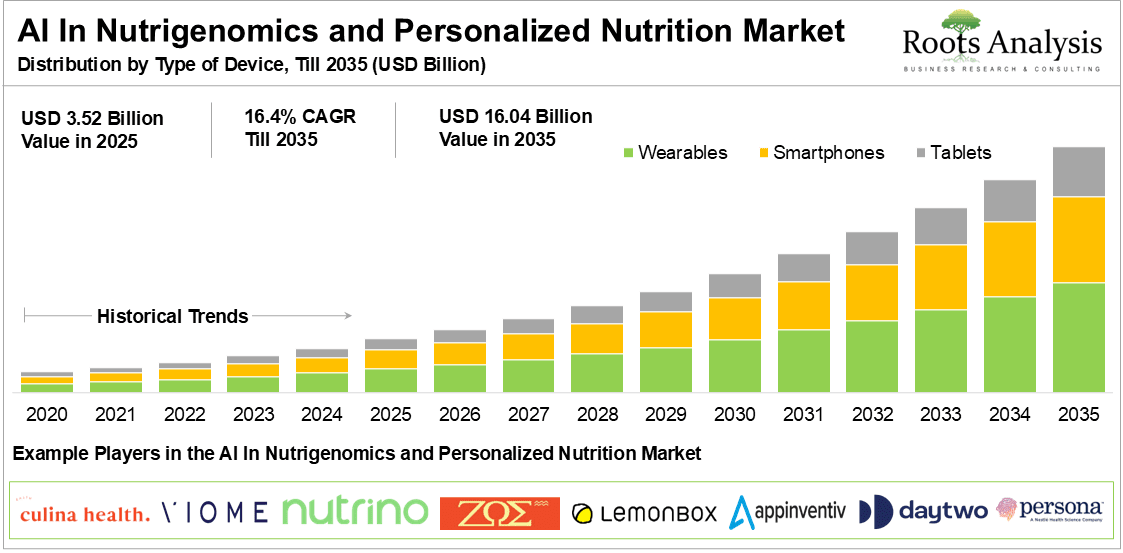
The global AI in nutrigenomics and personalized nutrition market size, valued at USD 2.92 billion in 2024, is projected to reach USD 3.52 billion in 2025 and USD 16.04 billion by 2035, representing a CAGR of 16.4% during the forecast period.
 |
AI in Nutrigenomics and Personalized Nutrition Market: In Summary
- The global market for AI in nutrigenomics and personalized nutrition is experiencing rapid growth, driven by a convergence of technological advancements and a rising consumer demand for tailored health solutions.
- The market, valued at USD 3.52 billion in 2025, is projected to reach USD 16.04 billion by 2035, growing at an impressive CAGR of 16.4%.
- The growing global prevalence of conditions like obesity, diabetes, and cardiovascular diseases has increased the need for personalized approaches to disease management and prevention.
- Companies like Zoe and Viome leverage large genomics and microbiome databases to offer personalized nutrition insights.
- Dietary supplements hold the largest market share due to increasing consumer demand for personalized vitamins and minerals. The nutraceuticals segment is also projected for strong growth, driven by a shift toward preventative health.
- Machine learning is the leading technology, essential for analyzing the vast datasets generated in nutrigenomics studies.
- Cloud-based solutions are the most dominant and fastest-growing segment due to their cost-effectiveness, accessibility, and robust data storage capabilities.
- North America holds the largest market share (nearly 40%), driven by advanced digital healthcare infrastructure, high demand for personalized nutrition, and extensive research in nutrigenomics.
- The integration of data from genomics, proteomics, metabolomics, and microbiomes will provide deeper, more holistic insights into individual health.
- Companies are increasingly focusing on using AI to analyze human microbiome sequencing data, offering a new frontier for personalized nutritional recommendations.
See What’s in the Full Report – Request Your Complimentary Insights!
AI in Nutrigenomics and Personalized Nutrition Market Introduction
Nutrigenomics refers to the study of human genomes and their correlation with nutrition and health. This field is recently gaining momentum due to the rising shift towards personalized approach to treat patients and growing awareness about significances of personalized nutrition in maintaining overall health. As per the report of World Obesity Foundation, nearly 1.13 billion adults are projected to be living with obesity. Notably, the rising incidence of obesity seems like a burden on healthcare industry, causing diseases, such as hypertension, heart attack and stroke. Generalized nutrition and traditional approach has a limiting effect on obesity, and it requires a personalized approach to mitigate the overweight conditions.
The synergy between personalized nutrition and nutrigenomics helps in customizing dietary strategies to overcome the concern of obesity, nutritional deficiency, food intolerance / sensitivity and chronic conditions, thereby improving overall health. Owing to the growing importance of nutrigenomics for personalizing nutrition, the market players are emphasizing integrating AI technology to decipher genetic data and formulate tailored nutrition plans for patients with utmost accuracy.
The AI-driven personalized nutrition has been further bolstered by the rising adoption of medical wearable devices, and smartphones that help to collect vital information for disease monitoring and management. Moreover, AI integration with nutrigenomics can help in determining vast amount of data generated through genomics, and metabolomics. Notably, this field is at the forefront of innovation, catering the attention of industrial players.
For instance, in February 2025, Fay (US), a digital nutritional therapy startup has raised USD 50 million in Series B funding round, to expand AI-powered usage for personalized nutrition. As market players continue to raise investment for innovations, the AI in nutrigenomics and personalized nutrition market is expected to grow at a higher rate in the future.
AI in Nutrigenomics and Personalized Nutrition Market: Report Attributes
| Key Report Attribute | Details | |
| Historical Trend | Since 2023 | |
| Forecast Period | Till 2035 | |
| Market Size 2025 | USD 3.52 Billion | |
| Market Size 2035 | USD 16.04 Billion | |
| CAGR (Till 2035) | 16.4% | |
One of the key objectives of the AI in nutrigenomics and personalized nutrition market report was to estimate the current size, opportunity, and the market growth potential, over the forecast period, till 2035. We have provided informed estimates on the likely evolution of the market for the forecast period.
The global AI in nutrigenomics and personalized nutrition market analysis also features the likely distribution of the current and forecasted opportunity within the market across various segments, such as type of product, type of service, type of technology, type of component, application area, type of device, type of deployment mode, end user, geographical regions, and leading players.
In order to account for future uncertainties associated with some of the key parameters and to add robustness to our model, we have provided three market forecast scenarios, namely conservative, base, and optimistic scenarios, representing different tracks of industry's evolution.
Recent Developments in AI In Nutrigenomics and Personalized Nutrition Market
Several recent developments in the field of AI-driven precision nutrition platforms have occurred and we have outlined some of these below:
- In July 2025, Dexcom launched AI-powered photo meal logging feature to Stelo (the first-of-its-kind counter glucose biosensor approved by the USFDA in the US). This new feature enable users to log their personalized meals more consistently.
- In March 2025, Reviv Global (UK) launched Reviv’s 10x Precision Genetic Test, world-first in this field of personalized health within the UK. This platform has been launched in partnership with Cardone Investments. It use AI to analyze up to 20 million genetic variations, offering precise insights into biological data for designing personalized nutrition.
- In February 2025, Bevel (US) launched AI-powered nutrition tracking that can be integrated with blood glucose monitors, such as Libre and Dexcom to provide real-time insights into dietary impacts.
- In February 2025, BioAro (Canada) unveils its groundbreaking AI-powered PanOmiQ platform at Precision Medicine World Conference in Silicone Valley. This AI-powered platform offers unparallel efficiency in analyzing genomic data in real-time for personalized nutrition, immunotherapy, and chronic disease management.
- In May 2025, Fitterfly Healthtech (India) launched Nutrition 360 Suite, a cutting-edge API-based solution that bring together fitterfly klik (AI-based photo logging), meal scoring, fitterfly talk (voice-based multilingual logging), and AI diet plan generator. This comprehensive suite enable digital healthcare companies, and wellness platforms in embedding powerful nutrition features within their products.
AI in Nutrigenomics and Personalized Nutrition Market Segmentation Insights
The market report presents an in-depth analysis of AI in digital genome technologies developers who are currently active across various segments of the industry as mentioned below:
AI in Nutrigenomics and Personalized Nutrition Market: Market Segmentation
| Market Segmentations | Details | |
| Type of Product |
|
|
| Type of Service |
|
|
| Type of Technology |
|
|
| Type of Component |
|
|
| Application Area |
|
|
| Type of Device |
|
|
| Type of Deployment Mode |
|
|
| Geographical Regions |
|
|
| Market in North America |
|
|
| Market in Europe |
|
|
| Market in Asia-Pacific |
|
|
| Market in Middle East & Africa |
|
|
| Market in Latin America |
|
|
Industry Experts on AI in Nutrigenomics and Personalized Nutrition Market
AI in nutrigenomics and personalized nutrition is a groundbreaking approach to facilitate overall wellbeing and disease management. Market players are presently focusing on the advancements in AI technologies to get faster genomic analysis results with higher precision.
During the launch of latest genomic technology (PanOmiQ), Dr. Raja B. Singh (Chief Scientific Officer at BioAro) says that “We’re not just making genomics faster; we’re making it smarter and more precise. AI-driven accuracy at this scale ensures that patients receive the most reliable genetic insights, leading to better diagnostics, targeted treatments, and groundbreaking discoveries in fields like cancer research, personalized nutrition and rare genetic diseases. This is the future of precision medicine and healthcare industry”
AI In Nutrigenomics and Personalized Nutrition Market Share Insights
Market Share by Product: Why Dietary Supplements Segment Holds the Largest Share?
- The global market is segmented across different type of products, such as dietary supplements (vitamins, minerals, probiotics, prebiotics, botanicals, proteins, carbohydrates, and fats), functional foods, and nutraceuticals. According to the AI nutrigenomics personalized nutrition market report, the dietary supplements segment accounts for the highest share of the market due to the rising deficiency of vitamins, such as Vitamin D has necessitated the demand for advanced AI-powered precision medicine software / platforms. The integration of machine learning algorithms in nutrigenomics and dietary planning helps in providing deep insight for personalized supplements to mitigate the concern of metabolic issues.
Pay Only for What You Need – The Best Way to Optimize
- It is worth noting that nutraceuticals segment is likely to show robust growth in the future, anticipating the show higher CAGR in the future. This lucrative growth is due to the growing shift toward preventative approach to treat illness. Nutraceuticals include functional foods that are derived from the natural sources and have therapeutic values, making them more fortified to prevent illness.
Market Share by Type of Service: Will Dietary Assessment Segment Continue to Dominate the Market?
-
- This segment highlights the distribution of global market across different type of service, such as dietary assessment, nutrigenomics, personalized meal planning, lifestyle assessment, and health monitoring. According to the AI nutrigenomics personalized nutrition industry analysis, the dietary assessment segment holds the largest share of the market. This dominance reflects the growing integration of machine learning algorithms in nutrigenomics and dietary planning for managing health.
- It is worth noting that the nutrigenomics segment is likely to grow at a higher CAGR in the future. The rising awareness about nutrigenomics and its significant role in personalized nutrition is likely to increase the demand for AI in nutrigenomics for gene data analysis and tailored dietary suggestions.
Market Share by Type of Technology: Does Machine Learning Nutrigenomics Market Grow at Higher CAGR in the Future?
- Based on the type of technology, the global market is distributed into machine learning, natural language processing, computer vision, and predictive analytics. It is worth noting that the machine learning segment is holding maximum AI nutrigenomics personalized nutrition market share and is likely to remain dominant in the future. AI technology, such as machine learning, plays a crucial role in analyzing vast amount of data generated during genomics studies, which further helps in customizing meal plans for patients and individuals.
- Owing to the growing usage of machine learning across nutrigenomics and personalized nutrition, this segment will continue to grow at a higher CAGR in the future.
Market Share by Type of Component: Are Genomic AI Platforms the Fastest-Growing Segment in This Market?
- This segment is further sub-divided based on the type of component into software, hardware, and services. Presently, the software segment holds the maximum share of the AI nutrigenomics personalized nutrition market size. This is due to the increasing adoption of mobile app software that can be integrated with AI-powered nutrigenomics services platforms for data analysis to customize nutrition plans.
- In the long run, services segment is likely to grow at a higher CAGR during the forecast period. The services segment provides this by offering continuous monitoring, evolving recommendations, and expert guidance. This long-term engagement model is highly attractive to consumers and leads to sustained revenue growth.
Market Share by Application Area: Is Weight Management Segment Continue to Gain Momentum?
- Based on the application area, the global market is segmented into weight management, sports nutrition, digestive health, cognitive health, and immune health. According to our analysis, the weight management segment is dominating the market and is likely to maintain dominance in the future. This dominance reflects from the growing focus on mitigating concern of obesity and shift towards fitness that requires personalized nutrition instead of one-site-fit approach to meet individual preferences.
- It is worth noting that this segment will continue to maintain its dominance in the future, anticipating growing at a higher CAGR in the future. The growing awareness about fitness and overall health is likely to fuel the growth of AI powered nutrition solutions.
Market Share by Type of Device: Is Wearables Technology Segment Bolstered in the Future?
- The global market is segmented based on the type of device into wearables, smartphones, and tablets. According to the artificial intelligence nutrigenomics market analysis, the wearables segment is dominating the market by securing highest share. This dominance stems from the rising penetration of wearable medical devices for data analysis and personalized health management solutions.
- It is important to highlight here that the smartphones segment is likely to register higher CAGR during the forecast period. The widespread adoption of smartphone-based patient healthcare applications, and personalized nutrition apps are likely to be the key reason for highest growth of this segment in the future.
Market Share by Type of Deployment Mode: Does Cloud-Based Segment Maintain Its Dominance in the Future?
- Based on the type of deployment mode, the global market is segmented into cloud-based and on-premises. Among these, the cloud-based segment is dominating the market, and the trend is likely to remain unchanged in the future. This dominance stems from the rising adoption of cloud services for data storage and analysis.
- It is important to highlight here that the cloud-based segment is likely to grow at a higher CAGR in the future. The cost-effectiveness, ease of access, and massive data storage capabilities are likely to be a key growth factor for this segment.
Market Share by End User: The Individuals Segment is Securing Maximum Share of the Market
- On the basis of end user, the global market is segmented into individuals, fitness centers, healthcare providers, and dieticians. According to our projection, the individuals segment is securing maximum share of the market. This is likely to be the result of increasing acceptance of AI in personalized nutrition for maintaining overall health by the individuals.
- It is worth mentioning that the fitness centers segment is likely to grow at a higher CAGR during the forecast period. The growing focus on fitness and rising shift towards overall wellbeing is likely to fuel the adoption of AI in nutrigenomics and personalized nutrition in fitness centers.
Want Information on Specific Region / Segment?
Market Share by Geographical Regions: Which Regions are Leading AI Adoption in Nutrigenomics Applications?
- The global market is distributed across North America, Europe, Asia-Pacific, Middle East & Africa, and Latin America. According to our projection, North America is dominating the market by holding nearly 40% of the market share. Several factors, such as increasing penetration of digital healthcare infrastructure, heightened demand for personalized nutrition to manage chronic conditions, and growing research on nutrigenomics are the key growth factor of this region.
- In Asia-Pacific, the global market is likely to grow at a higher CAGR during the forecast period. This growth is reflected from the growing adoption of mobile technology, and shift towards personalized dietary strategies to maintain fitness goals are the key growth factors driving growth of market in this region.
AI in Nutrigenomics and Personalized Nutrition Market: Report Deliverables
| Report Deliverables | Details | |
| Excel Data Packs (Complimentary) |
Available | |
| Key AI in Nutrogenomics and Personalized Nutrition Companies Profiled |
|
|
| PowerPoint Presentation (Complimentary) |
Available | |
| Customization Scope | 15% Free Customization | |
AI in Nutrigenomics and Personalized Nutrition Market Key Takeaways
The "AI in Nutrigenomics and Personalized Nutrition Market Report: Industry Trends and Global Forecasts, till 2035" market report features an extensive study of the current market landscape, market size, market share, market growth, market trends, market value, market forecast, market outlook, statistics, and future opportunities for market players. The market research report lays emphasis on the AI in nutrigenomics and personalized nutrition that are being developed. Key takeaways of the market report are briefly discussed below.
How Does Competitive Landscape Impact AI Personalized Nutrition Market Growth?
The global market landscape is immensely competitive, featuring the presence of several small, mid-sized, and large industrial players. Notably, the market players are widely emphasizing the development of AI-driven precision nutrition platforms and solutions that helps in personalizing the nutrition and dietary strategies to maintain overall health. In order to leverage competitive edge, several market players are undertaking strategic initiatives, such as partnerships and collaborations, which further maintain a long-term competitiveness in the market.
What's Driving the 16.4% CAGR in AI-Powered Personalized Nutrition?
Personalized nutrition has gained significant momentum due to the rising preferences for healthy lifestyles and overall wellbeing. The growing demand has underscored the requirement of AI algorithms to customize dietary suggestions, which is likely to be a ley growing factor of this industry. Several other factors that are propelling market growth are listed below:
Rising Chronic Diseases Across the Globe
With growing prevalence of chronic conditions, such as diabetes, cardiovascular diseases, and hypertension are necessitating the demand for advanced digital health nutrigenomics solutions. Notably, the integration of AI helps in designing personalized diets based on the genomic data, which is crucial for managing chronic conditions, such as diabetes. In addition, the continuous glucose monitoring AI integration with food logging app helps in analyzing how specific macronutrients, such as carbohydrates, proteins, and fats raise blood glucose level. The information collected through AI apps helps to define nutritional plans to reduce post meal spikes.
Preference of Personalized Nutrition to Maintain Overall Wellbeing
The global market for personalized meal planning algorithms is further driven by the growing preferences of tailored dietary plans to maintain overall wellbeing. Notably, the rising shift towards healthy lifestyle and fitness regime has further underscore the demand for AI-powered tools for customizing dietary plans to meet individual’s preferences. Additionally, the growing fitness industry is also encouraging personalized formulation to achieve fitness goals.
What Market Barriers Limit AI Adoption in Personalized Nutrition?
Despite growing demand, several factors may impede market growth. Some of the potential challenges are listed below:
Data Security and Safety: How are Data Privacy Regulations Impacting AI Nutrigenomics Market Growth?
AI in nutrigenomics and personalized nutrition relies on medical device, and AI-powered data omics platforms for genetic data analysis. Since it requires transfer / exchange of data through open network, it may raise a concern of data security and safety. Therefore, market players are required to adhere with robust healthcare cybersecurity measures to ensure data safety.
Your Business is Unique-Why Shouldn’t Your Report Be?
Lack of Regulatory Guidelines Associated with Technology Approval
Notably, the lack of regulatory guidelines for the acceptance and approval of AI technology in personalized nutrition may hinder its adoption. Furthermore, the market players are required to adhere with HIPAA guidelines for maintaining data security and safety of the individual’s personalized data.
What are the Key AI Nutrigenomics Personalized Nutrition Market Trends?
Several trends that are shaping the AI nutrigenomics and personalized nutrition industry are listed below:
Rising Focus on AI-Powered Microbiome Analysis
The global market is driven by the growing focus on AI-powered microbiome analysis. Notably, when AI-powered platforms combine with microbiome sequencing and machine learning help to provide comprehensive insights into nutritional needs and metabolic responses. Moreover, the penetration of predictive analytics tools for preventive nutritional guidelines is likely to be an emerging opportunity in industry.
Multi-Omics and Wearable Biosensors
The increasing integration of multi-omics data and wearable biosensors are the key trends of the market. This unique approach combines proteomics, genomics, microbiomics, and metabolomics data to gain better insights into individual nutritional needs. Furthermore, wearable biosensors such as sleep trackers, heart rate monitors, and metabolic sensors help to collect vital health information, which further helps to design nutritional plans to meet individual preferences.
Market Size Analysis: Emerging Applications of Deep Learning in Gene-Diet Interaction Research
In 2025, the global AI in nutrigenomics and personalized nutrition market size is valued at USD 3.52 billion and is poised to reach USD 16.04 billion by 2035. This lucrative growth is driven by the emerging applications of deep learning in gene-diet interaction research. Notably, the deep learning models can help to identify complex, non-linear interactions between multiple genes and dietary factors that might lead to diseases like diabetes or cardiovascular disease. This information helps to design a personalized dietary recommendation that helps to improve overall health.
AI in Digital Genome Market Report Coverage
The market report presents an in-depth analysis, highlighting the capabilities of various stakeholders in AI in nutrigenomics and personalized nutrition industry, across different geographies. Amongst other elements, the market report includes:
- An Infographic Executive Summary
- Regulatory Scenario
- Comprehensive Database of Leading Players
- Competitive Landscape
- Porter’s Five Forces Analysis
- Company Competitiveness Analysis
- Startup Ecosystem in the AI in Nutrigenomics and Personalized Nutrition Market
- Company Profiles
- Partnerships and Collaborations
- Market Forecast and Opportunity Analysis
- Adjacent Market Analysis
- Key Winning Strategies
- Value Chain Analysis
Glossary
- Machine Learning: This refers to the subset of AI that enables computers to learn and improve from experience without being explicitly programmed.
- Deep Learning: It is an advanced form of machine learning that uses neural networks to model complex patterns in data.
- Nutrigenetics: The study of how genetic variations affect individual responses to nutrients.
- Nutrigenomics: The study of how nutrients and dietary components influence gene expression and how genetic variations affect nutritional requirements.
- Personalized Nutrition: It refers to dietary recommendations customized to individual needs based on genetic, metabolic, lifestyle, and health factors
From the Author’s Desk
Author’s View on AI in Nutrigenomics and Personalized Nutrition Market
The AI in nutrigenomics and personalized nutrition market represents a transformative shift within healthcare industry. Driven by the growing awareness about importance of overall health, the demand for AI in nutrigenomics and personalized nutrition has significantly increased. With robust growth projections, strong presence of industrial players, continuous innovation, and increasing scientific validation, this market is positioned to revolutionize how individuals approach dietary health and chronic disease prevention. However, industrial players are requirement to adhere with strategic navigation of regulatory and accessibility challenges in order to widespread the adoption of AI tools for personalized nutrition.
Customization Opportunities
At Roots Analysis, we genuinely care about your success and understand that your business requirements are unique. While our market research reports provide valuable insights, we recognize that they might not cover every aspect you need to make well-informed strategic decisions. To account for that, we offer 15% free report customization tailored to your specific needs. Whether you require additional quantitative analysis, qualitative insights, or any other information related to the electric vehicles market, reach out to us today at support@rootsanalysis.com


